

A surface-level patch on a leaking concrete wall isn't a repair; it's a temporary postponement of an inevitable structural failure. You've likely experienced the frustration of damp patches returning months after a generic sealant was applied, or perhaps you're rightfully concerned about the silent progression of rebar corrosion and concrete cancer within your commercial or strata asset. It's a significant risk when persistent water penetration disrupts operations and compromises the long-term viability of a building. Dealing with these recurring leaks requires more than a reactive fix; it demands a methodical, technical response that addresses the root cause of the failure.
This guide explains how to achieve a permanent hydraulic seal and restore structural capacity through advanced water ingress crack repair and engineered remediation protocols. You'll learn how to stabilise compromised sections using high-pressure epoxy and polyurethane injection, ensuring the bond between old and new concrete is absolute. We will preview the critical differences between curtain wall and shoring wall injection, the importance of adhering to updated industry guide specifications, and the necessity of detailed documentation for compliance and insurance purposes. By moving from reactive patching to planned life-cycle management, you can secure your structure against the most challenging hydraulic pressures.
Key Takeaways
- Understand how hydrostatic pressure drives moisture through micro-cracks and the importance of addressing hydraulic loads to prevent further concrete degradation.
- Learn to distinguish between polyurethane and epoxy resins to ensure the correct material is selected for either active leak suppression or structural bonding.
- Discover the methodical process of professional water ingress crack repair, involving strategic port installation and high-pressure injection for a deep-seated hydraulic seal.
- Recognise why engineered remediation is essential for protecting building valuations, preventing rebar corrosion, and maintaining compliance with insurance requirements.
- Identify the specialised technical protocols required to stabilise complex structures such as shoring walls and curtain walls against persistent water penetration.
Understanding Water Ingress and Structural Cracking in Concrete
Water ingress crack repair is a specialised remedial process that goes beyond simple waterproofing. It involves the systematic identification and sealing of pathways through which moisture penetrates a concrete matrix. In structural engineering, we don't view a leak as an isolated event. It's often a symptom of underlying hydraulic or mechanical stress. When water accumulates against a retaining wall or basement slab, it exerts hydrostatic pressure. This force acts as a wedge, driving moisture into micro-cracks and physically expanding them over time. This propagation is relentless; as the crack widens, the volume of water increases, further accelerating the rate of structural decay.
Distinguishing between non-structural seepage and critical structural leaks is vital for asset safety. Seepage might appear as minor dampness or efflorescence, whereas a structural leak involves active water movement that can signal a compromise in the slab's load-bearing capacity. If left unaddressed, this penetration initiates various causes of concrete degradation, specifically chloride-induced corrosion. Once salts reach the reinforcement steel, the resulting oxidation causes the metal to expand. This internal pressure eventually exceeds the tensile strength of the concrete, leading to fracturing and loss of bond between the steel and the surrounding matrix.
Common Causes of Water Ingress in Australian Buildings
The Australian climate subjects buildings to extreme thermal cycles. This leads to constant expansion and contraction, creating fatigue cracks that bypass original seals. Differential settlement is another primary factor, where uneven ground movement causes structural shear cracks that penetrate the full depth of a slab. We frequently find that inadequate original waterproofing membranes in deep basements or shoring walls simply cannot withstand the long-term hydraulic loads typical of high-density developments. When these membranes fail, the concrete itself must be treated to restore the building's envelope.
The Long-Term Risks of Unmanaged Leaks
Unmanaged leaks accelerate the carbonation process. This occurs when carbon dioxide reacts with the concrete's moisture, reducing its natural alkalinity and stripping the protective layer from the steel reinforcement. This leads to internal corrosion and eventual spalling, commonly known as concrete cancer. Implementing a timely concrete remediation strategy is the only way to arrest this decay. Professional water ingress crack repair is not merely about stopping a drip; it's about preserving the asset's structural integrity. Failure to act leads to a progressive loss of structural capacity that is far more costly to rectify in the future.
Diagnosing the Source: Identifying Hydrostatic Pressure and Active Leaks
Accurate diagnosis is the prerequisite for any permanent water ingress crack repair. We categorise moisture issues into two primary types: passive seepage and active leaks. Passive seepage often manifests as damp patches or efflorescence, where moisture slowly migrates through the concrete's capillary pores. In contrast, active leaks involve gushing or flowing water, indicating a direct pathway through the slab or wall. These active breaches are driven by hydrostatic pressure, a force that increases with depth and pushes water through micro-cracks with significant velocity. Without identifying the pressure source, any repair remains superficial.
Before initiating repairs, we utilise slab scanning to map the internal reinforcement layout and identify hidden voids. Understanding the proximity of steel to the crack is critical to prevent damage during the drilling process. We also evaluate whether a crack is static or dynamic. Static cracks have ceased moving, while dynamic cracks continue to expand or contract due to thermal cycles or settlement. This distinction dictates the choice of resin, as detailed in established Concrete Repair Techniques used in high-pressure environments. Treating a dynamic crack with a rigid material will inevitably lead to a secondary failure as the structure moves.
Technical Assessment Protocols
Our assessment protocols begin with a rigorous visual inspection for efflorescence and calcium leaching. These white, powdery deposits are clear indicators of long-term water transit through the concrete matrix. We employ crack monitoring gauges to record movement over time, ensuring our remediation strategy accounts for structural shifts. Non-destructive testing (NDT) allows us to assess the depth of penetration without compromising the concrete's integrity. These data points prevent the common error of treating a surface symptom while the internal defect remains active and dangerous.
Identifying Curtain Wall vs Shoring Wall Issues
Water ingress in shoring walls often occurs during the excavation phase, where high groundwater tables exert immense pressure on the structure. Managing these leaks requires immediate stabilisation to prevent soil loss and potential structural instability. Curtain wall leaks in high-rise envelopes present different challenges, typically involving failures at the joints or interfaces between disparate materials. Identifying the precise entry point is essential to avoid the 'chasing the leak' phenomenon, where water is simply diverted to a different part of the structure. For complex assets, engaging a specialist in shoring wall crack injection ensures the hydraulic load is managed correctly from the outset. This methodical approach ensures the repair is definitive rather than a temporary patch.
Polyurethane vs Epoxy: Selecting the Correct Injection Resin
Choosing the right resin is the most critical technical decision in the remediation process. It's not a one-size-fits-all application. The choice between polyurethane and epoxy depends entirely on the environmental conditions and the structural requirements of the asset. For an effective epoxy vs polyurethane crack injection, we must first determine if the crack is active, moving, or dry. Polyurethane is the primary choice for stopping active water flow due to its rapid expansion and flexibility. Conversely, epoxy is utilised when the objective is to weld the concrete back together to restore its original load-bearing capacity.
In complex scenarios involving high-pressure leaks in structural elements, a dual-stage approach is often required. We first inject a fast-reacting polyurethane to arrest the water flow and create a dry environment. Once the leak is stabilised, we follow with a high-strength structural epoxy to bond the fracture. This ensures the water ingress crack repair provides both a hydraulic seal and a permanent structural fix. Without this sequential method, a structural repair might fail because the resin cannot bond to a saturated surface, or a flexible seal might fail to provide the necessary reinforcement.
Polyurethane Hydrophilic and Hydrophobic Resins
Polyurethane resins are categorised by how they react with moisture. Hydrophilic resins are "water-loving"; they use the incoming water as a catalyst to expand into a flexible, foam-like gasket that fills every micro-void. These are ideal for sealing basement cracks and lift pits where minor movement is expected. Hydrophobic resins, however, repel water and are used to create permanent, non-shrink barriers. They provide excellent long-term stability in shoring walls where the resin must resist constant groundwater contact without degrading or losing volume over time. Both types are essential for creating a responsive, hydraulic barrier.
Structural Epoxy for Dry Crack Remediation
When the concrete element is dry and requires a return to monolithic integrity, epoxy resins are the industry standard. Unlike polyurethane, epoxy does not expand; it's a high-viscosity liquid that penetrates deep into the crack to create a bond stronger than the concrete itself. We specify epoxy based on its tensile strength and modulus of elasticity to ensure it meets the specific engineering requirements of the project. For any scenario where structural capacity must be restored, epoxy remains the gold standard for concrete crack repair. It effectively turns two separate pieces of concrete back into a single, cohesive unit, preventing further propagation of the defect.
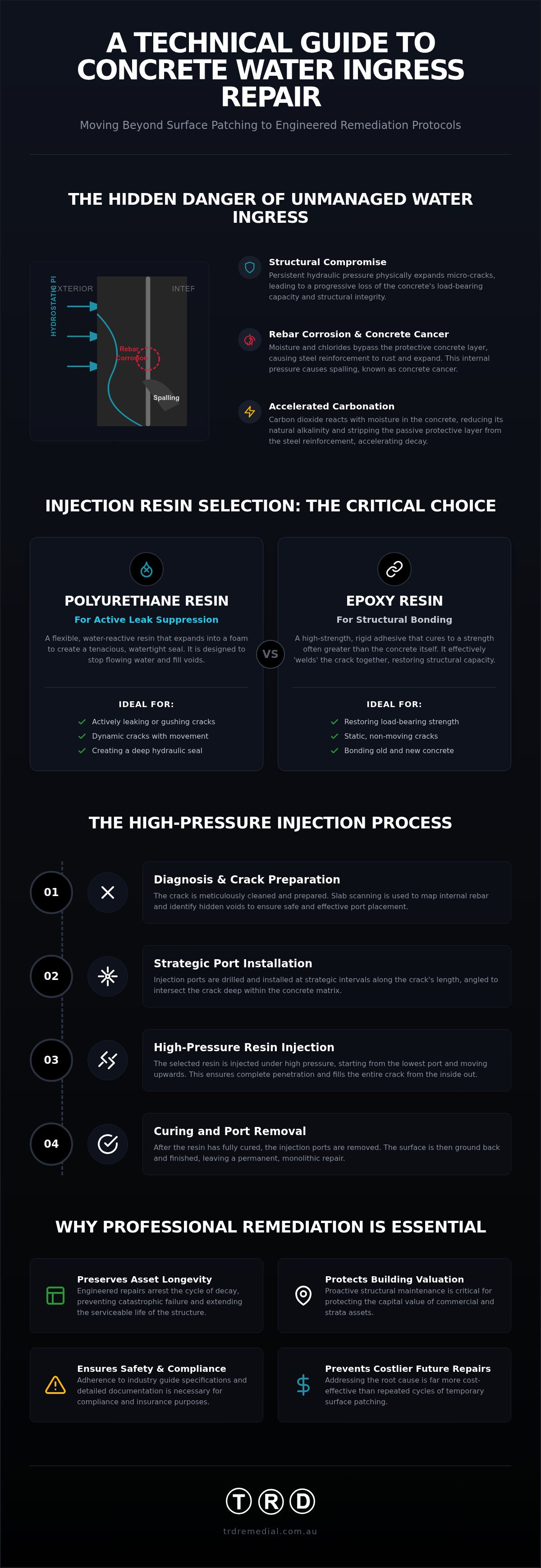
The Step-by-Step Process of Pressure Injection Remediation
Executing a permanent seal against hydraulic pressure relies on a disciplined, sequential protocol. It is not a matter of simply filling a gap; it is an engineered procedure that requires technical precision at every stage. We begin with meticulous surface preparation, where the crack is cleaned of all contaminants to ensure absolute resin adhesion. Any loose debris or previous superficial patches must be removed to expose the true extent of the structural defect. Without this initial rigour, the bond between the injection resin and the concrete matrix will inevitably fail under load.
The next phase involves drilling and port installation. We utilise a staggered pattern, drilling at 45-degree angles to intercept the crack mid-slab. This geometry is critical because it ensures the resin reaches the full depth of the fracture rather than just the surface. Once ports are secured, we flush the crack with water or compressed air. This step serves a dual purpose: it removes internal dust and verifies connectivity between the injection points. If the flushing medium does not exit the adjacent port, the pathway is obstructed and requires recalibration before the resin is introduced.
Systematic injection then begins at the lowest point of a vertical crack or the furthest point of a horizontal one. We pump the resin into the first port until it emerges from the next, ensuring the entire void is saturated and all air or water is displaced. This process continues port-by-port until the entire length of the crack is treated. Finally, the ports are removed after the resin has cured, and the surface is finished to restore the aesthetic integrity of the substrate.
High-Pressure vs Low-Pressure Injection Techniques
The thickness of the concrete and the severity of the leak dictate the required injection pressure. High-pressure systems are essential for deep penetration in thick shoring walls or heavy foundation slabs where internal resistance is high. Conversely, low-pressure injection is prioritised for delicate structural elements or thinner sections to prevent the risk of secondary fracturing. We constantly monitor resin travel and pressure gauges to ensure complete crack saturation without compromising the surrounding material.
Quality Control and Verification
Rigorous verification is the final stage of an engineered repair. We pressure test the seal post-injection to confirm that the hydraulic pathway is fully blocked. In complex cases involving honeycombed concrete, we may implement secondary injection protocols to address micro-voids that were initially inaccessible. Every stage of the work is documented, including resin volumes and injection pressures, to provide a comprehensive record for compliance and insurance purposes. For assets requiring this level of technical precision, our team provides expert water ingress crack repairs that stand up to the most demanding regulatory and engineering scrutiny.
Why Professional Remediation is Essential for Asset Longevity
Superficial 'patch' repairs are more than just ineffective; they are a significant liability for any commercial or strata asset. While a generic sealant might temporarily hide a leak, it does nothing to arrest the internal corrosion of reinforcement steel or the progression of concrete cancer. Professional water ingress crack repair is a structural intervention that restores the building's envelope and protects its long-term valuation. Insurance providers and building certifiers increasingly require documented, engineered solutions rather than anecdotal fixes. Failure to provide this level of technical rigour can lead to denied claims or significant devaluations during a capital works audit.
In cases where the concrete matrix has been severely compromised by long-term saturation, stopping the water is only the first phase of the project. We frequently integrate crack injection with carbon fibre strengthening to restore the tensile capacity of the slab. This ensures the structural element can handle contemporary load requirements despite previous degradation. Specialised contractors bring a level of discipline to industrial and commercial asset management that general builders cannot match, particularly when dealing with complex hydraulic environments like lift pits and shoring walls.
Meeting Australian Building Standards
Compliance with the National Construction Code (NCC) is mandatory for all remedial works. We ensure that every material used, from hydrophilic polyurethanes to high-modulus epoxies, is Australian-tested to withstand local thermal cycles and soil chemistry. Meeting the design life requirements of a structure is a core engineering objective. A professional repair must be designed to last decades, not just until the next heavy rain event. This adherence to standards provides the legal and structural certainty required for large-scale asset management.
Next Steps for Strata and Facility Managers
Effective remediation begins with a precise brief. Facility managers should request a detailed assessment that identifies the pressure source, crack movement, and internal reinforcement condition. A coordinated approach between structural engineers and the remedial contractor ensures that the solution is technically sound and cost-effective. If you are managing an asset with persistent leaks or visible structural defects, the most prudent course of action is to contact TRD Remedial for a structural assessment. Our team provides the elite technical proficiency required to resolve complex water ingress issues permanently.
Securing Structural Integrity Against Hydraulic Stress
Resolving complex leaks requires a definitive transition from reactive patching to a disciplined, engineered methodology. By accurately diagnosing the source of hydrostatic pressure and selecting the specific injection resin for the environment, you stop the immediate flow of water while simultaneously restoring the monolithic strength of the concrete matrix. This methodical approach is the only way to prevent the silent, destructive progression of rebar corrosion and ensure your asset remains fully compliant with the National Construction Code.
As specialists in strata and commercial structural remediation, we deliver technical solutions for the most challenging water ingress scenarios. Our remediation protocols ensure that every water ingress crack repair meets the required design life and adheres strictly to Australian building standards. Don't let a minor breach evolve into a major structural failure that compromises the entire building envelope. You can secure your building's future with TRD Remedial's engineered crack injection services. Taking decisive, technical action today preserves the long-term viability and capital valuation of your property.
Frequently Asked Questions
Is water ingress crack repair a permanent solution for basement leaks?
Yes, water ingress crack repair is a permanent solution provided the root cause of the leak is correctly diagnosed and treated with high-pressure injection. By filling the entire void of the fracture with specialised resins, we create an internal hydraulic barrier that prevents moisture transit. This method is far superior to surface-level membranes, as it addresses the defect within the concrete matrix itself, ensuring long-term protection for basement slabs and retaining walls.
How long does the polyurethane injection process take to stop a leak?
Active leaks are typically arrested within minutes once the polyurethane resin is introduced into the crack. Polyurethane is a fast-reacting material that expands rapidly upon contact with moisture to form a dense, flexible seal. While the immediate suppression of water is quick, the entire process, including site preparation, staggered port drilling, and final surface finishing, usually takes a full day or more depending on the linear length of the fractures being treated.
Can you repair a crack while water is actively flowing through it?
We can absolutely repair cracks while water is actively gushing through the structure. We utilise hydrophilic polyurethane resins that use the flowing water as a catalyst to initiate the chemical reaction and expansion process. This allows us to stop high-pressure leaks in shoring walls and lift pits without needing to drain the area first. Once the active flow is suppressed, we can then apply secondary injections to ensure a permanent, high-performance seal.
What is the difference between structural crack injection and simple waterproofing?
Simple waterproofing typically involves applying a surface membrane to prevent moisture penetration from the outside. Structural crack injection is a remedial process that treats the defect internally. While waterproofing creates a skin, injection fills the full depth of the crack to restore structural capacity or create a deep-seated hydraulic block. For load-bearing elements, epoxy injection is often used to weld the concrete back together, restoring its monolithic integrity and tensile strength.
Will crack injection fix concrete cancer caused by water ingress?
Crack injection is a critical first step in arresting the moisture that causes concrete cancer, but it doesn't fix existing spalling. If the reinforcement steel has already oxidised and caused the concrete to fracture, you'll require specialised spalling repairs in addition to injection. The injection stops further water ingress, while the spalling repair involves removing damaged concrete and treating the steel to restore the asset's structural health and safety.
Do I need an engineer's report before starting water ingress repairs?
For minor seepage, a specialist contractor's assessment is often sufficient, but critical structural defects usually require an engineer's report. This ensures the water ingress crack repair protocol aligns with the original design life and load requirements of the building. Having an engineer oversee the remediation also provides a necessary layer of compliance for strata insurance and ensures that the materials selected, such as high-strength epoxies, meet the specific tensile demands of the slab.
How much disruption will the injection process cause to my building?
Pressure injection is a low-impact, non-invasive remediation method that causes minimal disruption to building occupants. Unlike traditional waterproofing which often requires extensive excavation or demolition, injection only requires small diameter holes to be drilled at strategic intervals. The equipment used is portable and relatively quiet, allowing operations in commercial basements or residential car parks to continue with very little interference. This makes it an ideal solution for active facilities and high-density strata assets.
Is polyurethane injection safe for residential drinking water tanks?
Polyurethane injection is safe for drinking water tanks provided the resin is certified to Australian Standard AS/NZS 4020. This standard ensures the material doesn't leach chemicals or affect the taste and appearance of the water. We specifically select potable-water-approved resins for residential tanks and municipal infrastructure to ensure safety and compliance. Always verify that your remedial contractor is using materials tested and approved for contact with drinking water before commencing repairs.


