

The lightest strengthening method is not automatically the right one. Structural beam and column strengthening can use carbon-fibre-reinforced polymer (CFRP), steel jacketing or concrete encasement. CFRP consists of carbon fibres embedded in polymer resin. Bonded to a concrete beam’s tension face, it can improve flexural capacity, while U-wraps can help resist diagonal cracking in shear.
It is understandable to focus on how much strength a method can add, but the type of structural demand matters too. CFRP is lighter than steel and resists corrosion, while jacketing and encasement reinforce a member in different ways. This guide explains CFRP and compares the methods for beam flexure, shear and column strengthening, outlining the trade-offs that inform a suitable solution.
Key Takeaways
- Match the strengthening method to the member’s demand and available space; steel jacketing can suit a column when capacity must increase without much cross-section growth.
- For beam flexure, identify whether the member is under-reinforced before comparing added reinforcement, composite materials or steel plates.
- Diagonal cracking calls for attention to shear resistance and stirrup provision, with added stirrups or bonded hoops among the possible approaches.
- If a concrete column shows longitudinal cracking or broken compression-side cover, provide temporary support and strengthen the column promptly.
CFRP compared with steel jacketing and concrete encasement
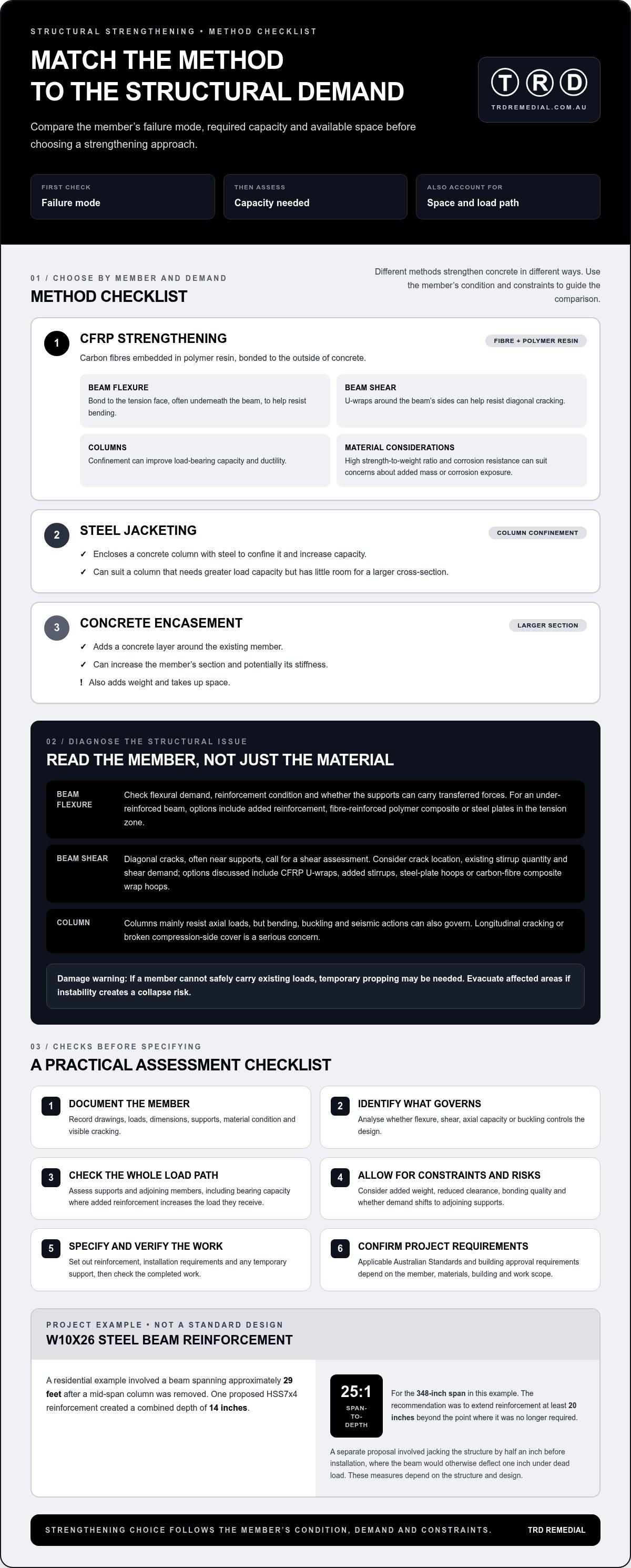
Choose a method based on the member’s failure mode, required capacity and available space. CFRP, steel jacketing and concrete encasement strengthen concrete in different ways.
CFRP Strengthening
CFRP is carbon fibre embedded in polymer resin and bonded to the outside of concrete. Its high strength-to-weight ratio and corrosion resistance can suit beams or columns where added mass and corrosion exposure are concerns. For beam flexure, CFRP is typically bonded to the tension face, often underneath the beam; U-wraps can help resist diagonal cracking. Around columns, confinement can improve load-bearing capacity and ductility, including where deformation capacity matters during seismic activity.
Steel Jacketing and Concrete Confinement
Steel jacketing encloses a concrete column with steel to confine it and increase its capacity. It can suit a column that needs greater load capacity but has little room for a larger cross-section. Concrete encasement adds a concrete layer around the existing member, increasing its section and potentially its stiffness, but also adding weight and taking up space. The choice depends on the required capacity, dimensions and structural behaviour.
Concrete underpinning and compensating slabs address foundation or ground movement, which differs from bonding reinforcement to a beam. Underpinning supports foundations; a compensating slab may be designed to balance excavation effects. Strengthening is considered when increased loads, deterioration or damage reduce a member’s ability to perform its structural role.
Concrete columns mainly resist axial loads, but bending, buckling and seismic actions can also govern. Longitudinal cracking or broken concrete cover on the compression side signals a serious structural concern. Temporary support and strengthening may be needed. Diagonal cracking in a beam, by contrast, calls for a shear-strengthening assessment.
Applicable Australian Standards and building approval requirements depend on the member, materials, building and work scope. Project documentation should identify the requirements that govern the work.
Temporary propping is needed if a damaged or altered member cannot safely carry existing loads. Evacuate affected areas if instability creates a collapse risk.
Engineers assess drawings, loads, member dimensions, material condition and visible cracking, then analyse whether flexure, shear, axial capacity or buckling governs.
Strengthening risks include added weight, reduced clearance, poor bonding or transferring demand to adjoining supports. The design must account for these interactions.
For work in Australia, involve a structural engineer experienced in strengthening and a contractor able to carry out the specified method and coordinate the work.
Beam and slab flexural strengthening
Strengthening begins with documenting the beam or slab, its loads, supports and visible damage. An engineer checks flexural demand, reinforcement condition and whether the supports can carry transferred forces. The design then specifies the reinforcement, installation requirements and any temporary support, followed by checks of the completed work.
For an under-reinforced concrete beam, options include adding reinforcement or bonding fibre-reinforced polymer composite or steel plates in the tension zone. CFRP is commonly bonded to the tension face, often the beam’s underside, where it helps resist bending. An over-reinforced beam, by contrast, may call for section enlargement or added support rather than external strengthening.
Consider a residential example involving a W10x26 steel beam. It spanned approximately 29 feet after removal of a mid-span column. One proposed HSS7x4 reinforcement created a combined depth of 14 inches. For the 348-inch span, its span-to-depth ratio was 25:1. These figures describe that example, not a standard design for other buildings.
Reinforcement needs to extend beyond the point where it is no longer required, allowing forces to transfer into the existing member. In the discussed W10 beam example, the recommendation was at least 20 inches beyond that point. Another proposal involved jacking the structure by half an inch before installation, where the beam would otherwise deflect one inch under dead load. Such measures depend on the structure and design.
For slabs, flexural strengthening also targets the tension zone, but the intervention must suit the slab’s support arrangement and load path. Changes to a beam or slab can affect adjoining members, so the assessment should consider how forces move through the structure. Check the bearing capacity of supporting wall ends if added reinforcement increases the load they receive.
Where a concrete beam needs external reinforcement in its tension zone, carbon fibre strengthening is one method to consider. The choice between bonded reinforcement, steel plates, section enlargement or added support follows the member’s condition and flexural demand.
Inclined-section and shear strengthening
Shear forces can produce diagonal cracks across a concrete beam, often near its supports. These differ from flexural cracks on the tension face, so strengthening must address the beam’s web and existing stirrups. Before selecting a method, an assessment considers crack location, stirrup quantity and the member’s shear demand.
CFRP U-wraps extend around a beam’s sides to improve resistance to diagonal cracking. This configuration adds external reinforcement across the web, helping the beam resist shear. Bonded carbon-fibre composite wrap hoops are another option when a beam has too few stirrups and diagonal cracks have developed. The concrete’s surface condition and the wrap’s continuity affect how forces transfer into the member.
Existing stirrup provision helps guide the intervention. If a beam has fewer stirrups than the minimum reinforcement ratio and diagonal cracks appear, options may include adding stirrups, bonding steel-plate hoops or bonding carbon-fibre composite wrap hoops. These methods add web reinforcement but differ in installation and material. The design must relate the added reinforcement to the beam’s existing capacity and crack pattern.
For a beam with a stirrup ratio between its upper and lower limits, its position within that range matters. If the ratio is nearer the lower limit, adding web reinforcement is recommended. The strengthening approach should reflect the beam’s existing reinforcement and shear behaviour. The ratio alone does not describe the whole problem, so the engineer also considers shear demand and the beam’s condition.
The condition V≤0.25fcbho is relevant when assessing whether additional web reinforcement can be effective. It is a design check, not a universal instruction to add reinforcement. The required intervention depends on the beam’s geometry, existing reinforcement and shear behaviour. Matching the repair to diagonal cracking and stirrup provision helps target the weakness rather than simply adding material without addressing the load path.
What are the common methods for strengthening structural beams and columns?
Common methods include externally bonded composites, added steel reinforcement and section enlargement. The choice depends on the member’s material, failure mode and available space. A concrete beam needing extra flexural capacity may use bonded reinforcement, while a column needing greater stiffness may benefit from an enlarged section that reduces its length and slenderness.
CFRP is available as flexible sheets, strips or bars, selected to suit the reinforcement required. Installation involves preparing and priming the concrete surface, bonding the composite with epoxy resin, then allowing it to cure. Once cured, it acts as external reinforcement. Steel plates can also be bonded to concrete, while added reinforcement changes the member’s internal capacity.
For columns, the load direction helps determine where strengthening is needed. In a large-eccentricity compressed reinforced-concrete column, strengthen the tension side. In a small-eccentricity compressed column, strengthen the larger side. If both increased capacity and stiffness are required, section enlargement can address slenderness as well as load resistance.
Steel shapes can reinforce an existing beam, but their connections and supports matter. Staggered stitch welds may be suitable, with continuous welding at the ends of the added shape. Parallel beams may also need new beam pockets at their ends or columns against supporting walls. These details affect how forces enter the structure, not just the strength of the added steel.
Compare each option against the required capacity, member geometry, support conditions and construction access. A composite adds external reinforcement; steel shapes need effective connections and bearing; encasement enlarges the section. That comparison helps identify a method suited to the actual structural demand. For project-specific structural strengthening support, discuss the member’s condition and required reinforcement with a specialist.
A forum contributor noted that parallel beams may need new beam pockets at their ends or columns against the walls.
After concrete surface preparation and priming, CFRP bonded with epoxy resin acts as external reinforcement once cured.
TRD Remedial: Carbon Fibre Strengthening
TRD Remedial provides Carbon Fibre Strengthening for concrete members requiring additional reinforcement. It may suit a project when an engineer identifies a need to improve beam flexural capacity or column confinement and selects a design using externally bonded carbon fibre. The assessment should account for the member’s condition, strengthening demand and connection to the surrounding structure.
If cracking or concrete deterioration also affects the member, Crack Injection or Concrete Repairs may address those defects alongside Structural Strengthening. The required work depends on the cause and extent of the damage, not just its appearance. Contact TRD Remedial to discuss strengthening work for your structure.
Turn the assessment into a clear next step
The next decision is not simply which material to use. It is how the strengthening scope responds to the member’s condition, the loads it carries and the way forces transfer through the surrounding structure. A focused assessment can turn those findings into a practical work scope, identify where repairs and reinforcement intersect, and help coordinate the next stage without treating one method as a universal fix.
For structural beam and column strengthening, bring together the available drawings, details of alterations and observations of cracking or movement. These details help frame a useful discussion about the structural issue and the work required. TRD Remedial can discuss the repair and strengthening needs of your concrete structure. Contact TRD Remedial to discuss a considered next step for your project.
Frequently Asked Questions
What is CFRP?
CFRP means carbon fibre-reinforced polymer, a composite reinforcement material. In structural beam and column strengthening, its performance depends on how it is configured for the member’s demands. It does not replace diagnosing the cause of structural distress: engineers still need to distinguish, for example, between a member needing added flexural capacity and one affected by shear cracking.
What materials are used for beam and column strengthening in Australia?
Options include carbon-fibre composite, steel and concrete, used in different forms to suit the existing member and required structural response. For example, a concrete beam may need reinforcement directed at bending, while a column may need confinement or a larger section. The design also accounts for how the added material transfers force into the existing structure and its supports.
How do carbon fibre wraps compare with steel plates and concrete jacketing?
The methods differ in how they are fitted to a member and how the work affects surrounding space. Carbon-fibre wraps can follow a member’s surface, while steel plates require carefully resolved connection details. Concrete jacketing changes the member’s finished dimensions, so adjoining clearances and connections need consideration. For structural beam and column strengthening, these practical constraints help distinguish suitable options.


