

The plate is only as effective as the bond transferring force into the structure. High load carbon fibre plate bonding uses an adhesive to attach CFRP plates to structural elements, helping increase their load-carrying capacity; carbon fibre strengthening can improve a building structure’s load-bearing capacity by up to 20%. The right system depends on the element, its condition and the forces it needs to resist.
If you’re assessing a heavier load, a change in building use or a structural defect, the material matters, but so do the design and installation. This article explains high load carbon fibre plate bonding, what CFRP strengthening involves and what affects a project’s cost, without assuming one system suits every structure.
You’ll also learn how engineers assess an existing structure, how surface preparation and adhesive bonding contribute to installation, and why support matters after strengthening. The aim is to clarify the decisions involved and how a designed system can address the structural need.
Key Takeaways
- Understand where CFRP can strengthen buildings, bridges and other structures, and the types of structural demands it can address.
- Compare carbon fibre with steel by considering the strengthening goal, the existing structure and the demands placed on the element.
- See how system design, surface preparation, bonding and curing work together to support a reliable installation.
- Learn which project conditions influence cost and why ongoing inspection and support matter after strengthening.
What Is Carbon Fibre Reinforced Polymer (CFRP) Strengthening?
CFRP strengthening bonds carbon-fibre material to a structural element to help it resist stress and carry loads. Its effectiveness depends on the engineering design, the condition of the structure and the bond’s ability to transfer force.
CFRP Uses Across Structures
CFRP can strengthen concrete beams, floors and columns, as well as bridges and other structures. Plates suit flat surfaces, while sheets can wrap columns; structural epoxy adhesive transfers force between the CFRP and substrate. Applications include addressing corrosion-related deterioration, inadequate reinforcement and structural changes such as new openings. A McGill University study by Professor Maurice Dusseault found that CFRP panels for bridge rehabilitation could be an attractive alternative to other materials. Engineers assess the structure and load path before specifying a system.
Strengthening for Increased Loads
When a building changes use or supports heavier machinery, CFRP can help increase an element’s load-carrying capacity. For example, a concrete floor or beam may need strengthening when its new demands exceed its original design assumptions. CFRP materials used for structural strengthening have tensile strength approximately 10 times that of structural steel, while their elastic modulus ranges from 150-500 GPa depending on fibre type. These material properties don’t establish the capacity of a particular structure. The engineer must assess existing condition, loads, geometry and likely failure modes, then design reinforcement to suit.
Australian Requirements and Available Plates
For Australian projects, structural design and the relevant building approval pathway depend on the project. The engineer documents the design basis, including loads, substrate condition and how the bond transfers force. There isn’t one universal plate grade or width for every structure. Bonded carbon-fibre plate thicknesses are typically 2-40 mm; tensile strength varies by material and fibre type, so system selection relies on its specified properties and the structural design.
Capacity depends on more than the plate’s tensile strength. The adhesive bond, concrete condition, plate position and force transfer all affect how a strengthened element performs. A project-specific assessment relates these factors to the intended change in load or use.
Is Carbon Fibre a Cost-Effective Solution for Structural Strengthening?
Carbon fibre can be a cost-effective alternative when low added weight, durability or crack control matters. Bonded plates, fabric and steel suit different structural demands, so compare each option with the element’s required performance.
CFRP Compared with Steel
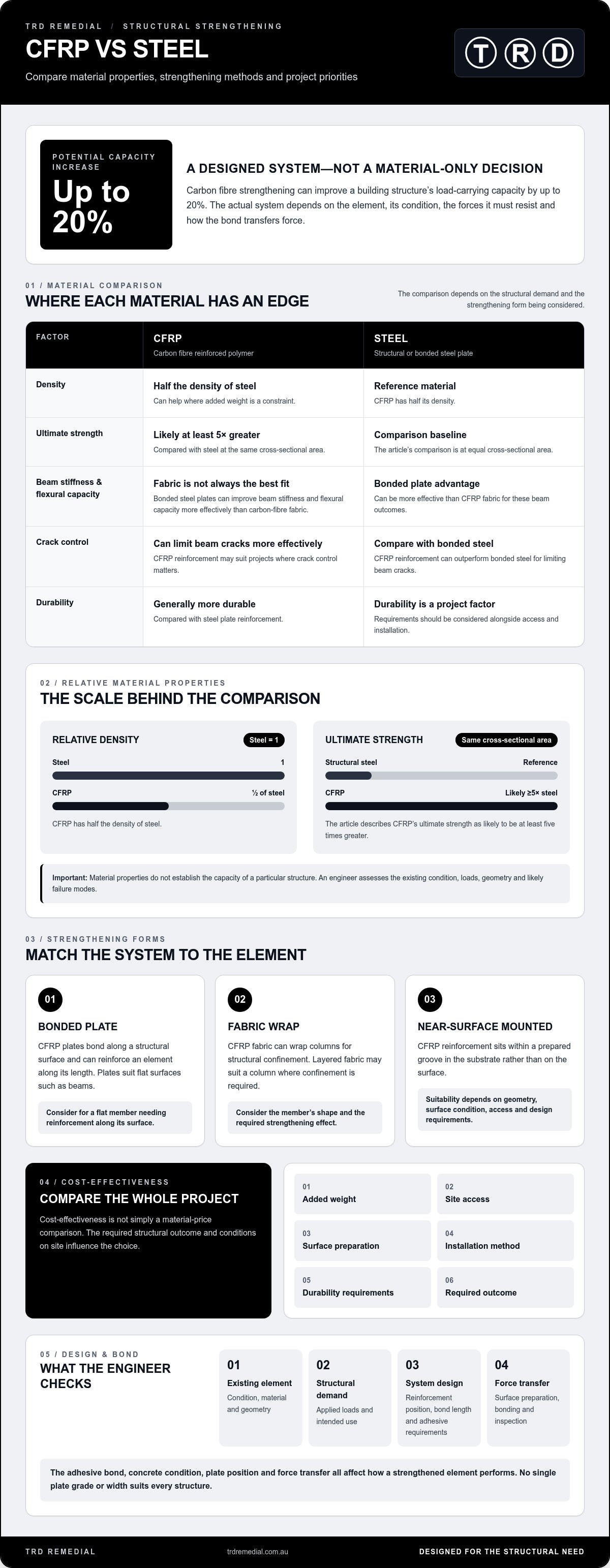
CFRP is a lightweight composite alternative to steel for strengthening structural elements. It has half the density of steel, and at the same cross-sectional area its ultimate strength is likely to be at least five times greater. These properties can help where added weight or space is a constraint. However, bonded steel plates can improve beam stiffness and flexural capacity more effectively than carbon-fibre fabric. CFRP is generally more durable than steel plate reinforcement.
Fabric and Plate Strengthening Methods
Fabric and plate systems transfer force into the existing structure through a bonded connection, but their form affects performance. CFRP fabric can wrap columns for structural confinement, while bonded plates reinforce a structural element along its length. SikaWrap systems are used for fabric applications, and Sika CarboDur systems provide externally bonded plate strengthening. CFRP reinforcement can also limit beam cracks more effectively than bonded steel, so system selection should reflect the intended outcome.
Externally Bonded and Embedded Systems
Externally bonded strengthening fixes CFRP or steel to a surface; near-surface mounted reinforcement sits within a prepared groove in the substrate. The first approach leaves reinforcement visible, while the second embeds it in the element. Both rely on force transfer between the reinforcement and the existing material. Suitability depends on the member’s geometry, surface condition, access and design requirements, not material strength alone.
Cost-effectiveness is a project comparison, not simply a material price. Added weight, access, preparation, installation method, durability requirements and the required structural outcome all affect the decision. For a project assessment focused on carbon fibre strengthening, compare the system’s design purpose with the structural need.
CFRP system design, installation and support
A designed CFRP system must suit the structural demand, substrate and installation conditions. Surface preparation, bonding and inspection all affect force transfer.
Engineering Load Calculations and Design
Engineers assess the existing element, applied loads, material condition and intended use before sizing reinforcement. Concrete and steel require different checks because their geometry, substrate behaviour and connection details differ. Concrete Society Technical Report 55 provides design guidance for strengthening concrete structures with fibre composites. The design sets plate location, bond length and adhesive requirements, then checks how forces transfer through the strengthened element. This links the proposed system to the actual structural demand.
Plates Compared with Fabric Wrapping
Plates bond along a structural surface, while fabric wraps around elements such as columns. The right option depends on the member’s geometry and the required strengthening effect. A flat beam may suit a bonded plate; a column requiring confinement may suit layered fabric. Near-surface mounted CFRP sits in a prepared groove rather than on the surface. Each method needs a compatible substrate and a design that accounts for how the reinforcement engages with the element.
Layer Count and Bond Length
Layer count and bond length are design variables, not universal installation settings. Engineers select them to transfer the required force without creating unsuitable stress concentrations at the plate ends. Adding fabric layers does not automatically improve performance if the substrate or bond is the limiting factor. For plates, the bonded length and adhesive connection must suit the element’s geometry and load path. Drawings should specify reinforcement placement and termination details before work begins.
Inspection and Installation Quality Assurance
Installation quality checks focus on surface condition, adhesive application, alignment and curing. Guidance specifies a concrete profile equivalent to ICRI CSP 3-4, compressive strength of 25-30 N/mm² at the installation location, and an adhesive bed typically 1-3 mm thick. Leave the bond undisturbed for at least 7 days above 10°C before loading. Adhesion testing is recommended every 5-10 metres of plate, or as the engineer specifies.
Debonding can follow inadequate surface preparation or a compromised bond; moisture can also interfere with adhesion. Carbon fibres resist high temperatures, but heat can affect the epoxy adhesive: one study identifies its glass-transition temperature as 50°C. Post-installation inspection should follow the engineer’s requirements, with bonded CFRP inspection recommended every 5-10 years within the building’s principal structural inspection programme.
Carbon fibre plate bonding
Carbon fibre plate bonding attaches a reinforced polymer plate to a structural surface with adhesive. The plate and bond work together: the adhesive transfers force from the concrete section into the carbon fibres, which resist tension. This method can strengthen a beam when an engineering assessment identifies a need for greater flexural capacity, without replacing the original construction.
Successful bonding depends on a planned sequence. First, assess the concrete for cracks, contamination, corrosion-related damage and soundness. Then prepare the bonding surface and position the plate according to the design. Apply the specified adhesive consistently and seat the plate to ensure continuous contact along its bonded length. Alignment matters: a plate outside the intended stress path cannot deliver the designed strengthening effect.
The bond is a critical part of the system, not a secondary construction detail. Poor adhesion, voids or weak concrete can interrupt force transfer and contribute to debonding. At the plate ends, stress must transfer back into the structural element, so detailing matters as much as the plate itself. For a concrete beam, the engineer considers existing reinforcement, loads, geometry and the required strengthening before determining plate position and bond length.
Carbon fibres can resist temperatures up to 1200 °C, but that figure does not describe the performance of the complete bonded system. Epoxy adhesive behaviour also matters: a study identifies 50 °C as its glass-transition temperature. Exposure conditions, including direct sunlight and harmful media, should inform protection and maintenance planning. Research and field studies document CFRP strengthening service lives of 50 years or more in dry interior environments, making exposure and inspection relevant to long-term performance. For a project-specific application, discuss carbon fibre strengthening in relation to the structural demand.
TRD Remedial: Carbon Fibre Strengthening
TRD Remedial provides Carbon Fibre Strengthening for structures requiring reinforcement to address increased loads or structural concerns. This work can suit concrete elements that need strengthening, with the right approach determined by the member’s condition and the intended structural outcome.
If cracking or concrete deterioration is also an issue, Crack Injection and Concrete Repairs can address those defects alongside strengthening. Coordinating these needs keeps the repair scope focused on the structural problem, rather than treating each symptom in isolation.
If you’re considering carbon fibre strengthening for a building or other structure, contact TRD Remedial to discuss your project.
Set a clear direction for your project
The next step is to relate the proposed reinforcement to the building’s intended use and the issues observed on site. A concise project brief can identify the affected element, planned change, visible cracking or deterioration, and access constraints. These details help frame the engineering assessment and clarify what the strengthening work needs to address.
For high load carbon fibre plate bonding, the key decision is how the strengthening system fits the full structural scope, not simply which plate to install. TRD Remedial provides Carbon Fibre Strengthening and Structural Strengthening, as well as Crack Injection where cracking needs attention. The appropriate work depends on the structural concern and project requirements.
Discuss your project and its structural needs with TRD Remedial. A clear starting point can help you move towards a considered strengthening plan.
Frequently Asked Questions
What are CFRP Laminates?
CFRP laminates are composite reinforcement products made from carbon fibres held in a polymer matrix. They come in forms such as rigid plates or flexible fabric, with the fibres carrying tension when bonded to a structural element. For example, a plate can reinforce a beam’s tension face, while fabric can wrap a column. The selected form depends on the member’s shape and the strengthening design.
Would Carbon Fibre Improve Load Bearing?
Carbon fibre can improve load-bearing performance when reinforcement is designed for an element’s specific weakness. For a beam with inadequate flexural capacity, reinforcement may help resist tension; a column may need a different arrangement. It will not automatically resolve every structural issue, such as a damaged support or unstable foundation. Before selecting a system, the assessment needs to identify the load path, existing condition and required performance.
What is high-load carbon fibre plate bonding and what applications is it used for?
High-load carbon fibre plate bonding attaches a stiff CFRP plate to a structural member so force can transfer through the adhesive bond. It may suit concrete beams or floor elements facing changed demands, such as heavier equipment or altered use. The plate’s position and anchorage must match the engineering design. Bonded reinforcement does not replace the need to address deterioration or defects in the underlying substrate.
What adhesive is suitable for bonding carbon fibre plates under high loads?
A structural epoxy adhesive is used to bond carbon fibre plates, with selection based on the plate system, substrate and design requirements. Adhesives and resins used by TRD Remedial are described as complying with Australian Standard AS 3600. The adhesive must create a compatible bond with the prepared surface and transfer the design forces. Ordinary construction glue isn’t an equivalent substitute for a structural bonding system.
What surface preparation and installation steps are required for structural carbon fibre plate bonding?
Preparation starts by exposing sound concrete and removing contaminants, weak material and coatings that could compromise adhesion. The installer then creates the specified surface profile, checks the substrate, applies the structural epoxy adhesive and positions the plate to match the design. Voids, uneven contact or dust can disrupt force transfer. Installation records should document substrate condition, materials, environmental conditions and quality checks.
How long does carbon fibre plate adhesive take to cure at different temperatures?
There is no single cure-time table that applies to every adhesive and temperature. Cure behaviour depends on the selected epoxy formulation and conditions at the structure, including substrate and ambient temperature. Lower temperatures can slow curing, while warmer conditions can change working time. Keep the plate undisturbed during curing, and base loading on the adhesive’s technical requirements and the project’s engineering criteria.


