

Did you know that 80% of Australians live in coastal zones where salt-laden air relentlessly accelerates concrete degradation? For commercial property managers, this isn't just an environmental statistic; it's a direct threat to the structural integrity of your facility. When concrete spalling begins to damage tenant vehicles or water ingress creates visible cracking, the risk to your asset moves from theoretical to critical. You need a solution that goes beyond cosmetic patches.
Managing these defects is complex, especially when you can't afford to close the entire facility for weeks. We understand that maintaining safety and compliance is your top priority. This professional guide to car park structural repair identifies the root causes of deterioration and outlines engineered remediation techniques designed for longevity. We'll explore how to diagnose deep-seated issues, apply advanced strengthening methods like carbon fibre reinforcement, and execute a methodical repair plan that keeps your car park operational while ensuring its long-term stability. By addressing structural vulnerabilities now, you protect both your tenants and your bottom line.
Key Takeaways
- Learn to distinguish between minor cosmetic issues and critical structural distress, ensuring you prioritise high-risk defects effectively.
- Understand the electrochemical triggers behind concrete cancer and carbonation to stop recurring degradation at the source.
- Evaluate engineered remediation techniques, such as epoxy injection and carbon fibre strengthening, to select the most durable solution for car park structural repair.
- Discover how professional slab scanning and staged project management allow for essential remediation without requiring a full facility closure.
- Gain the technical insights needed to protect your commercial asset's integrity and ensure tenant safety through compliant, engineered solutions.
Identifying Common Structural Defects in Australian Car Parks
Commercial car parks are high-stress environments where structural integrity is constantly challenged by heavy vehicle loads and environmental exposure. Identifying defects early isn't just about maintenance; it's about risk mitigation. While minor hairline cracks might appear aesthetic, deep fractures that penetrate the slab suggest serious distress. These fractures often indicate a failure in load distribution, necessitating professional car park structural repair to prevent a total loss of asset integrity.
In basement levels, the presence of moisture is the most aggressive catalyst for deterioration. When water reaches the internal steel reinforcement, it triggers a chemical chain reaction that compromises the entire slab. Detecting these signs before they manifest as major failures is critical for safety and compliance.
Concrete Spalling and Reinforcement Corrosion
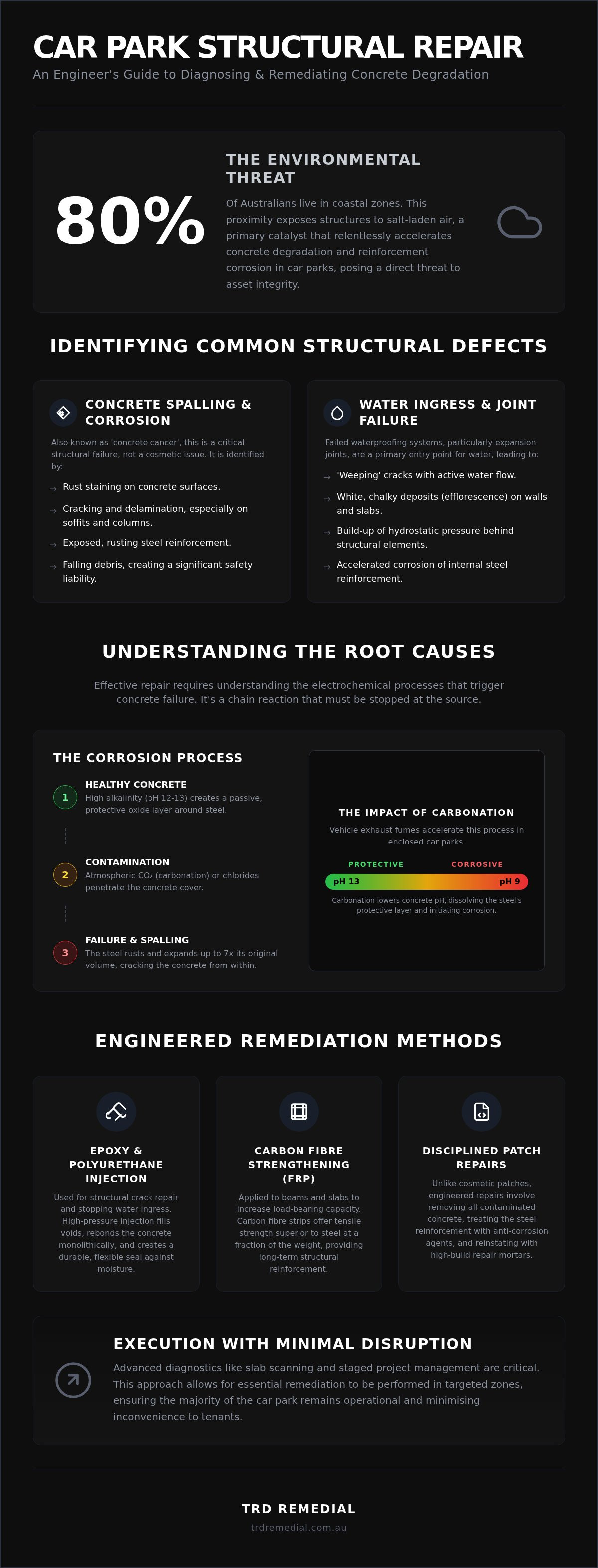
Visual indicators of concrete cancer include rust staining, cracking, and delamination on soffits and columns. As internal steel oxidises, it expands, exerting immense pressure on the surrounding concrete. This is a primary factor among the various causes of concrete degradation found in Australian commercial buildings. The resulting spalling isn't just a structural issue; it's a liability. Falling concrete debris in high-traffic zones poses a direct threat to tenants and their vehicles.
Surface patching often fails because it doesn't address the underlying oxidation. A disciplined approach requires removing the contaminated concrete, treating the reinforcement, and restoring the structural section. Without this level of technical precision, the corrosion continues unabated beneath the new patch. It's a methodical process that prioritises long-term stabilization over temporary fixes.
Water Ingress and Joint Failure
Expansion joints are designed to accommodate thermal movement, yet they are frequently the first point of failure in a car park's waterproofing system. When these joints perish, they allow water to penetrate lower-level infrastructure. You may notice 'weeping' cracks, which are often accompanied by white calcium deposits known as efflorescence. These signal a build-up of hydrostatic pressure behind the wall or slab.
Implementing an engineered water ingress crack repair strategy is the only way to stabilise these areas. By injecting specialised resins, we stop the moisture path and protect the reinforcement from further corrosive attack. This protects the facility's core and prevents the accelerated degradation of structural components in submerged or underground levels.
Understanding the Root Causes of Concrete Cancer and Degradation
Effective car park structural repair requires a granular understanding of the chemical shifts occurring within the concrete matrix. Concrete cancer is fundamentally an electrochemical process. In a healthy state, concrete's high alkalinity protects embedded steel with a passive oxide layer. Once this alkalinity is compromised, moisture and oxygen reach the reinforcement, causing it to oxidise. As the steel rusts, it expands up to seven times its original volume, generating internal tensile stresses that exceed the concrete's capacity. This leads to the cracking and spalling that compromises the entire facility.
Dynamic loads exacerbate these chemical vulnerabilities. The constant weight and vibration from vehicle movement don't just wear down the surface; they flex the structure. This mechanical stress widens existing micro-cracks, creating pathways for aggressive agents to bypass the concrete cover. If you suspect your facility is reaching a critical threshold of degradation, seeking an expert structural assessment is the first step toward stabilisation.
The Carbonation Process in Multi-Level Structures
Carbonation occurs when atmospheric carbon dioxide reacts with calcium hydroxide in the concrete to form calcium carbonate. This chemical shift lowers the concrete's pH from a protective level of 12 or 13 down to approximately 9. At this lower alkalinity, the steel's passive protective layer vanishes. Enclosed car parks are particularly vulnerable because vehicle exhaust fumes elevate CO2 concentrations, which drives the carbonation front deeper into the slab at an accelerated rate. Specialists use phenolphthalein testing to measure this depth; a lack of pink colouration indicates the concrete has lost its ability to protect the reinforcement.
Chloride Contamination and Structural Integrity
Chloride ion attack represents a different, often more aggressive, form of degradation. In coastal regions, salt-laden air carries chlorides that penetrate the concrete matrix. Unlike carbonation, chlorides cause 'pitting' corrosion, a highly localised and deep form of structural damage. This can drastically reduce the load-bearing capacity of reinforcement bars before any surface cracking is visible. In suspended slabs, the consequences of ignoring chloride ingress are severe. Comprehensive car park structural repair must involve removing all contaminated concrete beyond the steel and applying specialised barriers to prevent further ion migration.
Evaluating Remediation Methods: Injection, Patching, and Strengthening
Selecting the correct methodology for car park structural repair depends entirely on the nature of the defect. While surface-level patching is a common industry default, it often fails to address underlying structural instability. A disciplined approach prioritises engineered solutions that restore the load-bearing capacity of the slab and columns. This involves a strategic choice between resin injection, traditional breakout remediation, or advanced composite strengthening.
Traditional remediation remains the benchmark for treating localised concrete cancer. This process requires a precise breakout of the contaminated concrete to at least 20mm behind the reinforcement. Once exposed, the steel must be mechanically cleaned to a bright metal finish and treated with a zinc-rich primer. Simply applying a mortar over rust ensures the corrosion will return. Once the steel is stabilised, we apply high-strength, shrinkage-compensated mortars to restore the original profile. To finish, we apply specialised anticarbonation coatings or silane penetrants to create a barrier against future chloride and CO2 ingress.
Technical Injection Systems for Crack Remediation
Cracks in car park decks are seldom just aesthetic. When determining the right approach, we compare epoxy vs polyurethane crack injection based on the crack's behaviour and structural role. Epoxy resins provide high-tensile structural bonding for dormant cracks, effectively welding the concrete back together to restore monolithic integrity. Conversely, polyurethane is the superior choice for active water leaks or moving joints. Its expansive properties allow it to track and seal water paths under high pressure, ensuring a watertight finish even in vibrating basement environments. Our high-pressure injection protocols ensure the resin penetrates the full depth of the crack, providing a total seal rather than a surface plug.
Structural Strengthening with Carbon Fibre
When a slab's design capacity is exceeded or structural alterations are required, carbon fibre strengthening offers a modern alternative to traditional steel plate bonding. Carbon fibre reinforced polymers (CFRP) provide an exceptional strength-to-weight ratio. They are particularly effective in height-restricted car parks where low-profile reinforcement is essential to maintain vehicle clearance. Integrating these systems into a broader concrete remediation strategy allows for significant load increases without the weight or corrosion risks associated with steel. It's a precise, engineered solution that provides immediate stabilization for complex structural demands.
Planning and Executing Car Park Repairs with Minimal Disruption
Executing a successful car park structural repair project in an active commercial environment requires more than technical skill; it demands rigorous logistical planning. The primary challenge for any asset manager is balancing the urgency of structural work with the need to keep the facility operational. A methodical, staged approach allows for remediation to proceed in designated zones while maintaining tenant access and parking availability in others. This prevents the financial and operational fallout of a total facility closure.
Compliance with Australian standards, such as AS/NZS 2890.1:2021 for parking facilities, remains essential throughout the execution phase. Safety protocols must be integrated into the project plan from day one. This includes managing hazardous materials like silica dust through wet-cutting techniques and high-efficiency particulate air (HEPA) extraction. Clear communication with strata managers and building stakeholders ensures that noise-intensive works are scheduled during off-peak periods, minimising the impact on the building's occupants.
Slab Scanning and Non-Destructive Testing
Slab scanning is the non-negotiable first step before any physical remediation begins. We use Ground Penetrating Radar (GPR) to create a precise map of the internal reinforcement, post-tension cables, and embedded services. The risks of core drilling or concrete cutting without accurate scanning are severe; severing a post-tension cable can lead to immediate structural failure and catastrophic safety risks. GPR provides a non-destructive way to 'see' through the concrete, ensuring every cut is made with engineering certainty.
Beyond mapping steel, we employ ultrasonic pulse velocity testing to identify hidden internal defects. This technology detects voids, honeycombing, and deep-seated delamination that aren't visible from the surface. By identifying these issues early, we can adjust the repair scope to address the root cause, rather than just the symptoms. This data-driven approach ensures that the remediation is both comprehensive and efficient.
Site Logistics and Safety Protocols
Managing an active construction site within a functioning car park requires a disciplined traffic management plan. This involves clear signage, physical barriers, and temporary lighting to guide vehicles safely around remediation zones. Our team prioritises the containment of work areas to prevent debris or dust from affecting tenant vehicles. If you need to maintain facility access while addressing critical defects, contact our specialist team for a staged remediation plan that prioritises both safety and continuity.
TRD Remedial: Disciplined Authority in Structural Remediation
TRD Remedial operates at the intersection of engineering rigor and field execution. We recognise that car park structural repair isn't a one-size-fits-all service. Each facility presents a unique set of challenges, from chloride contamination in coastal zones to carbonation in high-traffic urban basements. Our commitment to technical precision ensures that every remediation project we undertake is backed by a definitive diagnosis. We don't just patch symptoms; we stabilise the core of the asset.
Our methodical approach prioritises safety and regulatory compliance. By adhering to strict engineering specifications and Australian standards, we provide commercial property owners with the security of long-term asset integrity. Quality control is embedded in our workflow, from the initial slab scanning to the final application of protective coatings. This disciplined mindset allows us to manage complex projects without compromising on the quality of the final result.
Technical Mastery in Concrete Repair
We specialise in solving the root causes of structural distress. Whether the issue is reinforcement corrosion or design-induced stress, we utilise state-of-the-art equipment to deliver a precise fix. Our expertise in complex concrete crack repair and strengthening allows us to handle projects that other providers find too complex. By using advanced materials like high-strength resins and carbon fibre polymers, we extend the service life of commercial car parks, ensuring they remain safe for decades to come.
Technical mastery also means staying ahead of the curve with equipment. We invest in high-pressure injection systems and ultrasonic testing tools to verify the success of every repair. This data-driven execution removes the guesswork from remediation, providing a level of certainty that's essential for high-value commercial assets.
A Partner for Strata and Facility Managers
We understand the pressures faced by strata and facility managers. Transparency is the foundation of our project management style. We provide detailed reporting at every stage, ensuring stakeholders have a clear view of the project's progress and compliance status. Our team works alongside structural engineers to execute precise alterations and remediation plans that align with the building's overall maintenance strategy.
Reliability is our hallmark. We act immediately when critical issues arise, yet we maintain a steady, methodical pace for large-scale works. This balance makes us the preferred partner for complex commercial assets. If your facility shows signs of distress, contact TRD Remedial for a professional assessment of your car park. We provide the engineered solutions required to protect your investment and ensure the safety of your tenants.
Securing the Long-Term Integrity of Your Commercial Asset
Maintaining a commercial car park requires more than reactive maintenance; it demands a disciplined, engineered approach to structural health. We've explored how identifying the root causes of concrete cancer and implementing technical injection or strengthening systems can prevent catastrophic failure. A successful car park structural repair project relies on precise diagnosis and methodical execution to ensure the safety of both the structure and its users. By prioritising engineered solutions over cosmetic fixes, you protect your investment from the aggressive effects of carbonation and chloride ingress.
As specialist structural remediation contractors, TRD Remedial provides national coverage for commercial and industrial assets. We deliver engineered solutions for complex building defects, ensuring compliance with Australian standards while minimising operational downtime. It's vital to address these defects before they escalate into high-cost liabilities. Taking proactive steps today ensures your facility remains a safe, stable environment for years to come.
Secure your asset's future; contact TRD Remedial for an expert structural remediation consultation.
Frequently Asked Questions
What are the first signs that a car park needs structural repair?
The earliest indicators often include fine hairline cracks, rust-coloured staining on the concrete surface, or white powdery deposits known as efflorescence. You might also notice localised dampness or small flakes of concrete detaching from the ceiling. These signs suggest that moisture has reached the internal reinforcement. Identifying these symptoms allows for a targeted car park structural repair strategy before the damage spreads to the main structural columns or load-bearing slabs.
Is concrete spalling always a structural emergency?
While every instance of spalling requires a professional assessment, it is a safety emergency if it occurs on overhead soffits where falling debris threatens the public. Spalling results from internal steel expansion, which compromises the concrete's bond. Even if it isn't an immediate collapse risk, it indicates active corrosion. Ignoring it allows the degradation to accelerate, eventually requiring more invasive and expensive structural stabilisation to restore the asset's integrity and compliance.
How long does a typical car park remediation project take?
The duration of a project depends entirely on the defect's complexity and the facility's size. Localised crack injections or minor spalling repairs might be completed within a few days. However, a full-scale structural overhaul involving carbon fibre strengthening or extensive slab remediation can span several weeks. We use a methodical, staged approach to ensure high-priority zones are stabilised first, providing a clear timeline that aligns with your operational requirements and engineering specifications.
Can car parks remain open during structural repairs?
Yes, most facilities can remain partially operational during a car park structural repair project. We implement a rigorous traffic management plan to isolate work zones while maintaining vehicle access in other areas. This staged remediation strategy minimises disruption for tenants and visitors. By using dust extraction systems and scheduling noise-intensive works during off-peak hours, we ensure the project proceeds safely without requiring a total facility closure or significant loss of revenue.
Why is water ingress so dangerous for concrete car parks?
Water ingress is the primary catalyst for concrete cancer because it introduces oxygen and chlorides to the steel reinforcement. This moisture strips the concrete of its natural alkalinity, leaving the steel vulnerable to rapid oxidation. In basement levels, water also creates hydrostatic pressure that can widen cracks and lead to secondary issues like mould or electrical damage. Effective remediation must involve stopping the water path through specialised resin injection to prevent long-term structural instability.
What is the difference between carbon fibre strengthening and steel reinforcement?
Carbon fibre strengthening provides a high-tensile, low-profile solution that is significantly lighter and more durable than traditional steel plate bonding. Unlike steel, carbon fibre reinforced polymers are non-corrosive, making them ideal for humid or coastal car park environments. They also maintain vehicle clearance heights due to their minimal thickness. While steel is effective for specific heavy-duty applications, carbon fibre offers a versatile, engineered alternative that reduces the overall weight added to the structure.
How often should commercial car parks undergo a structural inspection?
We recommend that commercial property managers schedule a professional structural inspection every three to five years. Facilities located in coastal zones or those older than 20 years should undergo annual reviews to monitor for concrete cancer. Regular assessments allow you to detect subtle changes in crack patterns or moisture levels. This proactive approach ensures you can address minor defects before they evolve into major safety liabilities or require expensive and complex structural alterations.
Does slab scanning work for post-tensioned concrete slabs?
Yes, Ground Penetrating Radar (GPR) is the industry standard for locating cables in post-tensioned concrete slabs. It provides a non-destructive way to map the exact depth and trajectory of PT tendons before any core drilling or concrete cutting begins. Because severing a live post-tension cable can cause immediate structural failure, slab scanning is a mandatory safety protocol for any remedial work involving slab penetration. It ensures every cut is made with engineering certainty.


