

A simple surface patch is often nothing more than a cosmetic mask for a developing structural failure. When you notice a fissure snaking across a reinforced slab, the instinct to fill it quickly is understandable; however, it's rarely effective. Most property owners and asset managers share the same underlying anxiety: is this a minor settlement issue, or the beginning of a costly structural collapse? You're right to be concerned, as ignoring the root cause of water ingress and corrosion can lead to irreversible damage and compromised safety.
This guide cuts through the confusion between temporary DIY fixes and professional concrete crack repair to provide a clear, engineered path forward. You'll discover how to accurately categorise different crack types and select the precise remediation method, such as epoxy or polyurethane injection, required to restore structural capacity. We'll outline the exact steps needed to stabilise your asset, ensure compliance with Australian Standards, and deliver a long-term solution that protects your investment from the inside out.
Key Takeaways
- Learn to distinguish between superficial hairline shrinkage and critical structural fractures that threaten the integrity of your building.
- Understand how reactive soils and extreme Australian temperature cycles drive concrete failure and why surface patching is an insufficient response.
- Discover the technical differences between epoxy and polyurethane systems to ensure the correct concrete crack repair method is selected for structural bonding or waterproofing.
- Follow a disciplined, engineered remediation process that utilises non-destructive testing and slab scanning to accurately map hidden defect networks.
- Ensure long-term asset protection and safety compliance by adhering to Australian Standards and moving beyond temporary cosmetic fixes.
Understanding Concrete Cracks: Cosmetic Issue or Structural Risk?
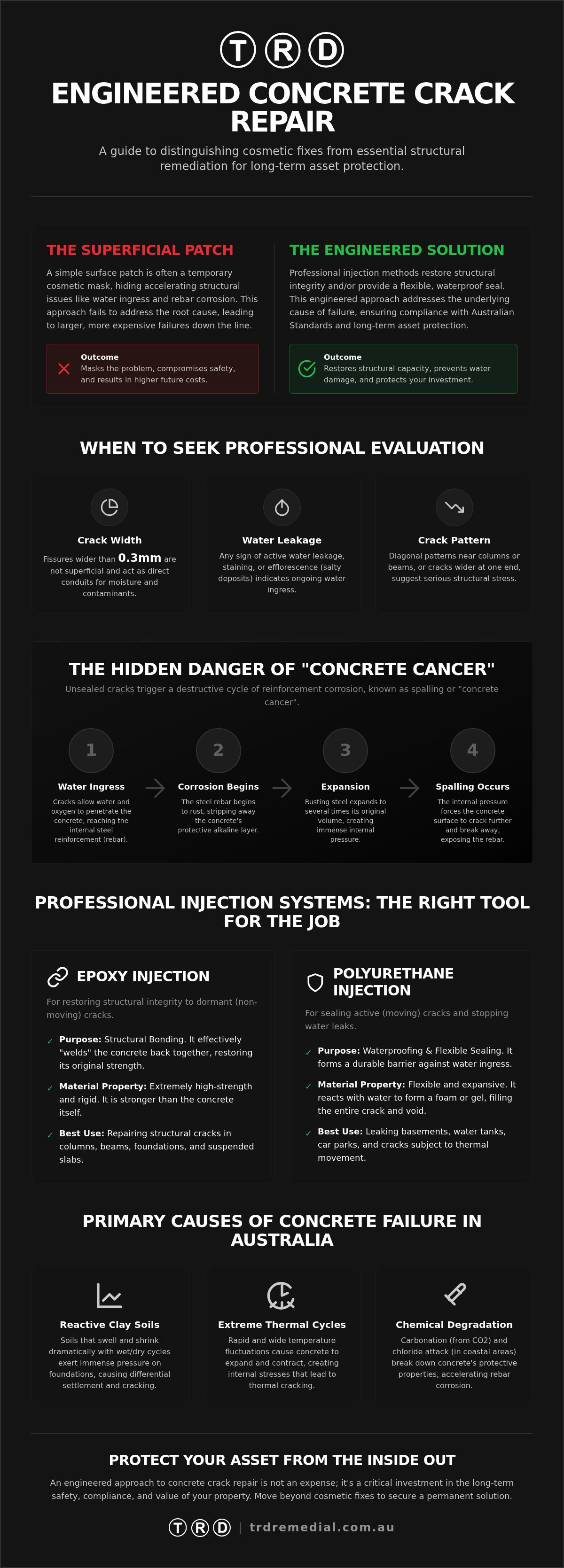
Concrete is a material of contradictions. It possesses immense compressive strength, yet it's notoriously weak in tension. Because of this, cracks are almost inevitable as the material settles, cures, or responds to external loads. Distinguishing between a superficial hairline fracture and a critical structural failure is the first step in any remediation project. Most cracks aren't just visual defects; they act as direct conduits for water ingress and chloride contamination. Once moisture penetrates the surface, it begins a slow, destructive process that compromises the entire slab. If a crack is wider than 0.3mm, shows signs of active water leakage, or follows a diagonal pattern near load-bearing points, it requires immediate professional evaluation.
Categorising Crack Types
Effective concrete crack repair begins with identifying whether a fissure is dormant or active. Dormant cracks have stabilised; they no longer grow in width or length. These are typically the result of initial drying shrinkage or minor settlement. Conversely, active cracks continue to move due to thermal expansion or ongoing foundation shifts. Using a rigid repair material on an active crack will simply cause a new fracture to form nearby.
- Shrinkage cracks: These usually appear shortly after pouring as the concrete loses moisture and contracts.
- Structural cracks: These are often wider at one end and suggest that the structure's load-bearing capacity is being tested beyond its design limits.
- Thermal cracks: These occur when extreme temperature cycles cause the concrete to expand and contract at different rates than the surrounding materials.
The Hidden Danger of "Concrete Cancer"
The term "concrete cancer" refers to the accelerating cycle of reinforcement bar (rebar) corrosion. When cracks remain unsealed, oxygen and water reach the internal steel. As the steel rusts, it expands to several times its original volume. This internal pressure causes the surrounding concrete to crack further and eventually break away, which we call spalling. While concrete pavement restoration techniques often deal with surface wear, structural remediation focuses on stopping this oxidation before the steel loses its cross-sectional area. Addressing these defects early is a strategic financial decision. The cost of a professional concrete crack repair injection is negligible compared to the massive expense of replacing a compromised structural column or suspended slab.
Identifying the Root Causes of Concrete Failure in Australia
Effective concrete crack repair requires more than a visual assessment; it demands a forensic understanding of the root cause. If you don't address why the concrete failed, any remediation will be temporary. Australia's geological and climatic profile presents unique challenges that differ significantly from other regions. Many areas are dominated by highly reactive clay soils that undergo massive volume changes during wet and dry cycles. This ground movement exerts immense pressure on footings and slabs, forcing the concrete to flex beyond its tensile limits. When the ground moves, the structure must either move with it or fracture.
Thermal expansion is another primary driver of structural distress. In a climate where surface temperatures can fluctuate by 30 degrees in a single day, concrete slabs experience intense internal stress. Chemical degradation also plays a silent, destructive role. Carbonation occurs when carbon dioxide penetrates the concrete, lowering its pH and stripping away the protective alkaline layer around the steel reinforcement. In coastal environments, chloride-induced corrosion is even more aggressive. Salt spray penetrates the pores of the concrete, attacking the rebar directly and triggering the expansive rusting process. Referencing established standards like the TxDOT Concrete Repair Manual highlights how damage assessment must precede material selection to ensure long-term stability.
Environmental and Geotechnical Factors
Soil subsidence is frequently exacerbated by poor site drainage. When water pools near footings, it softens the supporting ground, leading to differential settlement. This uneven support causes the slab to rotate or sink, creating diagonal fractures that often indicate serious structural instability. Vibration damage also contributes to failure. Heavy machinery or adjacent piling works can trigger micro-cracking in older, more brittle concrete. If you are noticing recurring fissures, a professional structural defect assessment can identify whether the issue is geotechnical or material-based.
Workmanship and Material Defects
Workmanship errors often seal the fate of a structure during the initial pour. Inadequate concrete cover is perhaps the most common defect; if the steel reinforcement is placed too close to the surface, it's vulnerable to rapid oxidation. Incorrect water-to-cement ratios also compromise the mix's integrity. Excessive water increases the porosity of the cured slab, making it a sponge for corrosive agents. Additionally, missing expansion joints in large commercial slabs prevent the material from moving naturally. Without these joints, the concrete will create its own "joints" in the form of uncontrolled, jagged cracks that compromise the asset's longevity.
Professional Injection Systems: Epoxy vs Polyurethane
The choice between epoxy and polyurethane isn't arbitrary; it's a critical engineering decision based on the crack's behaviour and the desired outcome. While both materials are delivered via injection, they serve fundamentally different purposes within a remediation strategy. The primary objective of concrete crack repair is to restore the structure's design capacity or to create an impermeable barrier against environmental contaminants. Achieving this requires a precise match between the resin's properties and the structural defect. The Texas DOT Concrete Repair Manual provides a clear framework for selecting these materials based on the specific environmental conditions and structural requirements of the project. Technicians must also determine whether to use low-pressure injection for fine, surface-level fissures or high-pressure systems to penetrate the full depth of thick structural members.
Epoxy Injection for Structural Integrity
Epoxy resins are the industry standard for structural bonding. Because of their high tensile strength and superior bond, they effectively weld the concrete back together. This process restores the original monolithic strength of the concrete member, allowing it to once again distribute loads as intended. It's the preferred solution for structural beams, columns, and load-bearing slabs where movement has ceased. However, epoxy is rigid. If it's used on a crack that's still moving due to thermal cycles or foundation shifts, the concrete will likely fracture again right next to the repair. Selecting the correct viscosity is also vital; ultra-low viscosity resins are required to gravity-feed or inject into hairline cracks, ensuring the material reaches the deepest points of the fracture.
Polyurethane Injection for Water Ingress
Polyurethane resins are the specialist choice for water ingress crack repairs, particularly in basements, lift pits, and retaining walls. Unlike epoxy, polyurethane remains flexible after curing, allowing it to accommodate minor structural movements without debonding. These resins are categorised as either hydrophilic, which actively seek out and react with water to form a tight seal, or hydrophobic, which repel water and are ideal for stopping high-pressure leaks. For complex scenarios like shoring walls, curtain wall injection allows technicians to create a waterproof membrane on the exterior of the structure without excavation. This adaptability makes it a staple in professional concrete crack repair for subterranean structures where moisture management is the priority over structural bonding.
The Engineered Remediation Process: From Diagnosis to Completion
Professional concrete crack repair is a disciplined engineering exercise. It's far removed from the "patch and paint" approach favoured by general maintenance contractors. A successful remediation project follows a logical, sequential plan to ensure the underlying defect is stabilised rather than just hidden. This process begins with an exhaustive visual inspection and mapping of the crack network. Technicians trace every visible fissure to understand the stress patterns affecting the slab. This data informs the placement of injection ports and the selection of the correct resin viscosity.
Once the network is mapped, the remediation follows a strict five-step protocol:
- Step 1: Mapping and Cleaning. Removing surface contaminants to expose the full extent of the fracture.
- Step 2: Non-Destructive Testing. Utilising advanced scanning to see inside the concrete matrix.
- Step 3: Port Installation. Drilling and setting mechanical packers or surface ports at calculated intervals.
- Step 4: Controlled Injection. Pumping resin at specific pressures while monitoring for "travel" to adjacent ports.
- Step 5: Post-Repair Validation. Removing ports and patching the surface to restore the aesthetic finish while confirming internal saturation.
The Role of Slab Scanning
Before any drilling or injection commences, technicians use ground penetrating radar (GPR) to visualise the internal reinforcement. This is a safety-critical step. In post-tensioned slabs, hitting a tendon during port installation can lead to catastrophic structural failure. Slab scanning also identifies hidden voids or air pockets that might otherwise consume excessive amounts of resin or cause uneven pressure distribution during the injection phase. By identifying the internal extent of the cracks, we ensure the repair reaches the full depth of the member. If you're concerned about hidden defects, engaging a professional slab scanning and diagnostic service is the only way to mitigate these risks.
Structural Strengthening Upgrades
In cases where the concrete has suffered significant loss of cross-sectional area or the original design is no longer sufficient for current loads, crack injection alone may not suffice. We often integrate carbon fibre strengthening to provide additional tensile support. This lightweight, high-strength material bonds to the exterior of the concrete, effectively acting as external reinforcement. This is a core component of modern concrete remediation strategies, ensuring that the repaired asset can handle future stresses without further fracturing. This holistic approach transforms a simple repair into a long-term life extension for the structure.
Specialist Remedial Solutions for Long-Term Asset Protection
Professional concrete crack repair represents a strategic investment in the longevity and safety of an asset. While the initial cost of engineered remediation exceeds that of a cosmetic patch, the long-term value is found in the prevention of catastrophic structural failure. In Australia, compliance with standards such as AS 3600 (Concrete Structures) and HB 84 (Guide to Concrete Repair and Protection) is non-negotiable for commercial and residential buildings. Adhering to these frameworks ensures that repairs are not only durable but also legally defensible. Detailed technical reporting is essential for strata managers and insurance providers, as it provides a transparent record of the remediation's scope and the materials used. When dealing with complex structural alterations or significant defects, partnering with a specialist ensures that the work meets the rigorous demands of modern engineering.
Selecting a Remedial Contractor
Choosing the right partner for structural work requires a thorough evaluation of technical capability and industry experience. A qualified contractor must demonstrate a deep understanding of epoxy and polyurethane crack injection protocols, ensuring they can adapt to the specific needs of a project. Beyond injection, they should offer a comprehensive suite of technical services including core drilling, slab scanning, and controlled demolition. This breadth of expertise is critical for managing the unforeseen complexities that often arise during structural work. A proven track record across commercial, industrial, and residential sectors indicates a contractor's ability to operate within diverse regulatory environments and meet varied performance specifications.
Maintaining Structural Integrity
The completion of a repair should mark the beginning of a proactive maintenance programme rather than the end of the project. Ageing concrete assets require regular monitoring to identify new stress points or early signs of chemical attack before they escalate into major defects. Engineered solutions focus on stabilisation and reinforcement, whereas temporary aesthetic patches merely hide the problem, allowing corrosion to continue unabated. By prioritising technical mastery and structural rigor, asset owners can avoid the cycle of repetitive, ineffective repairs. If you have identified fissures in your structure, the most responsible course of action is to consult a specialist for a definitive diagnosis and an engineered concrete crack repair plan.
Secure Your Structure Through Engineered Remediation
Ignoring a structural fissure only accelerates the deterioration of your asset. Professional concrete crack repair isn't just about aesthetics; it's a critical intervention that stops water ingress and restores the monolithic strength of your slab. By choosing an engineered approach over a temporary patch, you ensure compliance with Australian Standards and protect the building's long-term value. Whether you're dealing with reactive soil movement or chloride-induced corrosion, a methodical diagnosis is the only way to determine if epoxy bonding or flexible polyurethane sealing is required.
TRD Remedial brings technical precision to every project. We are specialists in structural remediation and engineered repair solutions, offering expertise in high-pressure injection and carbon fibre strengthening. From advanced slab scanning to core drilling, our comprehensive services provide the data and execution needed to stabilise complex defects. Don't leave your property's integrity to chance. Contact TRD Remedial for professional concrete crack diagnosis and repair today. Taking decisive action now prevents costly spalling and ensures your structure remains safe and compliant for years to come.
Frequently Asked Questions
How do I know if a concrete crack is structural?
A crack is likely structural if it's wider than 0.3mm, follows a diagonal path near load-bearing columns, or shows signs of active movement. These fractures often indicate that the building's design capacity is being exceeded or the foundation has shifted. You should also check for "stair-step" patterns in masonry or cracks that pass through the entire thickness of a slab. Professional diagnosis involves visual mapping and slab scanning to determine the defect's depth and impact.
Is it better to repair a crack with epoxy or polyurethane?
The choice depends on whether you need structural bonding or water suppression. Epoxy resins are superior for restoring monolithic strength in dormant cracks because they create a high-strength bond that effectively welds the concrete together. Polyurethane is the preferred choice for concrete crack repair involving active water leaks or structures subject to thermal movement. It remains flexible after curing, allowing it to maintain a waterproof seal even if the crack shifts slightly over time.
Can I fix a concrete crack myself or do I need a professional?
While DIY fillers are available, they only provide a superficial cosmetic mask and don't address the underlying defect. Professional remediation is required for any crack that threatens structural integrity or allows water ingress. Specialist contractors use high-pressure injection systems and non-destructive testing to ensure full-depth penetration of the resin. Attempting a DIY fix on a structural fracture can hide developing issues like concrete cancer, leading to much more expensive repairs in the future.
What happens if I leave a concrete crack unrepaired?
Leaving a crack untreated exposes the internal steel reinforcement to oxygen, moisture, and chlorides. This triggers a cycle of corrosion known as concrete cancer, where the rusting steel expands and causes the concrete to fracture and fall away, a process called spalling. Over time, the loss of steel cross-section reduces the structure's load-bearing capacity. What begins as a minor fissure can evolve into a major building defect requiring extensive structural strengthening or controlled demolition.
How long does a professional concrete crack repair last?
A correctly executed concrete crack repair using high-quality epoxy or polyurethane resins is designed to last for the remaining service life of the structure. The longevity of the repair depends on the accuracy of the initial diagnosis and the correction of root causes, such as poor drainage or soil subsidence. By adhering to Australian Standards and utilising engineered injection protocols, specialist contractors deliver permanent solutions that prevent the reoccurrence of fissures and protect the asset from further degradation.
Will repairing the crack stop water leaking into my basement?
Yes, professional crack injection is a highly effective method for stopping active leaks in subterranean structures. Technicians typically use hydrophilic or hydrophobic polyurethane resins that react with moisture to expand and form a tight, flexible seal within the crack. This method is often combined with curtain wall injection for shoring walls to create an external waterproof barrier. Unlike surface coatings, this approach stops water at the source, preventing it from reaching the interior and causing damage.
Does crack injection restore the strength of the concrete?
Epoxy injection is specifically designed to restore the original monolithic strength of the concrete member. Once the resin cures, its tensile strength often exceeds that of the surrounding concrete, effectively welding the fracture shut. This is critical for load-bearing elements like beams and columns. Polyurethane injection, however, is a sealing and waterproofing solution rather than a strengthening one. If the structure requires additional load-bearing capacity, we often integrate carbon fibre strengthening as part of a comprehensive remediation strategy.
How much does professional concrete crack injection cost?
The cost of professional remediation varies based on several technical factors, including the total linear length of the cracks, the depth of the slab, and the type of resin required. Accessibility and the need for specialised equipment like slab scanning or core drilling also influence the final project budget. While rates are project-specific, it's important to view professional injection as a strategic investment that prevents the far higher costs associated with structural failure and asset replacement.


