

Did you know the cost of concrete spalling repair can escalate by more than 700 per cent if a minor defect is neglected for just two or three years? It is a confronting reality for strata managers and asset owners who often find that "quick fix" mortar patches fail within months, leaving the underlying steel reinforcement to continue its silent oxidation. You are likely frustrated by the cycle of repeated repairs and the conflicting remedial advice that makes navigating compliance requirements feel like a moving target.
This article provides the technical clarity you need to move beyond cosmetic patches and master an engineered approach to structural restoration. We will detail the precise requirements for identifying root causes, treating exposed reinforcement, and implementing permanent solutions such as carbon fibre strengthening and professional crack injection. By the end of this guide, you will understand how to secure your building's structural integrity, satisfy safety standards, and ensure the long-term viability of your commercial or residential asset.
Key Takeaways
- Learn to identify the early warning signs of "concrete cancer," including rust staining and "drummy" areas, to intervene before structural integrity is compromised.
- Understand why standard patch repairs often fail and how engineered concrete spalling repair strategies provide a permanent, electrochemical restoration of the concrete-steel bond.
- Discover the role of advanced technologies like carbon fibre strengthening and epoxy crack injection in restoring the load-bearing capacity of your commercial or residential structure.
- Master the best practice protocols for remediation, from mechanical breakout to reinforcing steel treatment, ensuring your asset meets strict Australian safety and compliance standards.
- Gain clarity on navigating complex strata requirements by partnering with specialist remedial contractors who prioritise technical precision over cosmetic fixes.
Understanding Concrete Spalling and the Corrosion Cycle
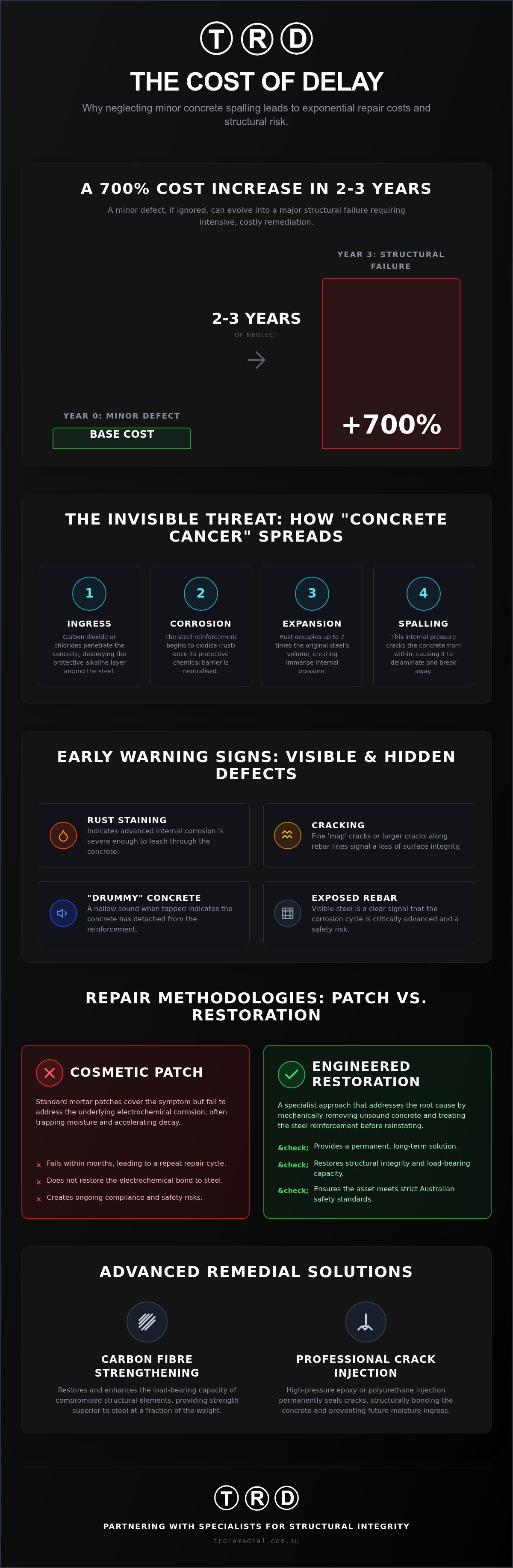
Concrete spalling is the physical manifestation of a deeper, more aggressive chemical process. It represents the end stage of internal steel reinforcement corrosion. In the remedial industry, this is often termed "concrete cancer" because the damage spreads invisibly within the slab before erupting on the surface. When steel oxidises, it undergoes a massive volumetric expansion. Rust can occupy up to seven times the volume of the original steel. This internal growth exerts immense tensile pressure on the surrounding concrete, which is naturally strong in compression but structurally weak in tension.
Ignoring these early signs is a high-stakes gamble for any asset owner. Delaying concrete spalling repair causes remedial costs to rise exponentially. A minor surface crack that is affordable to treat today can evolve into a major structural failure within 24 to 36 months, requiring intensive mechanical breakout and reinforcement replacement to ensure the structure remains safe and compliant.
The Role of Carbonation and Chloride Ingress
Concrete remains durable when its high alkalinity protects the steel. Carbonation occurs when atmospheric carbon dioxide penetrates the concrete matrix, lowering its pH level and destroying the protective "passive" layer of the rebar. In coastal environments, airborne salts introduce chlorides that bypass this alkalinity even faster. These are primary causes of concrete degradation. Structures with insufficient concrete cover, where the steel is positioned too close to the surface, are particularly vulnerable to these environmental triggers. Once the chemical threshold is crossed, the corrosion cycle begins in earnest.
The Mechanics of Structural Delamination
As the steel expands, it creates horizontal fractures within the concrete matrix. This stage is known as delamination. While the surface may look intact, the concrete has detached from the reinforcement. This results in "drummy" concrete, a term used by specialists to describe the hollow sound produced when the surface is tapped during a diagnostic survey. Once the first crack reaches the surface, moisture ingress accelerates. Water and oxygen reach the steel directly, creating a self-sustaining cycle of decay that cannot be reversed without intervention. Passivation is the natural chemical protection of steel within alkaline concrete. When this state is lost, professional concrete spalling repair becomes the only viable path to structural stabilisation.
Identifying the Early Warning Signs of Concrete Cancer
Accurate diagnosis is the prerequisite for any engineered concrete spalling repair. While surface cracks are obvious, the most dangerous defects often remain hidden beneath the surface for years. Identifying these issues early prevents minor delamination from becoming a significant structural liability or a safety hazard for occupants.
Visual indicators such as rust staining, longitudinal cracking, and exposed rebar are clear signals that the corrosion cycle is well advanced. Fine "map cracking" on concrete facades often suggests a loss of surface integrity, which allows moisture to penetrate deeper into the substrate. Asset owners should also be alert to "drummy" concrete. This term refers to areas where the concrete has already detached from the reinforcement, creating a hollow sound when struck, even if the surface appears intact.
Visual Symptoms vs. Hidden Defects
When rust leaches onto a facade, it indicates that internal deterioration is severe enough to transport iron oxide through the concrete pores. This is a critical safety concern, particularly for soffits and balconies where spalling concrete poses a risk of falling debris. Understanding these risks and the modern methods used to address them is part of the evolution of concrete repairs and structural remediation. A professional assessment often includes slab scanning to locate internal voids and map reinforcement placement before any mechanical work begins.
Professional Diagnostic Techniques
Engineered remediation relies on data rather than guesswork. Hammer sounding remains a primary method for detecting delaminated zones, but it is supplemented by advanced tools in modern practice. Cover meters are used to verify the depth of concrete cover, ensuring it meets Australian Standards for the specific exposure environment. For a comprehensive engineered report, specialists conduct chloride ion testing and carbonation depth testing to determine the extent of chemical ingress. As outlined in the U.S. Bureau of Reclamation Guide to Concrete Repair, a technical assessment of the substrate condition is vital before selecting a repair system. If you suspect your asset is showing these signs, engaging a specialist for an accurate structural diagnosis is the first step toward a lasting solution.
Comparing Remedial Repair Methodologies and Systems
Effective concrete spalling repair requires a shift from cosmetic patching to systematic structural restoration. While many property owners opt for a simple mortar patch to hide exposed rebar, these isolated fixes often fail because they ignore the electrochemical environment of the slab. A professional remedial system addresses the root cause of the corrosion cycle rather than just the visible symptoms.
A critical consideration in engineered remediation is the incipient anode effect, commonly known as the "halo effect." When a fresh patch of high-alkalinity repair mortar is applied to a chloride-contaminated substrate, it creates an electrochemical imbalance between the new material and the existing concrete. This imbalance can actually accelerate corrosion in the areas immediately adjacent to the new patch. Preventing this requires the use of sacrificial anodes or specialised bonding agents that equalise the electrical potential across the repair zone.
Patch Repair vs. Structural Strengthening
Determining the appropriate repair method depends on the extent of the reinforcement loss. Polymer-modified mortar patches are suitable for minor surface defects where the loss of rebar cross-section is negligible. However, if the steel has lost more than 20 per cent of its original diameter, structural reinforcement becomes mandatory. In these scenarios, carbon fibre strengthening offers a lightweight, high-tensile solution for restoring the load-bearing capacity of compromised beams, columns, and slabs. Regardless of the material used, achieving "bright steel" (Class 2.5) preparation via mechanical cleaning or abrasive blasting is essential to ensure a durable bond between the reinforcement and the new repair mortar.
Specialist Injection Systems
Where spalling is accompanied by deep cracking, specialist injection systems are deployed to seal the structure and prevent further moisture ingress. The choice of resin is determined by the nature of the crack. Epoxy injection is used for dormant, structural cracks. It creates a bond that is often stronger than the concrete itself, effectively reuniting the fractured elements into a monolithic whole. Conversely, polyurethane injection is the preferred solution for active water ingress in basement retaining walls and car parks. These resins react with water to expand into a flexible foam, sealing the leak while allowing for minor thermal movement. While epoxies provide high structural strength, polyurethanes offer the rapid cure times and flexibility needed to stop high-pressure leaks in real-time. Selecting the correct system is a vital component of any comprehensive concrete spalling repair strategy.
Best Practice Protocols for Long-Term Concrete Protection
Longevity in concrete spalling repair is achieved through a disciplined adherence to engineered protocols. A systematic approach ensures that the remediation does not merely hide the damage but stabilises the electrochemical environment for the long term. This process requires a sequential execution of five critical stages to satisfy Australian Standards and building compliance requirements.
The protocol begins with the accurate mapping of all spalled and drummy zones using diagnostic tools discussed in previous sections. Once identified, specialists perform a mechanical breakout to sound concrete. This is not a surface scrape. It involves removing concrete to at least 20mm behind the reinforcement to allow for full encapsulation of the rebar. The steel is then treated to a "bright" finish to remove all traces of iron oxide. Following this, we apply migratory corrosion inhibitors or install sacrificial anodes to provide active electrochemical protection. The void is then reinstated with high-build, low-shrinkage remedial mortars that match the structural properties of the parent concrete. Finally, we apply anticarbonation coatings or silane water repellents to seal the building envelope against future ingress.
Electrochemical Protection Strategies
Modern remediation prioritises active protection over passive patches. Sacrificial zinc anodes are installed within the repair zone to prevent the "halo effect" by becoming the preferred site for corrosion, effectively protecting the surrounding steel. For large surface areas where breakout is not feasible, migratory corrosion inhibitors (MCIs) are utilised. These chemicals travel through the concrete pores to form a protective molecular layer on the reinforcement. An anticarbonation coating is a CO2-resistant barrier that allows concrete to breathe while blocking the harmful gases that trigger alkalinity loss. These technologies represent the current benchmark for concrete spalling repair in 2026.
Waterproofing and Joint Management
Structural integrity is often compromised by the failure of secondary systems. Moving joints must be repaired with specialised sealants to prevent water from reaching the substrate. In basements or complex facades, curtain wall injection provides a secondary line of defence for the building envelope. These waterproofing measures are essential components of the concrete remediation pillar for maintaining asset value. Neglecting joint management often leads to premature failure of even the most precise structural repairs. To ensure your project follows these technical standards, engage a specialist for a professional remedial assessment today.
Partnering with Specialist Remedial Contractors for Structural Integrity
Remedial engineering is a distinct discipline that differs fundamentally from new building construction. While new builds follow a pre-determined blueprint on a clear site, concrete spalling repair involves deconstructing and stabilising an existing, compromised structure. This requires a veteran specialist who can adapt to unforeseen site conditions as layers of degraded concrete are removed. A general builder might view spalling as a cosmetic defect, but a remedial expert understands it as a structural failure that demands strict adherence to engineered specifications and Australian Standards.
Successful outcomes depend on a contractor's ability to interpret structural reports and translate them into a site-specific repair methodology. This process ensures that every mechanical breakout and reinforcement treatment is executed with technical precision, maintaining the architectural integrity of the asset throughout the project lifecycle. Working with specialists who understand the chemistry of corrosion and the mechanics of load-bearing elements is the only way to ensure a repair lasts for the intended service life of the building.
The TRD Remedial Advantage
TRD Remedial operates as a disciplined authority in the field of structural restoration. We don't just patch concrete; we provide a comprehensive suite of technical services including slab scanning and core drilling to ensure every intervention is based on accurate data. Our team excels under the pressure of complex commercial and residential projects, acting as a reliable partner for engineers, builders, and strata managers. This collaborative approach ensures that safety and compliance are never sacrificed for speed. By integrating advanced capabilities like carbon fibre strengthening with traditional concrete spalling repair, we deliver results that protect the long-term viability of the structure.
Next Steps for Asset Managers
The transition from identifying a defect to initiating a remedial project should be methodical. Once a structural report identifies "concrete cancer" or delamination, the next step is a comprehensive site inspection to define the precise scope of work. Asset managers should prioritise proactive management rather than waiting for emergency structural interventions. As verified by industry data, the cost of repair increases exponentially the longer a defect is left untreated, making early diagnosis a financial necessity.
A clear understanding of the remedial process allows for better budgeting and more effective stakeholder communication. Moving from a diagnostic report to a site-specific methodology ensures that the chosen remedial system is fit for purpose and compliant with all regulatory requirements. If you are navigating the complexities of strata compliance or structural defects, engaging a specialist early is the most effective way to secure your asset's future.
Securing Structural Longevity Through Technical Mastery
Maintaining a commercial or residential asset requires a shift from reactive maintenance to disciplined, engineering-led restoration. Effective concrete spalling repair is not a cosmetic exercise; it's a systematic intervention that addresses the electrochemical corrosion of steel reinforcement at its source. By prioritising accurate diagnosis and adopting advanced remedial technologies like carbon fibre strengthening and sacrificial anodes, you ensure your structure remains safe, compliant, and durable for decades to come. Partnering with a veteran specialist allows you to navigate complex strata and compliance requirements with absolute confidence.
TRD Remedial brings a methodical approach to every project, providing expert structural remediation for commercial and industrial assets. As specialists in technical concrete repair, we focus on precision and architectural integrity to eliminate the cycle of repeated patch failures. Secure your asset’s future with TRD Remedial’s engineered structural solutions. Proactive management today is the most effective way to protect your investment and ensure the long-term stability of your built environment.
Frequently Asked Questions
What is the difference between concrete spalling and concrete cancer?
Spalling is the visual breaking or flaking of concrete, while concrete cancer refers to the underlying chemical corrosion of the steel reinforcement. Think of spalling as the physical symptom and concrete cancer as the systemic disease. The corrosion cycle causes the steel to expand, which then forces the concrete to crack and flake away. Effective concrete spalling repair requires treating the internal steel rather than simply patching the surface.
Is concrete spalling dangerous for the structural integrity of a building?
Yes, untreated spalling is a significant threat to both structural integrity and public safety. As reinforcement corrodes, it loses its cross-sectional area and its ability to bond with the concrete, compromising the load-bearing capacity of beams and columns. Additionally, falling debris from high-rise balconies or soffits poses an immediate risk to pedestrians. Ignoring these defects leads to emergency structural interventions and exponentially higher remedial costs as the damage spreads.
Can I just render over concrete spalling to fix the appearance?
Rendering over spalling is a temporary cosmetic fix that fails to address the root cause of the problem. Because the internal steel is still oxidising and expanding, the new render will eventually crack and fall off, often within a few months. Professional concrete spalling repair involves mechanical breakout to expose the steel, cleaning it to a bright finish, and applying electrochemical protection before reinstating the concrete to ensure a permanent bond.
How much does concrete spalling repair typically cost in Australia?
The cost of remediation varies significantly based on the depth of the damage, site accessibility, and the required repair methodology. Factors such as the need for specialised access, the extent of reinforcement replacement, and the application of protective coatings all influence the final investment. While minor surface repairs are less intensive, major structural restoration involving carbon fibre strengthening or extensive mechanical breakout requires a higher level of technical expertise and materials.
How long do professional concrete repairs last?
Professional, engineered repairs are designed to last for several decades when executed according to Australian Standards. The longevity of the repair depends on the quality of surface preparation, the use of high-performance remedial mortars, and the implementation of protective systems like sacrificial anodes. Routine maintenance and periodic inspections are essential to ensure the building envelope remains sealed and the electrochemical protection continues to function effectively over the asset's service life.
What causes concrete spalling in car parks and basements?
Car parks and basements are highly susceptible to spalling due to constant exposure to moisture, poor ventilation, and the introduction of chlorides from vehicle runoff. These environments accelerate the carbonation process and chloride-induced corrosion. Additionally, leaking expansion joints and cracks in retaining walls allow water to reach the reinforcement directly. Specialist crack injection and joint remediation are often required in these areas to stop water ingress and protect the substrate.
Do I need a structural engineer for concrete spalling repairs?
For any repair involving load-bearing elements or significant reinforcement loss, a structural engineer is essential for safety and compliance. They provide the technical specifications and repair methodologies that contractors must follow to satisfy Australian Standards. An engineer’s report ensures that the remediation addresses the structural requirements of the building rather than just the cosmetic defects. This professional oversight is a critical component of a successful, compliant, and legally sound project.
What are anticarbonation coatings and do I need them?
Anticarbonation coatings are specialised barriers designed to prevent carbon dioxide from penetrating the concrete and lowering its alkalinity. These coatings are "breathable," meaning they allow water vapour to escape while blocking the harmful gases that trigger the corrosion cycle. They are a vital secondary defence for facades and exposed structures. Applying these coatings after a structural repair significantly extends the life of the asset by shielding the substrate from environmental triggers.


