

The era of the cosmetic patch is over; in 2026, structural remediation has evolved into a high-stakes discipline of precision engineering. You've likely experienced the frustration of watching a 'cheap' fix fail as spalling recurs or cracks reappear just months after the contractor leaves the site. It's a cycle that doesn't just waste capital; it creates genuine fear regarding structural liability and long-term safety. Effective concrete repairs now require more than a trowel and a bucket of mortar. They demand a methodical approach rooted in technical mastery and a deep understanding of structural mechanics.
We agree that a repair should only happen once. This guide explores how advanced engineering and modern materials are transforming the industry, turning what was once a maintenance headache into a robust strategy for asset protection. You'll discover the latest trends in carbon fibre reinforcement and non-destructive testing that ensure your building meets the stringent requirements of AS 5216:2026. We're moving beyond guesswork to provide a clear roadmap for achieving structural integrity and a definitive return on your remedial investment.
Key Takeaways
- Recognise why the 'patch and paint' era is finished and how professional concrete repairs now prioritise long-term structural integrity over temporary cosmetic fixes.
- Understand the necessity of non-destructive testing and slab scanning to identify subsurface defects that visual inspections cannot detect.
- Evaluate the advantages of carbon fibre strengthening for increasing load capacity and providing superior durability compared to traditional support methods.
- Ensure full compliance with updated Australian Standards, such as AS 5216:2026, to effectively mitigate structural risk and legal liability.
- Learn how to select a specialist remedial partner who integrates advanced diagnostics with precise engineering execution for maximum asset protection.
The Economic Shift in Australian Concrete Repairs
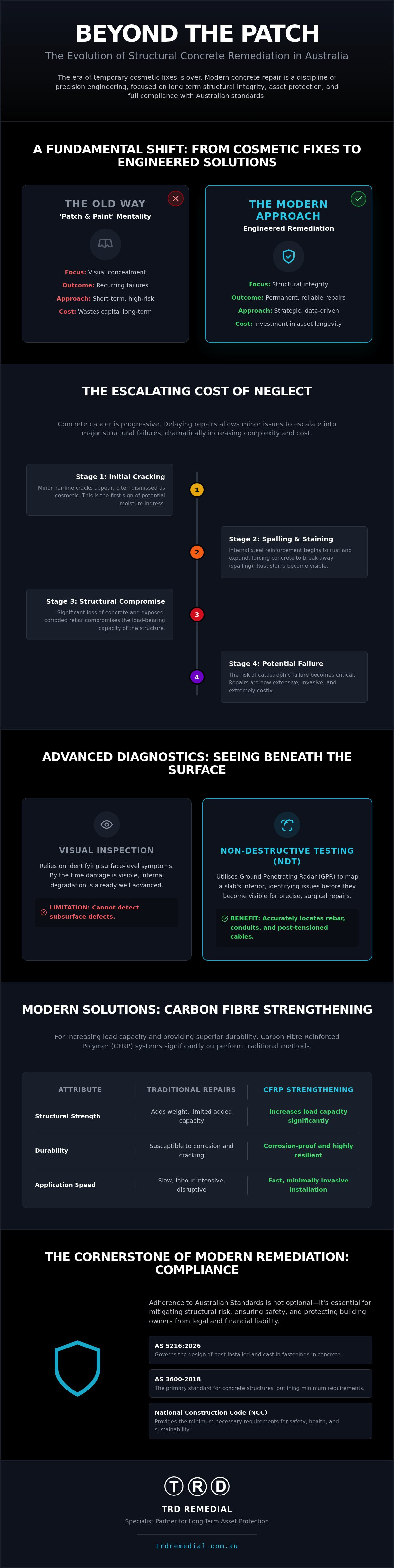
Concrete repair is the process of restoring the structural integrity and aesthetic appearance of a concrete surface. Historically, the industry was dominated by a "patch and paint" mentality that prioritised short-term visual concealment over long-term structural health. In 2026, this approach is no longer acceptable for professional asset managers. Modern concrete repairs have shifted toward engineered interventions that address the fundamental causes of concrete degradation, such as chloride contamination and carbonation. This evolution reflects a broader economic trend where remedial work is viewed as a strategic investment in asset longevity rather than a burdensome maintenance cost. By addressing the root cause of failure, specialists can ensure that a structure remains safe and functional for its entire intended service life.
Understanding the Cost of Delay
Procrastination in structural maintenance is a high-risk financial strategy. Concrete cancer is progressive and relentless. What starts as a minor hairline crack can quickly escalate into widespread spalling as internal reinforcing steel oxidises and expands. This process compromises the load-bearing capacity of the element and increases the complexity of the eventual fix. By 2026, property valuations are increasingly influenced by documented structural health. Investors and insurers now demand evidence of proactive maintenance to mitigate risk. Transitioning from reactive fixes to strategic concrete remediation allows owners to stabilise their assets before the damage becomes catastrophic. Early intervention typically saves significant capital by preventing the need for invasive, large-scale reconstruction or controlled demolition.
The Role of Compliance in 2026
Compliance has become the cornerstone of remedial engineering in the current landscape. Stricter adherence to Australian building codes, specifically AS 3600-2018 and the National Construction Code (NCC), is now mandatory for all remedial works. Professional certification in concrete repairs protects building owners from significant legal and financial liability. In the commercial and industrial sectors, there is a disciplined focus on engineered solutions that provide verifiable results. This shift ensures that every intervention, from crack injection to structural strengthening, is backed by technical mastery rather than guesswork. Engaging a specialised contractor who understands these regulatory frameworks is essential for ensuring that repairs are not only effective but also fully compliant with modern safety standards. This rigorous approach to compliance minimises the risk of "cowboy" repairs that fail to meet the structural demands of high-density or high-traffic environments.
Advanced Diagnostics: From Visual Inspection to Slab Scanning
Visual assessments are no longer the gold standard for structural reporting. While a seasoned eye can spot surface spalling or rust staining, these symptoms only appear once internal degradation is well advanced. Relying solely on what you can see is a high-risk strategy that leads to inaccurate quoting and scope creep. The industry has moved toward Non-Destructive Testing (NDT) to provide a transparent, data-backed view of a structure’s internal condition. This shift ensures that concrete repairs are based on physical reality rather than assumptions. By identifying problems before they manifest as surface failures, asset managers can intervene while the solution is still cost-effective.
The Power of Slab Scanning
Slab scanning using Ground Penetrating Radar (GPR) is the most critical tool in a modern remedial arsenal. It allows technicians to locate reinforcement bars, conduits, and voids without breaking the surface. This technology is particularly vital when dealing with post-tensioned (PT) slabs. Accidental damage to a PT cable during repair or alteration can lead to immediate structural failure and significant safety hazards. By mapping the subsurface environment, we can execute surgical interventions that avoid critical infrastructure. This precision doesn't just improve safety; it reduces project timelines by eliminating the guesswork associated with traditional "break and find" methods. If your project involves concrete cutting or core drilling, a comprehensive scan is your first line of defence against unforeseen structural damage.
Data-Driven Remedial Methodology
Effective structural remediation relies on predictive data rather than reactive patching. We use core drilling to extract samples for laboratory analysis, which confirms the exact depth of carbonation and chloride penetration. This level of detail allows us to determine if the surrounding concrete is still "passivated" or if it is actively contributing to the corrosion of the steel reinforcement. When you understand the chemical state of the slab, you can design a repair that lasts decades instead of years. This data-driven approach is the only way to guarantee a return on investment for large-scale concrete repairs. Before committing to a scope of work, ensure your contractor has performed the necessary diagnostic slab scanning to verify the structural baseline.
Modern Remediation Trends: Carbon Fibre vs. Traditional Patching
While traditional cementitious patching remains a staple for minor surface spalling, it's increasingly viewed as a secondary support method in professional concrete repairs. The industry has pivoted toward high-tensile, lightweight solutions that provide genuine structural reinforcement rather than just a cosmetic mask. This evolution is particularly evident in high-density urban environments where structural failure carries significant liability. We're seeing a move away from simply filling holes and toward restoring the monolithic integrity of the concrete element through advanced resin technologies and composite materials. For heritage buildings, this means balancing high-tech reinforcement with strict aesthetic requirements to maintain architectural history.
The Rise of Carbon Fibre Reinforced Polymer (CFRP)
The surge in carbon fibre strengthening represents a major technological leap in remedial engineering. CFRP systems offer an unmatched strength-to-weight ratio. They allow for significant structural upgrades without adding the bulk or weight associated with traditional steel plating. In many cases, these systems increase a concrete member’s load capacity by 25 to 60 percent within a matter of days. This makes carbon fibre the preferred choice for seismic upgrades and floor capacity increases. The installation requires disciplined precision. Surfaces must be meticulously prepared and the fibre bonded with high-performance adhesives to ensure long-term load transfer. It's a clean, fast-paced solution. It can save up to 50 percent on repair costs compared to traditional demolition and reconstruction.
Advanced Crack Injection Systems
Modern crack injection has moved beyond simple sealing to become a sophisticated method of structural stabilisation. Choosing the correct resin is critical. Epoxy resins are typically utilised for structural defects where high-tensile strength is required to "weld" the concrete back together, effectively restoring its monolithic nature. Conversely, polyurethane resins are the industry standard for water ingress crack repairs, particularly in deep basement shoring walls. Polyurethane is hydrophobic and flexible. This allows it to expand and seal against active water pressure. A growing trend in 2026 is curtain wall injection, where resins are pumped behind a structure to create a waterproof barrier in inaccessible areas. These systems ensure that concrete repairs address both structural stability and environmental protection.
Navigating Compliance and Structural Risk Mitigation
Engaging specialised remedial contractors is a fundamental prerequisite for effective risk management in 2026. General builders often lack the technical mastery required to execute complex concrete repairs, leading to the high-risk "cowboy" repairs frequently seen in high-rise strata. These substandard fixes often mask deeper issues, creating a false sense of security while the underlying corrosion continues. There's a clear industry trend toward independent engineering oversight on remedial sites. This ensures that every stage of the project, from surface preparation to the application of reinforcement, adheres to the original design intent and meets all regulatory benchmarks. Comprehensive documentation and "as-built" records are now essential. They provide a transparent audit trail that protects the building’s valuation and simplifies the due diligence process during future asset sales.
Safety Standards and Site Protocols
Remedial work often takes place in occupied residential or commercial buildings, making environmental control a primary concern. We prioritise the management of dust, noise, and vibration to minimise disruption to occupants. Controlled demolition techniques are utilised in sensitive zones to ensure that the removal of degraded material doesn't compromise adjacent structural elements. Adhering to strict WHS standards is non-negotiable, particularly during high-risk activities such as core holing and wall cutting. These processes require a disciplined approach to prevent accidental strikes on hidden services or structural reinforcement. Maintaining a clean, organised site is a hallmark of a professional remedial operation and a key indicator of technical precision.
The Remedial Engineer Partnership
Lasting results depend on a seamless partnership between the contractor and the remedial engineer. This collaboration ensures that the execution of concrete repairs is grounded in engineering rigor rather than guesswork. Engineers provide the diagnostic framework and material specifications, while the contractor brings the practical expertise to deliver the solution under site conditions. This relationship is particularly vital when securing repair funding. Strata committees and commercial boards rely on specialised engineering reports to justify the allocation of capital for major works. Engineered solutions are the only reliable way to mitigate structural risk and ensure that the building remains compliant with the National Construction Code. If you're managing a structural defect, ensure your project is backed by a specialist remedial contractor who values engineering led execution.
Choosing a Specialist Partner for Long-Term Asset Protection
Selecting a partner for structural remediation is a decision that dictates the future viability of your property. In 2026, the complexity of concrete repairs requires more than a generalist's touch; it demands a specialist with a multi-disciplinary service offering. A contractor who manages the entire project lifecycle, from initial slab scanning and core drilling to carbon fibre strengthening and structural alterations, provides a single point of professional accountability. This integrated approach eliminates the communication gaps that frequently occur when multiple sub-contractors are involved. It ensures that the diagnostic data gathered during the assessment phase directly informs the precision of the execution. By maintaining a national perspective on remedial works, a specialist partner can deliver consistent quality and technical mastery regardless of the project's scale or location.
What to Look for in a Remedial Quote
A professional remedial quote should serve as a transparent roadmap of the project’s technical requirements. You should look for a detailed breakdown of diagnostic findings rather than vague, lump-sum figures that hide potential scope creep. A high-quality proposal will explicitly include structural strengthening options, such as carbon fibre reinforced polymer (CFRP), when traditional patching is insufficient for the required load capacity. It must also clearly define risk management strategies and realistic timelines that account for the building's occupancy. If a contractor cannot explain the engineering logic behind their chosen methodology, they likely lack the technical rigor required to ensure long-term asset protection. Transparency in the quoting stage is the first indicator of a disciplined and reliable partner.
TRD Remedial: Engineered for Longevity
TRD Remedial operates with a disciplined authority, bringing technical precision to every structural challenge we face across Australia. Our commitment to restoring structural performance ensures that your concrete repairs are not merely temporary fixes but robust, long-term engineering solutions. We maintain a broad range of specialised capabilities, including core holing, precise wall cutting, and complex structural alterations, allowing us to handle the most demanding remedial environments. Our team excels under pressure, delivering results that comply with the most stringent Australian standards and building codes. If you are responsible for the integrity of a commercial, industrial, or high-density residential asset, contact our team for a professional assessment of your concrete assets. We focus on securing the longevity of your property through expert diagnosis and elite execution.
Securing Structural Integrity for the Next Decade
The landscape of Australian remedial engineering has fundamentally shifted. We've moved beyond the era of surface-level fixes toward a disciplined focus on asset longevity and technical mastery. By integrating advanced diagnostics like slab scanning with high-performance materials such as carbon fibre strengthening, professional contractors can now provide permanent solutions for complex building defects. These modern concrete repairs don't just hide damage; they restore the monolithic strength of the structure while ensuring full compliance with current Australian Standards.
Managing structural risk requires a partner who understands the intersection of engineering rigor and site-specific execution. Documented structural health is now a cornerstone of asset valuation; delaying intervention only increases capital expenditure and liability. It's time to transition from reactive maintenance to strategic remediation. Our team provides the specialist structural remediation and technical expertise needed to stabilise and protect your property for years to come.
Contact TRD Remedial for an engineered assessment of your concrete assets. Your building deserves a solution that lasts.
Frequently Asked Questions
What is the main cause of concrete spalling in coastal structures?
Chloride-induced corrosion of the reinforcing steel is the primary driver. Salt spray and airborne chlorides penetrate the porous concrete matrix, reaching the internal steel reinforcement. Once the chloride concentration hits a critical threshold, the protective oxide layer on the steel breaks down. The resulting rust expands to several times its original volume. This internal pressure forces the concrete to crack and flake away, creating the visible symptom known as spalling.
How long do professional concrete repairs typically last?
A high-quality structural repair should provide a service life of 20 to 50 years. This longevity depends on the severity of the environmental exposure and the rigour of the initial diagnosis. By addressing the root cause of the defect, such as carbonation or chloride ingress, specialists ensure the intervention is permanent. Using advanced materials like carbon fibre and high-performance resins prevents the recurring failure often seen with cheaper, cosmetic patching methods.
Is carbon fibre strengthening better than traditional steel reinforcement?
Carbon fibre offers a superior strength-to-weight ratio and is completely non-corrosive. While steel is still used for certain applications, carbon fibre is the preferred choice for seismic upgrades and increasing load capacity. It adds minimal bulk to the structure and is significantly faster to install. This technology allows for complex structural upgrades without the heavy lifting and invasive welding associated with traditional steel plating, making it a highly efficient remedial tool.
Can I continue to use the building during concrete remediation works?
Occupants can generally remain in the building while we execute the works. We use disciplined site protocols to manage noise, dust, and vibration, ensuring that the impact on daily operations is kept to a minimum. For high-density residential or commercial assets, we often phase the project to keep essential areas accessible. Clear communication and a well-organised project plan are vital for maintaining safety and building functionality during technical concrete repairs.
What is the difference between concrete cancer and surface spalling?
Surface spalling is the physical symptom, while concrete cancer is the underlying process of reinforcement corrosion. Spalling occurs when chunks of concrete break away due to internal pressure. Concrete cancer is the chemical degradation of the internal steel caused by chloride ingress or carbonation. Addressing only the visible spalling is a temporary fix. Effective remediation must treat the corrosion at its source to prevent the cycle of degradation from continuing deep within the slab.
How much does concrete cancer repair cost on average?
Costs vary based on the depth of the corrosion and the specific engineering requirements of the site. Factors like the need for structural strengthening or specialised crack injection will influence the total investment. Because every project presents unique structural challenges, we provide professional assessments rather than generic price lists. Investing in a technical diagnosis early prevents the exponential cost increases associated with structural failure or the need to redo failed, substandard repairs.
Why is slab scanning necessary before starting concrete repairs?
Slab scanning identifies internal reinforcement, post-tension cables, and hidden conduits to prevent accidental damage during the remediation process. It provides a non-destructive view of the subsurface environment, allowing for a surgical repair methodology. Without this data, core drilling or concrete cutting carries a high risk of striking critical structural elements. Accurate scanning ensures the safety of the site and the long-term integrity of the concrete repairs by providing a clear map of the slab.
What should be included in a structural remediation report?
A comprehensive report must include a detailed diagnosis of the structural defect, backed by evidence from slab scanning or core sample testing. It should outline the proposed engineered solutions and the specific materials required, such as high-performance resins or carbon fibre systems. The report must also provide a clear risk management strategy and a timeline for execution. This documentation is essential for regulatory compliance and serves as a vital record of structural health for future asset sales.


