

A single rust stain on an exposed slab or a hairline crack in a structural column is rarely just a surface issue. These are often the visible symptoms of deep-seated chemical decay that, if left unaddressed, will lead to catastrophic repair costs and severe safety liabilities. For asset managers and strata committees, understanding the technical nuances of concrete remediation is no longer optional; it's a fundamental requirement for maintaining building safety and long-term asset value.
It's frustrating to face the uncertainty of whether a defect is merely cosmetic or a precursor to structural failure. You need a solution that goes beyond a temporary patch to address the root cause of the deterioration. This guide provides an authoritative, engineering-led framework for diagnosing defects and implementing permanent repairs that align with Australian Standards. We'll detail the precise applications of carbon fibre strengthening, the mechanics of structural crack injection, and the rigorous diagnostic protocols required to ensure your structure remains stable for decades to come.
Key Takeaways
- Understand the critical distinction between surface-level maintenance and comprehensive concrete remediation to ensure structural integrity is restored rather than masked.
- Learn how the breakdown of the protective passivity layer leads to reinforcement corrosion and why proactive intervention is essential to prevent escalating failure.
- Discover why an engineering-led diagnosis, utilising slab scanning and core drilling, is the mandatory first step before any physical repair work begins.
- Identify the physical symptoms of "Concrete Cancer" and the systematic process required to expose, treat, and stabilise corroding steel reinforcement.
- Gain insights into selecting a remedial partner based on technical mastery and proven adherence to Australian Standards to secure long-term asset longevity.
Understanding Concrete Remediation: Beyond Surface Repairs
Concrete remediation is the engineered process of restoring a structure to its original design strength and long-term durability. It is a strategic intervention. Unlike routine maintenance, which often involves aesthetic cleaning or surface-level sealing, remediation targets the fundamental structural integrity of the asset. The primary objective is structural design life extension. We don't just fix a crack; we reset the clock on the building's lifespan to ensure it remains fit for purpose for decades.
In the Australian environment, this process is critical. Our structures face aggressive environmental stressors, including high-chloride coastal air and intense urban pollution. These factors significantly accelerate the causes of concrete degradation. When the initial protective barriers of the concrete fail, the internal steel reinforcement becomes vulnerable to rapid oxidation and expansion.
The Remediation vs. Repair Distinction
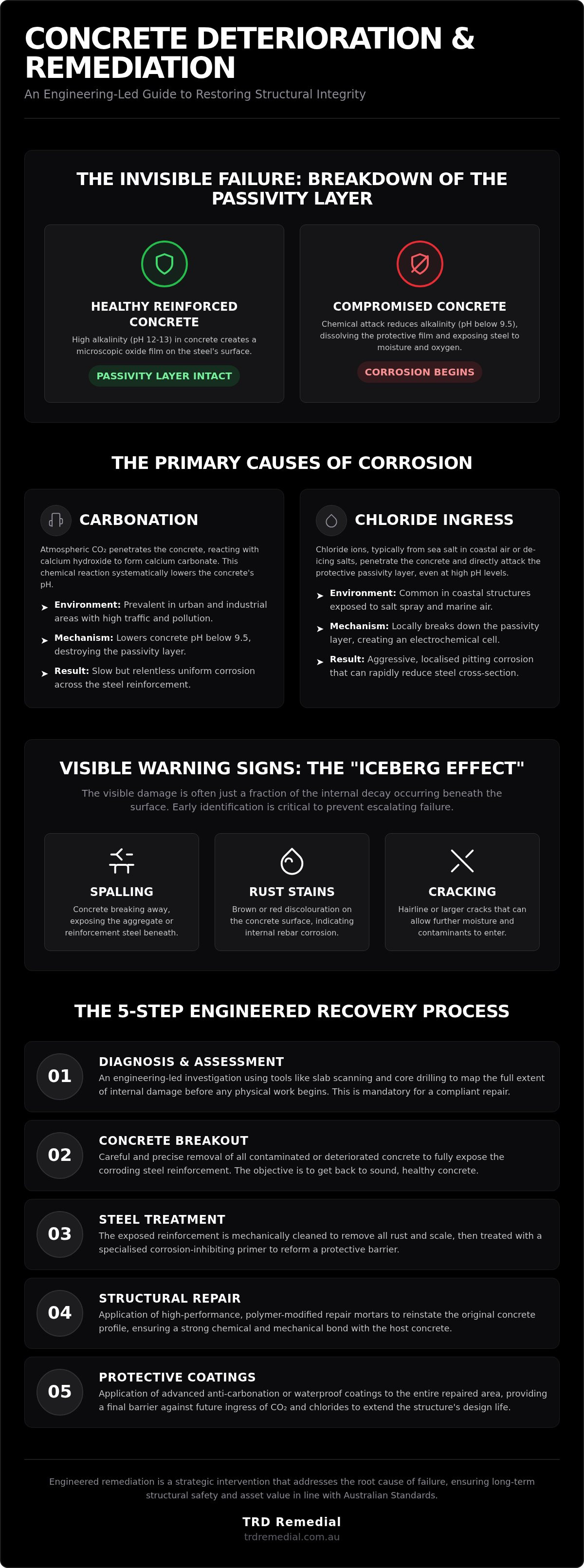
A frequent error in asset management is treating a systemic structural issue as a simple localised repair. Repairs are typically reactive and isolated. If you patch a spalled area without addressing the underlying chloride contamination or carbonation, the "iceberg effect" takes hold. The visible damage is usually just a fraction of the internal decay occurring beneath the surface.
Effective concrete remediation identifies and resolves the root cause of failure. This disciplined approach ensures that the resolution is permanent. It prevents the recurrence of defects that otherwise lead to escalating repair costs and severe safety liabilities. For commercial and strata assets, engineered remediation isn't just a choice; it's a mandatory step for regulatory compliance and risk mitigation.
Why National Standards Matter
Technical precision is anchored in strict adherence to Australian Standards. AS 3600 (Concrete Structures) provides the essential framework for durability, strength, and serviceability. A methodical approach during the diagnostic phase is vital to ensure the repair strategy is technically sound and legally compliant.
Remedial engineers are central to this process. They use precise data from slab scanning and core drilling to map the extent of internal damage before any physical work begins. This level of technical mastery allows for a targeted execution plan. It ensures that structural alterations are safe and that the final outcome meets the rigorous performance requirements of the original design. By following these standards, we provide a predictable, high-quality result that protects both the occupants and the financial value of the asset.
The Science of Deterioration: Why Reinforced Concrete Fails
Reinforced concrete is a composite material engineered for resilience. While concrete excels under compressive loads, it lacks significant tensile strength. Steel reinforcement, or rebar, is embedded within the matrix to provide this essential tensile capacity. Under normal conditions, the high alkalinity of concrete, typically a pH between 12 and 13, creates a microscopic oxide film on the steel surface. This passivity layer is the primary defence mechanism against corrosion. When this chemical shield is compromised, the structural integrity of the entire asset begins to diminish.
The breakdown of this protection is rarely accidental. It's the result of specific chemical reactions driven by the environment. Understanding The Concrete Remediation Process requires a technical grasp of how these reactions occur. Two primary chemical enemies dictate the rate of decay: carbonation and chloride ingress. If you suspect your building is showing early signs of these issues, a professional assessment of structural defects is the only way to determine the extent of the risk.
Carbonation: The Silent Threat to Urban Structures
In metropolitan and industrial areas, carbon dioxide is the principal driver of structural failure. Carbonation is the CO2-driven reduction of concrete pH that triggers steel oxidation. As CO2 from the atmosphere penetrates the concrete's pores, it reacts with calcium hydroxide to form calcium carbonate. This reaction systematically lowers the alkalinity of the concrete matrix.
Once the pH level drops below approximately 9.5, the passivity layer on the rebar dissolves. The steel is then exposed to moisture and oxygen, leading to uniform corrosion. This process is often slow but relentless. In high-traffic environments where CO2 concentrations are elevated, the depth of carbonation can reach the reinforcement far earlier than the original design intended. Effective concrete remediation in these cases involves not just patching the surface, but often applying protective coatings to halt further gas penetration.
Chloride Ingress: The Challenge for Coastal Assets
For structures located near the ocean, chloride ions present a far more aggressive threat. These salt ions migrate through the concrete via capillary action or diffusion. Unlike carbonation, which lowers the overall pH, chlorides can attack the passivity layer even while the concrete remains alkaline. This leads to pitting corrosion, a localised and highly destructive form of decay that can rapidly reduce the cross-sectional area of the steel reinforcement.
Chloride-induced damage is notoriously difficult to manage. Because the ions remain within the concrete, simply covering the area often fails to stop the reaction. Remediation for coastal assets frequently requires the removal of contaminated concrete well beyond the visible rust zones to ensure all salt-affected material is eliminated. This rigorous approach is necessary to prevent the "incipient anode effect," where new repairs inadvertently accelerate corrosion in adjacent, untreated sections.
Identifying Structural Defects: Spalling, Corrosion, and Concrete Cancer
"Concrete Cancer" is the colloquial term used to describe advanced reinforcement corrosion. It is a serious structural condition that requires immediate technical intervention. When the chemical protections discussed in previous sections fail, the steel reinforcement begins to oxidise. This process is not merely a surface issue. As the steel rusts, the resulting iron oxide expands to occupy up to seven times the volume of the original metal. This expansion exerts immense internal tensile pressure on the surrounding concrete, which possesses very little tensile strength. The result is a systematic failure of the concrete-steel bond, leading to visible distress and structural instability.
Successful concrete remediation depends on early and accurate identification of these symptoms. Asset managers must distinguish between minor cosmetic issues and high-risk structural defects. Use the following framework to categorise observed damage:
- Cosmetic Defects: Fine hairline cracks, surface-level crazing, or minor impact damage without rust staining or "drummy" sounds.
- Structural Defects: Longitudinal cracks following the line of reinforcement, rust-coloured leaching, exposed rebar, and delaminated or spalled sections.
Concrete Spalling: The Visible Warning Sign
Spalling is the actual flaking, chipping, or breaking away of concrete chunks from the main structure. It represents the final stage of internal pressure buildup. Before the concrete physically detaches, it often undergoes delamination, where an internal void forms between the steel and the concrete surface. This is often detectable by a hollow or "drummy" sound when the surface is tapped. In public or commercial environments, spalling is a critical safety hazard. Falling debris poses a direct threat to pedestrians and vehicles, creating significant liability for the building owner.
Crack Patterns and Their Meanings
Not all cracks indicate a structural failure, but every crack provides a pathway for moisture. Shrinkage cracks often occur during the initial curing process and are generally non-structural, though they still require sealing. In contrast, tension cracks or cracks appearing in high-stress zones indicate that the structure is struggling to manage its intended load. Once a crack forms, the corrosion cycle accelerates as water and contaminants reach the reinforcement more easily. In many cases, high-pressure crack injection is the first line of defence, used to stabilise the defect and restore the moisture barrier before the damage progresses to full-scale spalling.
The Remediation Process: Engineered Steps to Structural Recovery
Concrete remediation is a disciplined, multi-stage engineering workflow that replaces guesswork with technical precision. Every project must follow a sequential plan to ensure the structural integrity of the asset is restored according to Australian Standards. Skipping the diagnostic phase often leads to incomplete repairs that fail prematurely, as the root causes remain unaddressed. A successful outcome requires a methodical approach that prioritises long-term stability over quick fixes.
Phase 1: Diagnosis and Testing
Before any physical work begins, a comprehensive technical diagnosis is mandatory. We utilise non-destructive testing, specifically slab scanning, to accurately map internal reinforcement and identify subsurface voids without compromising the structure. Core drilling and carbonation depth testing follow, providing the chemical data needed to determine exactly how far the decay has progressed into the concrete matrix. This methodical approach ensures we don't under-repair the structure. It allows for a targeted intervention that addresses the full extent of the chemical decay rather than just the visible symptoms.
Phase 2: Execution and Strengthening
Once the defect boundaries are mapped, execution starts with the systematic removal of unsound concrete. This is a controlled process where the corrosion site is excavated until clean, uncorroded steel is exposed. We then treat the rebar using abrasive blasting to achieve a "white metal" finish, which is essential for the adhesion of new protective primers. For structures where the original load capacity has been significantly compromised, we implement carbon fibre strengthening. This provides a lightweight, high-tensile reinforcement solution that restores structural stability without adding significant mass to the existing framework.
A critical technical detail in the application of remedial mortars is the absolute avoidance of feather-edges. All repair zones must be saw-cut to create square "butt joints." This ensures the repair mortar has a sufficient depth at the edges to maintain long-term adhesion and prevent the perimeter from lifting or cracking under thermal stress. We conclude the process by applying high-performance, polymer-modified mortars and protective anticarbonation coatings. These layers seal the structure against future moisture and CO2 ingress. If your asset requires this level of technical mastery, our team is ready to deliver engineered concrete repairs that provide a permanent resolution to structural failure.
Strategic Asset Management: Choosing the Right Remedial Partner
Selecting a partner for concrete remediation requires a shift from general construction mindsets to specialist remedial expertise. Asset managers must prioritise technical mastery over the lowest tender price. High-risk structural alterations demand a disciplined authority who understands the physical realities of large-scale structural work. A general builder may be capable of surface repairs, but they often lack the diagnostic tools and chemical knowledge required to halt systemic decay. TRD Remedial positions itself at this intersection of engineering rigor and operational readiness, delivering engineered results that secure the long-term viability of commercial, industrial, and strata assets.
The most effective remedial outcomes are achieved through close collaboration with structural engineers. This partnership ensures that every intervention, from crack injection to structural strengthening, aligns with the original design intent and current Australian Standards. By engaging a specialist who understands the nuances of AS 3600, you ensure that the repair doesn't just mask a defect but restores the structure's intended load-bearing capacity. This professional synergy is the only way to mitigate the long-term safety liabilities associated with aging reinforced concrete.
The Importance of Specialised Equipment
Technical precision is directly linked to the quality of the equipment used on-site. Precision tools like concrete cutting and core holing are essential for remedial work because they significantly reduce vibration. Excessive vibration from standard demolition tools can cause micro-cracking in the surrounding concrete matrix, inadvertently creating new pathways for moisture ingress. In sensitive environments, controlled demolition allows for the removal of unsound sections without compromising the stability of the remaining framework.
Certain high-complexity tasks, such as post-tension truncation, require an elite level of expertise. Handling active tensioned cables is a high-risk operation that demands strict safety protocols and specialised training. Using the wrong technique can lead to catastrophic structural failure or severe injury. By employing advanced slab scanning and core drilling, a specialist contractor can map these internal elements with millimetre precision, ensuring that all alterations are executed safely and without collateral damage to the building's vital systems.
Long-Term Protection and Maintenance
A successful remediation project doesn't end when the mortar cures. To prevent the recurrence of concrete cancer, the structure requires a robust secondary line of defence. We implement protective measures such as anti-carbonation coatings and silane sealants to create a breathable yet impermeable barrier against CO2 and chloride ions. These coatings are specifically engineered to extend the service life of the repair and the broader asset.
Regular inspections remain the most cost-effective tool in an asset manager's arsenal. Catching a hairline crack early allows for simple interventions like resin injection before the damage evolves into expensive spalling. Proactive maintenance, supported by a disciplined remedial partner, ensures your structure remains compliant and safe for its entire design life. If you're concerned about the integrity of your building, it's time to act. Contact TRD Remedial for a professional structural assessment to secure your asset's future.
Securing the Future of Your Structural Assets
Concrete remediation is a strategic investment in the longevity and safety of your building. It isn't about hiding defects; it's about reversing the chemical processes of decay to restore the original design life. By prioritising a methodical diagnostic phase and high-precision execution, you eliminate the risk of recurring failure and escalating repair costs. The structural integrity of your asset depends on interventions that meet rigorous Australian Standards and address the specific environmental stressors of our landscape.
At TRD Remedial, we act as specialist technical contractors for commercial and industrial remediation projects. We deliver engineered solutions for complex building defects, utilising our expertise in carbon fibre strengthening and precision concrete services to stabilise and reinforce your property. Don't leave your structural security to chance with generalist repairs that only mask the symptoms of decay. Partner with TRD Remedial for Engineered Structural Solutions and ensure your asset remains a safe, high-performing investment for decades to come. Your building deserves a permanent resolution that only technical mastery can provide.
Frequently Asked Questions
What is the difference between concrete repair and concrete remediation?
Concrete repair typically addresses localised surface damage, whereas concrete remediation is a strategic engineering process designed to restore a structure's original strength and durability. While a repair might patch a single spalled area, remediation identifies and resolves the root cause of systemic failure, such as carbonation or chloride ingress. This methodical approach ensures long-term integrity and prevents the "iceberg effect" where internal decay continues beneath a superficial patch.
How much does it cost to fix concrete cancer in Australia?
The cost to resolve concrete cancer depends on the depth of reinforcement corrosion and the required remediation method. Factors such as the total area of affected concrete, the height of the structure, and the complexity of access significantly influence the final investment. Because every structural defect is unique, a precise technical assessment is necessary to determine the scope of works. Avoiding early intervention often leads to exponentially higher costs as the internal pressure from rusting steel increases.
Can I just paint over concrete spalling to stop the rust?
Painting over spalling is an ineffective cosmetic fix that fails to address the underlying chemical decay. Rusting steel reinforcement expands up to seven times its original volume, creating internal tensile pressure that will eventually force the paint and concrete to delaminate. Proper remediation requires the removal of unsound material, treatment of the rebar to a "white metal" finish, and the application of polymer-modified mortars to stop the corrosion cycle permanently.
How long does a professional concrete remediation project typically take?
Project timelines vary based on the scale of the structural defects and the specific remediation techniques employed. A typical workflow involves an initial diagnostic phase with slab scanning, followed by the systematic removal of contaminated concrete and the application of repair mortars. While minor crack injections might be completed in days, large-scale structural strengthening projects can span several weeks. A disciplined contractor provides a logical, sequential project plan to minimise downtime while ensuring compliance with Australian Standards.
Is concrete spalling a sign that my building is structurally unsafe?
Spalling is a significant indicator that the structural integrity of the asset is being compromised. While it doesn't always signal imminent collapse, it confirms that the internal reinforcement is corroding and losing its bond with the concrete. Additionally, falling concrete debris poses a severe safety liability in public or commercial spaces. Any visible spalling should be treated as an urgent priority for a professional structural assessment to mitigate long-term risk and ensure occupant safety.
What are the most common causes of concrete deterioration in coastal areas?
Coastal assets face aggressive deterioration primarily due to chloride ingress from salt-laden air. These chloride ions migrate through the concrete matrix and attack the protective passivity layer on the steel reinforcement, leading to aggressive pitting corrosion. This process is often accelerated by high humidity and frequent moisture cycles. Because salt contaminants remain within the concrete, remediation in these environments often requires more extensive material removal compared to inland structures affected only by carbonation.
Do I need a structural engineer for concrete remediation works?
Engaging a structural engineer is essential for any high-complexity remediation project. They provide the necessary technical specifications and ensure that all works comply with Australian Standards such as AS 3600. An engineer's diagnostic report, supported by slab scanning and core drilling, allows the remedial contractor to implement a targeted solution. This collaborative approach guarantees that the structural alterations are safe and that the building's load-bearing capacity is fully restored to its original design intent.
What is carbon fibre strengthening and when is it used in remediation?
Carbon fibre strengthening is an elite remedial solution used to increase the load-bearing capacity of existing structures. It involves bonding high-tensile carbon fibre reinforced polymers to the concrete surface, providing a lightweight yet incredibly strong reinforcement. This technique is typically used when the original steel reinforcement has been severely compromised by corrosion or when the building requires structural alterations to support higher loads. It's a non-invasive method that offers significant durability benefits in complex remedial environments.


