A cosmetic patch is not a structural repair; it's a mask that hides an accelerating failure. When steel reinforcement begins to oxidise, the resulting expansive forces will eventually compromise the integrity of any building. You've likely seen the bubbling paint or the falling chunks of render and felt the immediate concern for your asset's safety. It's frustrating to fund repairs only to see rust stains return because the underlying electrochemical process wasn't addressed. Professional concrete cancer repair requires more than a bucket of mortar; it demands an engineered approach to stop re-oxidation at its source.
This guide provides the technical roadmap to master the remediation process, ensuring your structure remains safe and compliant with the latest Australian Standards. You'll learn how to distinguish between superficial fixes and permanent solutions that stop the cycle of decay. We will preview the critical diagnostic steps, the precision of electrochemical stabilisation, and the advanced reinforcement techniques like carbon fibre strengthening that extend the service life of your structural assets. By following this disciplined methodology, you can ensure your project meets the rigorous requirements of AS 3600 and the updated HB 84 handbook.
Key Takeaways
- Identify how professional diagnostic techniques, including acoustic sounding and non-destructive slab scanning, reveal the true extent of subsurface delamination.
- Master the engineered stages of concrete cancer repair, from the precise breakout of contaminated material to the mechanical cleaning and priming of reinforcing steel.
- Learn when traditional patching is insufficient and why carbon fibre strengthening serves as the elite solution for restoring sectional area and load-bearing capacity.
- Understand the critical role of AS 3600 and the HB 84 handbook in ensuring all remediation works meet rigorous Australian building standards and safety requirements.
- Discover how integrating high-performance waterproofing and anti-carbonation coatings prevents future water ingress to significantly extend the service life of your asset.
Understanding Concrete Cancer and the Mechanics of Spalling
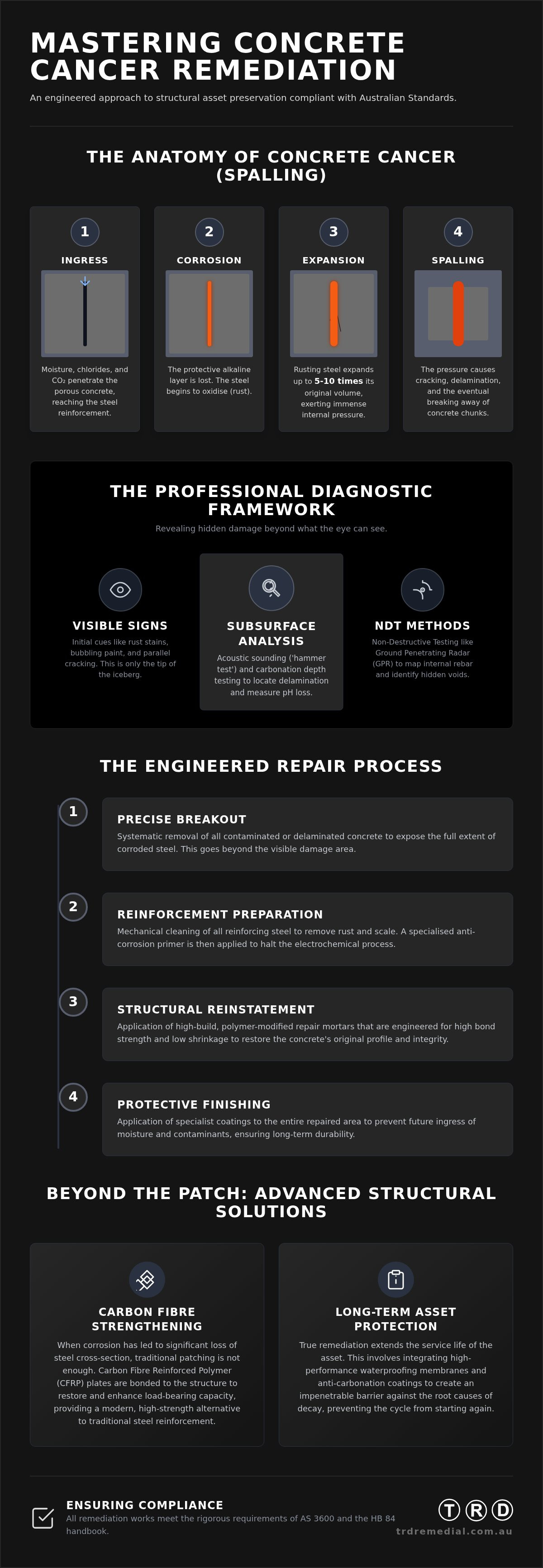
Concrete cancer is the colloquial term for the electrochemical oxidation of reinforcing steel within a concrete matrix. While concrete is naturally alkaline, providing a protective passivating layer around the steel, environmental factors eventually erode this defence. Once the steel loses this protection, it begins to corrode. This isn't a passive process. As the steel rusts, it expands to between five and ten times its original volume. This internal expansion exerts immense tensile pressure from within the slab, leading to fractures, delamination, and eventually, the ejection of concrete chunks known as spalling.
The spalling cycle is a self-accelerating failure. Initial micro-cracks allow moisture, oxygen, and contaminants to penetrate deeper into the structure. This creates a feedback loop where each new fracture provides a high-speed motorway for further corrosion. Without professional concrete cancer repair, the structural integrity of the asset will continue to degrade until it poses a significant safety risk to occupants and the public.
The Chemistry of Concrete Degradation
Two primary chemical mechanisms drive this decay: carbonation and chloride ingress. Carbonation occurs when atmospheric carbon dioxide reacts with the calcium hydroxide in the concrete, lowering its pH level. Once the pH drops below approximately 9, the steel is depassivated and becomes vulnerable. In coastal regions, chloride ingress is the dominant threat. Airborne salts penetrate the porous concrete, attacking the steel directly even if the pH remains high. Another complex internal factor is the Alkali-Silica Reaction (ASR), which causes internal swelling and further map-cracking. We use the term cancer because the condition is progressive and spreads through the reinforcement network if left untreated.
Visible Signs vs. Internal Structural Damage
Identifying the need for concrete cancer repair often starts with visual cues, but these are rarely the full story. Surface indicators include tea staining and rust streaks, which indicate active corrosion. You might also notice parallel cracking that follows the exact grid of the internal reinforcement. Sometimes, render or coatings detach from the substrate due to internal pressure before the concrete itself fails. Visible spalling is typically the tip of the iceberg. For every square metre of visible damage, there is often significantly more delaminated concrete that hasn't yet fallen. Relying on visual inspections alone is a dangerous strategy for asset management because the most critical damage remains hidden beneath the surface.
The Professional Diagnostic Framework: Identifying Structural Defects
Effective remediation begins with a rigorous diagnostic phase. Guesswork has no place in structural engineering; we rely on empirical data to define the scope of concrete cancer repair. While surface symptoms provide a starting point, understanding the science of concrete cancer requires looking deep into the matrix to identify the root cause of the failure. A comprehensive structural report is the only way to ensure the repair strategy addresses the underlying electrochemical instability rather than just the visible spalling.
Acoustic sounding remains a fundamental tool in the diagnostic arsenal. By performing a "hammer test" across the surface, technicians identify hollow or "drummy" zones that indicate subsurface delamination. These areas sound different because the concrete has already detached from the reinforcing steel, even if it hasn't yet fallen. We complement this with carbonation depth testing. By applying a phenolphthalein indicator to a freshly fractured concrete sample, we can measure the exact depth to which the alkalinity has been lost. If the carbonation front has reached the steel, depassivation is certain, and corrosion is active.
Non-Destructive Testing (NDT) Methods
Modern diagnostics rely heavily on Ground Penetrating Radar (GPR) and cover meter surveys. GPR is essential for locating reinforcement depth and identifying hidden voids or conduit runs within the slab. This prevents accidental strikes to post-tension cables or electrical services during the breakout phase. Cover meter surveys allow us to assess the thickness of the concrete "cover" protecting the steel. Slab scanning serves as the primary line of defence in technical remediation, providing a non-invasive map of the structural interior before a single hammer is swung. For complex assets, utilising professional slab scanning services ensures that the repair plan is based on accurate, real-world data.
Assessing Structural Integrity
The diagnostic framework must distinguish between aesthetic spalling and load-bearing failure. While a small corner of a balcony might be a localized issue, widespread cracking in a primary support beam suggests a loss of sectional area in the steel. When the corrosion is severe enough to compromise the original design capacity, we involve a remedial engineer to calculate the necessary upgrades. We also look for "unvented" moisture traps. Basements and underground car parks are notorious for high humidity and poor ventilation, which accelerate the spalling cycle. Identifying these environmental catalysts is just as important as fixing the concrete itself, as it dictates the type of protective coatings and waterproofing systems required to ensure a permanent fix.
The Engineered Repair Process: Step-by-Step Remediation
Executing a concrete cancer repair is a high-precision operation that follows a strict sequence of chemical and mechanical stabilisation. A simple surface patch will fail within months because it ignores the electrochemical reality of the substrate. Professional remediation requires a deep breakout of the affected zones to reach sound concrete and clean steel. We don't just clear the visible rust. We remove the concrete until we have exposed at least 20mm of clean reinforcement behind the corrosion zone. This ensures the new repair material can fully "key" into the structure and provide a complete passivating environment.
Steel Reinforcement Stabilisation
Once the steel is exposed, we perform mechanical cleaning using abrasive blasting or high-speed wire brushing to achieve a "bright metal" finish. This removes every trace of oxide. If the corrosion has reduced the bar's sectional area by more than 20%, we perform reinforcement replacement. This involves "lapping" new steel bars alongside the existing ones, secured according to engineered specifications. We then apply a zinc-rich, anti-corrosion primer to the steel. This coating acts as a secondary barrier, breaking the rust cycle and protecting the metal during the reinstatement phase.
Cathodic Protection and Reinstatement
A critical risk in any repair is the "incipient anode effect." This occurs when the new, highly alkaline repair patch creates a voltage differential with the surrounding, carbonated concrete, actually accelerating corrosion in the adjacent areas. To prevent this, we install sacrificial zinc anodes within the repair zone. These anodes corrode in place of the steel, providing long-term electrochemical protection. We then reinstate the structure using high-build, polymer-modified mortars. These materials are specifically engineered for low shrinkage and high bond strength, often applied over an epoxy bonding agent to ensure the patch becomes an integral part of the original slab.
Application of Remedial Mortars
The choice of application method depends on the volume and orientation of the repair. For smaller, overhead sections, hand-applied mortars are often the most precise. For large-scale structural reinstatement, we use poured micro-concretes or "gunite" spray systems. Every application follows a strict curing protocol. This often involves the use of curing compounds or wet-burlap covers to prevent rapid moisture loss. Proper curing is non-negotiable. Without it, the new repair will develop shrinkage cracks, inviting water ingress and restarting the spalling cycle. For high-risk assets, utilising an engineered solution is the only way to ensure the long-term viability of the repair.
Beyond the Patch: Structural Strengthening and Crack Injection
Standard concrete cancer repair focuses on stabilisation and reinstatement. However, when corrosion reduces the cross-sectional area of reinforcing steel by more than 20%, the structural capacity of the member is fundamentally altered. In these scenarios, a simple mortar patch restores the appearance but fails to restore the load-bearing performance. We must then look toward engineered strengthening solutions to ensure the asset meets modern safety requirements and remains fit for purpose. Relying on a cosmetic fix for a structural deficiency is a risk that asset managers cannot afford to take.
Carbon Fibre Reinforcement (CFRP)
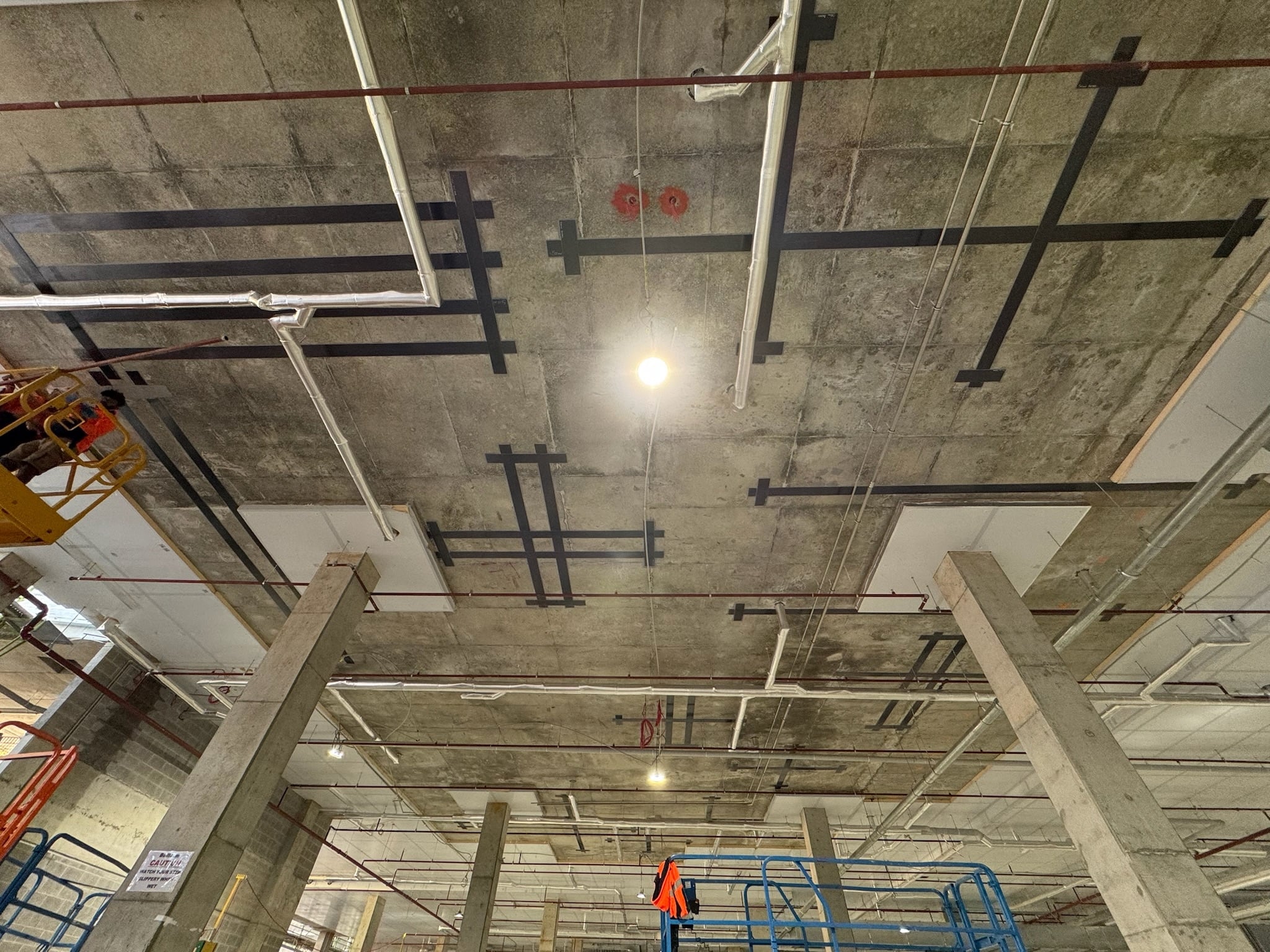
Carbon fibre strengthening has emerged as the elite alternative to traditional steel plate bonding. It's particularly effective in car parks and multi-storey commercial assets where adding significant weight is not an option. CFRP strips provide a weight-to-strength ratio that far exceeds steel; they are non-corrosive and require minimal clearance. Successful installation depends on absolute precision. We prepare the concrete substrate to a specific surface profile before saturating the carbon fabric with high-performance structural resins. This creates a composite material that effectively takes over the tensile loads from the degraded internal steel. For high-load areas or structures undergoing a change of use, this is the most reliable method for ensuring long-term stability without the bulk of traditional methods.
Technical Injection Systems
Sealing the entry path for moisture is the most effective way to prevent recurring structural defects. We use high-pressure crack injection to treat fractures that haven't yet reached the spalling stage. This prevents the initial moisture ingress that triggers the "spalling cycle" discussed earlier.
- Structural Epoxy Injection: This process "welds" cracked concrete back together, restoring the monolithic integrity of the slab. It's used for dry cracks where structural continuity is the primary goal.
- Polyurethane Curtain Wall Injection: This is a specialised technique for stopping active water ingress in basements and retaining walls. It creates a flexible, waterproof barrier behind the structure, effectively shutting off the water source.
Injection doesn't just fix a leak; it prevents the electrochemical process of concrete cancer by excluding the oxygen and moisture necessary for rust. It acts as a preventative shield for the reinforcement grid.
Comparing remediation methods requires a focus on longevity. Basic patching might address the immediate symptom, but advanced strengthening and injection address the root structural vulnerability. While the initial investment for these technical systems is higher, they provide a permanent solution that stops the cycle of re-oxidation and structural decay. If your asset shows signs of deep structural cracking or significant steel loss, you require an engineered structural strengthening solution rather than a cosmetic fix.
Mitigation Strategies: Protecting Your Asset Post-Repair
Completing a high-precision concrete cancer repair is only the first phase of an effective asset management strategy. The environment that triggered the initial decay remains hostile; without secondary defences, the cycle of carbonation and chloride ingress will eventually resume. We view remediation as a holistic process that extends beyond the patch. Implementing a robust mitigation strategy is the only way to ensure the long-term viability of the structural works and to protect the capital value of the asset. A failure to address the building envelope often leads to the recurrence of spalling in adjacent, untreated areas.
Surface Protection and Waterproofing
Protective coatings serve as the final line of defence against atmospheric contaminants. We apply specialised anticarbonation paints that block the ingress of carbon dioxide while remaining vapour-permeable, allowing the concrete to release internal moisture without blistering the finish. For coastal infrastructure, chloride ion screens and silane sealers are essential. These penetrative treatments create a hydrophobic barrier that repels salt-laden water at the surface level. Joint remediation is equally critical. We ensure that all moving joints are correctly sealed to prevent water from bypassing the protective envelope. A holistic building envelope strategy reduces long-term repair costs by maintaining the electrochemical stability of the entire substrate.
The TRD Remedial Approach to Longevity
A "set and forget" mentality is a significant risk for remedial works. Concrete structures require ongoing maintenance schedules to identify new cracks or coating failures before they escalate into structural defects. Selecting a remedial contractor requires a focus on engineering expertise rather than general building experience. While a general builder might understand the aesthetics of a patch, a specialist understands the chemistry of the bond and the physics of the load. This distinction is what separates a temporary fix from a permanent structural solution.
Our approach is rooted in safety, technical precision, and absolute compliance with Australian Standards. We provide engineered solutions designed to extend the service life of commercial, industrial, and residential assets across the country. We don't just fix the symptom; we stabilise the structure and fortify the exterior against future failure. If you are managing an asset with signs of degradation, contact our technical team at TRD Remedial for a comprehensive structural assessment and a definitive remediation plan.
Securing the Future of Your Structural Assets
Structural integrity isn't a matter of chance; it's a result of disciplined engineering and technical precision. A permanent fix requires moving beyond the surface to address the electrochemical instability of the concrete matrix. Utilising advanced diagnostics like slab scanning and implementing rigorous repair protocols allows you to halt the spalling cycle and restore the design capacity of your building. A successful concrete cancer repair project is defined by its ability to stop re-oxidation and extend the asset's service life through high-performance coatings and waterproofing.
TRD Remedial operates as a specialist structural remediation contractor, delivering engineered solutions for complex building defects on a national scale. Our expertise in commercial and industrial projects ensures your asset meets the highest Australian compliance standards. Secure your structure with TRD Remedial’s engineered solutions today. Taking decisive action now protects your investment and ensures the long-term safety of your structural assets for decades to come.
Frequently Asked Questions
How do I know if I have concrete cancer or just a surface crack?
Surface cracks are often localised and shallow. Concrete cancer presents with rust stains, "tea staining," or parallel cracking following reinforcement lines. Professional diagnosis using acoustic sounding or slab scanning is required to confirm if the steel is oxidising. If the crack reveals rusted metal or causes the concrete to flake off in chunks, it's a structural defect rather than a cosmetic issue. You should seek an expert assessment immediately.
Can concrete cancer be fixed permanently, or will it always come back?
Permanent remediation is achievable through an engineered approach rather than a simple patch. A successful fix requires removing contaminated concrete, cleaning the steel to a bright metal finish, and installing sacrificial anodes to prevent the incipient anode effect. When combined with high-performance anti-carbonation coatings and proper waterproofing, the repair stops the electrochemical process of re-oxidation. This technical methodology ensures the long-term viability of the structural asset.
Is it safe to live or work in a building with visible concrete spalling?
Visible spalling indicates that the internal reinforcement has already expanded enough to fracture the concrete. While the structure might not collapse immediately, falling debris poses a significant safety risk to occupants and the public. Exposed steel corrodes at an accelerated rate, leading to a rapid loss of sectional area. You should commission a structural assessment immediately to determine if the load-bearing capacity has been compromised or if temporary shoring is required.
What is the average cost of concrete cancer repair in Australia?
Project costs vary significantly based on the severity of the damage, site access, and the specific technical requirements of the remediation. Minor localised repairs are less intensive than moderate facade remediation or severe structural reinforcement. Factors such as the need for scaffolding, rope access, or specialised materials like carbon fibre also influence the final investment. We recommend a professional diagnosis to establish a precise scope of work and a detailed engineered solution.
How long does a typical structural remediation project take to complete?
The duration depends on the scale of the structural defects and environmental conditions. A small residential balcony repair might take several days, while a large-scale commercial car park remediation could span several weeks or months. The process includes stages for breakout, steel treatment, anode installation, and mortar curing. Proper curing protocols are essential for bond strength and cannot be rushed without risking shrinkage cracks and future water ingress.
Does carbon fibre strengthening replace the need for traditional concrete repair?
No, carbon fibre is a supplementary strengthening system rather than a replacement for basic repair. You must first treat the underlying concrete cancer by stabilising the corroded steel and reinstating the concrete matrix. Carbon fibre reinforcement (CFRP) is then applied to restore or increase the load-bearing capacity where significant steel loss has occurred. It's an elite solution for high-load areas that provides a superior weight-to-strength ratio compared to traditional steel plates.
Why does concrete cancer happen more frequently in coastal properties?
Coastal environments subject buildings to high concentrations of airborne chlorides. These salts penetrate the porous concrete matrix and attack the reinforcing steel directly, even if the concrete's alkalinity remains high. This process, known as chloride ingress, triggers rapid electrochemical oxidation. Properties within five kilometres of the ocean are at the highest risk. These assets require robust chloride ion screens and silane sealers as part of a comprehensive mitigation strategy.
What happens if I delay concrete cancer repairs for another year?
Delaying concrete cancer repair allows the spalling cycle to accelerate. What begins as a minor rust stain will evolve into significant delamination and structural weakening as moisture reaches deeper into the reinforcement grid. Over twelve months, the cost of remediation can increase substantially as the volume of contaminated concrete grows and the steel loses more sectional area. Proactive intervention is the only way to prevent a localised defect from becoming a full-scale structural failure.