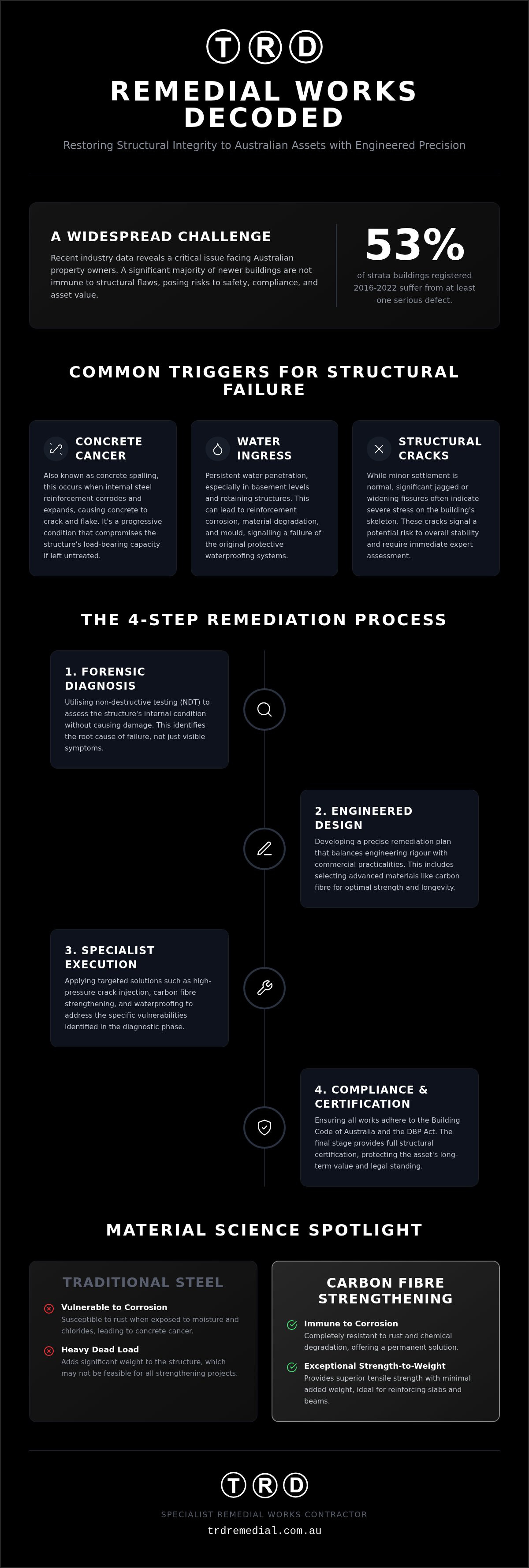
Did you know that recent industry data revealed 53% of strata buildings registered between 2016 and 2022 suffer from at least one serious defect? For many asset managers and owners corporations, this isn't just a statistic; it's a constant threat of budget blowouts and structural instability. Effectively addressing these issues requires more than a superficial patch. It demands specialised remedial works that integrate diagnostic technology with high-tensile material science.
You likely understand the frustration of navigating complex building regulations while fearing that today's repair won't stop tomorrow's concrete cancer. We agree that structural safety is non-negotiable and requires a methodical, safety-first approach. This article demonstrates how professional remedial works restore structural integrity, ensure compliance, and protect your asset’s long-term value through engineered precision. We'll explore the technical precision of carbon fibre strengthening, the necessity of accurate slab scanning, and the path to achieving full structural certification under the Building Code of Australia.
Key Takeaways
- Understand why forensic engineering and non-destructive testing are the non-negotiable first steps in identifying the root cause of structural failure.
- Navigate the complexities of the Design and Building Practitioners (DBP) Act to ensure every stage of your project remains compliant with current Australian regulations.
- Learn how high-tensile material science, such as carbon fibre strengthening, provides a permanent solution for restoring compromised load-bearing capacity.
- Discover the strategic advantages of engaging a specialist contractor for remedial works to prevent recurring defects and protect your financial investment.
- Evaluate a practical case study that illustrates the successful restoration of a major commercial asset through methodical, engineered intervention.
Remedial Works: Restoring Structural Integrity to Australian Assets
In the Australian engineering landscape, remedial works represent a high-level technical response to structural failure. It's not a cosmetic exercise. Research indicates that 70% of Australian homes and a significant portion of commercial assets suffer from at least one building defect, making professional intervention a necessity rather than an option. While general maintenance involves routine upkeep like painting or cleaning, remedial intervention is a form of remedial action designed to correct fundamental defects. It's the difference between a surface-level fix and an engineered solution that ensures a building remains safe and compliant with the Building Code of Australia. Failing to act on these issues doesn't just risk safety; it leads to rapid asset depreciation and potential legal liability.
Several triggers necessitate these works. Concrete cancer, persistent water ingress, and structural movement are the most frequent culprits. When these issues emerge, they indicate that the building's original protective systems have failed. Precise intervention is the only way to stop the decay and restore the structure to its intended strength.
Identifying Structural Defects in Commercial Infrastructure
Concrete spalling, commonly known as concrete cancer, is a primary concern for ageing Australian assets. It occurs when the internal steel reinforcement corrodes and expands, forcing the concrete to crack and flake away. It's a progressive condition. If you ignore the initial signs, the corrosion spreads, eventually compromising the slab's load-bearing capacity. You must distinguish between structural cracks and non-structural settlement. While minor settlement is common, jagged or widening fissures often signal a significant risk to the building's skeleton. Environmental factors like coastal salt air and industrial pollutants accelerate this deterioration, making regular inspections essential for early detection.
The Scope of Remedial Building Services
Modern remedial works encompass a broad range of technical services tailored to specific structural failures. These aren't standard building tasks; they require specialised engineering knowledge. Key services include:
- Crack Injection: Using high-pressure resins to seal fissures and prevent further moisture penetration.
- Structural Strengthening: Enhancing the load-bearing capacity of beams and slabs, often through carbon fibre application.
- Water Ingress Solutions: Utilising curtain wall and shoring wall injection to stop leaks in basement levels and retaining structures.
- Structural Alterations: Executing precise modifications through core drilling and wall cutting without compromising the surrounding integrity.
Each of these services addresses a specific vulnerability. By applying these engineered methods, contractors can stabilise a building, extend its lifespan, and ensure it meets modern safety standards. This methodical approach ensures that the root cause of the defect is addressed, rather than just the visible symptoms.
The Remediation Process: From Diagnosis to Engineered Design
Successful structural recovery begins with a rigorous forensic engineering assessment. We don't rely on visual cues alone; we diagnose the underlying pathology of the structure. This initial site assessment identifies why a component failed, ensuring that the subsequent remedial works target the root cause rather than just the visible symptoms. Non-destructive testing (NDT) is the backbone of this diagnostic phase. It allows us to peer inside the concrete without causing further damage, providing a clear map of internal stresses and reinforcement layouts. Stakeholders require a remediation plan that balances engineering rigor with commercial reality, providing a clear pathway to structural certification.
Material selection involves a critical trade-off between traditional methods and advanced composites. While traditional steel reinforcement remains a staple for certain repairs, modern Concrete Restoration often favours high-tensile carbon fibre. Carbon fibre provides an exceptional strength-to-weight ratio and is immune to the corrosion that plagues steel. This makes it an ideal choice for strengthening slabs where adding significant dead weight is not an option or where environmental exposure is high. Choosing the right material at the design stage dictates the longevity of the entire project.
Slab Scanning and Diagnostic Accuracy
Precision is paramount when dealing with post-tensioned (PT) slabs. We use advanced slab scanning technology to identify the exact location of PT cables and existing reinforcement before any physical intervention occurs. This mapping is vital. A single accidental strike during concrete cutting can lead to catastrophic structural failure or life-threatening injury. Accurate diagnostics keep project budgets under control by preventing the expensive delays that occur when unforeseen internal elements are struck mid-work. It's about eliminating variables before the first tool touches the surface.
Engineered Solutions for Complex Defects
Complex defects require specialised interventions that go beyond standard building practices. Designing for structural strengthening often involves the application of carbon fibre laminates to restore or increase load-bearing capacity. For multi-level structures requiring structural alterations, we implement strict post-tension truncation protocols to maintain the tension integrity of the remaining slab. We also integrate epoxy and polyurethane injection systems for long-term crack remediation. These materials are selected for their ability to restore the monolithic nature of the concrete while sealing against future water ingress. If you're managing a site with complex structural needs, engaging a specialist remedial contractor early in the process ensures these engineered designs are executed with absolute precision.
Case Study: Structural Strengthening and Concrete Restoration in Practice
A high-stakes project involving a multi-level commercial asset illustrates the necessity of engineered precision in remedial works. The structure exhibited severe concrete spalling across several primary load-bearing columns and beams. Upon forensic inspection, we discovered that chloride-induced corrosion had reduced the cross-sectional area of the steel reinforcement by approximately 18% in critical zones. This wasn't merely a cosmetic concern. The loss of material directly threatened the building's overall structural stability and its ability to handle live loads. We didn't just patch the surface. We developed a multi-stage approach that integrated non-destructive testing, substrate stabilisation, and high-tensile reinforcement to ensure the building's future viability.
Our team initiated the process with high-resolution slab scanning to identify the exact layout of internal reinforcement and avoid any accidental strikes during the repair phase. This diagnostic accuracy allowed us to map out a surgical strategy that addressed the structural defects without causing unnecessary disruption to the building's operations. By identifying the root cause of the corrosion early, we could design a solution that prevented the recurring cycle of concrete cancer that often plagues poorly diagnosed structures.
Execution: Precision Concrete Repairs and Carbon Fibre Application
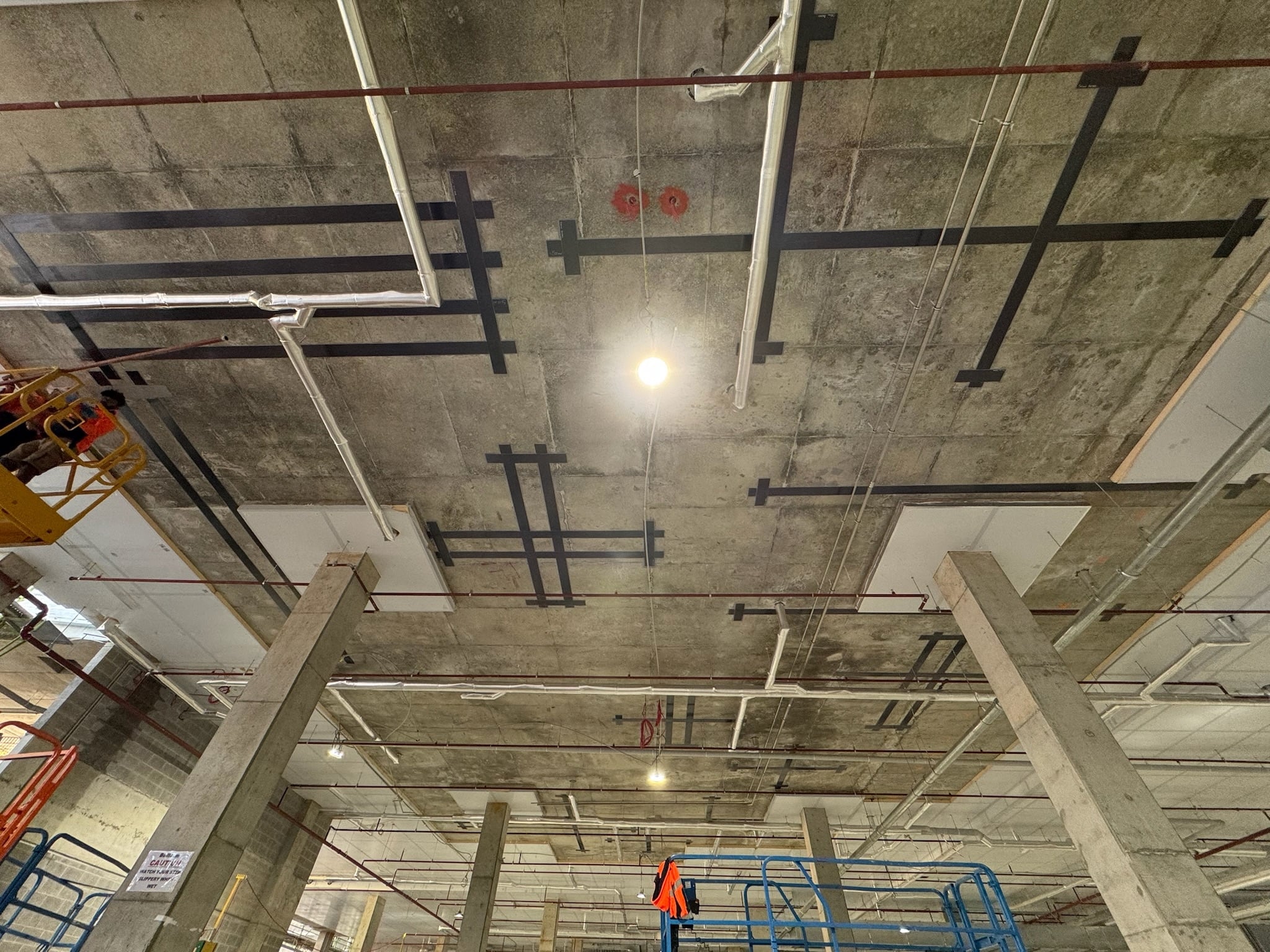
Execution began with the careful removal of all delaminated and carbonated concrete. We used controlled demolition techniques to expose the corroded reinforcement while preserving the healthy surrounding substrate. Once the steel was exposed, we treated it with high-performance zinc-rich primers to halt further oxidation and provide long-term cathodic protection. The core of the strengthening solution involved the application of carbon fibre reinforced polymer (CFRP) laminates. We applied these high-tensile strips to the tension zones of the beams, effectively restoring and exceeding the original load-bearing capacity. Every stage of these remedial works followed strict quality control measures, including bond pull-off tests and environmental monitoring, to ensure adherence to the engineer's specifications.
Outcome: Compliance and Asset Longevity
The intervention resulted in a comprehensive restoration of the building's structural integrity. Because the project was executed by registered specialists, it adhered strictly to the regulatory requirements outlined in the Design and Building Practitioners Act 2020. This compliance was essential for the building owners to secure the necessary structural certification and maintain their professional indemnity insurance coverage. The long-term benefits are substantial. The asset's lifespan has been extended significantly, and the building now meets all current safety standards. This case study proves that methodical, technical mastery is the only reliable way to manage complex structural failures in the Australian market.
Navigating Compliance: The DBP Act and Quality Assurance
The implementation of the Design and Building Practitioners (DBP) Act 2021 transformed the execution of remedial works on Class 2 buildings across Australia. Compliance is now a legal mandate that requires registered practitioners to declare that all designs and construction work adhere to the Building Code of Australia (BCA). This process involves the meticulous lodgement of Compliance Declaration and Insurance (CIRD) documents through the NSW Planning Portal. For owners corporations and strata managers, this regulatory framework offers essential protection against substandard workmanship. It ensures that every structural intervention is supported by professional indemnity insurance and verified engineering designs.
Registered practitioners act as the authoritative link between engineering theory and on-site execution. Their involvement in the remedial works lifecycle is critical for achieving structural certification. By maintaining a disciplined approach to documentation, we ensure that every stage of the project is transparent and verifiable. This level of quality assurance is vital for managing risk and protecting the long-term viability of high-density residential and commercial assets. It's about providing a clear paper trail that satisfies both regulators and insurers.
Meeting Australian Standards for Structural Repair
Every structural intervention must align with the BCA and relevant Australian Standards. We utilise forensic structural reports to certify that our remediation methods restore the building's original design intent. Longevity is not an accident. It's the result of using high-performance protective coatings and polymer-modified mortars. These materials are selected for their ability to withstand harsh environmental conditions, providing a durable shield against future concrete cancer and water ingress. These engineered barriers are essential for extending the maintenance cycle of the asset and preventing the recurrence of defects.
Safety and Controlled Demolition Protocols
Executing structural alterations like wall cutting or core drilling demands absolute precision. We implement rigorous safety protocols to mitigate risk during complex remediation phases. Controlled demolition is never a blunt force exercise. It requires a methodical understanding of structural load paths and the strategic use of temporary propping to maintain stability. We follow strict core holing and drilling standards to ensure that every penetration is accurately placed, avoiding internal reinforcement and post-tension cables. This safety-first approach prevents catastrophic failure and ensures the project remains on schedule. If you need to navigate these complex regulatory requirements, consult with our registered remedial specialists to ensure your project meets every compliance standard.
Partnering with a Specialist Remedial Works Contractor
Choosing a contractor for remedial works is a decision that dictates the long-term safety and financial value of your asset. General builders often lack the technical depth required for structural restoration. While a standard contractor might focus on aesthetics, a specialist prioritises engineering rigor and structural integrity. They understand the underlying pathology of concrete cancer and the complexities of load-bearing redistribution. This expertise is critical when dealing with high-tensile strengthening or post-tensioned slabs. You need a partner who views every project through the lens of structural certification rather than simple completion.
Evaluating a contractor’s specific experience with carbon fibre and PT slabs is non-negotiable. These materials require precise handling and specific environmental conditions to achieve their engineered strength. A specialist doesn't just apply the material; they manage the entire lifecycle from forensic scanning to final testing. Successful remediation relies on a collaborative triad between the builder, the structural engineer, and the strata manager or asset owner. This alignment ensures that diagnostic findings translate into an executable plan that satisfies both regulatory bodies and financial stakeholders. It's about ensuring the fix is permanent.
The TRD Remedial Advantage: Discipline and Authority
TRD Remedial brings a methodical, safety-first expert perspective to every site. We excel under the pressure of complex structural alterations and high-stakes remediation. Our technical mastery allows us to execute precision concrete services that general builders simply cannot match. We don't guess; we scan, verify, and reinforce using the latest industry technology. This disciplined approach ensures that every intervention is a permanent correction rather than a temporary fix. Our focus remains on technical mastery and the long-term viability of the projects we handle.
Next Steps: Securing Your Building’s Future
Initiating a remedial project begins with a comprehensive diagnostic phase. Stakeholders must be prepared for a thorough site assessment and forensic testing to establish an accurate baseline. Understanding the scope of the defect early prevents the budget blowouts associated with poor initial diagnosis. Once the engineering requirements are clear, a detailed proposal outlines the path to compliance and structural certification. Don't wait for structural defects to compromise your building's safety or compliance status. To begin your structural restoration journey, enquire about our specialist remedial works today.
Securing Structural Longevity Through Engineered Precision
Structural integrity is the foundation of asset value. We've explored how forensic diagnosis and non-destructive testing eliminate the guesswork that leads to recurring concrete cancer. Navigating the DBP Act 2021 requires a disciplined approach to documentation and engineering rigour. By integrating advanced materials like carbon fibre with precise slab scanning, we transform compromised structures into compliant, long-term assets.
Effective remedial works aren't just about fixing what's broken; they're about engineered stabilisation that withstands the test of time. As specialist structural remediation and concrete repair contractors, TRD Remedial provides the technical mastery needed for complex building defects. Our commitment to safety and precision ensures your project meets the highest Australian standards. It's about providing security for stakeholders and longevity for the structure itself.
Ready to restore your building's integrity? Request a Technical Consultation for Your Remedial Project today. We look forward to securing your asset's future through methodical engineering excellence.
Frequently Asked Questions
What exactly are remedial works in the Australian construction industry?
Remedial works refer to specialised construction and engineering activities designed to rectify structural defects or restore the integrity of an existing building. Unlike general maintenance, these works address fundamental issues like concrete cancer, structural movement, or water ingress. In Australia, this often involves engineered solutions such as carbon fibre strengthening or high-pressure crack injection. These interventions ensure the building remains safe, compliant with the Building Code of Australia, and protected against further deterioration.
How much do remedial works typically cost for a commercial building?
The cost of remedial projects varies significantly based on the severity of the structural defects and the specific engineering requirements. Factors influencing the final budget include the accessibility of the site, the extent of concrete spalling, and the volume of specialised materials like polymer-modified mortars or carbon fibre. Because every structure presents unique pathologies, a forensic engineering report is essential for establishing an accurate scope of work and preventing unexpected budget blowouts during the execution phase.
What is the difference between concrete cancer and simple concrete spalling?
Concrete spalling is the physical symptom where concrete flakes or chips away, often exposing the steel reinforcement. Concrete cancer is the underlying progressive condition caused by the oxidation of that internal steel. As the steel corrodes, it expands, creating internal pressure that forces the concrete to crack. If you don't treat the root cause through professional remedial works, the corrosion will continue to spread throughout the slab, eventually compromising its total load-bearing capacity.
How does the DBP Act affect remedial building work on Class 2 buildings?
The Design and Building Practitioners (DBP) Act 2021 mandates that remedial work on Class 2 buildings must be designed and executed by registered practitioners. This legislation requires the lodgement of regulated designs and compliance declarations on the NSW Planning Portal. It ensures that structural repairs meet stringent safety standards and are backed by professional indemnity insurance. This framework protects building owners by ensuring all interventions are verifiable and performed by qualified, accountable specialists.
Why is slab scanning necessary before commencing any concrete cutting?
Slab scanning is a non-negotiable safety requirement to identify the exact location of internal reinforcement and post-tension (PT) cables. Striking a PT cable during concrete cutting can cause immediate structural failure and poses a severe safety risk to site personnel. By using advanced ground-penetrating radar, we create a precise map of the slab's interior. This diagnostic accuracy prevents catastrophic damage and ensures that structural alterations or core drilling proceed without compromising the building's skeleton.
How long do structural strengthening works using carbon fibre usually last?
Structural strengthening using carbon fibre reinforced polymer (CFRP) is designed to last for the remaining service life of the building when installed correctly. Because carbon fibre is immune to corrosion and environmental degradation, it provides a permanent enhancement to the structure's load-bearing capacity. These high-tensile materials are bonded with specialised epoxies that maintain their integrity under significant stress. Adhering to engineered specifications during the application phase is essential for ensuring this long-term durability.
Can remedial works be carried out while the building is still occupied?
Yes, many remedial works can be performed while a building is occupied through meticulous staging and safety management. We implement strict protocols to minimise noise, dust, and vibration, ensuring minimal disruption to residents or commercial tenants. Safety exclusion zones and temporary propping are used to maintain structural stability during the repair phases. Clear communication between the contractor, strata manager, and occupants is vital for managing expectations and ensuring the project proceeds safely and efficiently.