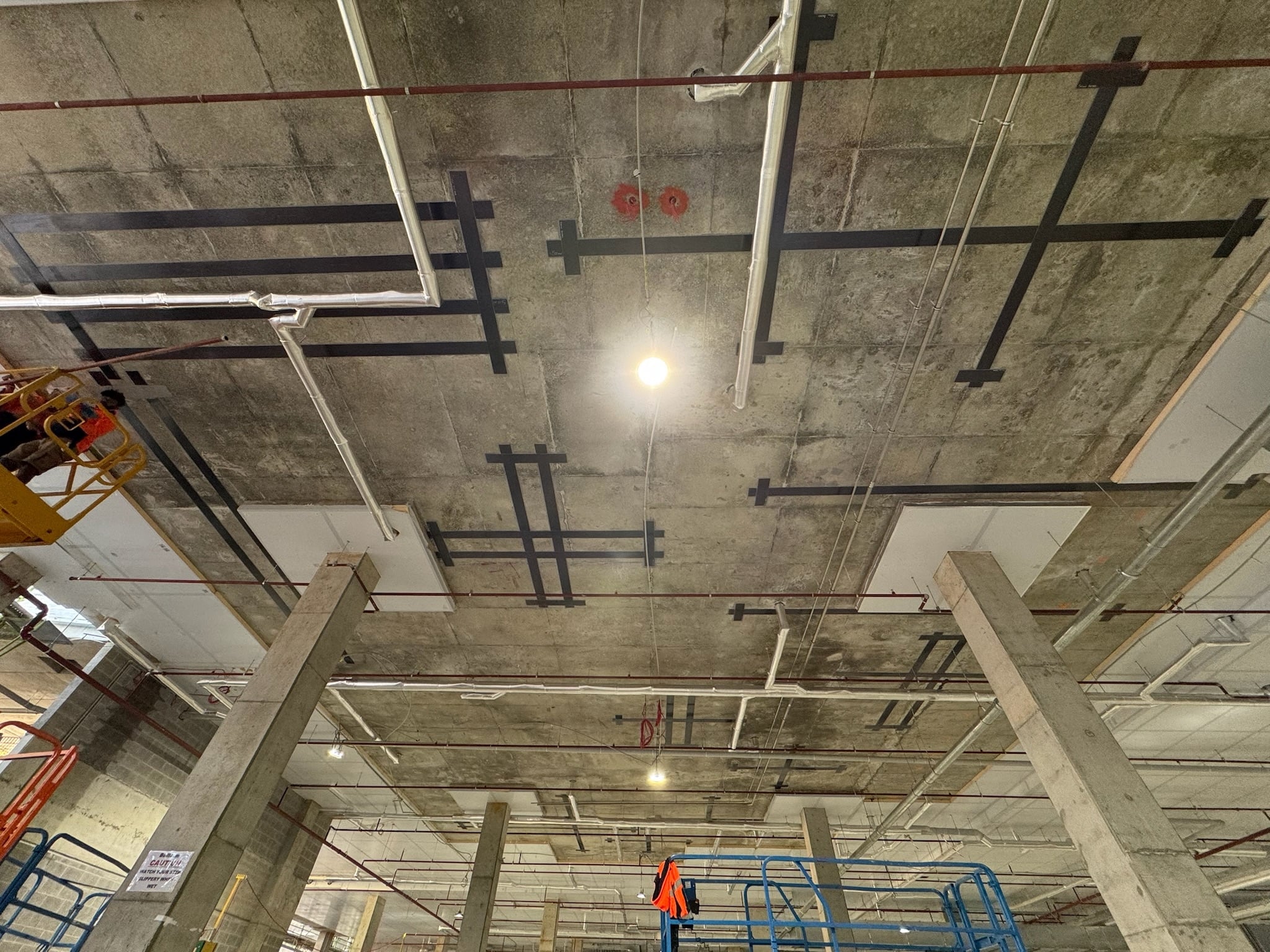
A hairline crack in a reinforced concrete slab is rarely just a surface issue; it is often the first visible symptom of a deep-seated structural failure that could compromise the entire asset. For many property owners and strata managers, the discovery of spalling or "concrete cancer" triggers immediate anxiety regarding escalating costs and the safety of the occupants. Effective remedial building requires more than a cosmetic patch. It demands a disciplined, engineering-led approach to stabilise the structure and halt deterioration at its source.
You're right to be concerned about the complexity of these repairs, especially with the stringent requirements of the NCC 2026 and the Design and Building Practitioners (DBP) Act. This guide provides the technical clarity needed to master these complexities, allowing you to identify structural risks early and ensure full compliance with Australian standards. We will detail the precision of carbon fibre strengthening, the efficacy of specialised crack injection, and how engineered restoration protects the long-term integrity and value of your assets.
Key Takeaways
- Differentiate between cosmetic maintenance and remedial building to address the underlying causes of structural decline and restore original load-bearing capacity.
- Recognise the critical indicators of concrete spalling and structural cracking to mitigate safety risks and prevent the progression of concrete cancer.
- Evaluate advanced strengthening technologies, such as carbon fibre reinforcement, to provide high-tensile stabilisation for compromised structural elements.
- Implement a disciplined remediation lifecycle that prioritises non-destructive testing and slab scanning to ensure compliance with the latest Australian building codes.
- Define the technical criteria required to select a specialist contractor capable of delivering engineered solutions for complex structural defects.
What is Remedial Building? Defining Structural Restoration
Remedial building is a specialised discipline focused on the identification and correction of structural defects within existing assets. It goes beyond the surface. While aesthetic repairs might hide a problem, remedial building identifies and rectifies the root cause of structural decline to restore an asset's original load-bearing capacity. Remedial building represents the critical intersection of engineering diagnosis and high-precision construction. Key disciplines within the sector include concrete remediation, structural strengthening, and the management of water ingress. The process aligns with the foundational principles of building restoration and conservation, ensuring the physical integrity of a structure is maintained for decades rather than just years.
Maintenance vs. Remediation: Understanding the Difference
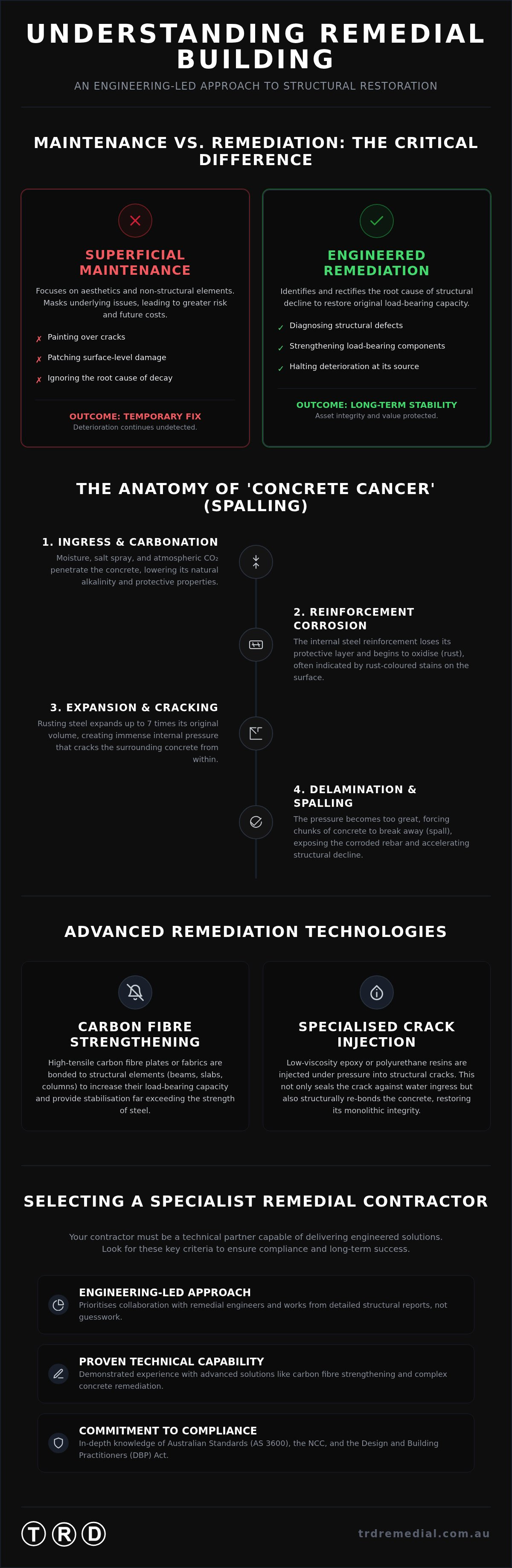
General maintenance typically involves preventative care for non-structural elements, such as painting, cleaning gutters, or replacing floor finishes. These activities focus on aesthetics and minor wear. Remediation is far more invasive. It requires a detailed diagnosis of load-bearing components like beams, columns, and suspended slabs. Applying a "patch" to a structural crack without addressing the underlying cause, such as reinforcement corrosion or foundation movement, is a temporary fix. These superficial treatments often mask ongoing deterioration. This leads to significantly higher costs and greater safety risks when the failure eventually becomes critical and requires emergency intervention.
The Role of the Remedial Engineer
Effective structural restoration depends on a collaborative partnership between specialist contractors and remedial engineers. This disciplined approach ensures that all works adhere to rigorous Australian Standards, such as AS 3600 for concrete structures, to maintain safety and compliance. The process begins with a comprehensive structural report. This document forms the basis of a compliant remediation programme, outlining the specific technical requirements for the project. Specialist contractors then execute these engineered designs, managing complex structural alterations, crack injection, or strengthening tasks that fall outside the scope of general construction. This methodical execution is essential for protecting the long-term viability of the asset.
By prioritising engineered solutions over cosmetic fixes, asset owners can mitigate the risk of cascading failures. Remedial building provides a clear path from technical uncertainty to structural stability, ensuring that every repair contributes to the overall longevity of the building's core framework.
Common Structural Defects in Australian Assets
Australian assets face unique environmental pressures that accelerate structural degradation. Coastal salt spray and urban pollution create aggressive conditions for reinforced concrete, leading to rapid deterioration if left unmanaged. In the field of remedial building, identifying these defects early is the difference between a controlled repair and a catastrophic failure. Common issues range from foundation-induced cracking to the slow, destructive cycle of water-driven corrosion. Technical precision is required to diagnose whether a defect is a surface-level nuisance or a symptom of deeper instability.
Concrete Spalling: Identifying the Signs of 'Concrete Cancer'
Concrete spalling, colloquially known as "concrete cancer," is the most prevalent structural defect in Australian urban centres. It occurs when the alkalinity of the concrete is compromised by carbonation or chloride ion ingress. This chemical shift causes the internal reinforcement steel to oxidise. Because steel expands significantly when it rusts, it exerts immense internal pressure on the surrounding concrete. This pressure eventually forces the concrete to crack and flake away. Adhering to official standards for restoration ensures that the remediation addresses the electrochemical cause, not just the surface damage.
Visual indicators of spalling include:
- Rust-coloured staining leaching through the concrete surface.
- Linear cracking that follows the direction of the internal reinforcement.
- Delamination where chunks of concrete break away to reveal corroded rebar.
Delaying repairs is a high-risk strategy. Once the process begins, it accelerates as more steel is exposed to the elements. This leads to a rapid loss of structural capacity and potential falling debris hazards in high-density areas.
Water Ingress and Joint Failure
Water is the primary catalyst for structural instability. Leaking curtain walls and porous shoring walls often compromise basement integrity, leading to the slow deterioration of the building's sub-structure. In large-scale industrial or commercial slabs, the failure of temporary moving joints can lead to significant slab curling or cracking under load. Managing these joints is critical for maintaining a flat, safe working surface. Persistent moisture doesn't just damage the concrete; it facilitates mould growth and weakens the bond between the concrete and its reinforcement. Early intervention through specialised water ingress crack repairs is essential to stabilise the environment before the damage requires more invasive structural strengthening.
Beyond environmental factors, structural cracking often results from foundation movement, thermal expansion, or historical overloading. Poorly executed structural alterations from previous renovations can also leave an asset vulnerable. These defects require a methodical approach to restoration, prioritising engineering rigor over cosmetic concealment to ensure the asset remains viable for its intended lifespan.
Advanced Remediation Technologies: Structural Strengthening Solutions
Structural strengthening is a critical requirement when an asset's load-bearing demands change or its original design capacity is compromised by age and environmental fatigue. Whether adapting a commercial space for heavier machinery or rectifying historical Common Defects in Commercial Buildings, the objective remains the same: restore stability with surgical precision. Modern remedial building leverages composite materials and high-performance resins to achieve these outcomes without the bulk and weight of traditional steel reinforcement.
Carbon Fibre Strengthening: The Modern Standard
Carbon fibre reinforced polymer (CFRP) is now the preferred solution for structural upgrades in high-density urban environments. Its primary advantage lies in its extreme tensile strength and high strength-to-weight ratio. Unlike steel plates, carbon fibre is lightweight and entirely resistant to corrosion; this makes it ideal for suspended slabs, beams, and columns exposed to moisture. The application is a disciplined process. Success depends on rigorous surface preparation. The concrete substrate must be mechanically abraded to ensure a high-strength bond. Resin application must be flawless, as any voids can lead to delamination and reduced load transfer capacity.
Crack Injection Systems: Epoxy vs. Polyurethane
Precision crack injection is the first line of defence against structural instability and water ingress. In the context of remedial building, the selection of injection media is a critical engineering decision based on the specific defect. We use high-strength epoxy resins for structural bonding in dry conditions. These resins penetrate deep into the substrate to weld the concrete together, effectively restoring the monolithic integrity of the element.
For active water leaks, polyurethane injection is the required protocol. This material reacts with water to expand and form a flexible, hydrophobic seal. This technique is indispensable for shoring wall crack injection and curtain wall repairs where constant hydrostatic pressure is present. By selecting the correct chemical formulation, we ensure the repair remains durable under thermal movement and hydraulic stress.
Modern high-rise assets often utilise post-tensioning, which adds another layer of complexity to remediation. Structural alterations frequently require post-tension truncation. Tendons must be identified through slab scanning and safely managed before any concrete cutting occurs. This prevents the uncontrolled release of energy and maintains the structural equilibrium of the floor plate. These advanced technologies allow for complex building modifications that were once considered technically unfeasible.
The Remedial Lifecycle: From Diagnosis to Structural Handover
A successful remedial building project is defined by its sequence. It isn't a collection of isolated repairs; it is a disciplined lifecycle that prioritises engineering certainty over guesswork. This methodical approach ensures that every intervention meets current Australian building standards while protecting the long-term viability of the structure. The lifecycle transitions from non-destructive diagnosis to high-precision execution, culminating in a rigorous quality assurance handover. We don't just fix symptoms. We restore structural integrity through a controlled, sequential programme.
Slab Scanning and Core Drilling Protocols
Structural safety begins with visibility. Before any concrete cutting or drilling occurs, we utilise Ground Penetrating Radar (GPR) to map the internal composition of the slab. This non-destructive testing is a non-negotiable safety step. It allows for the precise location of reinforcement steel and, crucially, post-tension cables. Damaging a live tendon during core drilling can lead to explosive energy release and immediate structural failure. By establishing clear "no-go" zones, core holing and core drilling for services can proceed without compromising the slab's integrity. Precision is the baseline requirement. This data-driven mapping eliminates the risks associated with "blind" penetrations and ensures the structural report's recommendations are followed to the millimetre.
Controlled Demolition and Structural Alterations
Executing structural alterations in occupied or sensitive environments requires surgical control. Controlled demolition is a calculated process. When building modifications involve post-tension truncation, the sequence must be managed with extreme care to maintain the structural equilibrium of the floor plate. This involves de-stressing tendons in a controlled manner before any removal occurs. Techniques like wall cutting and concrete cutting are executed only after temporary propping is installed to manage load redistribution. Site safety is maintained through these methodical demolition sequences, ensuring that the surrounding structure remains stable throughout the modification. We prioritise safety and structural stabilisation above speed.
The final phase of the lifecycle is the structural handover. This involves a comprehensive review of all repairs against the original engineering specifications. Every crack injection, carbon fibre strip, and structural reinforcement must be verified for compliance. This disciplined oversight provides asset owners with the technical assurance that the building is not only repaired but restored to its designed capacity. If you require a specialist contractor to manage the complexities of your next project, contact us for an engineered approach to remedial building services.
Selecting a Specialist Contractor for Remedial Works
Selecting the right partner is the most critical decision in the remedial lifecycle. A generalist builder typically lacks the technical depth required for high-stakes structural restoration. Remedial building is a precision engineering discipline where errors are both costly and dangerous to the public. You must seek a contractor who demonstrates a proven track record in carbon fibre strengthening and complex concrete repairs. They must operate with a commitment to Australian Standards and provide transparent, engineered results that are validated by structural reports. We don't just fill cracks; we restore the structural equilibrium of the asset.
Effective remediation depends on a collaborative triangle between the contractor, the structural engineer, and the strata manager or asset owner. The specialist contractor must act as a technical executor of the engineer's design, ensuring that every injection and reinforcement strip meets the specified tolerances. This level of coordination is what separates a successful project from a temporary fix. A disciplined contractor provides the data and quality assurance necessary to give stakeholders total confidence in the building's stability.
The TRD Remedial Approach: Disciplined Authority
TRD Remedial brings disciplined authority to every project. Our focus remains on engineered solutions for the residential, commercial, and industrial sectors nationally. We provide the accurate diagnosis required to halt structural decline and deliver lasting results. By integrating our own technical services, including slab scanning, core drilling, and wall cutting, we maintain total control over the remediation programme. This internal capability allows us to support complex structural alterations with a level of precision that generalist firms cannot match. We are unfazed by complexity and excel under the pressure of large-scale structural requirements.
Securing Your Asset's Future
Securing your asset's future requires a shift from reactive maintenance to strategic restoration. There is a significant long-term economic benefit to addressing structural issues early with a specialist. Proactive, compliant remediation prevents the exponential cost increases associated with advanced concrete cancer or cascading structural failures. It maintains property value and ensures the building remains a safe, viable asset for its entire design life. By choosing a partner who values engineering rigor, you mitigate liability and protect the long-term integrity of your investment.
Consult with TRD Remedial for your structural remediation requirements. We provide the technical expertise and disciplined execution necessary to ensure your building survives the challenges of the Australian environment and remains structurally sound for decades to come.
Securing the Long-Term Integrity of Your Structural Assets
Effective remedial building is a strategic investment in the survival of your property. We've established that addressing structural defects like concrete cancer and water ingress requires more than a superficial patch; it demands a disciplined, engineered response. By prioritising advanced technologies such as carbon fibre strengthening and precise slab scanning, you ensure your asset meets modern Australian Standards while mitigating the risk of catastrophic failure. Early intervention is the only reliable method to control costs and protect the safety of all occupants.
As specialists in carbon fibre and concrete remediation, we provide engineered solutions for the most complex building defects. Our national technical contracting services include specialised scanning, core drilling, and controlled demolition to support every phase of your project's lifecycle. You don't have to manage these technical complexities alone. Partner with the specialists at TRD Remedial for structural integrity and compliance. Taking action today ensures your asset remains a stable, high-value investment for the future.
Frequently Asked Questions
What are the first signs that a building needs remedial work?
The earliest indicators often include rust-coloured leaching on concrete surfaces, which suggests internal reinforcement corrosion. You might also notice linear cracking along the path of steel rebar or chunks of concrete beginning to delaminate and fall away. Water ingress in basements or through curtain walls is another critical sign. These issues indicate that the asset's structural equilibrium is compromised and requires immediate professional assessment to prevent further deterioration and safety risks.
How much does concrete cancer repair typically cost in Australia?
Costs vary based on the extent of the damage and the accessibility of the site. Factors like the depth of chloride ingress, the amount of steel replacement required, and the need for specialised access equipment all influence the final investment. While we don't provide generic price lists, a disciplined assessment is essential to determine the scope. Addressing these defects early is always more cost-effective than waiting for a total structural failure to occur.
What is the difference between epoxy and polyurethane crack injection?
Epoxy resins are used for structural bonding in dry cracks to restore the monolithic integrity of the concrete. It essentially welds the crack back together to restore load-bearing capacity. Polyurethane injection is a flexible solution designed to stop active water leaks. It reacts with moisture to expand and create a hydrophobic seal. Choosing the correct injection media depends on whether the goal is structural stabilisation or resolving water ingress issues in shoring walls.
Is slab scanning necessary before core drilling?
Slab scanning is a non-negotiable safety requirement before any core drilling or concrete cutting. We use Ground Penetrating Radar (GPR) to map the internal state of the slab, identifying the exact location of reinforcement and post-tension cables. Cutting a live tendon can cause explosive energy release and immediate structural failure. This non-destructive testing ensures that service installations or structural alterations proceed without compromising the safety of the building or its occupants during the works.
Can carbon fibre strengthening be used on all types of buildings?
Carbon fibre strengthening is highly versatile and suitable for residential, commercial, and industrial assets. Its high strength-to-weight ratio makes it ideal for reinforcing suspended slabs, beams, and columns where adding traditional steel would be too heavy or bulky. It is particularly effective for seismic upgrades and load-bearing capacity increases. Because it's corrosion-resistant, it's a preferred modern standard for remedial building in aggressive coastal or urban environments across the country.
How long does a typical structural remediation project take?
Project timelines are dictated by the complexity of the defects and the required remediation lifecycle. A minor crack injection programme might be completed in days, while a comprehensive structural strengthening project involving carbon fibre and controlled demolition could take several months. The process includes diagnosis, surface preparation, execution, and quality assurance. We prioritise a methodical sequence over speed to ensure all repairs meet engineering specifications and provide long-term asset longevity for the owner.
What are the risks of ignoring concrete spalling in coastal areas?
Ignoring concrete spalling in coastal environments is high-risk due to the presence of airborne chlorides. Salt spray accelerates the oxidation of reinforcement steel, causing the process to advance much faster than in inland areas. This leads to a rapid loss of load-bearing capacity and creates significant safety hazards from falling concrete debris. Delays often result in the need for more invasive structural alterations and substantially higher repair costs as the damage spreads through the asset.
Do I need a structural engineer for remedial building works?
Yes, engaging a structural engineer is essential for any remedial building project involving load-bearing elements. The engineer provides the technical diagnosis and repair specifications required to ensure compliance with Australian Standards like AS 3600. We work closely with engineers and strata managers to execute these engineered designs with precision. This collaborative approach ensures that all repairs are structurally sound and provides the necessary documentation for a compliant structural handover at the project's conclusion.