
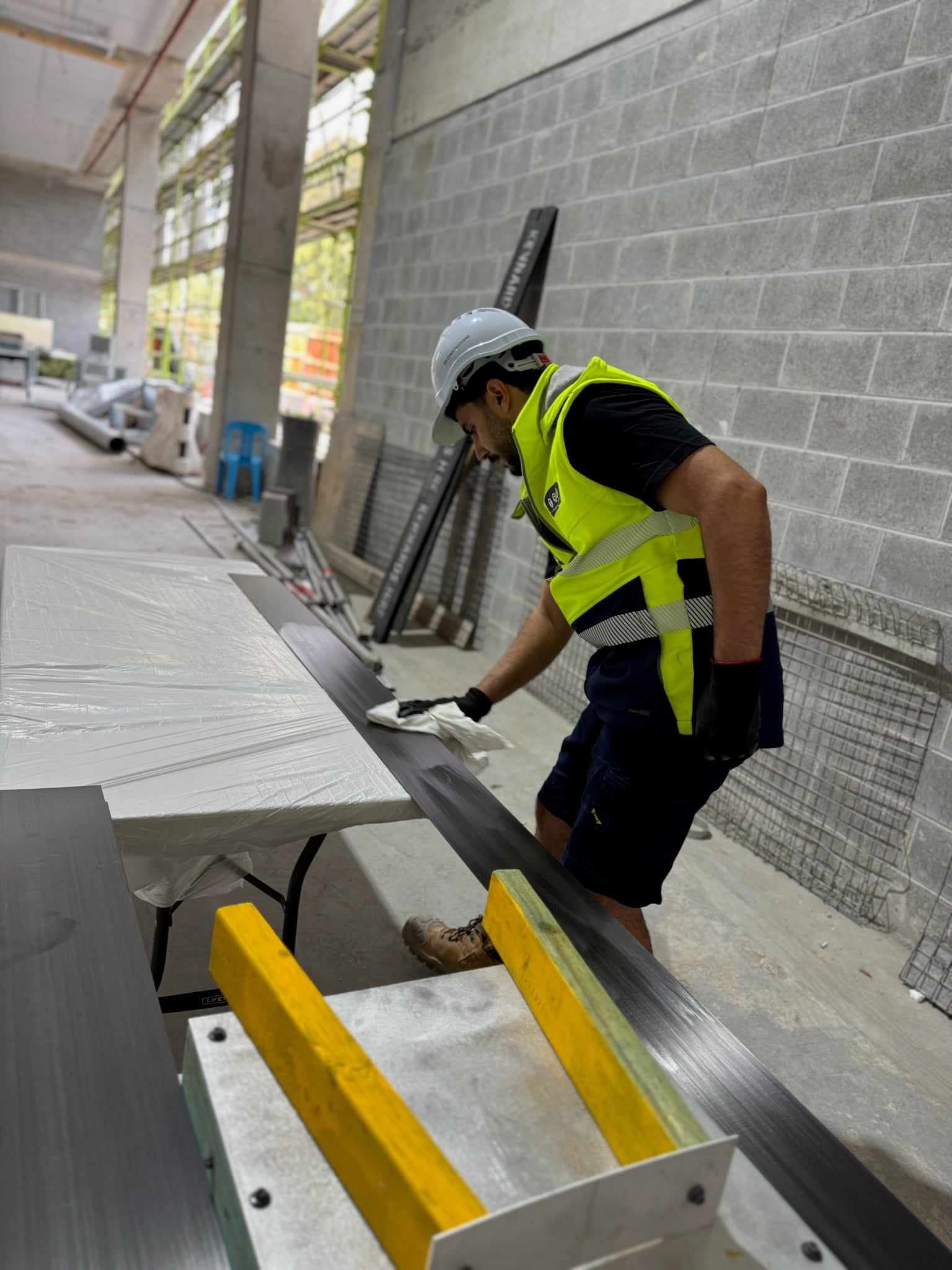
Traditional steel reinforcement is no longer the default for critical structural remediation in Australia. When an asset faces structural non-compliance or severe corrosion, the instinct to default to heavy, intrusive steel beams often leads to unnecessary weight loads and massive operational disruption. Carbon fibre strengthening has shifted this paradigm; it provides a high-tensile, non-intrusive alternative that rectifies structural defects without compromising the building's existing footprint.
You're likely facing the pressure of structural non-compliance or the threat of corrosion in your steel reinforcement. We know that massive disruption during repairs is a primary concern for any facility manager. This article explores how engineered CFRP systems provide a compliant, long-term solution for Australian commercial and industrial sectors. We'll detail the technical precision required for successful application, the critical nature of substrate preparation, and how these systems deliver maximum reinforcement with minimal facility downtime.
Key Takeaways
- Understand how carbon fibre reinforced polymer (CFRP) provides a high-tensile, lightweight alternative to traditional steel plate bonding without compromising structural integrity.
- Learn the technical distinctions between prefabricated laminates, flexible fabrics, and NSM rods to select the most effective reinforcement system for your specific project.
- Discover why carbon fibre strengthening is the preferred choice for Australian infrastructure projects where minimal disruption and weight limitations are critical operational factors.
- Identify the mandatory substrate preparation and epoxy bonding protocols required to meet Australian standards and ensure long-term structural compliance.
- Gain confidence in managing complex structural alterations by collaborating with specialist remedial contractors who prioritise engineering rigor and technical precision.
Carbon Fibre Structural Strengthening: Modern Engineering for Asset Longevity
Structural integrity is the foundation of any built asset, yet environmental factors and evolving operational demands often compromise this stability. Carbon fibre strengthening has emerged as the definitive modern solution for reinforcing structures without the weight or bulk of traditional steel. Carbon fiber reinforced polymer (CFRP) is a sophisticated composite of high-strength carbon filaments and a structural epoxy resin matrix. This system allows for precision reinforcement that bonds directly to the substrate, effectively arresting further movement and restoring load-bearing capacity.
At TRD Remedial, we operate as a disciplined authority in structural remediation. We don't view strengthening as a simple product application. It's a methodical engineering process. We collaborate closely with structural engineers to diagnose the root cause of inadequacy before selecting a reinforcement strategy. This rigorous approach ensures that every application of carbon fibre strengthening meets Australian standards and provides a permanent, compliant fix for aging concrete assets across the country.
The Mechanics of CFRP Reinforcement
CFRP acts as external reinforcement, taking up the tension and shear forces that the original structure can no longer manage. Carbon fibre delivers a tensile strength significantly higher than structural steel while remaining a fraction of the weight. By bonding these high-tensile materials to the exterior of concrete, masonry, or timber elements, we facilitate effective load redistribution. This prevents the progression of structural failure and allows the asset to handle stresses beyond its original design parameters.
When is Structural Strengthening Required?
The need for remedial intervention often arises from three primary triggers:
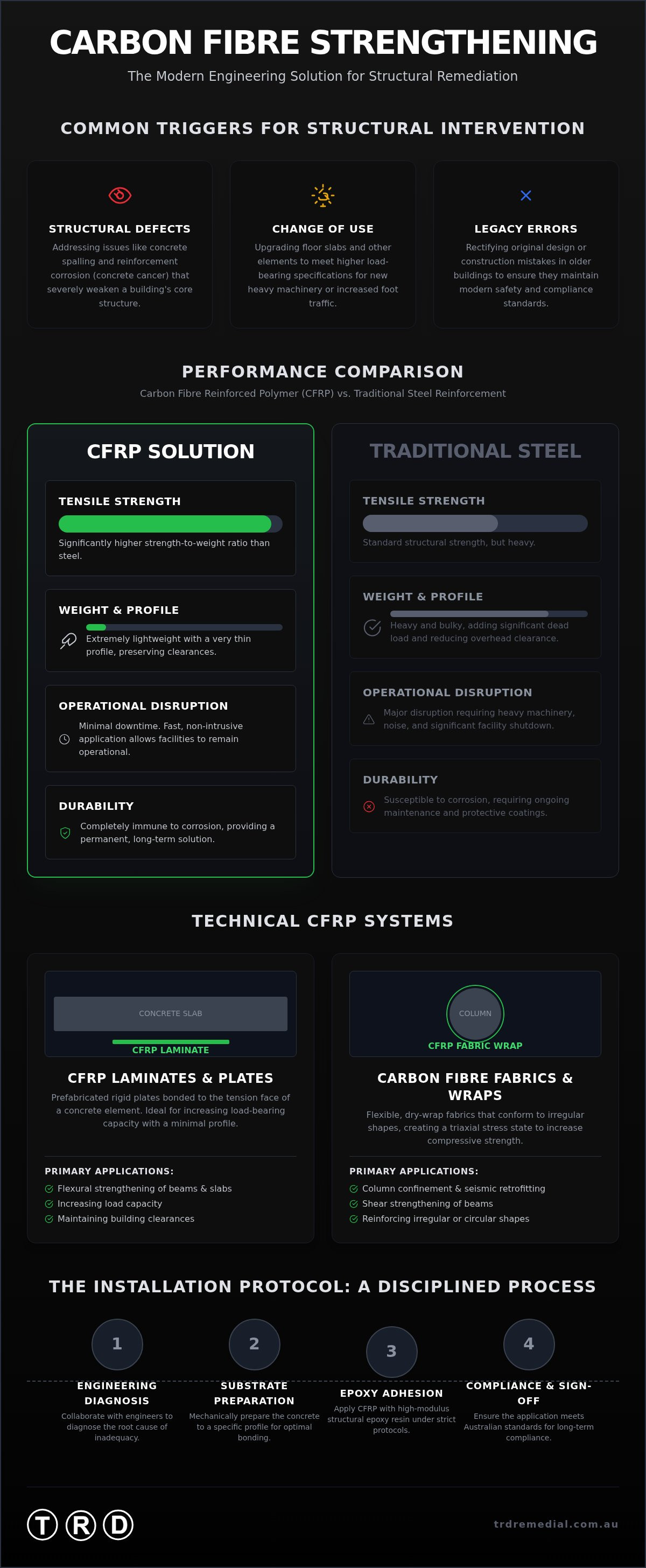
- Structural Defects: Concrete spalling and reinforcement corrosion, often called concrete cancer, can severely weaken a building's core.
- Change of Use: Commercial facilities upgrading to house heavy machinery or increased foot traffic require floor slabs to meet higher load-bearing specifications.
- Legacy Errors: Rectifying design or construction mistakes in older buildings is essential for maintaining safety and compliance.
These scenarios demand a fast, non-intrusive solution. Unlike traditional concrete jacketing, CFRP systems allow for capacity upgrades with minimal impact on the building's footprint or operational schedule. The result is a structure that isn't just repaired, but enhanced for long-term viability.
Technical CFRP Systems: Laminates, Fabrics, and NSM Rods
The selection of a carbon fibre strengthening system is never arbitrary. It requires a precise assessment of the substrate geometry and the specific load increase dictated by the structural design. Modern engineering allows us to utilise high-modulus carbon fibre to meet these rigorous requirements. Recent research into strengthening carbon-fiber composites has highlighted how molecular-level simulations can lead to even higher tensile performance, ensuring these systems remain at the forefront of remedial technology.
CFRP Laminates and Plates
Prefabricated laminates are the primary choice for flexural strengthening of beams and slabs. These rigid plates are bonded to the tension face of a concrete element to increase its load-bearing capacity. Because they have an exceptionally thin profile, they maintain building clearances and aesthetic integrity without the bulk associated with traditional steel plate bonding. Success depends on strict bonding protocols. We ensure the concrete soffit is mechanically prepared to a specific profile before the high-modulus laminate is applied with a structural epoxy resin.
Carbon Fibre Fabrics and Wraps
Flexible dry-wrap fabrics offer versatility that rigid plates cannot provide. They are essential for column confinement and seismic retrofitting, where the material must conform to circular columns or irregular masonry shapes. By wrapping a column, we create a triaxial stress state that significantly increases its compressive strength. For shear strengthening of beams, we employ U-wraps with specialised anchoring systems to prevent debonding under high stress. This method is highly effective for rapid stabilisation in constrained remedial sites.
Near-Surface Mounted (NSM) Systems
NSM systems involve embedding carbon rods or strips into pre-cut grooves within the concrete cover. This method provides superior bond protection and is often preferred in environments with high fire risk or potential for mechanical abrasion. The reinforcement is recessed and encapsulated in structural resin. This allows for a flush surface finish that is virtually invisible once the area is rendered or coated. If you are managing a facility with strict clearance or protection requirements, engaging a specialist contractor is the most reliable way to determine if NSM is the optimal path for your asset.
Each of these systems requires a disciplined approach to installation. Whether applying a surface-bonded plate or an embedded rod, the technical precision of the bond is as critical as the fibre itself. We prioritise engineering rigor to ensure the chosen system performs exactly as intended by the structural design.
Carbon Fibre vs. Traditional Reinforcement: A Performance Comparison
Choosing between traditional steel and modern composites is a decision that dictates a project's long-term success. Traditional methods like steel plate bonding or concrete jacketing add significant dead weight to a structure. This often creates a cascading effect where further reinforcement is required elsewhere to compensate for the added mass. Carbon fibre strengthening eliminates this cycle. It provides the necessary tensile reinforcement without altering the structural profile or adding substantial weight. This allows for precise capacity upgrades that don't compromise the original design intent.
Logistical and Access Advantages
The logistics of steel reinforcement are often prohibitive in constrained Australian urban sites. Steel requires heavy lifting equipment, extensive scaffolding, and mechanical anchoring that can damage existing reinforcement. CFRP is different. It's lightweight and easy to handle. This allows our teams to perform strengthening in live environments with minimal business interruption. You save on labour hours because the installation process is significantly faster than intrusive concrete demolition and replacement. It's a cleaner, more efficient approach for high-density commercial or industrial facilities.
Durability and Corrosion Resistance
Durability is where carbon fibre truly outperforms steel. Steel is inherently vulnerable to moisture and chemical attack, which leads to corrosion and the structural degradation commonly known as "concrete cancer." Carbon fibre is inert. It doesn't rust or degrade when exposed to harsh Australian coastal conditions or industrial chemicals. This eliminates the risk of future spalling repairs. While traditional remedial methods require ongoing maintenance to manage corrosion, CFRP systems offer a set-and-forget solution for asset longevity. They provide a permanent barrier against the environmental factors that typically cause structural failure.
Builders often debate the "total project cost" versus "material cost." While the raw material for carbon fibre is priced higher than structural steel, the total project expenditure is frequently lower. When you factor in reduced scaffolding costs, lower labour requirements, and the absence of heavy machinery, the financial logic becomes clear. For the Australian market, the value lies in the speed of delivery and the extension of the asset's service life without the recurring threat of corrosion. We focus on these total-cost efficiencies to deliver results that satisfy both the engineer and the facility owner.
The Installation Protocol: Preparation, Adhesion, and Compliance
The efficacy of carbon fibre strengthening is dictated by the integrity of the bond between the composite material and the concrete substrate. Without a perfect interface, the engineered load transfer cannot occur, rendering the reinforcement ineffective. We treat the installation as a high-precision sequence where every variable, from ambient temperature to batch tracking, is rigorously monitored. This disciplined approach ensures that the final application performs exactly as specified in the structural design.
Substrate Preparation and Priming
Achieving the correct Concrete Surface Profile (CSP) is the first mandatory step in our protocol. We mechanically grind the concrete to remove laitance, coatings, and contaminants, creating a mechanical lock for the structural adhesive. Moisture management is equally critical. We verify that the moisture content in the substrate is within acceptable limits to prevent delamination. Specialised primers are then applied to stabilise the concrete surface, ensuring the subsequent epoxy layers achieve maximum penetration and adhesion.
Adhesion and Pull-Off Testing
Pull-off testing, or adhesion testing, is a non-negotiable quality control measure in structural remediation. It serves as physical proof that the concrete substrate is strong enough to support the new reinforcement system. The concrete surface must achieve a minimum tensile bond strength of 1.4 MPa (200 psi) to be deemed suitable for a successful CFRP application. We document every test result meticulously. This creates a transparent compliance trail that provides engineers and strata managers with absolute confidence in the remedial works.
Compliance with Australian Standards
All remedial works must align with the National Construction Code (NCC) and relevant Australian engineering standards. Carbon fibre application is a technical discipline that requires specialist expertise, particularly during high-risk structural alterations. We ensure all materials meet Australian fire-rating and performance benchmarks. Where a specific fire rating is mandated by the design, we apply secondary insulating coatings to protect the CFRP system from thermal degradation. This commitment to compliance protects the long-term viability of the asset.
Precision during the remedial phase prevents structural failure during the operational phase. For projects requiring documented technical mastery and adherence to rigorous engineering specifications, consult with TRD Remedial to ensure your infrastructure meets every safety and compliance benchmark.
Partnering with TRD Remedial for Engineered Strengthening Solutions
Successful structural remediation depends on more than just a high-performance material. It requires a contractor who understands the engineering principles behind the solution. TRD Remedial excels in delivering complex engineering designs where technical precision is non-negotiable. We don't simply install carbon fibre strengthening systems. We manage the entire remedial ecosystem. This involves a high level of coordination between our technicians, structural engineers, and site managers to ensure the physical application aligns perfectly with the original design intent.
Our Disciplined Approach to Remediation
We start every project with an accurate diagnosis. This often begins with advanced slab scanning to identify existing reinforcement and post-tension cables before any surface work commences. Our process moves methodically from substrate preparation to final quality assurance checks. In sensitive commercial and industrial environments, safety and compliance are our non-negotiable priorities. We understand the operational pressure of maintaining facility access while fixing critical structural defects. Technical precision isn't just a goal for us; it's a strict requirement to prevent future failures and extend the service life of the asset.
Comprehensive Structural Services
Structural issues rarely exist in isolation. A beam requiring carbon fibre strengthening often shows signs of water ingress, structural cracking, or spalling. TRD Remedial provides a single point of accountability by integrating composite reinforcement with crack injection, concrete repairs, and spalling remediation. This holistic approach ensures that the root cause of the defect is addressed alongside the capacity upgrade. We handle everything from structural alterations to car park remediation with a focus on lasting results.
We invite builders, engineers, and strata managers to discuss their structural capacity upgrades or defect remediation needs with a team that values engineering rigor. Our national focus ensures that we bring elite technical mastery to every project, regardless of complexity. If you need a partner who prioritises safety, compliance, and long-term asset viability, organise a technical assessment of your structure today to secure your infrastructure's future.
Securing Structural Longevity through Engineered Reinforcement
Modern structural remediation demands a transition from traditional, heavy-handed methods to high-precision engineering. Carbon fibre strengthening represents this shift; it provides a high-tensile, non-intrusive solution that addresses structural non-compliance without the logistical burden of steel. By prioritising technical precision during substrate preparation and adhesion testing, asset owners can effectively extend the service life of critical infrastructure while maintaining full operational capacity. The result is a structure that isn't just repaired, but fundamentally enhanced for the future.
TRD Remedial operates as a specialist structural remediation contractor with a national service capability. We focus on delivering engineered solutions for building defects that prioritise safety and long-term compliance. Our disciplined approach ensures that every reinforcement system is applied with the technical rigor required to meet Australian standards. We don't settle for surface-level fixes. We provide the stability and confidence required for large-scale commercial and industrial assets to thrive under increased load demands.
Take the first step toward a permanent structural solution today. Request a Technical Consultation for Your Strengthening Project and partner with a team that understands the physical realities of large-scale structural work. We look forward to securing your asset's future.
Frequently Asked Questions
How long does carbon fibre strengthening last on a concrete structure?
CFRP systems are engineered for long-term durability, often matching or exceeding the remaining service life of the concrete structure. Because carbon fibre is inert, it doesn't suffer from corrosion or chemical degradation like traditional steel. When protected from UV radiation and mechanical impact, these systems provide a permanent remedial solution. This longevity makes it a superior choice for Australian infrastructure projects where asset life extension is a primary objective.
Is carbon fibre strengthening more expensive than using structural steel?
While the raw material cost for carbon fibre strengthening is higher than structural steel, the total project expenditure is often lower. You save significantly on labour, scaffolding, and heavy lifting equipment. Because the installation is non-intrusive and fast, business downtime is minimised. When you factor in the elimination of future maintenance costs associated with steel corrosion, CFRP becomes the more cost-effective choice for many large-scale commercial assets.
Can carbon fibre be used to repair concrete cancer or spalling?
Carbon fibre is not a direct repair for spalling, but it's a critical component of the remediation process. We first treat the structural defects by removing damaged concrete and treating or replacing corroded steel reinforcement. Once the substrate is restored, CFRP is applied to provide the additional tensile strength lost during the degradation. This integrated approach ensures the structure meets current compliance standards while preventing future failure in the affected area.
Does CFRP reinforcement require a specific fire-rating treatment?
Standard CFRP systems require secondary fire protection if the structure must maintain a specific fire-resistance level. The epoxy resins used in these systems begin to lose structural integrity at relatively low temperatures, typically between 60°C and 80°C. To achieve a compliant fire rating, we apply specialised insulating coatings or intumescent plasters over the reinforcement. This ensures the strengthening system remains functional during a fire event according to Australian building codes.
What is the typical curing time for carbon fibre epoxy resins?
Most structural epoxy resins achieve an initial set within 2 to 6 hours, depending on the ambient temperature and specific product formulation. However, the system typically requires 24 hours to reach a level where it can handle some load. A full chemical cure usually takes 7 days. We monitor environmental conditions throughout this period to ensure the resin develops its specified mechanical properties and achieves a permanent bond with the substrate.
Can carbon fibre strengthening be applied to masonry or timber structures?
Carbon fibre strengthening is highly effective for reinforcing masonry and timber elements in addition to concrete. For masonry, it's used to increase out-of-plane flexural strength and seismic resistance. In timber structures, CFRP strips can be bonded to the tension face of beams to increase load capacity or repair split sections. This versatility allows us to provide engineered reinforcement solutions across a wide range of heritage and modern Australian building types.
Is a structural engineer required before installing carbon fibre?
A structural engineer is always required to design the CFRP system and specify the required fibre orientation and layer count. This is a precision-engineered solution, not a general maintenance task. The engineer must calculate the current capacity of the structure and the deficit that the composite needs to bridge. We work closely with engineers to ensure our installation matches their technical specifications and meets all National Construction Code requirements.
How do you test the bond integrity of a carbon fibre installation?
We verify bond integrity through pull-off testing and acoustic sounding. Pull-off testing involves bonding a metal dolly to the CFRP surface and using a hydraulic jack to measure the force required to cause failure. This confirms the substrate's tensile strength is sufficient for the load transfer. Additionally, we use acoustic sounding to identify any hollow spots or delaminations. These quality control steps are essential for documenting compliance and ensuring structural reliability.


