

Injecting a concrete crack without a forensic understanding of its kinetic behaviour is not a repair; it's a temporary mask that invites structural decay. Whether you're weighing up epoxy vs polyurethane crack injection for a basement or a commercial car park, the wrong choice leads to recurring water ingress and rebar corrosion. You've likely felt the pressure of distinguishing between a minor cosmetic defect and a failure that threatens the building's structural integrity.
We agree that a professional remediation strategy must be permanent and compliant with engineering standards rather than a quick fix. This article provides the technical clarity required to master these injection methods, ensuring your repairs are fit for purpose and stop leaks for good. We'll compare the high-strength bonding of epoxies against the expansive sealing power of polyurethanes to help you select the right engineered solution for any cracked concrete substrate.
Key Takeaways
- Distinguish between structural welding and dynamic sealing to select the correct resin for your specific concrete defect.
- Master the technical criteria of epoxy vs polyurethane crack injection to ensure your remediation strategy meets Australian Standards and prevents concrete cancer.
- Understand why slab scanning and professional diagnosis are essential precursors to any high-pressure injection project.
- Identify the physical properties, such as tensile strength and elongation, that dictate the long-term performance of a structural repair.
- Learn how precise packer placement and engineered solutions restore load-bearing capacity while protecting internal reinforcement from corrosion.
Defining Concrete Crack Injection: Why Material Selection Matters
Crack injection is a technical methodology used to pump specialised resins into concrete voids at high pressure. The objective isn't merely aesthetic; it's a critical intervention designed to restore structural integrity or terminate water ingress. By sealing these fissures, we protect the internal steel reinforcement from moisture and oxygen, effectively preventing the onset of concrete cancer. Choosing between epoxy vs polyurethane crack injection hinges on a fundamental assessment: is the crack dormant or active? Selecting the wrong material doesn't just waste resources; it can lead to secondary cracking as the structure seeks new ways to relieve stress.
The Role of Structural Diagnosis
Before any resin is specified, a remedial builder must identify the root cause of the failure. Cracks typically originate from three sources: plastic shrinkage, foundation settlement, or structural overload. Understanding these causes of concrete degradation is vital for long-term stability. If we treat a settlement crack with a rigid resin while the ground is still shifting, the repair will fail within months. Diagnosis involves assessing crack width and depth with precision tools. We often utilise slab scanning to map internal reinforcement and post-tension cables before injection begins. This ensures the high-pressure system delivers the resin to the full depth of the void without compromising the surrounding substrate.
Static vs. Dynamic Cracks: The Deciding Factor
The kinetic behaviour of a crack dictates the required material properties. Static, or dormant, cracks are those where the initial cause of stress has been resolved. These require structural bonding to weld the concrete back together and restore the original design strength. Dynamic cracks are more complex. These active fissures change width in response to thermal cycles, ongoing vibration, or soil movement. A rigid repair in a dynamic crack will inevitably snap. When evaluating epoxy vs polyurethane crack injection, we focus on these specific requirements:
- Dormant Cracks: These require high tensile strength and rigid adhesion to restore load-bearing capacity to the slab or wall.
- Active Cracks: These require high elongation and flexibility to accommodate movement without losing the seal.
- Thermal Cycling: In car parks or external walls, cracks may expand and contract daily, requiring a resin that won't fatigue under constant stress.
Successful remediation relies on matching the chemical properties of the resin to the physical reality of the structure. Without this alignment, the repair is merely a temporary patch rather than an engineered solution.
Epoxy Injection: Restoring Structural Integrity and Load-Bearing Capacity
Epoxy injection is the industry standard for structural welding. These high-strength resins are engineered to restore the monolithic nature of a concrete element. Unlike flexible sealants, epoxy creates a rigid bond that transfers loads across the crack. It's the primary choice for structural cracks in beams, columns, and suspended slabs where the tensile strength of the repair must exceed the surrounding concrete. When we discuss epoxy vs polyurethane crack injection, we're comparing a structural weld against a flexible seal.
The material's low viscosity is a key technical advantage. It allows the resin to penetrate hairline cracks as narrow as 0.05mm through capillary action and high-pressure delivery. When injected correctly, it ensures the entire depth of the void is occupied. Because epoxy does not shrink during the curing process, it provides a permanent, stable bond that resists future settlement or load-induced movement. This stability is a core differentiator when the goal is to stop the spread of structural failure.
When to Specify Structural Epoxy
Structural epoxy is essential when modifying load-bearing elements. We frequently specify this method when preparing for post tension truncation or during major structural alterations where the slab's integrity is compromised. It's also vital for restoring the seismic and wind-load resistance of aging commercial assets. By welding the concrete back together, we ensure the building's original design parameters are maintained. This is particularly effective in industrial environments where heavy machinery or high-traffic loads place constant stress on the floor slabs.
Limitations and Environmental Considerations
Epoxy has specific operational constraints. It generally requires dry or only slightly damp conditions for the resin to achieve its maximum bond strength. Moisture can interfere with the chemical cross-linking, leading to a compromised repair. As detailed in the TxDOT Concrete Repair Manual, proper surface preparation and moisture testing are non-negotiable for structural success. If water is actively flowing through the crack, epoxy is rarely the correct first-stage response.
We must also consider thermal movement. Epoxy is rigid. If it's used to "lock" a crack that is actually a moving joint, the stresses will likely cause a secondary crack to form adjacent to the repair. This is why a precise diagnosis of the crack's kinetic behaviour is required before choosing a resin. For complex defects, engaging a specialist in concrete repairs ensures the chosen material aligns with the structure's long-term movement profile.
Polyurethane Injection: Managing Active Leaks and Dynamic Movement
Polyurethane injection serves a distinct purpose in structural remediation. While epoxy focuses on restoring compressive strength, polyurethane prioritises containment and flexibility. It's an elastomeric resin that reacts with moisture to expand, creating a tight seal within the concrete void. This expansion capability makes it the primary choice for stopping active water ingress in underground assets like basements, tunnels, and retaining walls. When deciding on epoxy vs polyurethane crack injection, the presence of flowing water is often the deciding factor. Polyurethane doesn't just fill the gap; it seeks out the water to form a barrier.
The material remains flexible after curing. This allows it to move with the structure's natural cycles without rupturing the seal. Formulations range from rapid-foaming "water-stops" that terminate high-flow leaks in seconds to slow-curing flexible grouts designed for long-term joint movement. Because these resins can expand up to 20 times their initial volume, they're highly effective at filling large, irregular voids that rigid epoxies might struggle to saturate. This is vital for cracks subject to thermal expansion or ongoing vibrations from heavy traffic.
Hydrophobic vs. Hydrophilic Resins
Hydrophobic resins are engineered for environments with constant water pressure. They don't absorb water; they use it as a catalyst to form a semi-flexible foam that resists wash-out. This makes them exceptionally durable in high-pressure scenarios. In contrast, hydrophilic resins swell in the presence of moisture to maintain a seal. These are best used in joints that cycle between wet and dry conditions, as the resin expands whenever water returns. Selecting the correct expansion ratio is critical. We match the resin's reactivity to the void size and the specific water flow rate to ensure the seal is permanent and doesn't degrade under hydrostatic load.
Remediating Water Ingress in Shoring Walls
Excavation projects often encounter unexpected groundwater, necessitating immediate shoring wall crack injection. Polyurethane is uniquely suited for this task because it can be injected directly into the path of incoming water to create an instant plug. For multi-level basement car parks, flexible resins manage the immense hydrostatic pressure exerted by the surrounding water table. If the failure is widespread, we may deploy curtain wall injection. This involves pumping resin through the structure into the soil behind it. This technique creates an external waterproof barrier that protects the entire concrete face from future saturation and corrosion.
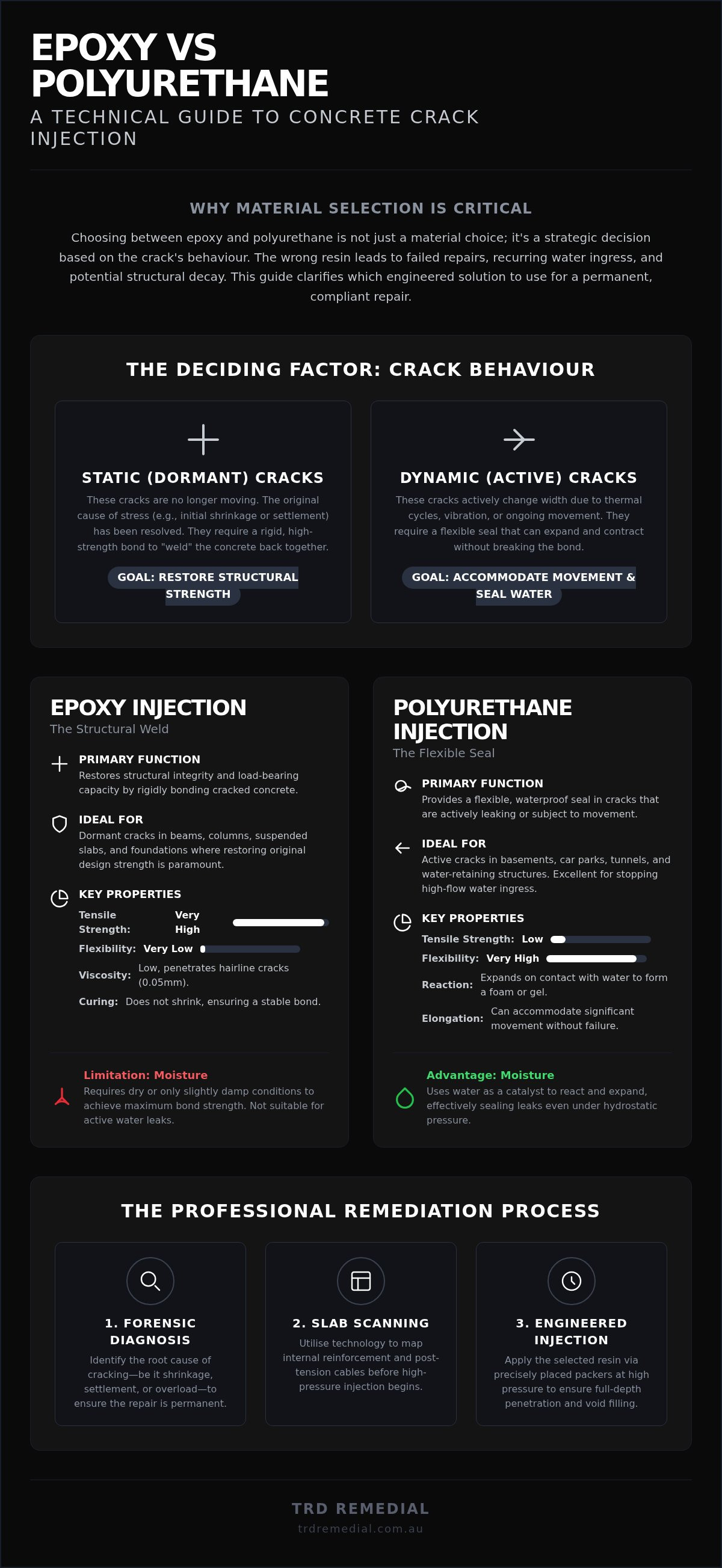
Side-by-Side Comparison: Epoxy vs. Polyurethane Selection Matrix
Selecting the correct resin requires more than a cursory glance at the crack surface. It demands a rigorous evaluation of the material's physical properties against the structure's environmental load. While the industry often simplifies the choice to "epoxy for dry and polyurethane for wet," this oversimplification ignores critical engineering nuances. In the context of epoxy vs polyurethane crack injection, we must evaluate three primary metrics: tensile strength, elongation, and bond integrity under specific site conditions. Our selection matrix ensures the remediation strategy aligns with the intended service life of the asset, particularly in harsh Australian coastal environments where salt-laden air accelerates rebar corrosion.
Technical Performance Metrics
The fundamental difference lies in how these materials handle stress. Epoxy is a structural adhesive with high tensile and compressive strength. It's designed to weld the concrete back together, creating a rigid bond that restores the original load-bearing capacity. Polyurethane, conversely, is an elastomeric sealant. It prioritises elongation, often exceeding 100% to 400% depending on the specific formulation. This flexibility allows the resin to maintain a water-tight seal even as the crack undergoes thermal expansion or contraction. While epoxy requires a dry or slightly damp substrate for a 3,000 psi bond, high-quality hydrophobic polyurethanes thrive in saturated environments, using the moisture to trigger their expansive chemical reaction.
Application Scenarios for Remedial Works
Practical application depends on the structural role of the cracked element. We categorise projects into three primary scenarios to ensure technical compliance:
- Scenario A: Structural Floor Slabs. For non-moving cracks in a high-rise floor slab, epoxy is the mandatory choice. It restores the monolithic integrity required to support live loads and prevents the spread of the failure.
- Scenario B: Leaking Construction Joints. In basement car parks where construction joints are weeping, polyurethane is Specified. Its ability to expand and remain flexible ensures the joint remains sealed despite the building's natural settling.
- Scenario C: Complex Asset Restoration. Large-scale concrete remediation often requires a hybrid approach. We may use polyurethane to terminate active water ingress before following up with epoxy or carbon fibre to reinforce the structural deficit.
Cure times also influence the project schedule. Polyurethane reacts almost instantly, providing immediate relief from water flow, whereas epoxy may require several hours to reach full structural strength. If you're managing an asset with active leaks or visible fissures, contact our team for a professional assessment of your structural defects.
Engaging Remedial Builders for Engineered Solutions
Effective crack injection is more than a simple resin application; it's a high-precision engineering task. Achieving full penetration through the entire concrete cross-section requires high-pressure delivery systems and strategically placed mechanical packers. Non-specialists often rely on low-pressure gravity feeds that fail to reach the core of the defect. When evaluating epoxy vs polyurethane crack injection, the success of the repair depends entirely on the installer's ability to navigate the internal geometry of the structure. This is where professional remedial builders provide value, ensuring every cubic centimetre of the void is occupied by the specified resin.
Compliance with Australian Building Standards, such as AS 3600, is non-negotiable for commercial assets. We utilise slab scanning as a standard precursor to injection. This allows us to map internal reinforcement and post-tensioned cables with precision. Drilling for packers without this data risks catastrophic damage to the building's structural skeleton. By integrating injection with complementary services like carbon fibre strengthening, we deliver a holistic remediation strategy that addresses both the symptom and the root cause of the failure.
The Risks of Non-Specialist Repair
Engaging a general contractor for structural work often results in surface-only repairs. These cosmetic patches hide deeper structural issues while allowing rebar corrosion to continue unabated. Incomplete resin penetration leaves internal steel exposed to moisture, leading to the eventual expansion of the metal and the onset of spalling. For strata managers and commercial property owners, the financial cost of a failed "quick-fix" is substantial. A botched injection usually requires the entire repair to be re-executed, doubling the capital expenditure and extending the building's downtime.
The TRD Remedial Approach to Injection
Our methodology is built on technical discipline and forensic assessment. We don't just fill cracks; we engineer solutions that protect the long-term viability of the asset. Every project begins with a methodical site assessment to determine the kinetic profile of the cracking. Our methodical site assessment ensures that the debate between epoxy vs polyurethane crack injection is settled by technical data rather than guesswork. We then develop an integrated concrete crack repair plan that fits within a broader maintenance framework. This commitment to safety and engineering rigor ensures that our structural interventions are permanent, compliant, and fit for purpose.
Securing Structural Longevity through Engineered Remediation
The technical distinction between epoxy vs polyurethane crack injection is the difference between a permanent restoration and a recurring maintenance burden. Successful remediation requires a forensic approach that matches the resin's chemical profile to the structure's physical movement. While epoxy restores the monolithic integrity of load-bearing elements, polyurethane provides the essential flexibility needed to terminate active water ingress in dynamic environments.
TRD Remedial brings over 8 years of specialist technical contracting experience to every project. We prioritise engineered solutions for complex commercial and industrial defects, utilising comprehensive site scanning and technical reporting to ensure every injection is precise and compliant. Masking structural issues with surface-level patches only invites future failure. Consult the TRD Remedial experts for a structural diagnosis and engineered injection solution today. Restoring a dry, stabilised structure is a critical investment in the long-term safety and viability of your asset.
Frequently Asked Questions
Can epoxy be used to stop an active water leak in concrete?
No, epoxy is generally unsuitable for terminating active water ingress. Most structural epoxies require a dry or slightly damp substrate to achieve maximum bond strength. If water is flowing through the fissure, the resin will likely wash out or fail to cross-link with the concrete surface. In these scenarios, we typically deploy a polyurethane "water-stop" to seal the leak before considering any secondary structural reinforcement or bonding.
How long does an epoxy or polyurethane crack injection repair last?
When specified correctly and installed using high-pressure equipment, these repairs are designed to be permanent. The longevity of the intervention depends on an accurate diagnosis of the crack's kinetic behaviour. For example, using epoxy on a dynamic crack subject to thermal movement will cause a premature failure. However, an engineered solution that matches the resin to the structural load should last for the remaining service life of the asset.
Is crack injection a structural repair or just a cosmetic fix?
The nature of the repair depends entirely on the material choice within the epoxy vs polyurethane crack injection framework. Epoxy injection is a structural repair designed to weld the concrete back together and restore load-bearing capacity. Polyurethane injection is primarily a remedial waterproofing solution. While it effectively stops water ingress and prevents rebar corrosion, it does not restore the original tensile or compressive strength of the concrete element.
What happens if you use the wrong resin for a concrete crack?
Using the incorrect resin often leads to immediate repair failure and potential secondary damage. If a rigid epoxy is injected into a moving joint, the building's natural expansion will force a new crack to form adjacent to the original site. Conversely, using a flexible polyurethane in a structural beam where bonding is required fails to restore the necessary integrity. This often results in continued structural degradation and increased remediation costs for the asset owner.
Do I need to scan the concrete slab before performing crack injection?
Yes, slab scanning is a critical safety and compliance requirement for commercial and industrial projects. High-pressure injection requires drilling for the installation of mechanical packers. Without scanning, there is a significant risk of severing internal reinforcement or post-tensioned cables. Mapping the internal geometry of the slab ensures the repair is executed without compromising the building's structural skeleton or violating Australian Building Standards during the remediation process.
How much does epoxy vs polyurethane crack injection cost?
The cost of a professional injection project is determined by several technical variables rather than a flat rate. Factors include the total linear metres of cracking, the depth of the concrete substrate, and the complexity of site access. High-pressure systems and specialised resin formulations also influence the final investment. Because each defect requires a bespoke engineered solution, a site assessment is necessary to provide an accurate scope of work for the remediation.
Can I perform crack injection myself using a DIY kit?
DIY kits are fundamentally unsuitable for structural remediation or commercial assets. These consumer-grade products often rely on low-pressure application that fails to achieve deep penetration into the void. Without the high-pressure equipment used by specialist contractors, the resin often only forms a surface-level plug. This masks the defect while allowing internal concrete cancer and rebar corrosion to progress invisibly behind the cosmetic patch, leading to more expensive future repairs.
Does crack injection fix the cause of the concrete crack?
No, crack injection is a treatment for the symptom of structural stress rather than the root cause. While it effectively seals the void and restores integrity, it does not address underlying issues like foundation settlement or design overloads. A comprehensive remediation strategy must include a forensic diagnosis to identify why the crack occurred. If the cause remains active, the structure may require additional reinforcement, such as carbon fibre strengthening, to ensure long-term stability.


