

A surface-level patch is often the most expensive mistake a building manager can make. You've likely dealt with the frustration of recurring water ingress that returns months after a supposedly permanent fix, leaving you to manage rising maintenance costs and the looming threat of concrete cancer. It's a cycle that drains budgets and compromises the long-term structural integrity of your assets. We understand that reactive repairs are no substitute for engineered precision.
This guide provides the technical roadmap to break that cycle by mastering the professional process of identifying, diagnosing, and rectifying leaks for good. We'll examine the mechanics of hydrostatic pressure, the strategic application of polyurethane and epoxy injection, and the rigorous standards required to stabilise your building against deep-seated deterioration. By shifting from temporary patches to structural remediation, you'll gain the expertise needed to partner effectively with engineers and strata managers to ensure the safety and longevity of your property.
Key Takeaways
- Differentiate between superficial dampness and deep-seated structural penetration to ensure your remediation strategy targets the root cause rather than masking symptoms.
- Evaluate the technical advantages of polyurethane (PU) and epoxy injection for stabilising active leaks and reinforcing the building envelope against hydrostatic pressure.
- Follow a rigorous five-step professional remediation protocol that prioritises substrate preparation and the precise placement of injection ports for maximum penetration.
- Permanently rectify water ingress to mitigate the risk of concrete cancer and ensure your building assets remain compliant with Australian Standards AS 3740 and AS 4654.
- Learn how to integrate specialised crack injection with engineered solutions like carbon fibre strengthening to maintain the integrity of moving structural joints.
Understanding Water Ingress: The Silent Threat to Building Longevity
Water ingress is the unintended penetration of moisture into a building envelope. It represents a fundamental failure of the primary barrier designed to keep a structure dry and stable. While many property owners mistake early signs for simple structural dampness, the reality is usually far more severe. Surface dampness is often just the visible symptom of a deep-seated structural breach that has already begun to compromise the interior of the concrete matrix.
The true danger lies in what happens beneath the surface. Once moisture reaches the internal steel reinforcement, an oxidation process begins. This causes the steel to expand significantly, exerting internal pressure that leads to concrete spalling. This condition, commonly known as concrete cancer, is a progressive defect. It doesn't just damage the aesthetics of a building; it actively strips away its load-bearing capacity and structural integrity.
Hydrostatic pressure presents a unique challenge for below-ground structures. It acts as a relentless force, driving groundwater through microscopic defects in shoring walls and basement slabs. Water doesn't simply seep into these spaces; it's pushed through with enough force to bypass many traditional surface-applied waterproofing treatments. Understanding this pressure is vital for any permanent remediation strategy.
The Consequences of Unchecked Water Penetration
Neglecting these leaks triggers a cascade of structural degradation. Micro-cracks expand into major fissures, eventually necessitating complex concrete repairs to prevent total failure. Beyond the concrete itself, water often migrates toward building services. This places electrical systems and mechanical plant at risk of short-circuiting or chronic corrosion. From a health perspective, persistent moisture fosters toxic mould growth. This compromises indoor air quality and creates significant liability for building owners and strata managers.
Common Entry Points in Large-Scale Structures
Large structures are particularly vulnerable at transition points. Expansion joints and construction joints often fail when the sealant loses its elasticity or was incorrectly installed during the original build. In basements, cracks in shoring walls allow high-pressure groundwater to bypass original waterproofing layers. Higher up the building, degraded curtain wall seals and perished window flashings are the primary culprits for water ingress during heavy storm events. Identifying these specific failure points is the first step toward a disciplined, engineered solution.
Identifying the Root Cause: Professional Diagnostic Protocols
Visual symptoms like peeling paint or damp patches are often misleading. They represent where water exits, not necessarily where it enters. Because water follows the path of least resistance, it can travel metres through porous concrete or along reinforcement bars before appearing. A disciplined approach requires moving beyond visual cues to technical moisture profiling. This aligns with the Whole Building Design Guide on moisture management, which emphasises that controlling moisture flow is central to building durability.
Engineers utilise pressure testing to simulate storm conditions or groundwater surges. This identifies breaches in the building envelope that only manifest under specific environmental loads. By mapping moisture levels across a surface, specialists can triangulate the source of water ingress rather than just treating the symptom. Collaborative diagnostics between remedial contractors and engineers ensure that the resulting remediation plan is grounded in physical data, not guesswork. If you're seeing persistent dampness, a professional site assessment is the only way to ensure the root cause is addressed.
Non-Destructive Testing (NDT) Methods
NDT allows for a comprehensive assessment without compromising the structure. Thermal imaging cameras detect temperature differentials caused by evaporation, revealing hidden moisture paths behind finished walls. Electronic leak detection is essential for verifying the integrity of waterproof membranes on rooftops or podiums. Professional slab scanning identifies structural voids and locates post-tension cables or conduits before any invasive work begins. This precision prevents accidental damage during the repair phase and ensures the safety of the site crew.
Signs You Require Immediate Remedial Intervention
Certain indicators signal that the building’s structural integrity is actively declining. Ignoring these signs leads to exponential increases in repair costs. Look for the following critical markers:
- Active weeping: Constant water flow from concrete cracks or cold joints indicates a failure under hydrostatic pressure.
- Efflorescence: These white, powdery salt deposits occur when water leaches minerals from the concrete, weakening the matrix over time.
- Rust staining: Visible orange or brown streaks coming from cracks suggest that internal steel reinforcement is already corroding.
When these signs appear, the window for simple maintenance has closed. You've entered the phase of remedial engineering, where stabilization and reinforcement become the priority. Proper diagnosis at this stage prevents the "repair-fail-repeat" cycle that plagues many poorly managed building assets.
Remediation Methods: Crack Injection vs. Membrane Replacement
Selecting a remediation strategy depends on accessibility and the nature of the breach. Positive side waterproofing involves applying a membrane to the exterior face of the structure. While effective in new builds, it often requires extensive excavation for existing assets. In built-up environments or deep basements, this is rarely feasible. Negative side remediation, specifically high-pressure crack injection, allows specialists to treat the defect from the interior. This surgical approach targets the path of water ingress directly without the massive disruption and expense of total site excavation.
Injection is an engineered exercise in pressure management. Rather than trying to "hold back" water with a surface coating, injection methods fill the entire depth of the fissure. This creates a permanent barrier within the concrete matrix itself. For large-scale commercial or residential assets, targeted injection is significantly more cost-effective than excavation. It allows for localised repairs that address specific structural defects while the building remains fully operational.
The Science of Polyurethane Crack Injection
Polyurethane (PU) resins are the primary choice for stopping active water flow. When injected into a wet crack, the resin reacts with the moisture to expand into a dense, closed-cell foam. This expansion allows the material to fill deep-seated voids and counteract high-pressure groundwater. It reacts with water. Because PU remains flexible after curing, it accommodates the minor thermal and structural movements typical in shoring walls and lift pits. It doesn't just block water; it adapts to the environment. This makes it the elite choice for curtain wall injection where dynamic movement is a constant factor.
Epoxy Injection for Structural Integrity
While PU seals, epoxy reinforces. Epoxy injection is designed to restore the monolithic strength of a concrete member by bonding the crack faces together. It's a critical component of concrete remediation when structural cracks threaten the building's stability. Unlike PU, epoxy requires dry or damp-stable conditions to achieve a high-strength bond. It's used when the goal is to "weld" the concrete back together, ensuring the reinforcement is protected from further oxygen and moisture exposure. This method is essential for stabilising load-bearing elements that have suffered from structural defects or excessive loading.
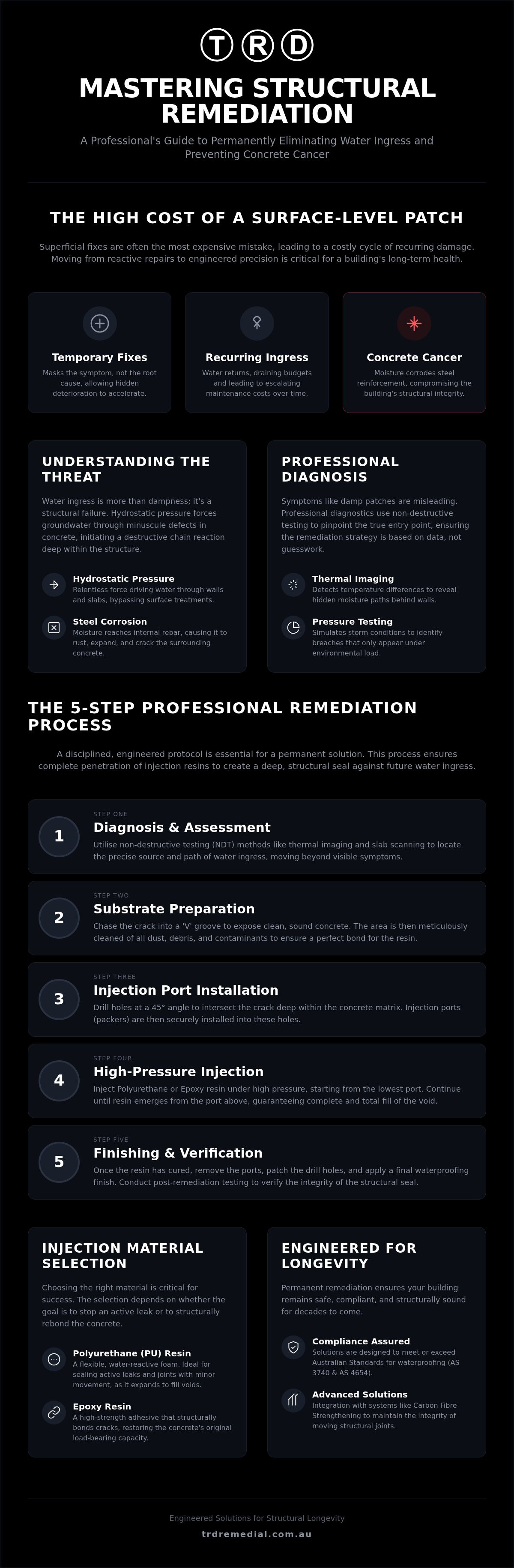
How-to: The 5-Step Professional Remediation Process
Professional remediation of water ingress requires a methodical, five-step execution plan. This disciplined approach ensures that the repair isn't merely a surface treatment but a deep-seated structural correction. We don't rely on guesswork. Every stage is designed to provide a permanent barrier against moisture.
Step 1: Substrate Preparation. The concrete surface must be cleaned to expose the true extent of the defect. We remove all laitance, dirt, and previous failed patches to ensure the remedial resin has a clean path to the crack. Step 2: Packer Installation. Specialists drill holes at a 45-degree angle to intersect the crack at its midpoint. Injection ports, or packers, are then set at calculated intervals. These distances are determined by the thickness of the concrete and the width of the fissure. Step 3: Systematic Injection. Using high-pressure pumps, we deliver the resin into the packers. On vertical walls, we work from the lowest point upward. This ensures that the resin displaces all air and water as it rises through the void. Step 4: Monitoring for Refusal. We monitor the pressure and the flow of material until the crack reaches "refusal." This technical state indicates that the resin has fully penetrated the void and can no longer be accepted. Step 5: Completion and Patching. Once the material has cured, we remove the packers. The injection holes are then patched with a high-strength, colour-matched remedial mortar to restore the surface finish.
Ensuring Long-Term Adhesion and Performance
The success of the repair depends on selecting the correct resin viscosity. Hairline cracks require ultra-low viscosity fluids to ensure deep penetration, while wider gaps need thicker materials to prevent washout. Environmental conditions like substrate temperature and ambient humidity must be managed, as they directly impact the chemical reaction and cure time. For high-stakes assets, we verify the results through post-repair flood testing or core sampling to confirm total void displacement and material adherence.
Safety and Compliance on Remedial Sites
All works must adhere to the Building Code of Australia (BCA) and relevant Australian Standards, including AS 3740 and AS 4654. Managing hazardous materials, particularly crystalline silica dust during concrete drilling, is a non-negotiable safety requirement. We implement site-specific safety plans that account for the technical complexities of high-pressure injection and controlled demolition. If your building requires this level of technical precision, request a specialist site assessment to organise a compliant remediation plan.
Engineered Solutions: Beyond Simple Leak Detection
Effective remediation doesn't stop at merely halting the flow of water. In complex assets, water ingress often signals that the structure's original design limits have been reached or exceeded. This is where simple maintenance fails and engineering-led solutions become necessary. We often integrate injection services with carbon fibre strengthening to reinforce concrete that has been weakened by chronic moisture exposure. This dual approach ensures the member isn't just dry, but also capable of meeting its original load-bearing specifications.
Joint remediation is another critical pillar of a professional strategy. Structural elements aren't static. They move due to thermal expansion, wind loads, and seismic activity. Applying a rigid fix to a moving joint leads to immediate failure. We specialise in temporary moving joints repair, using advanced elastomers that maintain a seal while allowing for necessary structural articulation. Strata managers and engineers prioritise these engineered solutions because they mitigate the risk of litigation and provide a clear audit trail for compliance with Australian Standards. Choosing an engineered fix over general building maintenance ensures the long-term viability of the asset.
Specialist Injection for Critical Infrastructure
High-rise building envelopes require curtain wall injection to address leaks in the glazing and aluminium frame interfaces. These are dynamic environments where wind loads create significant pressure differentials. Similarly, shoring wall crack injection is vital during deep excavations to prevent groundwater from destabilising the surrounding soil and infrastructure. In industrial settings, we manage temporary moving joints that must withstand heavy vehicle traffic and mechanical vibrations. Each of these scenarios demands a technical mastery that general builders cannot provide. We focus on the physics of the structure to ensure the repair lasts.
The TRD Remedial Advantage
Choosing a technical partner means moving away from the "patch and paint" mentality. TRD Remedial provides direct access to experienced remedial technicians who understand the chemistry of resins and the physics of structural loads. We don't just sell a service; we deliver stabilised, compliant assets that stand the test of time. Our engineered approach to building defects ensures that the root cause is permanently rectified, protecting your investment from the high costs of reactive maintenance. We act as a steady, methodical expert for strata managers and engineers who require results without the fluff.
Securing Your Building's Structural Future
Effective management of building assets requires shifting from reactive maintenance to disciplined engineering. We've explored how identifying the root cause of water ingress through technical diagnostic protocols is the only way to prevent the progressive cycle of concrete cancer. Surface patches won't stop hydrostatic pressure; only high-pressure injection and engineered reinforcement can stabilise a compromised building envelope. By prioritising technical precision and adhering to Australian Standards, you ensure the long-term viability and safety of your property.
As specialist structural remediation contractors, TRD Remedial delivers engineered solutions for complex building defects. Our team are experts in high-pressure crack injection, focusing on permanent rectification rather than temporary fixes. We act as the technical partner strata managers and engineers trust to handle high-stakes structural work. Don't let a minor leak evolve into a major structural failure that compromises your entire asset. We're ready to deploy methodical, results-oriented strategies to protect your investment.
Request a Professional Remedial Assessment to protect your asset with the rigour it deserves. Your building's integrity is our priority.
Frequently Asked Questions
What is the most common cause of water ingress in Australian buildings?
The leading cause is typically the failure of external waterproofing membranes or perished joint sealants. These barriers degrade over time due to UV exposure and natural building movement. In many Australian assets, non-compliance with AS 4654 for external waterproofing leads to chronic moisture penetration. High-pressure groundwater also exploits micro-cracks in shoring walls. Identifying these failure points early is essential to prevent the onset of structural defects and concrete spalling.
Can water ingress cause a building to collapse?
Chronic water ingress rarely causes immediate collapse, but it significantly compromises load-bearing capacity over time. Moisture triggers the oxidation of internal steel reinforcement, leading to concrete cancer. As the steel expands, it shatters the surrounding concrete. This loss of cross-sectional area in columns or slabs reduces the factor of safety. If left untreated, the cumulative damage can lead to a state where the structure is no longer compliant or safe.
How long does a professional crack injection repair last?
A professionally executed crack injection can last for the remaining service life of the structure. The longevity depends on the accurate selection of resins and the quality of substrate preparation. Polyurethane resins are designed to remain flexible, accommodating the natural thermal expansion of the building. When applied by specialist contractors to "refusal," the repair creates a permanent barrier within the concrete matrix that resists hydrostatic pressure far better than surface-applied patches.
Is it better to fix a leak from the inside or the outside?
For existing commercial and residential buildings, fixing a leak from the inside via negative-side injection is often the most viable professional solution. While positive-side waterproofing (outside) is the design ideal, it usually requires cost-prohibitive excavation and site disruption. High-pressure crack injection allows technicians to target the source of the leak directly from the interior. This method is faster, less invasive, and provides an engineered seal that stops water within the wall itself.
What is the difference between epoxy and polyurethane injection?
The choice between epoxy and polyurethane depends on the goal of the repair. Epoxy resins are used for structural strengthening; they bond the concrete faces together to restore monolithic integrity. This typically requires dry conditions. Polyurethane is a reactive resin used primarily for stopping active leaks. It expands upon contact with moisture to fill voids and seal the crack. PU remains flexible, making it ideal for joints or cracks subject to minor structural movement.
How much does it cost to fix water ingress in a basement?
Remediation costs are determined by technical variables rather than a fixed scale. The total investment depends on the category of water damage, the depth of the fissures, and the accessibility of the structure. Factors such as the volume of resin required and the density of injection ports needed for a systematic repair will dictate the budget. A professional diagnostic assessment is necessary to establish an engineered scope of works that ensures long-term structural stability.
Does insurance cover water ingress remediation?
Standard building insurance typically covers sudden and accidental water damage, such as a burst pipe. However, most policies exclude water ingress caused by gradual deterioration, wear and tear, or a lack of maintenance. If a leak is found to be a result of a failed waterproofing membrane that was past its service life, the claim is often denied. It's vital for strata managers to maintain rigorous inspection logs to demonstrate proactive asset management.
How do I know if my concrete has "concrete cancer" from water leaks?
Concrete cancer manifests through several distinct physical symptoms. You should look for concrete spalling, where chunks of the surface begin to flake or break away. Visible rust stains leaching from cracks are a definitive sign that the internal steel reinforcement is corroding. Another indicator is efflorescence, which appears as white, chalky salt deposits on the surface. If you notice these signs, the structural integrity of the member is already declining and requires immediate remedial intervention.


