

In remedial engineering, professional concrete cutting is a surgical procedure rather than a demolition task. One misplaced blade can compromise the structural integrity of an entire floor slab or sever critical post-tension cables. You likely understand the high stakes involved when modifying an occupied commercial building or a heritage asset. The fear of hitting hidden services or damaging reinforcement isn't just a minor concern; it's a risk that can lead to catastrophic failure and massive project delays.
This guide provides the technical intelligence needed to master precision concrete cutting and core drilling while maintaining strict site safety. You'll learn how to ensure zero damage to existing reinforcement through advanced slab scanning and methodical execution. We will examine the essential protocols for managing dust and slurry in sensitive environments and how to maintain compliance with Australian safety standards. From post-tension truncation to creating clean openings for new services, this specialist overview covers the disciplined approach required for successful structural alterations.
Key Takeaways
- Understand why technical concrete cutting is a critical surgical phase for structural strengthening rather than a standard demolition task.
- Learn to select the correct diamond-sawing methodologies to achieve precision while managing silica dust and slurry in sensitive environments.
- Discover the essential role of slab scanning and subsurface intelligence in protecting critical reinforcement and post-tension cables.
- Master the planning protocols required to maintain structural integrity and strict compliance with Australian safety standards.
- Recognise the advantage of using a remedial specialist to ensure that every alteration supports the long-term stabilisation of the asset.
The Role of Precision Concrete Cutting in Structural Remediation
Concrete cutting in the remedial sector is a controlled engineering process, not a brute-force demolition activity. While general construction might focus on speed and volume, remedial structural alterations demand surgical precision to isolate specific sections of an asset. This process involves the strategic removal of concrete to facilitate repairs or upgrades without compromising the surrounding structural fabric. The primary objectives often include creating service penetrations for new HVAC systems, removing spalled sections back to sound concrete, or modifying load-bearing elements to accommodate new architectural layouts.
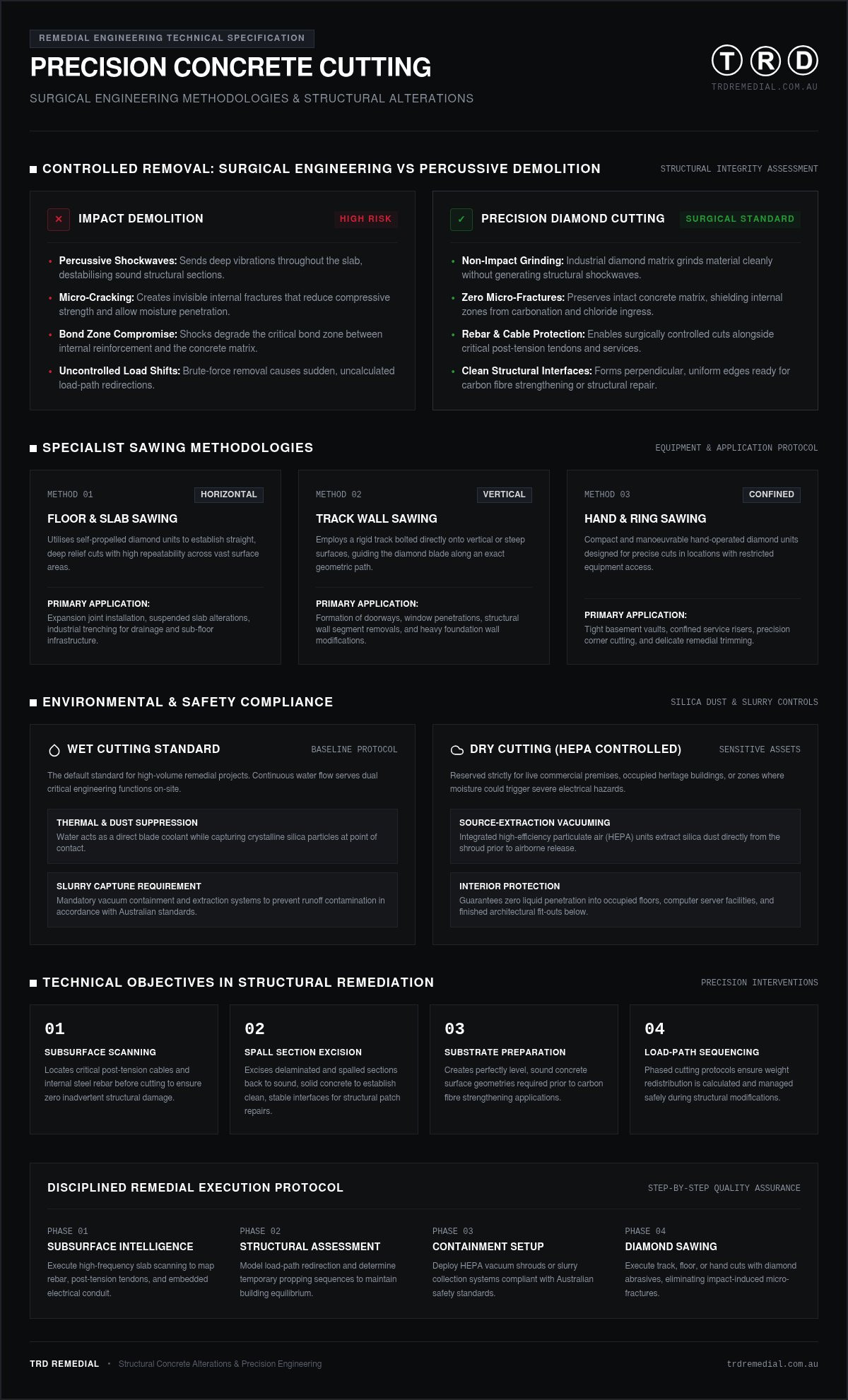
Modern concrete cutting relies on advanced concrete cutting saws and diamond blades to achieve clean, perpendicular edges. Unlike traditional impact-based demolition, which sends shockwaves through the slab, diamond cutting minimises vibration. This is vital for maintaining the integrity of the remaining concrete matrix and protecting sensitive internal services or reinforcement. By using a non-impact method, engineers ensure that the structural health of the building is not degraded by the very process intended to improve it.
When Remedial Projects Require Specialist Cutting
Structural remediation often necessitates the removal of damaged or redundant sections to make way for modern reinforcements. For example, preparing a substrate for carbon fibre strengthening requires a perfectly level and sound surface. Similarly, gaining access for deep concrete crack repair in thick structural elements often involves precise wall cutting to expose the full extent of the defect. In ageing commercial assets, these techniques allow for the installation of new service penetrations or the modification of load-bearing walls while the rest of the building remains operational.
Maintaining Structural Integrity During Alterations
The primary risk during any structural alteration is the introduction of micro-cracks. These invisible fractures can weaken the concrete's compressive strength and accelerate carbonation or chloride ingress. Precision cutting prevents this by using a grinding action rather than a striking one. This protects the bond zone between the existing reinforcement and the concrete paste. When a specialist handles the cutting, they also consider load-path redirection. Removing a section of concrete shifts the building's weight; the cutting sequence must be carefully planned to ensure the structure remains stable throughout the transition.
Essential Methodologies: Selecting the Right Cutting Technique
Professional concrete cutting relies on diamond-tipped technology to penetrate high-strength, reinforced concrete. The choice of methodology depends on the structural goal and specific site constraints. Diamond blades don't cut in the traditional sense; they grind through the material using industrial-grade diamond crystals embedded in a metal matrix. This mechanism allows for surgical precision without the micro-fractures associated with percussive tools. When selecting a technique, engineers must weigh the trade-offs between speed, precision, and the maximum depth of the cut required.
Wet cutting is the preferred standard for most remedial projects. The water acts as a coolant for the blade and a suppressant for hazardous dust. While OSHA crystalline silica construction standards provide a technical framework for risk mitigation, Australian contractors must also strictly manage slurry to prevent environmental contamination. Dry cutting is reserved for sensitive, occupied environments where water ingress poses a risk to finished interiors or electrical systems. This method requires high-efficiency particulate air (HEPA) vacuum systems to capture dust at the source, ensuring the environment remains safe for occupants.
Slab Sawing and Wall Cutting Techniques
Floor sawing is the primary method for creating expansion joints or trenching in industrial slabs. These self-propelled units ensure straight, deep cuts with high repeatability across large surface areas. For vertical structural elements, we utilise track-mounted wall cutting. The track is bolted directly to the surface, allowing the saw to travel along a precise path to create clean doorways or window openings. In areas with restricted access, hand sawing or ring sawing provides the necessary manoeuvrability. Ring saws offer significantly deeper cutting depths than standard hand-held units, making them ideal for thick masonry or reinforced walls where a larger rig cannot be mounted.
Core Drilling and Wire Sawing for Deep Penetrations
Core drilling, often referred to as core holing, is essential for installing new hydraulic, electrical, or fire services. It provides a clean, circular penetration with minimal vibration, protecting the surrounding concrete bond. This technique is also used to extract cylinders for structural testing to assess concrete carbonation or chloride levels. For massive structures where traditional circular blades reach their limit, wire sawing is the solution. This method uses a diamond-impregnated cable looped around the structure and driven by a hydraulic pulley system. It allows for virtually unlimited depth and can cut through the most heavily reinforced sections with ease.
Selecting the right equipment is a balance between technical requirements and site-specific limitations. If you are planning complex structural changes, consulting a specialist in structural alterations ensures the methodology matches the engineering requirements of your asset.
Safety Protocols and Risk Mitigation in Complex Environments
Safety in remedial concrete cutting is governed by a strict hierarchy of controls that begins long before a blade touches the surface. In complex environments, such as occupied high-rise buildings or ageing industrial facilities, the risks extend beyond the operator to the structural asset itself. We follow a methodical progression: subsurface scanning to identify reinforcement and services, physical isolation of utilities, and controlled execution under engineering supervision. This disciplined approach ensures compliance with Australian standards for high-risk construction work and aligns with the best-practice methodologies advocated by the Concrete Sawing & Drilling Association (CSDA).
Managing the byproducts of the cutting process is equally critical. Silica dust is a significant respiratory hazard, and slurry, the mixture of water and concrete fines, is highly alkaline and can damage building finishes or contaminate drainage systems. We employ industrial-grade containment strategies, using high-volume slurry vacuums and physical bunding to ensure zero discharge. On sites where we are performing structural defect repair, vibration monitoring is often deployed. This prevents the transmission of energy that could exacerbate existing cracks or delamination in the surrounding concrete matrix.
The High Stakes of Post-Tensioned (PT) Slab Management
Post-tensioned slabs present the highest risk profile in structural alterations. Accidental cable strikes can result in the explosive release of tension, potentially causing catastrophic structural failure or severe injury. Identification through slab scanning is the non-negotiable first step. If a penetration must pass through a PT zone, we implement protocols for post tension slab repair and truncation. This involves detensioning and anchoring the cables safely before any cutting commences. Specialist engineering oversight is mandatory here to ensure the load path is correctly managed throughout the alteration.
Environmental and Site-Specific Controls
Working in sensitive, occupied environments requires more than just technical skill; it requires environmental stewardship. Noise mitigation is a primary concern in residential or commercial settings, where we often deploy acoustic barriers and schedule high-impact tasks during specific windows. For work in confined spaces or at heights, we adhere to rigorous permit systems and rescue plans. Our use of specialised vacuum systems ensures that even in the most restricted areas, the site remains clean and the air quality is maintained. This allows other trades or building occupants to continue their activities without disruption or exposure to hazardous particulates.
How to Organise a Precision Concrete Cutting Project
Organising a successful concrete cutting project requires a logical, sequential approach that prioritises structural data over guesswork. Unlike general construction, remedial alterations cannot afford errors; a single misplaced cut can destabilise an entire section of a building. The process begins with a rigorous structural assessment, where original building plans are reviewed alongside current site conditions. This allows engineers to develop a cutting and drilling schedule that aligns with broader remedial timelines, ensuring that each removal phase supports the next stage of stabilization or reinforcement.
Step 1: Subsurface Intelligence through Slab Scanning
Professional subsurface intelligence is the non-negotiable foundation of any project. We utilise Ground Penetrating Radar (GPR) to map internal reinforcement, electrical conduits, and post-tension cables with high accuracy. This phase of slab scanning allows us to mark out definitive 'no-go' zones where cutting would compromise the structural integrity of the asset. By identifying these critical elements before the blade touches the surface, we eliminate the risk of accidental strikes and ensure the safety of both the structure and the site personnel.
Step 2: Equipment Selection and Site Preparation
Matching the specific tool to the substrate is essential for maintaining precision. Whether the material is high-strength concrete, heritage brick, or natural stone, the equipment must be calibrated for the density and reinforcement levels present. Site preparation involves more than just bringing in machinery; it requires the establishment of reliable water and power supplies for high-output diamond saws. We also implement strict exclusion zones and clear safety signage to manage site traffic and protect other trades working in the vicinity. This disciplined setup prevents delays and ensures that the concrete cutting phase proceeds without technical interruptions.
Step 3: Execution and Slurry Management
During the execution phase, maintaining constant cooling for diamond blades is vital for both tool longevity and cut accuracy. Our operators perform real-time monitoring of cutting resistance to detect any unexpected internal obstructions that the initial scan might have flagged for further investigation. Environmental management is handled simultaneously through the immediate capture of concrete slurry. Using industrial vacuum systems, we contain all wastewater and fines at the source, following strict environmental guidelines for disposal. This keeps the work area clean and prevents hazardous runoff from entering building drainage systems.
Once the cuts are complete, a final site inspection verifies that the openings meet the exact engineering specifications and that structural stability remains uncompromised. If your project involves complex modifications to high-value assets, you can rely on our expertise in structural alterations to deliver a precise, safe, and compliant result.
The TRD Advantage: Integrating Cutting with Remedial Engineering
Choosing a specialist remedial contractor for concrete cutting provides a level of risk management that general hire companies simply cannot match. While a standard operator focuses solely on the physical removal of material, we view every cut through the lens of structural engineering. This perspective is vital because remedial work often involves assets that are already compromised by age, environmental stress, or design defects. Our team doesn't just execute a cut; we ensure the intervention aligns with the long-term stabilisation requirements of the building.
There is a powerful synergy between technical cutting and the broader scope of concrete remediation. Often, the removal of concrete is merely the preparation phase for high-performance strengthening systems. By integrating these services, we eliminate the communication gaps that occur when multiple contractors handle different stages of a structural alteration. This unified approach allows us to maintain national capability across complex commercial, industrial, and strata projects, delivering engineered solutions that tangibly extend asset life.
Specialist Capabilities in Structural Alterations
Our in-house expertise covers the most high-risk aspects of structural modification, including post-tension (PT) truncation and the application of carbon fibre reinforcement. We specialise in controlled demolition within sensitive, occupied environments where noise, dust, and vibration must be strictly governed. By collaborating directly with site engineers, we deliver compliant outcomes in high-stakes scenarios where there's zero margin for error. This internalised workflow ensures that the load path is always protected, whether we're creating a new service riser or modifying a primary load-bearing element.
Your Partner for Reliable Remedial Works
The TRD approach is built on accurate diagnosis and a commitment to long-term structural performance. We don't believe in temporary fixes; we believe in engineering rigor and technical precision. This disciplined mindset ensures that every concrete cutting task we perform is executed with the highest regard for safety and architectural integrity. Whether you're managing a heritage restoration or a large-scale industrial upgrade, our team provides the steady, methodical expertise required to navigate technical complexity. Contact our specialist team to discuss how we can support your structural alteration requirements with a professional, results-oriented service.
Ensuring Long-Term Structural Viability through Precision
Precision concrete cutting is the critical first step in any successful structural alteration. It requires more than just high-output machinery; it demands a deep understanding of remedial engineering and subsurface conditions. By prioritising advanced slab scanning and methodical safety protocols, you protect your asset from the catastrophic risks of cable strikes or micro-cracking. These disciplined standards ensure that every modification supports the building's load path and satisfies strict Australian safety requirements. Integrating these technical tasks with wider remediation goals ensures that your structural changes are not just accurate, but contribute to the overall stabilisation and longevity of the asset.
A successful outcome relies on the synergy between subsurface intelligence and surgical execution. Secure your project's structural integrity with TRD Remedial's specialist concrete cutting services. Our team brings specialist remedial engineering expertise, integrated GPR slab scanning, and advanced PT truncation capabilities to every complex site. We look forward to helping you deliver a safe, precise, and engineered outcome for your next remedial project.
Frequently Asked Questions
What is the difference between concrete cutting and concrete sawing?
Concrete cutting is the broad industry term for any controlled removal of concrete, whereas concrete sawing refers specifically to using a circular diamond blade. Sawing is a sub-set of cutting that includes floor, wall, and hand-held methods. Other cutting techniques include wire sawing or core drilling. Selecting the right method depends on the required depth and the structural nature of the asset being modified to ensure engineering precision.
Do I always need to scan a slab before cutting or core drilling?
Slab scanning is a non-negotiable requirement for any remedial project involving penetrations. It's the only reliable way to map internal reinforcement, electrical conduits, and post-tension cables before work begins. Skipping this step risks catastrophic structural failure or fatal utility strikes. We utilise Ground Penetrating Radar (GPR) to provide real-time subsurface intelligence, allowing our operators to mark definitive 'no-go' zones and ensure the site remains safe throughout the process.
Can you cut through concrete that contains post-tension cables?
You can cut concrete containing post-tension cables, but it requires specialist post-tension truncation and detensioning. Cutting a live PT cable without proper anchoring can cause an explosive release of energy, endangering personnel and the building's stability. Our process involves identifying the exact cable locations, detensioning them safely, and installing new anchors before the final concrete cutting takes place. This always requires strict engineering oversight to maintain the structural integrity of the slab.
How do you manage the dust and mess during indoor concrete cutting?
We manage dust and slurry through integrated containment systems designed for occupied environments. Wet cutting is our primary method, as water suppresses silica dust at the source. We use high-volume slurry vacuums and physical bunding to capture all wastewater immediately, preventing it from entering building drains or damaging interior finishes. For sensitive areas where water cannot be used, we deploy HEPA-filtered extraction systems to maintain air quality and site cleanliness for building occupants.
Is it possible to cut concrete without causing vibrations that damage the building?
Diamond-tipped tools allow us to cut concrete with virtually zero vibration compared to traditional percussive demolition. The diamond blade grinds through the material rather than striking it, which prevents the transmission of energy through the slab. This non-impact approach is essential for protecting sensitive electronics in commercial buildings and preventing micro-cracking in the surrounding concrete matrix. It ensures the structural bond between the remaining concrete and reinforcement stays intact during alterations.
What are the typical depth limits for professional wall sawing?
Professional track-mounted wall saws typically reach depths between 600mm and 900mm using large-diameter diamond blades. While standard hand-held units are limited to around 150mm, our specialised equipment can handle much thicker structural elements. If a wall or footing exceeds these limits, we transition to wire sawing. This method uses a diamond-impregnated cable to cut through virtually any thickness, providing an engineered solution for the most massive concrete structures found in industrial or commercial assets.
Why is wet cutting preferred over dry cutting for most remedial projects?
Wet cutting is preferred because it provides superior cooling for the diamond blade and eliminates hazardous silica dust. The constant flow of water prevents the blade from overheating during deep structural cuts, which extends tool life and improves precision. Dry cutting is generally reserved for small-scale tasks or environments where water ingress poses a severe risk to electrical systems. In most remedial scenarios, wet cutting is the safest and most efficient methodology available.
What happens if a structural reinforcement bar (rebar) is accidentally cut?
Accidentally cutting structural rebar can significantly reduce the load-bearing capacity of a slab or wall. If a strike occurs, work must stop immediately to allow a structural engineer to assess the damage. Remediation typically involves installing supplemental reinforcement, such as carbon fibre strengthening or epoxy-bonded steel plates, to restore the lost tensile strength. This highlights why slab scanning is a critical concrete cutting protocol to prevent costly and dangerous structural defects during remediation works.


