

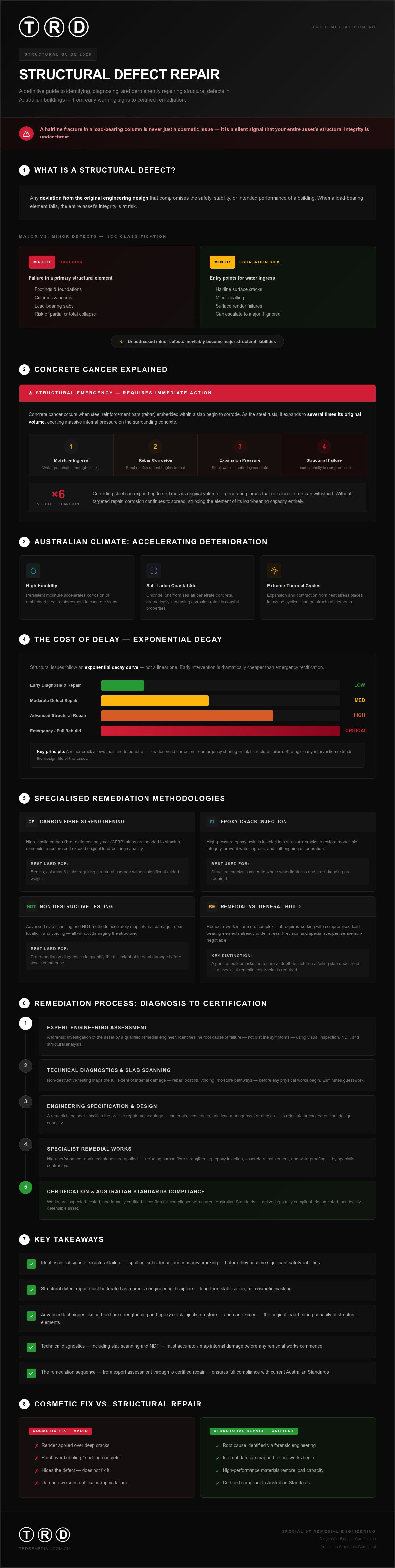
A hairline fracture in a load-bearing column is never just a surface issue. It is a silent signal that the integrity of your entire asset is under threat. While it's tempting to dismiss minor spalling or surface cracks as cosmetic, these symptoms often mask deeper systemic failures. For Australian property owners and strata managers, the stakes involve more than just aesthetics; they encompass safety, legal liability, and the long-term viability of the structure. Addressing these issues requires a shift from reactive maintenance to a disciplined approach to structural defect repair.
You likely recognise that the longer a structural flaw remains unaddressed, the more the eventual remediation costs will escalate. We understand the anxiety that comes with managing complex building failures and the confusion between temporary patches and permanent engineering solutions. This guide provides a clear roadmap for navigating the remedial process in 2026. You'll gain a definitive understanding of how modern remedial engineering identifies, manages, and permanently repairs structural defects in Australian buildings. We'll examine the essential stages of technical diagnosis, the application of high-performance materials like carbon fibre, and the path to achieving a fully certified, compliant asset.
Key Takeaways
- Identify critical signs of structural failure, such as concrete spalling and foundational subsidence, to prevent minor issues from becoming significant safety liabilities.
- Learn why professional structural defect repair must be treated as a precise engineering discipline that prioritises long-term stabilisation over cosmetic fixes.
- Explore advanced remediation methodologies like carbon fibre strengthening and epoxy crack injection designed to restore the load-bearing capacity of your building.
- Understand the necessity of technical diagnostics, including slab scanning and non-destructive testing, to accurately map internal damage before works commence.
- Establish a clear sequence for remediation that moves from expert engineering assessment to certified repair, ensuring full compliance with current Australian Standards.
Understanding Structural Defects in Australian Buildings
A structural defect is defined as any deviation from the original engineering design that compromises the safety, stability, or intended performance of a building. These aren't merely aesthetic flaws. When a load-bearing element fails to perform its function, the entire asset's integrity is compromised. In Australian property management, these issues typically manifest as concrete spalling, foundational subsidence, or significant masonry cracking. Recognising these signs early is the only way to prevent a localized issue from becoming a building-wide failure.
Australia's climate plays a decisive role in accelerating structural deterioration. High humidity, salt-laden coastal air, and extreme thermal cycles cause building materials to expand and contract, placing immense stress on the structural skeleton. Many asset owners mistakenly opt for "cosmetic" repairs to mask these symptoms. Applying render over a deep crack or painting over bubbling concrete doesn't solve the problem; it hides a critical structural defect repair requirement until the damage becomes catastrophic and far more expensive to rectify.
Major vs. Minor Structural Defects
The National Construction Code (NCC) provides clear criteria for categorising defects. A major defect involves a failure in a primary structural element, such as a footing, column, beam, or slab, that could lead to partial or total collapse. While minor defects like hairline cracks might seem insignificant, they often act as entry points for water ingress. Once moisture penetrates the building envelope, it begins a silent cycle of internal decay. What starts as a minor maintenance observation can rapidly evolve into a major structural liability if the underlying cause isn't professionally diagnosed and stabilised.
The Hidden Danger of Concrete Cancer
Concrete spalling, frequently referred to as concrete cancer, represents a genuine structural emergency. This condition occurs when the steel reinforcement bars (rebar) embedded within the slab begin to corrode. As the steel rusts, it expands to several times its original volume, exerting massive internal pressure on the surrounding concrete. This pressure causes the concrete to crack, flake, and eventually break away in large chunks. Concrete cancer is the oxidation of steel reinforcement within concrete. Without a targeted structural defect repair strategy, the corrosion will continue to spread, stripping the element of its load-bearing capacity and threatening the safety of all occupants.
The Role of Remedial Engineering in Asset Preservation
Remedial engineering is the specialised science of restoring and strengthening existing structures that have suffered from degradation or design failure. It is a discipline that operates at the intersection of forensic investigation and structural design. Unlike general maintenance, which addresses the superficial wear of a building, remedial engineering targets the core stability of the asset. When a property requires a structural defect repair, the objective is to reinstate or even exceed the original design capacity of the building. This ensures the structure remains safe for occupancy while protecting the financial interests of the owners.
The economic case for early intervention is undeniable. Structural issues do not remain static; they follow an exponential decay curve. A minor crack left untreated allows moisture to penetrate, leading to widespread corrosion and eventually requiring full-scale reconstruction. By engaging in building remediation at the first sign of distress, asset owners can avoid the catastrophic costs associated with emergency shoring or total structural failure. Strategic strengthening doesn't just fix a problem; it extends the design life of the asset, ensuring its long-term viability in a competitive market.
Remedial Engineering vs. General Construction
General construction focuses on building from a clean slate where loads are predictable and conditions are controlled. Remedial work is far more complex. It requires working with compromised load-bearing elements that are already under stress. Precision is non-negotiable. While a general builder may be proficient at erecting new walls, they often lack the technical depth required to stabilise a failing slab under load. Engaging a specialist remedial contractor ensures that every intervention is backed by technical mastery. This includes sophisticated risk management protocols and the use of engineered solutions specifically designed for the unique constraints of an existing site.
Compliance with Australian Standards
Adherence to regulatory frameworks is the cornerstone of professional remediation. All works must strictly align with AS 3600 for concrete structures to ensure that the materials and methods used meet rigorous safety benchmarks. In 2026, the National Construction Code (NCC) has placed an even greater emphasis on structural reporting and certified engineering designs. Every structural defect repair must be documented and certified by qualified professionals. This provides a legal paper trail that protects stakeholders and ensures the building remains compliant with current Australian Standards. Without this level of engineering rigour, any repair is merely a temporary patch that leaves the owner exposed to significant liability.
Specialised Methodologies for Structural Defect Repair
Modern remediation has evolved beyond simple cementitious patches. A successful structural defect repair requires a methodology that addresses the specific mechanical failure of the element. Whether the goal is restoring lost load capacity or sealing a path of water ingress, the choice of material and application technique must be dictated by rigorous engineering data. Using high-tensile, durable materials is essential to ensure a permanent fix rather than a temporary stopgap. For a deeper look at the broader scope of these works, see our guide on concrete remediation.
Engineers now prioritise materials that offer longevity and technical precision. Modern resins and composites are engineered to bond at a molecular level with existing substrates. This ensures that the repaired section performs as a monolithic unit with the original structure. When executing a structural defect repair, matching the resin viscosity to the crack width is critical to achieving full penetration. Failure to match the repair material to the environmental and structural demands of the site often leads to debonding or secondary cracking.
Carbon Fibre Strengthening (CFRP)
Carbon fibre reinforced polymer (CFRP) has established itself as the gold standard for structural reinforcement in 2026. Its extraordinary strength-to-weight ratio allows for significant upgrades to load-bearing capacity without adding substantial dead weight to the structure. This is particularly effective for reinforcing weakened beams or increasing slab capacity to accommodate higher live loads. CFRP is non-corrosive and incredibly thin; it provides a low-profile solution that does not compromise architectural clearances. The application process involves precision surface preparation and the use of high-performance structural adhesives to ensure the composite material acts as a true extension of the concrete. You can read more about these applications in our dedicated article on carbon fibre strengthening.
Specialist Crack Injection Systems
Injection systems provide a surgical approach to internal remediation by delivering resins directly into the heart of a defect. Epoxy injection is used for structural bonding where the intent is to "weld" the crack faces together and restore the original rigidity of the concrete. It's the primary choice for dormant cracks in load-bearing elements. In contrast, polyurethane injection is the preferred solution for flexible waterproofing and managing active water ingress. These resins expand upon contact with moisture to create a durable, watertight seal within the void. Specialist contractors use calibrated high-pressure pumps to ensure the resin penetrates the full depth of the crack, leaving no internal pockets of air or moisture. Our detailed guide on concrete crack repair explains how to select the right system for your specific site conditions.
The Remediation Process: From Diagnosis to Certification
A disciplined approach to structural defect repair follows a logical sequence designed to eliminate technical uncertainty. The process begins with forensic investigation rather than immediate physical work. By establishing a clear baseline of the building's current state, engineers can design solutions that address the root cause of failure. This structured workflow ensures that every intervention is precise, compliant, and permanent. The five critical stages of a professional remediation project include:
- Stage 1: Non-Destructive Testing (NDT): Utilising slab scanning and other diagnostic tools to map internal conditions without damaging the substrate.
- Stage 2: Engineering Assessment: Translating diagnostic data into a certified remedial design that specifies materials and methodologies.
- Stage 3: Technical Demolition: The controlled removal of compromised concrete or masonry, ensuring the surrounding structure remains stable.
- Stage 4: Execution: Applying specialised materials such as carbon fibre or high-performance resins as per the engineering specification.
- Stage 5: Final Inspection: A rigorous review of the completed works to verify adherence to design standards and safety codes.
The Importance of Slab Scanning
Slab scanning using Ground Penetrating Radar (GPR) is a mandatory safety protocol for modern remedial sites. It allows technicians to locate embedded reinforcement and high-tension post-tension cables with millimetre precision. This data is vital during core drilling or concrete cutting operations. Hitting a post-tension cable can lead to sudden, catastrophic structural failure and poses a severe risk to on-site personnel. By mapping the internal skeleton of the concrete, we ensure that structural alterations or repairs don't compromise the existing integrity of the asset. If you are planning significant works, you should engage a specialist for professional slab scanning to mitigate these high-stakes risks.
Structural Certification and Handover
The remediation process isn't complete until the works are legally certified. In Australia, obtaining a Form 15 (Design Certificate) and a Form 16 (Inspection Certificate), or their national equivalents, is a critical requirement for any structural defect repair. These documents provide proof that the remediation was designed and executed in accordance with the National Construction Code and relevant Australian Standards. This certification is indispensable for insurance purposes and is often a prerequisite for property resale or refinancing. Beyond the legal mandate, a certified handover provides asset owners with the documented assurance that their building is safe, compliant, and structurally sound for the long term.
Selecting a Specialist Remedial Contractor
Choosing the right partner for structural defect repair is a decision that impacts the long term safety and financial viability of your asset. While many licensed builders claim to handle repairs, structural remediation requires a depth of technical mastery that general construction does not provide. You need a contractor who understands the physics of load bearing elements and the chemistry of modern bonding agents. It's vital to select a specialist who employs engineered solutions rather than relying on generic, over the counter patches that fail to address underlying instability.
Technical expertise must be matched by a robust safety record and access to specialised equipment. A reputable contractor works as a strategic partner alongside remedial engineers and strata managers to ensure every phase of the project is transparent and compliant. This collaborative approach ensures that the final repair isn't just a physical fix but a certified restoration of the building's design life. By prioritising contractors who invest in advanced diagnostics like slab scanning, you eliminate the guesswork that often leads to project delays and safety breaches.
Questions to Ask Your Remedial Contractor
Vetting a contractor requires specific, high level inquiries that reveal their technical proficiency. Before awarding a contract, ensure they can provide definitive answers to these questions:
- Do you have documented experience with carbon fibre strengthening or complex post tension repair?
- What specific non destructive testing methods do you use to verify the diagnosis before starting works?
- Can you provide a comprehensive, site-specific methodology for this structural defect repair?
The TRD Remedial Advantage
TRD Remedial operates as a disciplined authority in technical concrete and demolition services across Australia. Our approach is defined by engineering rigour and a commitment to long term structural stability. We don't just patch cracks; we reinforce the integrity of your asset using high performance materials and proven methodologies. Whether the project involves carbon fibre structural strengthening or high pressure crack injection, our team delivers results that meet the highest Australian Standards. We invite you to contact TRD Remedial for a professional technical assessment of your structural assets.
Securing the Future of Your Structural Assets
Maintaining the structural integrity of an Australian building requires a shift from reactive maintenance to precise remedial engineering. Surface symptoms like spalling or cracking are often indicators of deeper systemic failures that demand immediate attention. Successful structural defect repair depends on a methodical approach that prioritises forensic diagnosis and engineered solutions over superficial fixes. By utilising non-destructive slab scanning and adhering to current Australian Standards, you protect both the safety of occupants and the long-term value of your asset.
The path to a safe, compliant building begins with selecting a partner who understands the complexities of modern materials and 2026 regulatory requirements. Our team brings a disciplined authority to every project, ensuring that repairs are not just completed but certified for longevity. We specialise in engineered structural strengthening and bring technical expertise to every complex remedial challenge. You don't have to navigate these technical risks alone.
Discuss your structural remediation project with TRD Remedial to ensure your asset remains a secure and stable investment. Taking action now prevents minor flaws from becoming catastrophic liabilities.
Frequently Asked Questions
Is a structural defect the same as a maintenance issue?
No, they're fundamentally different. A maintenance issue involves routine wear and tear, like peeling paint or a leaky tap. A structural defect is a failure in the building's load-bearing skeleton that compromises safety or stability. While maintenance preserves aesthetics, structural defect repair restores the engineering integrity of the asset. Neglecting a structural flaw leads to systemic failure, whereas maintenance neglect usually only impacts the building's appearance or occupant comfort levels.
How long does a typical structural defect repair take?
Project duration varies significantly based on the complexity and scale of the damage. A localised crack injection might take a few days, while comprehensive carbon fibre strengthening for an entire car park slab could take several weeks. The timeline includes diagnostic scanning, engineering assessment, surface preparation, and material curing. We prioritise a methodical workflow to ensure precision, as rushing structural works can lead to non-compliance or secondary failures that require further remediation and additional costs.
Can I live in the building while structural remediation is underway?
Most occupants can remain in the building during remediation, provided the works don't involve high-risk structural alterations or extensive controlled demolition. We implement strict exclusion zones and safety protocols to manage noise, dust, and vibration. If the engineering assessment identifies a critical risk of collapse, temporary relocation might be necessary. Our team works closely with strata managers to coordinate schedules, minimising disruption while ensuring all safety standards are met throughout the project duration.
Will structural repairs affect the appearance of my building?
Modern remedial engineering prioritises low-profile solutions that minimise visual impact. For example, carbon fibre strengthening is incredibly thin and can often be rendered or painted over to match the existing finish. While some technical concrete repairs may require localised removal of finishes, the goal is always to restore the structure to its original architectural state. We focus on technical mastery to ensure that once the repair is certified, the building's aesthetics remain intact.
What happens if I delay repairing concrete cancer?
Delaying repairs for concrete cancer allows the internal corrosion of steel reinforcement to spread exponentially. As the steel rusts and expands, it forces the surrounding concrete to crack and spall, which significantly reduces the element's load-bearing capacity. What begins as a minor surface flake can quickly become a building-wide safety emergency. Early intervention through specialised structural defect repair is the only way to arrest the corrosion cycle and avoid the massive costs of full structural reconstruction.
Are structural defect repairs covered by building insurance?
Coverage typically depends on the root cause of the defect and your specific policy terms. Insurance often covers damage resulting from sudden events, like a storm or impact, but may exclude issues caused by long-term wear, poor original design, or maintenance neglect. It's essential to review your policy and obtain a professional engineering report to support any claim. We provide the detailed documentation and certification required by insurers to verify that remediation meets all Australian Standards.
How do I know if a crack in my wall is a structural defect?
While hairline cracks are common in many buildings, certain red flags indicate a structural issue. You should look for cracks wider than 3mm, diagonal cracking near door frames, or cracks that extend through the entire thickness of a wall. Visible rust stains or bulging concrete are also signs of internal failure. If you notice these symptoms, you should engage a specialist for non-destructive testing to determine if the crack is cosmetic or a symptom of structural distress.
What is the most durable method for strengthening a concrete slab?
Carbon fibre reinforced polymer (CFRP) is considered the most durable and efficient method for slab strengthening in 2026. This high-tensile material provides exceptional reinforcement without adding significant weight or bulk to the structure. CFRP is non-corrosive, meaning it won't suffer from the oxidation issues that plague traditional steel. When applied by specialists using high-performance structural adhesives, it creates a permanent bond that restores or increases the slab's capacity for the remainder of its design life.


