

A single millimetre of deviation during a core hole penetration can be the difference between a successful structural alteration and a catastrophic post-tension cable failure. In the high-stakes environment of Australian tier-one construction, "near enough" isn't good enough for subsurface integrity. You understand that relying on outdated as-built drawings is a liability that leads to project delays, blown budgets, and severe compliance risks. Professional slab scanning is no longer just a checkbox for safety. It's the foundational diagnostic phase that dictates the viability of your entire remediation strategy.
You need a zero-strike record to maintain site safety and engineering confidence. This guide provides the technical framework to master slab scanning in 2026, ensuring every structural modification is precise, compliant, and risk-free. We'll examine the latest GPR requirements for high-density concrete, the protocols for clear structural reporting, and how to transition seamlessly from data acquisition to core drilling or carbon fibre strengthening. By the end of this analysis, you'll have the expertise to manage subsurface risks with disciplined authority and technical precision.
Key Takeaways
- Understand why non-destructive testing is the essential first step for mapping rebar, conduits, and internal voids before any structural modification.
- Compare the logistical and safety advantages of Ground Penetrating Radar (GPR) over traditional concrete X-ray methods for occupied sites.
- Identify the critical risks associated with post-tensioned slabs and learn the protocols required to prevent accidental cable truncation.
- Discover how integrated slab scanning data informs complex remediation tasks, from precise core drilling to carbon fibre strengthening.
- Master the technical requirements needed to achieve a zero-strike safety record and ensure full compliance with Australian engineering standards.
The Role of Slab Scanning in Modern Structural Remediation
Slab scanning is a non-destructive testing (NDT) method that provides a high-resolution map of the interior of a concrete structure. It serves as the primary line of defence for engineers and contractors tasked with structural alterations. Relying on guesswork is a liability that no modern project can afford. Instead, professional scanning enables a transition from "blind" drilling to data-driven remedial engineering. This shift ensures every core hole or wall cut is executed with surgical precision, protecting the building's long-term viability.
The benefits of this methodical approach are measurable across several key project metrics:
- Risk Mitigation: Eliminating the chance of striking high-tension cables or live electrical services.
- Structural Preservation: Maintaining the load-bearing capacity of the slab by avoiding critical reinforcement zones.
- Cost Control: Preventing the massive financial blowouts associated with emergency repairs, site shutdowns, and project downtime.
Why Visual Inspections Are Never Enough
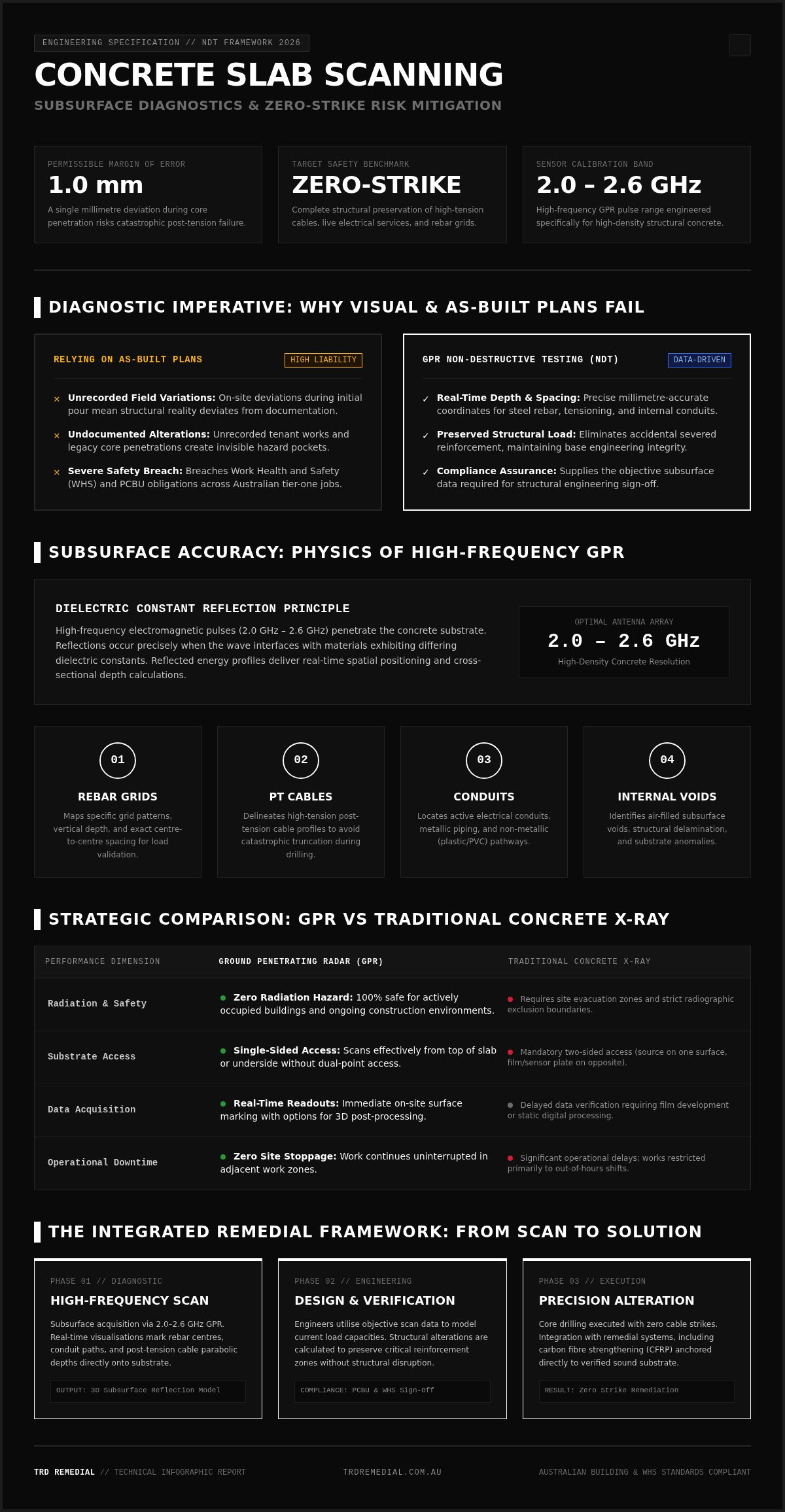
Modern concrete slabs are dense, complex systems. In 2026, the prevalence of reinforced and post-tensioned slabs means the internal layout is often congested and unpredictable. Relying on "as-built" structural drawings is a dangerous gamble. Site variations, undocumented changes, and construction errors often mean the physical reality doesn't match the paper plans. GPR is the industry standard for subsurface mapping because it provides real-time data on depth and object orientation with millimetre accuracy. By applying ground-penetrating radar principles, technicians can identify the exact location of reinforcement and conduits without damaging the substrate.
Compliance with Australian Building Standards
Slab scanning is not just a best-practice recommendation; it's a critical component of meeting Work Health and Safety (WHS) obligations on Australian sites. PCBU (Person Conducting a Business or Undertaking) responsibilities dictate that all foreseeable risks must be identified and managed. A strike on a post-tension cable isn't just a site delay. It's a major safety incident that can lead to structural collapse and severe injury.
Scanning provides the objective data required for engineering sign-off on remedial works. This is particularly vital during structural defect repair where the integrity of the existing slab is already under scrutiny. By verifying the subsurface conditions first, engineers can design reinforcement strategies, such as carbon fibre strengthening, with absolute confidence in the base material. This disciplined approach ensures that every alteration is compliant with national building standards and safe for the life of the structure.
Ground Penetrating Radar (GPR): The Science of Subsurface Accuracy
GPR technology operates by emitting high-frequency electromagnetic pulses into the concrete substrate. These waves travel through the medium until they encounter an object with a different dielectric constant, such as steel reinforcement, a plastic conduit, or an air-filled void. The antenna captures the reflected energy, allowing the system to calculate the object's depth and position. For high-density concrete slabs, we utilise high-frequency antennas, typically between 2.0 GHz and 2.6 GHz. This specific frequency range provides the resolution necessary to distinguish between closely spaced rebar and small-diameter conduits.
The precision of these nondestructive evaluation methods depends on the technician's ability to differentiate between various subsurface reflections. While modern equipment provides real-time visualisations for immediate on-site marking, complex projects often require post-processing. This involves exporting raw data into specialised software to create three-dimensional models. This level of detail is critical when planning intricate structural strengthening or navigating congested slabs where "blind" zones are a concern.
What a Slab Scan Can (and Cannot) Reveal
A professional slab scan identifies more than just the presence of steel. It maps the specific patterns, spacing, and depth of rebar, which is essential for calculating current load-bearing capacities. Beyond metal, GPR is highly effective at locating electrical conduits and PVC piping. This capability prevents service strikes that could lead to site-wide power failures or severe safety incidents. Technicians also look for anomalies like internal voids or honeycombing. These defects, if left unaddressed during structural alterations, can compromise the integrity of the concrete matrix.
Factors Affecting Scan Resolution
Environmental conditions on-site significantly influence data quality. High moisture content in "green" concrete or slabs exposed to heavy rain attenuates the electromagnetic signal. This reduces penetration depth and blurs the resulting imagery. Similarly, slabs with extremely dense reinforcement meshes can create "shadowing" effects. This occurs when the top layer of steel reflects the majority of the energy, making it difficult to "see" the elements located directly beneath.
Accuracy in these challenging conditions relies on the expert interpretation of signal hyperbolas. A seasoned specialist understands how to read these geometric curves to distinguish a secondary rebar layer from a high-voltage utility pipe. If your project involves high-risk penetrations, engaging a team that provides integrated slab scanning and core drilling ensures that data interpretation and physical execution are perfectly aligned. This disciplined approach eliminates the communication gaps that often lead to on-site errors.
Slab Scanning vs Concrete X-Ray: A Strategic Comparison
Choosing the correct diagnostic tool is a matter of operational safety and project efficiency. While both radiographic testing (X-ray) and Ground Penetrating Radar (GPR) serve to map subsurface elements, their logistical footprints differ significantly. Slab scanning via GPR has become the preferred non-ionising method for 2026 remedial projects. It eliminates the need for radioactive sources. This means site activities can continue without interruption. In contrast, X-ray requires stringent exclusion zones, often mandating site evacuations that cause costly delays to the construction programme.
The Federal Highway Administration NDE benchmark study confirms that GPR provides reliable depth and orientation data for reinforcement in a fraction of the time required for radiographic methods. Beyond safety, GPR offers superior operational efficiency. It only requires access to a single side of the concrete slab. X-ray requires access to both sides to place the film and the radiation source. This is often impossible in occupied commercial buildings or industrial facilities with limited clearance.
The Advantages of GPR for Remedial Works
GPR is the most versatile tool for active work sites. Because there is no radiation risk, technicians can perform scans while other trades remain in the immediate vicinity. This allows for a seamless transition to physical works. Once the subsurface layout is marked, crews can proceed immediately with core drilling or concrete cutting. This scan-to-action workflow is essential for keeping remedial projects on schedule. GPR equipment is also compact. This portability allows technicians to scan vertical walls and overhead soffits with the same precision as floor slabs.
When is X-Ray Still Necessary?
Radiographic testing remains a specialised tool for specific, high-resolution requirements. In extremely congested slabs where reinforcement meshes are layered tightly, X-ray can provide a clearer visual distinction between overlapping elements. It's also more effective at identifying certain non-metallic conduits that might have a dielectric constant too similar to the surrounding concrete for GPR to resolve clearly. However, the trade-off is significant. The logistical burden of clearing the site and the high cost of specialised radiographic equipment often outweigh the benefits for standard remedial applications. For the vast majority of structural alterations, high-frequency slab scanning provides the optimal balance of resolution, safety, and speed.
Managing High-Risk Post-Tension (PT) Slabs
Post-tensioned (PT) concrete slabs represent the highest risk category for subsurface penetrations. These systems aren't passive. They contain steel tendons stressed to extreme loads, storing massive amounts of potential energy within the concrete matrix. A single strike during core holing can lead to a violent release of this energy. This often results in concrete blowouts, structural instability, and immediate danger to site personnel. Professional slab scanning is mandatory for these environments to identify the specific layout and depth of the tendons before any work commences.
Accurate detection requires a technician who understands the unique hyperbolic signatures of PT cables on a GPR screen. Unlike standard rebar, which follows a predictable grid, PT tendons are often bundled and follow a parabolic path through the slab. This complexity demands a higher level of scanning precision and expert oversight to ensure that the data interpreted on-site matches the structural reality of the building.
The Anatomy of a Post-Tension Strike
The physical consequences of a cable strike are catastrophic. When a tendon is truncated, the tension is lost instantly. The cable can recoil through the slab, causing explosive spalling at the anchor points or along the cable path. If a strike occurs, immediate safety protocols must be activated. This includes cordoning off the area and engaging a structural engineer to assess the damage. In most cases, post tension slab repair is required to restore the lost structural capacity and prevent long-term structural failure.
Best Practices for Scanning PT Tendons
Mapping PT tendons involves more than just marking a line on the floor. Technicians must track the "drape" of the cable. This refers to the varying depth of the tendon as it moves from the top of the slab over support columns to the bottom of the slab at mid-span. Accurate slab scanning identifies these depth variations, allowing engineers to designate "no-go" zones around high-stress areas and anchor points.
Integrating this scan data with structural strengthening plans is the most effective way to mitigate risk. For projects involving complex PT systems, engaging a partner for integrated slab scanning and post-tension truncation provides the technical oversight needed to manage these high-stakes risks. This disciplined approach ensures that every alteration is backed by precise subsurface data, maintaining the integrity of the tensioning system throughout the remediation process.
The Integrated Remedial Approach: From Scan to Solution
TRD Remedial does not treat slab scanning as an isolated diagnostic task. It is the technical intelligence that dictates the safety and viability of every subsequent structural alteration. While generic scanning providers often stop at delivering a PDF report, our integrated model ensures that data flows directly into the execution phase. This eliminates the risk of misinterpretation during the handover between different trades. By maintaining a single point of accountability, we ensure that the subsurface reality found by the technician is exactly what the cutting crew respects on the tools.
This data-driven approach is particularly vital when designing carbon fibre strengthening systems. If a scan reveals that existing reinforcement is insufficient or has been compromised by previous works, we don't rely on generic assumptions. We use the precise mapping of rebar depth and spacing to engineer reinforcement solutions that are tailored to the slab's actual condition. This synergy between diagnostic scanning and structural repair ensures the long-term stabilisation of the asset.
Precision Core Drilling and Cutting
Translating 2D scan marks into a 3D structural reality on the slab requires disciplined field execution. When our teams perform deep core holing in critical infrastructure, they operate with the confidence that every subsurface element has been accounted for. Maintaining strict tolerances is not optional. It is a fundamental requirement for preserving the load-bearing capacity of the concrete. For concrete cutting in occupied commercial buildings, we implement rigorous safety protocols to manage vibration and noise. This allows for complex structural changes to proceed without compromising the safety of building occupants or the stability of adjacent structural elements.
Restoring Structural Integrity Post-Alteration
Major structural alterations often require a transition from demolition to reinforcement. The success of this transition depends on the accuracy of the initial subsurface map. There is a clear synergy between high-resolution scanning and successful concrete remediation. If a project requires the removal of structural sections, we provide the supplemental strengthening necessary to redistribute loads safely. Once the physical works are complete, final quality assurance checks verify that the structure meets all engineering specifications. This comprehensive process provides the documented compliance required for final sign-off, ensuring every modification is technically sound and risk-free.
Securing Structural Integrity for 2026 and Beyond
Effective structural alteration is built on the foundation of accurate data. Professional slab scanning via high-frequency GPR has moved beyond a safety precaution to become a non-negotiable diagnostic phase. By moving away from the logistical burdens of radiographic testing and embracing the precision of real-time subsurface mapping, you eliminate the guesswork that leads to service strikes and structural failures. It's especially critical in high-risk post-tensioned environments where the margin for error is non-existent.
TRD Remedial brings a specialist remedial engineering background to every project. We operate as a disciplined authority in complex environments, providing a comprehensive scan-to-repair service model that bridges the gap between data acquisition and physical execution. Our integrated approach ensures that every core hole, wall cut, and structural strengthening measure is technically sound and fully compliant with Australian standards. You can manage subsurface risks with absolute certainty and maintain a zero-strike record on every site.
Consult with TRD Remedial for precision slab scanning and structural alterations to ensure your next project is delivered with engineering rigour and architectural integrity.
Frequently Asked Questions
How deep can slab scanning accurately penetrate?
High-frequency GPR antennas typically penetrate up to 400mm to 500mm in standard reinforced concrete slabs. This depth is sufficient for mapping the majority of suspended slabs and ground-level floors found in Australian commercial buildings. Penetration depth is influenced by the concrete's dielectric properties, including moisture content and the density of the reinforcement mesh. If the slab exceeds these depths, lower frequency antennas can reach further, though this often results in a reduction of image resolution.
Is slab scanning 100% accurate in detecting all conduits?
While slab scanning is the most reliable non-destructive testing method available, no subsurface technology is 100% infallible. GPR is highly effective at detecting metallic reinforcement and live power conduits. However, non-metallic elements like PVC piping can be more challenging to resolve if their dielectric constant is similar to the surrounding concrete. Factors such as "shadowing" from dense top-layer rebar or high moisture levels can also obscure smaller targets. Expert interpretation remains essential to mitigate these technical limitations.
Can GPR scanning be performed on wet concrete?
GPR scanning cannot be performed effectively on wet concrete or standing water. Water is highly conductive and absorbs the electromagnetic energy emitted by the antenna, which prevents the signal from penetrating the slab. This results in poor data quality and "blind" zones. For new builds, "green" concrete that hasn't fully cured also presents challenges due to high internal moisture. It's best to wait until the surface is dry and the concrete has reached an appropriate maturity level before commencing.
What is the difference between GPR and a simple rebar locator?
A simple rebar locator, or covermeter, uses magnetic induction to detect metallic objects near the surface. It cannot identify plastic conduits, internal voids, or non-metallic structural elements. In contrast, slab scanning uses electromagnetic radar pulses to provide a comprehensive map of the subsurface. This includes depth data and the ability to differentiate between various materials. GPR provides the high-resolution imaging required for complex structural alterations where identifying more than just steel is a safety requirement.
Do I need to evacuate the building during a slab scan?
You don't need to evacuate the building or clear the site during a GPR slab scan. Unlike radiographic X-ray testing, GPR uses non-ionising electromagnetic pulses that pose no health risk to the operator or building occupants. This allows scanning to take place in active offices, hospitals, or industrial facilities without any disruption to daily operations. There are no exclusion zones required, meaning other trades can continue their work in the immediate vicinity while the scan is conducted.
How long does a typical commercial slab scan take to complete?
The duration of a scan depends on the complexity of the slab and the size of the area being investigated. A standard 1m x 1m grid for a single core hole typically takes between 30 and 60 minutes to complete, including the time required for on-site marking. Larger areas or complex structural mapping for wall cutting or carbon fibre strengthening will require more time. Our technicians work efficiently to provide real-time data, ensuring that site crews can proceed with physical works promptly.
What happens if the scan identifies a conflict with our proposed core hole?
If a scan identifies a conflict, such as a post-tension cable or a critical utility conduit, the technician will mark the obstruction and advise on a safe relocation. TRD Remedial provides an integrated service model where scan data informs our core drilling and cutting crews immediately. We work with your structural engineers to identify the nearest safe penetration point that maintains the structural integrity of the slab while meeting your project's mechanical or plumbing requirements.
Is slab scanning required by law for all concrete cutting projects?
Australian Work Health and Safety (WHS) laws don't explicitly name slab scanning as a legal requirement, but they do mandate that all foreseeable risks must be identified and managed. This includes the duty to locate and protect subsurface services and reinforcement before any invasive work begins. Failing to scan a slab before cutting or drilling often constitutes a breach of safety obligations. Most tier-one contractors and structural engineers now mandate scanning as a standard compliance protocol.


