

A failing expansion joint isn't just a cosmetic maintenance oversight; it's a structural liability that can compromise the long-term integrity of your entire asset. When a concrete expansion joint fails, the consequences are rarely limited to the surface. You've likely dealt with the persistent headache of water ingress in basement levels, dangerous trip hazards caused by joint spalling, or the recurring failure of generic sealants that simply can't handle the building's natural movement. It's a cycle of reactive repairs that often ignores the underlying mechanical stress and environmental pressure.
This technical guide provides the engineering protocols required to diagnose and remediate these critical points, ensuring a watertight, movement-capable system that meets Australian building standards. We'll move beyond temporary patches to explore disciplined solutions like slab scanning, pressure injection, and the selection of high-performance elastomeric materials. You'll learn how to stop concrete cancer and reinforcement corrosion at the source, securing the structural viability of your project for the long term.
Key Takeaways
- Understand the critical distinction between control and expansion joints to correctly manage structural movement and thermal expansion.
- Identify visual indicators of failure, such as edge spalling and sealant debonding, to mitigate the risk of concrete cancer and reinforcement corrosion.
- Utilise precise engineering protocols for concrete expansion joint remediation to ensure a watertight and movement-capable system.
- Recognise the necessity of slab scanning and meticulous substrate preparation before initiating repairs, particularly in sensitive post-tensioned slabs.
- Transition from reactive maintenance to permanent, high-performance remedial systems that comply with Australian building standards and industrial requirements.
Understanding the Role of Concrete Expansion Joints in Structural Integrity
A concrete expansion joint is a critical structural break that prevents uncontrolled cracking by accommodating multi-directional movement. Remedial specialists don't view these gaps as mere voids in a slab; they're the breathing components of a building's skeleton. Without these planned interruptions, the massive forces generated by thermal change and structural loading would have no outlet. This forces the concrete to relieve stress through irregular, destructive cracking.
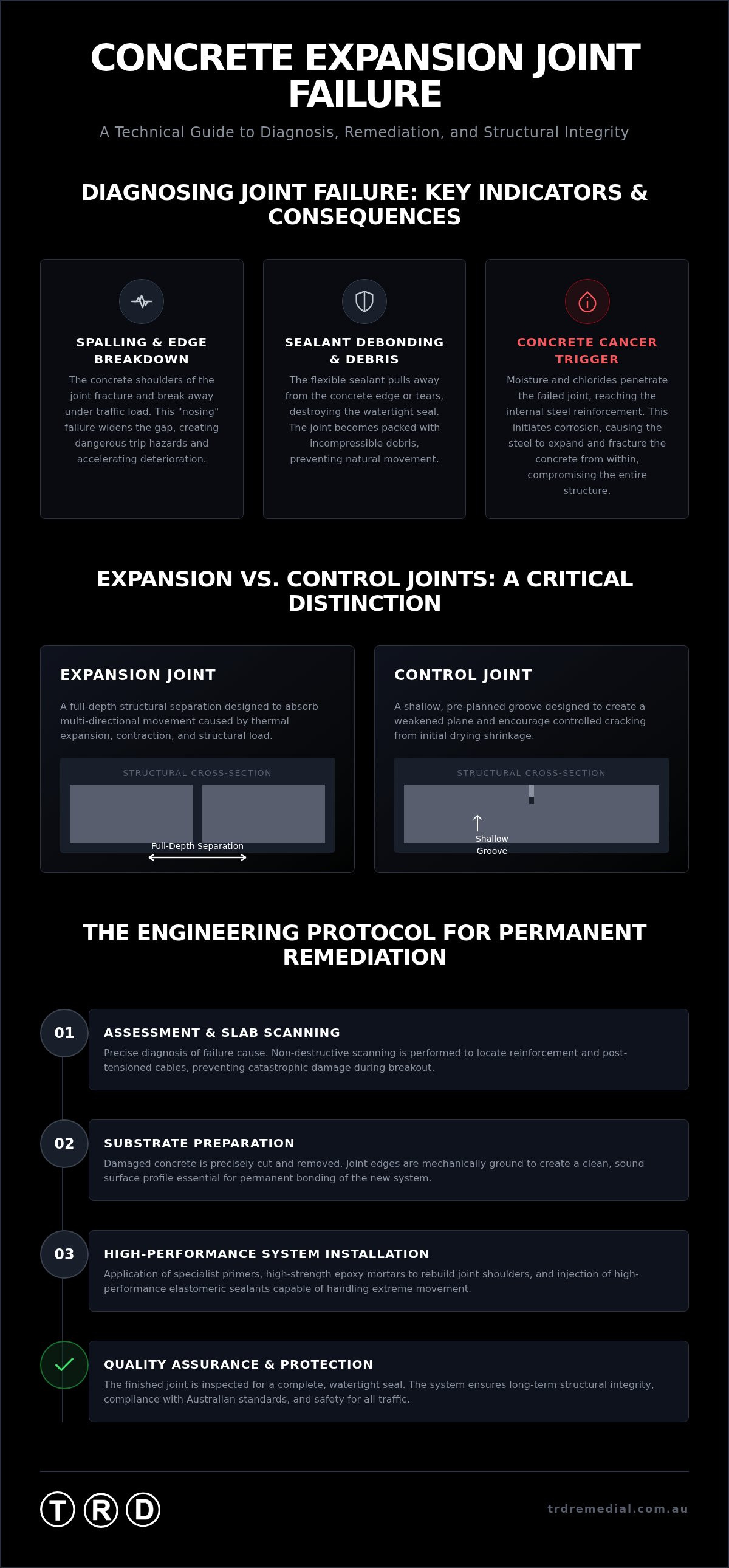
It's vital to distinguish between a standard control joint and a true expansion joint. While control joints are shallow grooves designed to manage initial drying shrinkage, a concrete expansion joint is a full-depth separation that allows independent movement between adjacent slab sections or between a slab and a fixed structure. Developing technical proficiency in this area is foundational to Understanding the Role of Concrete Expansion Joints in large-scale commercial and industrial assets.
Thermal Expansion and Structural Load
Concrete is a dynamic material. Temperature fluctuations in the Australian climate cause slabs to expand in the heat and contract in the cool. In an industrial setting, this movement is compounded by heavy machinery and intense point loads. If these movements aren't facilitated by functional joints, internal stresses build until the material reaches its breaking point. This often necessitates intensive concrete remediation to restore the integrity of the slab. Incorrect joint spacing or the use of non-compressible fillers leads to catastrophic failures, including buckling or severe concrete cancer when moisture exploits a failed concrete expansion joint.
Joint Types in Remedial Engineering
Precision in joint design varies based on the specific structural requirement. Isolation joints are used to decouple slabs from columns or footings, ensuring that settlement in one area doesn't drag down the entire floor. In contrast, construction joints are often cold joints where one pour ends and another begins. These may or may not be designed to move. Maintaining the specified joint width is particularly critical during structural alterations. Before any joint is cut or modified, slab scanning is a non-negotiable step to avoid striking reinforcement or post-tensioned cables, which would compromise the entire assembly.
Diagnosing Joint Failure: Why Remedial Intervention is Critical
A failed concrete expansion joint is a progressive structural defect. Left unaddressed, a minor sealant breach evolves into a systemic failure that compromises the entire slab. Diagnosis begins with identifying visual indicators such as spalling edges, sealant debonding, and debris infiltration. In industrial environments, these failures aren't just maintenance issues; they're operational bottlenecks. Compromised joints create significant floor safety risks, including trip hazards and damage to high-frequency forklift traffic.
The most severe consequence of joint failure is the "concrete cancer" link. When a joint no longer provides a watertight seal, moisture and chlorides penetrate deep into the structure. This leads directly to reinforcement corrosion. As the steel expands, it causes the surrounding concrete to fracture from within, necessitating urgent intervention to prevent total structural compromise. In multi-level car parks and basements, this water ingress can lead to secondary cracking and the deterioration of the sub-base. If you identify these indicators, consult a specialist remedial partner to assess the structural risk before the damage spreads.
Spalling and Edge Breakdown
The edges of a joint are its most vulnerable points. Under the pressure of heavy traffic loads, the concrete shoulders often experience "joint nosing" failure. This occurs when the material can no longer support the vertical shear forces of passing vehicles. As the edges break away, the gap widens, allowing more debris to enter and further restrict natural movement. This mechanical breakdown often accelerates the need for professional concrete crack repair to stabilise the surrounding slab sections before the damage becomes irreversible.
Sealant Debonding and Water Infiltration
Sealant failure typically manifests in two ways: adhesion failure, where the material pulls away from the concrete wall, or cohesion failure, where the sealant tears internally. Both scenarios allow water to bypass the joint system entirely. For post-tensioned slabs, this infiltration is particularly dangerous. Moisture reaching the PT anchors or tendons can lead to catastrophic structural instability. Addressing the root cause of debonding ensures that new sealants can withstand the physical realities of the site's environmental and mechanical demands. If slabs are rocking or unstable, surface-level repairs will fail; slab stabilisation must be the priority.
Selecting Remedial Joint Systems: Temporary vs. Permanent Solutions
Selecting the correct remediation system for a concrete expansion joint depends entirely on the building's current phase and its intended operational load. A standard sealant might suffice for a pedestrian walkway, but industrial and commercial assets require engineered materials that can withstand chemical exposure, thermal cycling, and heavy vehicle impact. In remedial engineering, we categorise these solutions into temporary systems designed for active construction phases and permanent systems intended for the remaining life of the asset.
Specialist environments demand even higher tiers of technical performance. For instance, cold storage facilities or chemical processing plants require joint systems that remain flexible at sub-zero temperatures or resist corrosive spills. Temporary moving joints are essential during remedial phasing to manage loads before final structural strengthening is complete. This strategic approach ensures the structure can breathe during alterations without risking edge failure or secondary cracking.
Temporary Moving Joint Repairs
Managing slab movement during complex remediation is a high-stakes task. When a building is undergoing structural changes, slabs often experience unpredictable shifts that generic, rigid fillers cannot accommodate. These off-the-shelf products fail in active "moving" environments because they lack the necessary elongation properties, leading to immediate debonding. Our approach involves stabilising joints with high-performance elastomers that protect the joint shoulders while allowing the slab to find its new equilibrium. This prevents the spalling and debris infiltration discussed in earlier stages of the diagnosis.
Permanent High-Performance Systems
Once the structure has reached a state of stability, we transition to permanent systems tailored to the site's specific demands. These systems are selected based on their mechanical properties and compliance with Australian building standards:
- Polyurethane (PU) Sealants: These offer superior flexibility and durability for joints that experience significant thermal movement, particularly in exterior slabs and car parks.
- Epoxy-based Joint Fillers: In high-impact industrial floors, semi-rigid epoxy fillers are used to support the joint edges against hard-wheeled forklift traffic, preventing the "dishing" that leads to floor failure.
- Fire-rated Joint Systems: Compliance in commercial assets often requires joints to serve as fire barriers. These specialised systems use intumescent materials to block the passage of flame and smoke through structural gaps.
Choosing the wrong material at this stage is a primary cause of recurring failure. A disciplined assessment of movement range and traffic type is the only way to ensure a permanent, watertight result for every concrete expansion joint within the facility.
The Remedial Process: Engineering Precision in Joint Restoration
Remediating a concrete expansion joint is a disciplined engineering sequence that requires more than a simple "clean and fill" approach. Success depends on a rigorous five-step protocol designed to ensure the joint functions as a dynamic structural component rather than a static plug. This process begins with technical diagnosis and movement analysis to determine the actual thermal and structural demands on the slab. Following this, the substrate undergoes mechanical preparation, backing rods are installed to control sealant depth, and specialist remedial sealants are applied under controlled conditions. The sequence concludes with quality assurance and compliance testing to verify the system meets Australian building standards.
Preparation: The Key to Longevity
Mechanical grinding of the joint walls is non-negotiable for long-term performance. We use diamond-tipped equipment to remove old sealants, contaminants, and laitance, creating a pristine profile for chemical bonding. Without this step, even the most expensive high-performance materials will suffer from adhesion failure. Following mechanical cleaning, we apply site-specific primers to stabilise the concrete surface and enhance the bond strength. In complex commercial environments, we utilise slab scanning to map reinforcement and post-tensioned cables. This ensures that any necessary joint widening or edge repair is conducted without compromising the structural core of the slab.
Sealing Techniques for Movement
The physics of joint movement dictates the application technique. A successful concrete expansion joint repair relies on achieving two-point adhesion, where the sealant bonds only to the side walls and not the bottom of the joint. We achieve this by installing a closed-cell backing rod, which acts as a bond breaker and defines the sealant's depth. This creates the essential "hour-glass" shape in the sealant bead, allowing it to stretch and compress without tearing. We strictly manage the width-to-depth ratio, typically 2:1 for most elastomeric materials, to maximise elasticity. If the sealant "bottoms out" and achieves three-point adhesion, it cannot move freely. This leads to internal stress and premature cohesion failure. To ensure your asset is protected by these precise engineering standards, request a technical assessment from our remedial engineering team today.
Quality assurance is the final pillar of the process. We verify that every linear metre of the joint is free from voids or air pockets that could allow water ingress. This methodical approach transforms a failing gap into a reliable, movement-capable system that prevents the secondary structural defects discussed in previous sections.
Specialist Remediation for Complex Commercial and Industrial Joints
Complex assets like multi-level car parks and high-bay warehouses present unique challenges for a concrete expansion joint. Standard maintenance often fails because it ignores the specific mechanical and chemical stresses of these environments. Industrial warehouse floors require joint systems that protect edges against the relentless impact of hard-wheeled machinery. Without engineered protection, joint nosing failures become a constant source of floor safety risks and operational downtime. We provide disciplined, engineered solutions that address these structural realities rather than offering temporary surface patches.
Post-Tensioned (PT) Slab Considerations
Post-tensioned slabs introduce a high level of risk during remediation. The joints in these structures interact directly with PT cable anchors; any failure here allows moisture to reach critical high-tensile steel. When moisture penetrates these points, the risk of corrosion is a precursor to catastrophic anchor failure. Professional post tension slab repair becomes necessary when failed joints are ignored. Maintaining structural integrity during joint deepening or widening requires absolute precision. We ensure that the structural core remains untouched through meticulous slab scanning and technical planning.
In car park environments, the primary threat is water ingress combined with chemical exposure from oils and automotive fluids. A concrete expansion joint in these structures must remain watertight while resisting these corrosive elements. Failure leads to secondary cracking and concrete cancer in the slabs below. Our engineered solutions prioritise high-performance elastomers that bond securely to the substrate. This creates a resilient barrier that handles both intense thermal movement and aggressive chemical attack.
Asset Protection and Maintenance
Strata managers and industrial facility owners should move away from reactive fixes. Developing a proactive joint maintenance schedule identifies minor sealant debonding before it necessitates major structural alterations. The ROI of professional remediation is clear; it eliminates the recurring costs of temporary patches and prevents the expensive reality of concrete cancer. We act as a strategic partner to ensure your joints remain movement-capable and watertight throughout the building's lifecycle. To secure your asset's longevity, Consult with TRD Remedial for a technical assessment of your structural joints.
The TRD Remedial advantage lies in our ability to manage the intersection of technical diagnosis and high-performance execution. We don't just fill gaps; we restore the structural intent of the joint system. This methodical approach ensures that your commercial or industrial asset remains compliant with Australian building standards while avoiding the operational disruptions caused by joint failure.
Securing the Long-Term Viability of Your Structural Assets
Remediating a failing concrete expansion joint is a structural necessity that demands engineering rigor. We've established that successful restoration relies on more than surface-level aesthetics; it requires a disciplined sequence of technical diagnosis, precise mechanical preparation, and the application of movement-capable systems. By transitioning from reactive maintenance to permanent, high-performance solutions, you effectively mitigate the risks of concrete cancer and reinforcement corrosion that threaten the core of your facility.
TRD Remedial stands as a disciplined authority in this field, providing engineered solutions for complex building defects. As specialists in temporary and moving joint repairs, we offer comprehensive remedial contracting across Australia to ensure your assets remain compliant and operational under intense structural loads. Don't let minor joint failures evolve into systemic liabilities. Contact TRD Remedial for Specialist Joint Remediation to receive a technical assessment tailored to your project's specific mechanical demands. Protecting your structure today prevents the costly, catastrophic failures of tomorrow.
Frequently Asked Questions
What causes a concrete expansion joint to fail prematurely?
Incorrect material selection, poor substrate preparation, and excessive mechanical load cause premature failure. If the joint walls aren't mechanically ground or the sealant lacks the necessary elongation, debonding occurs. In industrial settings, hard-wheeled traffic often crushes joint shoulders that aren't supported by semi-rigid fillers. Environmental factors like UV exposure and chemical spills also accelerate degradation if the system isn't specifically rated for those site conditions.
Can I use a standard silicone sealant for a structural expansion joint?
No, standard silicone sealants are generally unsuitable for structural expansion joints in industrial or commercial assets. These joints require high-performance elastomers, such as polyurethane or specialist polyurea, which offer superior tear resistance and adhesion strength. Structural joints must accommodate significant thermal and mechanical movement that exceeds the capability of domestic-grade silicone. Using the wrong material leads to immediate cohesion failure and compromises the structural integrity of the slab.
How often should commercial expansion joints be inspected and resealed?
Commercial assets should undergo a technical inspection every 12 to 24 months to identify early signs of sealant debonding or edge spalling. The actual resealing frequency depends on the environment; high-traffic industrial floors may require remediation every five years, while sheltered commercial joints might last a decade. Proactive monitoring allows for minor repairs before water ingress causes reinforcement corrosion, ultimately extending the life of the concrete expansion joint system.
What is the difference between an expansion joint and a control joint?
An expansion joint is a full-depth structural break designed to allow independent movement between slab sections, whereas a control joint is a shallow groove intended to manage initial drying shrinkage. Control joints only address internal tension within a single slab. Expansion joints are critical for accommodating large-scale thermal expansion and structural shifts. Confusing the two often leads to uncontrolled cracking because the structure cannot breathe as intended by the engineer.
Why is water leaking through my basement expansion joint?
Leaks typically occur due to sealant failure or the absence of a functional waterstop within the joint. Over time, sealants lose their elasticity or debond from the concrete walls, creating a direct path for hydrostatic pressure to force groundwater into the basement. This is a critical issue that requires urgent intervention, such as polyurethane injection or curtain wall injection, to prevent the moisture from reaching reinforcement and causing systemic structural decay.
Is it possible to repair a joint while the building is still in use?
Yes, it's entirely possible to remediate joints while a building remains operational. We use fast-curing polyurea or epoxy systems that allow for rapid return-to-service, often within hours of application. By phasing the work and utilising dust-extraction equipment during mechanical preparation, we minimise disruption to tenants or warehouse operations. This approach ensures that safety and structural integrity are restored without requiring a total facility shutdown or significant loss of productivity.
What are temporary moving joints, and when are they required?
Temporary moving joints are specialist remedial systems used during structural alterations or building remediation to manage active loads. They're required when a structure is in transition and slabs are experiencing unpredictable shifts that permanent, rigid systems cannot yet handle. These joints provide a flexible bridge that prevents edge spalling and secondary cracking while structural strengthening, such as carbon fibre application, is being completed to stabilise the overall asset.
Does a failed expansion joint lead to concrete cancer?
Yes, a failed concrete expansion joint is a primary catalyst for concrete cancer. When the joint seal is compromised, water and chlorides penetrate the slab and reach the internal steel reinforcement. This causes the steel to rust and expand, creating internal pressure that results in spalling and structural fracturing. Resolving joint failures early is the most effective way to prevent the expensive and complex process of full-scale reinforcement remediation.


