

Cutting into a reinforced concrete slab without a verified map of its internal layout is a gamble that no professional project manager can afford to take. The energy stored within a live tendon is immense. A single accidental strike during core drilling or wall cutting can trigger immediate structural failure or life-threatening injury on site. When you are managing remedial works, locating post tension cables is the most critical phase of your safety protocol. You already know that original as-built drawings are frequently unreliable, as site deviations during the initial construction phase are often left undocumented.
This guide provides the precise, non-destructive protocols required to identify subsurface reinforcements with absolute confidence. We will detail the specialist slab scanning methodologies that ensure your project remains compliant with rigorous structural engineering requirements. You will learn how technical expertise and advanced GPR technology combine to produce a definitive map of the concrete interior. This overview ensures total safety during subsequent core holing or structural alterations, protecting both the integrity of the building and the safety of your workforce.
Key Takeaways
- Understand the critical structural risks associated with tensioned cables and why they require more stringent safety protocols than standard rebar.
- Identify the most effective non-destructive testing technologies, including GPR and radiography, to achieve high-precision results on complex slabs.
- Master the professional sequence for locating post tension cables, from establishing a reference grid to capturing comprehensive 3D data.
- Learn how to translate raw scanning data into actionable site maps that define safe zones for core drilling and concrete cutting.
- Recognise the importance of an integrated remedial approach that prioritises structural integrity throughout the entire scanning and truncation process.
The Critical Importance of Locating Post-Tensioned Cables
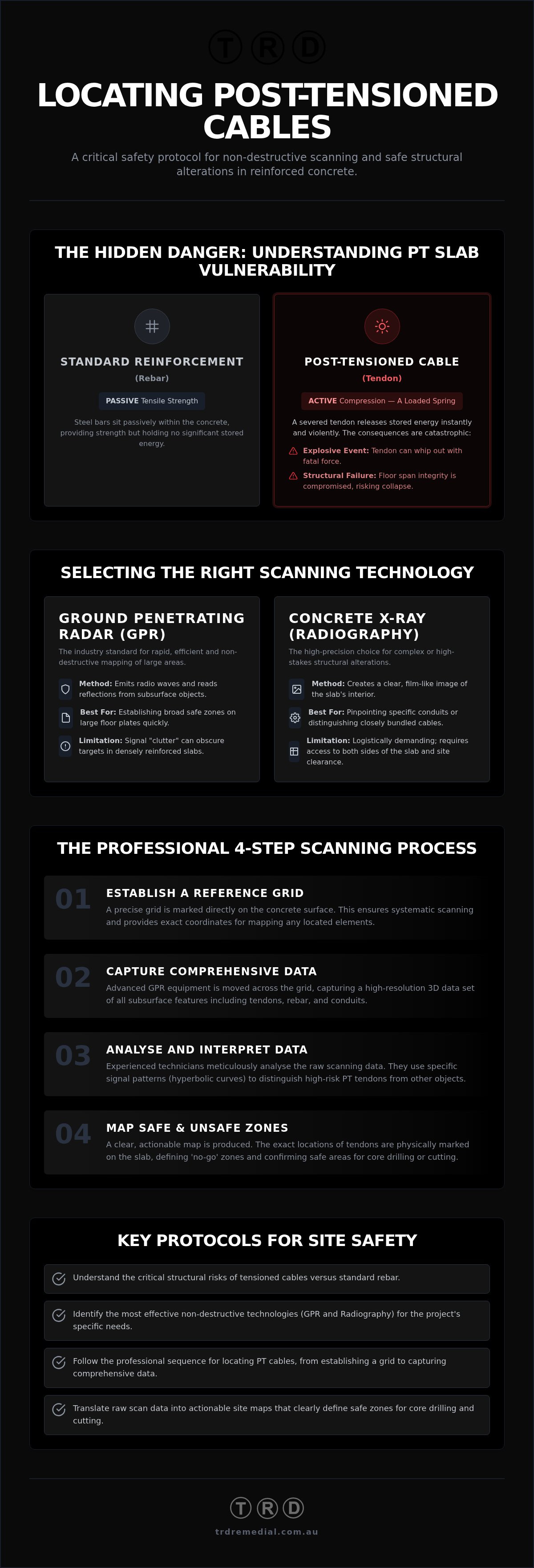
Unlike standard reinforced concrete where steel bars provide passive tensile strength, post-tensioned concrete relies on active compression. High-strength steel tendons are placed inside protective ducts and stressed to immense levels once the concrete has achieved sufficient strength. Visualise these cables as a loaded spring held under thousands of kilograms of tension. If a technician accidentally severs one of these tendons during core drilling or concrete cutting, that stored energy is released instantly and violently.
The consequences of a cable strike are often catastrophic. It's not merely a broken wire; it's an explosive event. The tendon can whip out of the slab with enough force to penetrate internal walls or cause fatal injuries to site personnel. Beyond the immediate physical danger, the structural integrity of the entire floor span may be compromised, leading to costly emergency repairs or even partial collapse. Relying on original as-built drawings for locating post tension cables is a high-risk strategy. Construction site realities frequently mean cables were diverted around penetrations or structural features during the pour, and these deviations are rarely documented on the final plans.
Understanding PT Slab Vulnerability
Post-tensioning allows engineers to design thinner slabs with significantly longer spans between columns. While this is efficient for modern high-rise construction, it leaves a smaller margin for error during remedial works. If moisture penetrates the slab through cracks or poor sealing, it can lead to tendon corrosion. This degradation is a serious form of concrete cancer that requires expert concrete remediation to ensure the asset's longevity. Before any slab penetration occurs, you must have absolute certainty of the cable profile to avoid compromising a structure that is already under significant stress.
Regulatory and Safety Compliance
Builders and contractors have strict work health and safety obligations to identify all subsurface hazards before commencing any invasive work. Locating post tension cables is a mandatory safety protocol, not an optional extra. Most structural engineers will refuse to certify new core holes or structural alterations without a comprehensive, non-destructive scan report. This documentation proves that the proposed works will not interfere with the primary load-bearing elements of the building, ensuring both legal compliance and site-wide safety.
Selecting the Right Technology for PT Cable Detection
Choosing the right tool for locating post tension cables is a matter of balancing speed, safety, and required resolution. Ground Penetrating Radar (GPR) has emerged as the industry standard for most remedial projects due to its non-destructive nature and immediate data feedback. However, certain high-stakes structural alterations may demand the surgical precision of radiography. Selecting the wrong method doesn't just waste time; it can lead to inaccurate markings that jeopardise the entire project's safety profile.
Ground Penetrating Radar (GPR) Explained
GPR units emit high-frequency radio waves into the concrete. These waves reflect off objects with different dielectric constants, such as steel tendons, plastic conduits, or air voids. It's exceptionally fast; a technician can map hundreds of square metres in a single shift. This speed makes it the preferred choice for establishing broad safe zones on large floor plates. While efficient, GPR can struggle in slabs with extremely dense reinforcement where signal "clutter" obscures deeper targets. In these complex environments, an experienced operator must carefully calibrate the equipment to distinguish between standard rebar and the specific hyperbolic curves of PT tendons.
Concrete X-Ray vs GPR
Concrete X-ray provides a clear, film-like image of the slab's interior. It's the superior choice for identifying specific conduit types or distinguishing between closely bundled cables that GPR might read as a single mass. The logistical burden is higher. You need access to both the top and bottom of the slab to place the film and the source. Because it uses ionising radiation, the site must be cleared of all personnel during the exposure, which often necessitates night works or weekend scheduling. For most commercial projects, professional slab scanning using advanced GPR offers the best balance of accuracy and site productivity.
| Feature | Ground Penetrating Radar (GPR) | Concrete X-Ray (Radiography) |
|---|---|---|
| Safety Requirements | Minimal (Non-ionising) | Stringent (Radiation exclusion zone) |
| Access Requirements | Single-side access | Dual-side access required |
| Data Delivery | Real-time 2D/3D imaging | Delayed (Film processing required) |
| Resolution | High (Sufficient for most PT cables) | Ultra-high (Superior for fine detail) |
Electromagnetic (EM) sensors serve as a vital secondary verification tool during the process of locating post tension cables. They detect the magnetic field of live power cables, ensuring that the scanning data doesn't just identify structural steel but also helps avoid active utilities. Using a multi-tool approach ensures that every subsurface element is accounted for before the first drill bit touches the concrete.
Step-by-Step: The Professional Process for Locating PT Cables
A successful scan begins long before the sensor touches the concrete. Precision is non-negotiable. Locating post tension cables requires a methodical, repeatable protocol that eliminates guesswork and accounts for the unique drape of tensioned tendons. This process transforms raw electronic signals into a physical map that site teams can follow with absolute confidence.
Preparation and Site Assessment
The first step involves clearing the work area of all debris and floor coverings. For GPR to provide accurate depth readings, the sensor must maintain consistent contact with the slab surface. Technicians establish a reference grid using a fixed coordinate system. This ensures that every data point can be precisely mapped back to the physical slab. During this phase, we also identify the "live ends" and "dead ends" of the post-tensioning system. Knowing where the cables were originally stressed allows the technician to predict the likely cable trajectory and depth variations throughout the span.
Scanning and On-Site Marking
Technicians perform a series of methodical cross-grid scans. We capture data in both longitudinal and transverse directions to ensure no reinforcement is missed. As the scanner moves, it generates real-time data where cables appear as distinct "hyperbola" signatures. The technician interprets these curves to determine the exact centre and depth of each tendon. We then mark the slab surface using a standardised colour-coded system:
- Red: Post-tension cables (No-go zones).
- Blue: Standard reinforcing steel (rebar).
- Yellow: Electrical conduits or subsurface utilities.
These markings include depth notations to inform the site team of the concrete cover available above the reinforcement.
Final Reporting and Approval
Once the physical marking is complete, the data is compiled into a digital scan report. This document provides a permanent record of the subsurface environment for the project's structural engineer. The engineer reviews this map to issue a formal "permit to drill," ensuring that any proposed core holes or structural alterations won't compromise the building's load-bearing capacity. If a cable is found to be damaged or corroded during this process, the project must pivot to a specialised post tension slab repair strategy to restore structural integrity before work continues.
Interpreting Scanning Data for Structural Alterations
Interpreting scan data is where technical theory meets site reality. A raw GPR image is merely a collection of hyperbolic curves; it requires a seasoned specialist to translate those signals into a definitive structural map. When locating post tension cables for remedial works, the objective is to find clear passage for new penetrations while maintaining the slab’s load-bearing capacity. Real-time interpretation is critical. A specialist on-site can immediately identify "no-go zones" where cable density is too high for safe penetration. This allows for instant adjustments to the project plan rather than waiting days for a back-office report. Expert interpretation also helps distinguish between the high-amplitude reflections of steel and the softer signals of plastic conduits, preventing unnecessary delays.
Planning Core Drilling and Wall Cutting
Once the cables are marked, any proposed core drilling must be offset by a strict safety margin, typically a minimum of 50mm from the edge of the tendon duct. This buffer accounts for potential signal drift or slight deviations in the cable’s path. We recommend "spot scanning" the exact entry point immediately before the drill bit touches the concrete. This final verification step ensures that the marking remains accurate and that no subsurface utilities have been overlooked. If the scan reveals a cable "bundle" rather than a single tendon, the exclusion zone must be expanded accordingly to prevent any risk of a multi-cable strike.
Structural Strengthening Requirements
In some complex structural alterations, cutting through a PT cable is unavoidable to accommodate a new stairwell or lift shaft. In these scenarios, scan data is vital for designing an engineered carbon fibre strengthening system. By precisely locating post tension cables in the surrounding slab, engineers can determine exactly where to apply external reinforcement to pick up the loads previously carried by the severed tendons. This synergy between scanning and strengthening ensures the building remains stable throughout the modification process. The data also informs the placement of anchors for the carbon fibre, ensuring the new reinforcement is securely bonded to the original structure without hitting remaining tendons.
For precise subsurface mapping that protects your structural assets, contact the experts at TRD Remedial today.
Why TRD Remedial is the Leading Choice for PT Slab Management
TRD Remedial operates as a disciplined authority in the structural concrete sector. We recognise that locating post tension cables is the foundation of a much larger engineering process. Many firms offer scanning as a standalone service; however, we provide an integrated solution that bridges the gap between diagnostic data and structural execution. Our team doesn't just identify a cable's location. We understand its specific role in the building's load-bearing system. This comprehensive perspective ensures that every decision made on-site prioritises the long-term stability and safety of the asset.
Our technical mastery extends to the most high-risk aspects of concrete works, including post tension truncation and complex structural alterations. We don't shrink from complexity. Instead, we apply engineering rigour to ensure that every slab penetration is executed without compromising the tensioned system. This commitment to quality and safety has made us the preferred partner for projects where the margin for error is zero. We provide the steady, methodical expertise required to manage the immense energy stored within PT slabs, ensuring site safety and structural integrity are never at risk.
Beyond Scanning: The Remedial Advantage
Our deep expertise in concrete crack repair provides us with a unique advantage when interpreting subsurface data. We see the early signs of structural stress or corrosion that a standard scanning technician might overlook. By offering a single point of accountability, we eliminate the communication gaps that often occur between different contractors. Whether you require initial slab scanning, precise core holing, or the repair of structural defects, our team manages the entire sequence with technical precision. This end-to-end service model ensures that the safety protocols established during locating post tension cables are strictly maintained throughout the physical works.
National Capability and Professional Service
TRD Remedial delivers specialist technical concrete services across Australia. We operate as a reliable partner alongside builders, structural engineers, and strata managers to solve the most difficult structural challenges. Our proven track record across residential, commercial, and industrial sectors demonstrates our ability to deliver lasting results in any environment. We excel under pressure and provide the quiet confidence that only comes from years of veteran experience in the remedial field. Our focus remains on compliance, precision, and the long-term viability of every project we handle.
Enquire with TRD Remedial for specialist PT slab scanning and remediation today.
Securing Your Structure Through Technical Precision
Managing the complexities of post-tensioned slabs requires more than just high-frequency radar; it demands an engineering-led approach to safety. You now understand that locating post tension cables is a critical prerequisite for any structural alteration, as relying on outdated drawings introduces unacceptable liability. By combining advanced GPR technology with specialist interpretation, you can map subsurface hazards with absolute certainty and ensure compliance with rigorous engineering standards.
TRD Remedial provides the disciplined authority needed for these high-stakes projects. As specialists in post tension truncation and engineered solutions for structural defects, we provide a single point of accountability across our national service coverage. We bridge the gap between scanning data and physical execution, ensuring your site remains secure from the first scan to the final core hole.
Contact TRD Remedial for Expert Slab Scanning and Structural Remediation
Your project's safety and longevity depend on technical mastery. Ensure your next slab penetration is backed by the industry's most reliable protocols and a partner ready to act on critical structural needs.
Frequently Asked Questions
Can you drill into a post-tensioned slab without scanning?
Drilling into a post-tensioned slab without prior scanning is a violation of standard safety protocols and carries extreme risk. Unlike standard rebar, PT cables are under immense tension; a strike can cause an explosive release of energy. This can lead to immediate structural failure, equipment damage, and life-threatening injuries. Professional scanning is mandatory to establish safe zones before any invasive work like core drilling or concrete cutting begins.
How deep can GPR see into a concrete slab to find PT cables?
Modern Ground Penetrating Radar systems typically achieve a depth penetration of 400mm to 600mm in standard concrete. The exact depth depends on the concrete's moisture content, density, and the frequency of the GPR antenna used. For most suspended slabs and structural floor plates, this range is more than sufficient for locating post tension cables and mapping the full profile of internal reinforcements before structural alterations commence.
What happens if a post-tension cable is accidentally cut?
If a cable is severed, the stored tension is released instantly, often causing the tendon to snap back through the slab like a high-velocity whip. This can blow out chunks of concrete, penetrate walls, and cause catastrophic injury to workers. The slab's load-bearing capacity is immediately compromised. In such events, specialist post tension truncation and structural strengthening are required to stabilise the area and restore the building's structural integrity.
How accurate is slab scanning for locating PT cables?
High-frequency GPR is exceptionally accurate, typically identifying the horizontal position of a tendon within a margin of 10mm to 20mm. Depth accuracy is generally within 10% of the total slab thickness. While the technology is precise, the results depend heavily on the technician's ability to interpret complex signal hyperbola. Using a specialist ensures that the data correctly distinguishes between rebar, conduits, and the specific drape of post-tensioned tendons.
Is it possible to scan through floor tiles or carpet?
GPR can effectively penetrate most floor finishes, including ceramic tiles, vinyl, and timber. However, thick carpet and heavy underlay can sometimes create an air gap that degrades the signal quality. For projects requiring maximum precision, we recommend removing floor coverings to allow the sensor to maintain direct contact with the concrete. This ensures the clearest possible imaging when locating post tension cables in congested or high-stakes structural environments.
Why do I need a specialist for PT scanning instead of a general locator?
General utility locators are typically trained to find pipes and cables in the ground, but they often lack the structural engineering knowledge required for internal slab analysis. Post-tensioned systems have a specific parabolic drape that varies in depth across the span. A specialist remedial contractor understands these structural nuances and can provide the technical interpretation needed to safely plan structural alterations, core holing, and concrete repairs without risking a tendon strike.
Do I need a structural engineer if I have a slab scan report?
Yes, a structural engineer must review the scan report to certify that the proposed penetrations won't compromise the building's load-bearing capacity. While the scan identifies the physical location of the cables, the engineer assesses the structural impact of working near those elements. This collaboration is essential for obtaining a formal "permit to drill" and ensures that all works remain compliant with Australian building standards and safety regulations.
How long does a typical PT slab scan take to complete?
The duration of a scan depends on the area's size and the complexity of the reinforcement. A standard 2m x 2m grid for a single core hole typically takes about one to two hours to scan, interpret, and mark out. Larger floor plates or areas with high cable density require more time for methodical cross-grid passes. Our technicians work efficiently to provide real-time data, allowing site teams to proceed with minimal delays.


