

What if the hairline crack in your concrete slab isn't just a minor cosmetic flaw, but a sign that a high-energy structural failure is already in motion? It's common to feel a sense of dread when you spot structural anomalies, especially when you're trying to distinguish between standard concrete cancer and the far more volatile reality of post tension cable damage. This isn't a situation where a simple patch job will suffice. We're dealing with immense stored energy that demands a disciplined, technical response.
The uncertainty regarding immediate building safety and the fear of escalating remediation costs can be paralysing for any facility manager or strata committee. You need to know exactly what you're looking at before you commit to a repair strategy. This article will help you discover the critical structural risks associated with post-tension cable failure and explain why specialised, engineered remedial intervention is non-negotiable for building safety.
We'll provide a clear identification guide for cable damage, debunking common myths while highlighting the rigorous requirements of the 2025 ACI-PTI 320-25 Building Code. By the end, you'll have the technical confidence to choose a stabilising solution that prioritises compliance and long-term structural health over temporary fixes.
Key Takeaways
- Understand why post-tensioned concrete is an active reinforcement system that relies on high-tensile steel cables to maintain the building's structural integrity.
- Learn to identify the specific visual indicators of post tension cable damage, such as blowout patterns and anchor distress, before they escalate into catastrophic failures.
- Recognise the explosive risks of sudden cable release and why these high-energy systems require immediate engineered stabilisation rather than cosmetic patching.
- Discover why professional slab scanning is a mandatory safety protocol before any core drilling or concrete cutting to prevent accidental cable strikes and operator injury.
- Gain insight into the specialised remediation process, including cable truncation and the installation of new anchorages, to restore the long-term viability of the structure.
Understanding Post-Tensioned Concrete: More Than Just Reinforcement
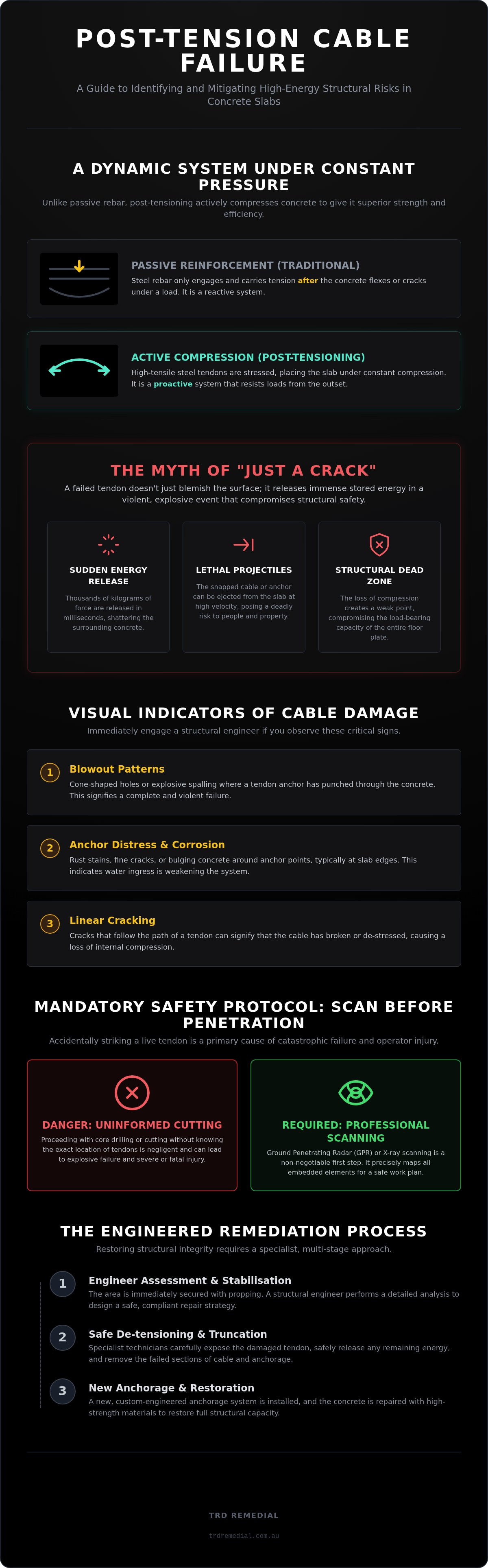
Post-tensioning is not a passive additive; it is a dynamic engineering system. Traditional reinforced concrete relies on steel bars to catch loads only after the concrete begins to flex or move. In contrast, What is Post-Tensioned Concrete is defined by its active state, applying a constant compressive force that transforms the material into a high-performance structural element. This internal pressure is what gives the slab its strength and durability.
In the Australian construction sector, particularly within commercial and residential high-rises, this method is preferred for its efficiency. It allows for thinner floor plates and expansive, column-free spans. While the terms "cable" and "tendon" are often used interchangeably, a specialist in a remedial building context will typically refer to the entire assembly, including the duct and anchors, as the tendon system. Understanding this distinction is vital when assessing structural health.
The Mechanics of a Post-Tensioned Slab
The process involves laying high-tensile steel cables in a specific profile before the concrete pour. Once the concrete cures and reaches a predetermined strength, technicians use hydraulic jacks to stress these cables to precise loads. This compression enables the slab to resist gravity loads more effectively than passive rebar, though it also means that any post tension cable damage can have immediate, cascading effects. Pre-stressing is the foundational principle that allows a concrete slab to maintain its structural integrity under extreme tension.
Myth: PT Slabs Are Indestructible
There is a persistent misconception that the high strength of PT slabs makes them immune to structural issues. This is a dangerous assumption. While the concrete itself is robust, the individual cable anchors are vulnerable to corrosion, water ingress, and mechanical interference. Internal tension represents a permanent, stored energy state. Consequently, post tension cable damage is never a minor issue; it is a critical failure that can lead to the sudden, violent release of force within the structure. Maintaining the integrity of these anchors is just as important as the strength of the concrete they reinforce.
Debunking the 'Just a Crack' Myth: The Physics of Cable Failure
Viewing a crack in a post-tensioned (PT) slab as a mere aesthetic issue is a dangerous oversight. In standard reinforced concrete, a crack might indicate settlement or thermal shrinkage. However, in a PT system, surface fissures often signal that the internal equilibrium has been compromised. When post tension cable damage occurs, the stored energy within the tendon is released with violent force. This isn't a gradual failure; it's an explosive event that can compromise the safety of the entire floor plate.
A sudden cable snap releases thousands of kilograms of force in milliseconds. This energy must go somewhere. Often, the cable or its anchor assembly becomes a projectile, punching through the concrete or exiting the edge of the slab. This poses a lethal risk to anyone in the immediate vicinity. Even if the cable remains contained, the shockwave typically causes significant secondary spalling, shattering the surrounding concrete and leaving the reinforcement exposed to the elements. This is why immediate structural strengthening assessment is critical when anomalies appear.
The Danger of High-Tensile Energy Release
To understand the risk, compare a stressed PT cable to a heavy-duty industrial spring compressed to its limit. If that spring snaps, the reaction is instantaneous and destructive. A failed tendon doesn't just lose its own capacity; it creates a "dead zone" in the slab where the concrete is no longer under compression. This loss of force leads to immediate structural instability. If a blowout is suspected, establishing a safety perimeter is the first priority. Only a qualified specialist should access the area to begin the diagnostic process.
Myth: If the Slab Hasn't Sagged, It's Safe
One of the most common misconceptions is that a lack of visible sagging means the structure is secure. In reality, modern slabs are designed with enough redundancy that adjacent tendons will temporarily absorb the unplanned stress of a failed neighbour. This "redistribution of loads" prevents immediate collapse but accelerates the fatigue of the remaining cables. Over time, this leads to long-term creep and excessive deflection. Structural failure is rarely a single moment in time; it's a slow, compounding process that starts the second a cable snaps. Professional Engineered Remediation is required to restore the design intent and prevent a localised failure from becoming a building-wide crisis. Addressing post tension cable damage early is the only way to avoid the astronomical costs of a full-scale structural overhaul later.
Signs of Post-Tension Cable Damage: Identifying Critical Failure Points
Identifying post tension cable damage requires a methodical eye and a technical understanding of how these systems degrade. It isn't merely about spotting cracks; it's about recognising the signature of a high-tensile system under duress. While Section 2 detailed the explosive physics of a sudden snap, the lead-up to such an event is often marked by progressive indicators. Distinguishing between a benign shrinkage crack and a structural blowout pattern is the difference between routine maintenance and an emergency structural intervention.
Surface cracks in concrete are typically linear and consistent in width. In contrast, a blowout pattern often presents as a conical or crater-like void where concrete has been forcibly ejected from the slab. This occurs when the internal pressure of the cable overcomes the tensile strength of the surrounding concrete cover. Moisture ingress acts as the primary catalyst for these failures, particularly when it reaches the anchorages at the slab edges.
Visual Red Flags for Strata and Facility Managers
For those overseeing high-rise assets or commercial car parks, several indicators demand immediate investigation. Exposed cable ends at the slab edge or within anchor pockets are clear signs of system vulnerability. You should also watch for rust staining trailing from a crack or joint, which suggests the internal steel is actively oxidising. In some cases, you might observe "oil canning," an unexpected warping or buckling of the slab surface, or noticeable slab deflection. If you spot conical concrete spalling around an anchor point, the tension may have already been lost. Regular concrete remediation inspections are essential to catch these issues before they compromise the building's safety.
Corrosion: The Silent Killer of PT Cables
Corrosion is the leading cause of post tension cable damage in Australian buildings. It often begins with faulty grouting or damaged plastic sheathing that allows moisture and oxygen to contact the high-tensile steel. High-tensile steel is particularly susceptible to hydrogen embrittlement, a chemical process that makes the steel brittle and prone to sudden snapping without warning. Coastal Australian buildings face an even higher risk due to chloride-induced corrosion from salt-laden air. When "concrete cancer" or traditional spalling intersects with a PT anchorage, the loss of concrete cover removes the final line of defence for the cable. This intersection of defects creates a high-probability failure scenario that demands an engineered solution.
Avoiding Catastrophic Errors: Why Standard Concrete Cutting is Dangerous
Standard concrete cutting or core drilling in a post-tensioned building isn't a routine task. It's a high-precision operation that carries significant risk if mismanaged. When a general contractor treats a PT slab like a standard reinforced slab, the result is often catastrophic. Accidental post tension cable damage caused by a drill bit or saw blade doesn't just result in a broken tool; it triggers an instantaneous release of thousands of kilograms of force. This energy can cause the cable to whip through the slab, leading to severe operator injury or even death, while simultaneously stripping the floor of its structural capacity.
Before any structural alterations occur, locating post tension cables is a non-negotiable prerequisite. This process ensures that every penetration is planned around the existing tendon grid. Regulatory compliance also dictates that a comprehensive Safe Work Method Statement (SWMS) must be in place. This document should specifically address the risks of PT strikes, exclusion zones, and the emergency response plan should a blowout occur.
The Role of GPR Slab Scanning
Ground Penetrating Radar (GPR) is the industry standard for non-destructive evaluation. It allows technicians to map the exact trajectory and depth of tendons within the concrete matrix. Relying on "as-built" drawings in older Australian structures is a common but dangerous error. Site variations during the original construction often mean the cables aren't exactly where the plans suggest they should be. GPR or X-ray imaging provides a real-time, accurate map of the internal reinforcement, making it a mandatory safety step for mitigating the risk of post tension cable damage during structural alterations.
Myth: You Can 'Feel' a Cable When Drilling
A dangerous piece of site folklore suggests that an experienced operator can "feel" the resistance change and stop before severing a cable. This is a lethal misconception. By the time a drill bit makes contact with the high-tensile steel, the tension release is already happening. There is no tactile warning. The snap is instantaneous. Beyond the physical danger, an unauthorised PT strike has severe legal and insurance ramifications. Most insurance policies won't cover structural repairs if the contractor failed to perform a specialised scan before drilling. If you are planning alterations, ensure you engage a partner with expertise in slab scanning and precision core drilling to mitigate these risks.
Engineered Remediation: How Specialist Contractors Restore Slab Integrity
Remedying post tension cable damage is a process defined by technical precision and engineering rigor. It isn't a standard concrete repair. Because PT systems are active, restoring slab integrity requires a specialist approach that addresses both the physical damage and the underlying loss of compressive force. A successful post tension slab repair involves stabilising the remaining tendon, installing new hardware, and re-stressing the system to its original design specifications. This ensures the floor plate regains its intended load-bearing capacity.
The process typically begins with the truncation of the damaged section. Technicians must cut back the compromised cable to a point where the steel remains healthy and unaffected by corrosion or mechanical fatigue. New anchorages are then installed to secure the cable. This stage relies heavily on the use of specialised epoxy and high-performance non-shrink grouts. These materials ensure that the new anchor pocket is sealed against future moisture ingress while providing the necessary bond strength to withstand the immense forces of re-stressing. Every stage of this remedial work requires formal engineered sign-off to ensure the structure meets Australian compliance standards.
Techniques for Cable Stabilisation and Re-Stressing
Accessing the internal system requires a "pocket" excavation. This is a surgical removal of concrete around the failed anchor or snap point. Once the cable is prepared and the new anchor is seated, specialist hydraulic jacks are used to restore the precise amount of tension required by the original structural design. In cases where the slab has suffered significant localised loss of capacity, carbon fibre strengthening is often applied as a secondary support system. This provides additional tensile strength to the concrete surface, acting as a redundant safety measure during the re-stressing phase and providing long-term stabilisation to the affected area.
The TRD Remedial Standard for PT Works
TRD Remedial operates as a disciplined authority in the field of technical concrete services. We understand that structural defects in post-tensioned assets are not just maintenance hurdles; they are safety priorities. Our methodical approach ensures that every project, from slab scanning to final truncation, adheres to the highest Australian quality and safety standards. We work closely with structural engineers and strata managers to deliver solutions that prioritise the long-term viability of the asset. If you suspect your building is suffering from post tension cable damage, contact TRD Remedial for a comprehensive structural assessment and an engineered path to stabilisation.
Restoring Structural Stability Through Technical Precision
Managing a post-tensioned building requires more than just standard maintenance. It demands an elite understanding of the active forces that keep the structure standing. Identifying post tension cable damage early is vital to preventing the volatile release of stored energy that can compromise safety and asset value. Relying on visual checks alone or bypassing professional slab scanning before structural alterations is a risk that no strata manager or facility owner should take.
Structural resilience is built on technical precision and adherence to Australian standards. TRD Remedial provides the disciplined authority needed to handle these complex building defects. Our team delivers comprehensive slab scanning and structural reports, ensuring every remedial path is backed by data. We specialise in post-tension truncation and engineered solutions that go beyond temporary patches to restore permanent stability.
Don't let structural uncertainty linger. Secure your structure with TRD Remedial’s specialist PT services and ensure your asset remains a safe, compliant, and durable environment for years to come.
Frequently Asked Questions
Can a damaged post-tension cable cause a building to collapse?
Yes, a compromised cable can lead to localised or progressive structural failure. While modern slabs are designed with redundancy, the loss of a high-tensile tendon places unplanned stress on adjacent cables. If multiple cables fail or a strike occurs in a critical transfer beam, the structural integrity of the floor plate is severely diminished. Immediate professional assessment is required to prevent a localized incident from escalating into a building-wide safety crisis.
What is the difference between a bonded and unbonded post-tension system?
The primary difference lies in the interaction between the steel and the concrete. Bonded systems use cementitious grout to fuse the tendon to the surrounding duct, providing continuous load transfer. Unbonded systems use a protective grease and a plastic sheath, allowing the cable to move independently. While common in Australian residential high-rises, unbonded systems are more vulnerable to moisture ingress and corrosion if the protective sheathing is breached or the anchors fail.
How do I know if my building has a post-tensioned slab?
Architectural drawings marked with "PT" or showing tendon profiles are the most reliable indicators. Visually, you can often spot anchor pockets or circular concrete patches along the slab edges in car parks and balconies. If plans are unavailable, professional slab scanning using Ground Penetrating Radar is the only definitive way to confirm the presence of high-tensile cables. This non-destructive method identifies the specific grid and trajectory of the internal reinforcement.
Is it safe to core drill into a post-tensioned slab if I have the original plans?
No, relying solely on plans is a high-risk practice that can lead to catastrophic strikes. As-built variations mean cables are rarely positioned exactly as drawn during the original construction. A minor deviation of only a few centimetres can result in a severed tendon. Professional slab scanning is mandatory to map the actual depth and trajectory of cables. This ensures a safety buffer is maintained during core drilling to protect both the operator and the structure.
What happens if a post-tension cable snaps during a concrete strike?
An instantaneous and violent release of stored energy occurs. The cable can whip through the slab or eject from the anchor point with projectile force, posing a lethal risk to anyone nearby. This event typically causes secondary concrete spalling and an immediate loss of structural compression. If a strike occurs, you must evacuate the area and establish a safety perimeter before engaging a specialist to assess the post tension cable damage and begin engineered stabilisation.
How much does it cost to repair a damaged PT cable in Australia?
Costs vary significantly based on the severity of the damage and the accessibility of the affected tendons. Factors such as the number of cables involved, the depth of the slab, and whether secondary carbon fibre strengthening is required will influence the final budget. Every remediation project requires a specific engineered assessment to determine the correct path. Strata managers should prioritise specialised intervention over temporary patches to avoid the compounding costs of long-term structural fatigue.
Can I use standard epoxy to fix a crack in a PT slab?
Standard epoxy is insufficient for structural PT remediation. While crack injection can seal surface fissures against moisture, it cannot restore the lost compressive force of a damaged tendon. Effective repair requires specialised high-performance grouts and engineered truncation or re-stressing techniques. Relying on cosmetic fixes for post tension cable damage ignores the underlying physics of the system and leaves the structure vulnerable to ongoing deterioration and potential high-energy failure.
How long do post-tensioned cables typically last before needing remediation?
PT systems are designed for the life of the building, but environmental factors often dictate their actual longevity. In ideal conditions, they remain maintenance-free for decades. However, coastal Australian buildings face accelerated corrosion risks from chloride ingress. Faulty grouting or breached sheathing can lead to failure in as little as 10 to 15 years. Regular inspections and moisture management are critical to ensuring the tendons reach their intended design life without requiring premature structural strengthening.


