

In structural remediation, a single millimetre of deviation during core holing is the difference between a successful service penetration and the catastrophic failure of a post-tensioned slab. It is not merely a drilling task; it is a surgical intervention that demands absolute precision. You understand that every penetration into an aged concrete asset carries the risk of hitting reinforcement or unbonded cables, potentially compromising the load-bearing capacity of the entire structure. Striking a live conduit or a tensioned tendon doesn't just cause delays; it creates immediate safety hazards and long-term liability.
This technical reference provides the essential protocols you need to master the structural implications and safety requirements of core holing for 2026 projects. We will detail how to maintain compliance with Australian building standards while ensuring the long-term performance of the asset. Our guide covers everything from the integration of high-frequency GPR scanning for subsurface clearance to the latest ASTM C42 requirements for diagnostic core sampling. You will also learn the disciplined approaches to crystalline silica management and slurry disposal that keep your site both safe and compliant with modern environmental regulations.
Key Takeaways
- Learn the technical distinctions between wet and dry methodology to select the most stable approach for complex remedial geometries.
- Understand why integrated slab scanning is a mandatory prerequisite to protect post-tension cables and reinforcement from unintentional damage.
- Master the Australian Standards and WHS protocols governing core holing to ensure site-wide compliance with 2026 silica dust and safety regulations.
- Discover how to execute precision penetrations for building upgrades without compromising the load-bearing capacity of the existing asset.
- Identify the criteria for selecting specialist contractors who prioritise engineered solutions over commodity drilling services.
Understanding Core Holing in Structural Engineering
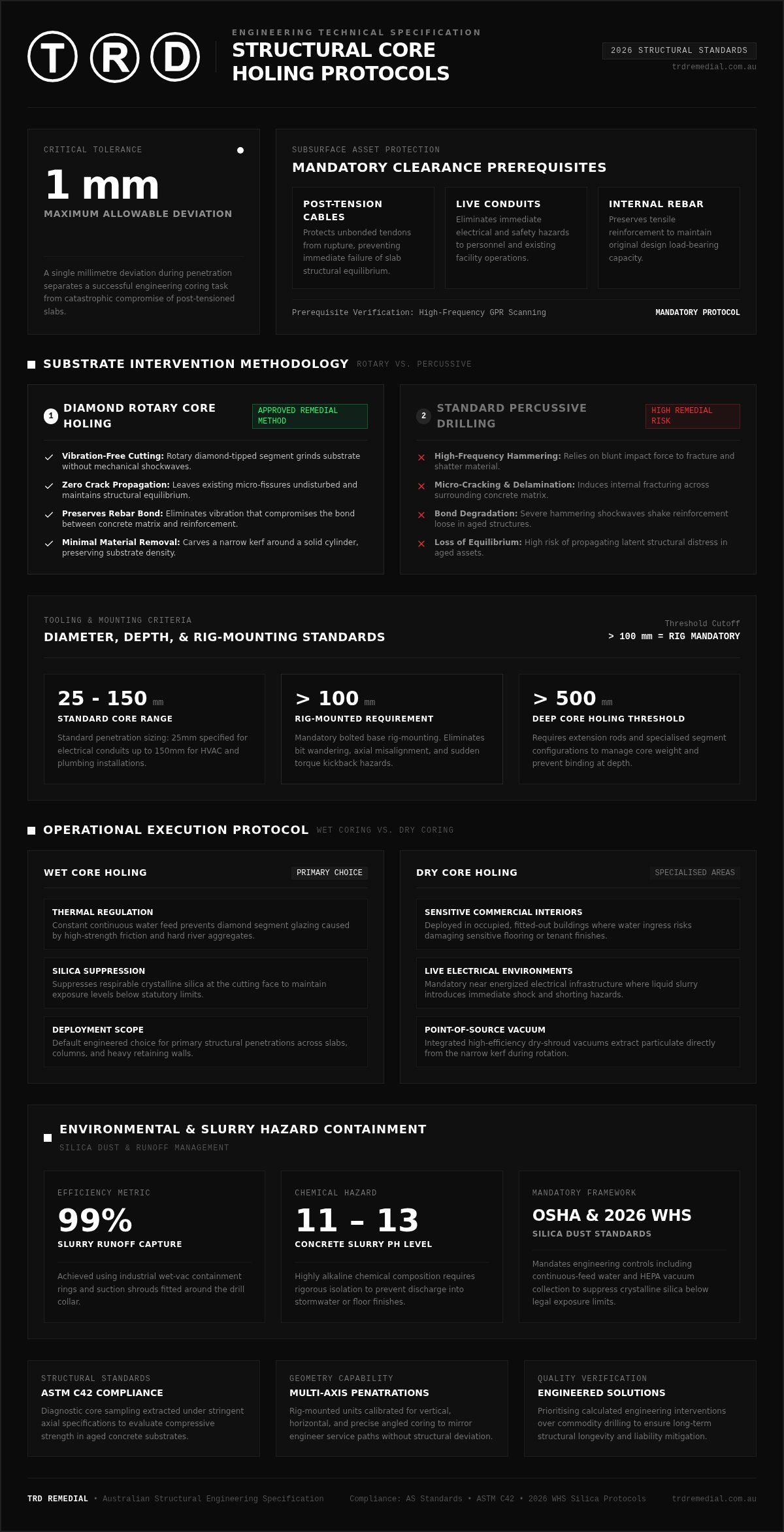
Core holing is the engineered process of creating precise, circular penetrations through reinforced concrete, masonry, and natural stone. In the context of structural remediation, this is never a generic drilling task; it's a surgical intervention. Unlike standard impact or percussive drilling, which relies on high-frequency hammering to fracture the material, core holing uses a rotary diamond-tipped bit to grind away the substrate. Why is this distinction so critical for remedial engineering? Percussive methods often create micro-cracks and internal delamination. These hidden defects can compromise the integrity of an already weakened asset. Diamond core holing eliminates these risks by providing a vibration-free cut that maintains the structural performance of the surrounding material.
The Mechanics of Diamond Core Technology
The efficacy of this method lies in the core drill mechanics and tooling. Industrial-grade diamond segments are bonded to a hollow steel tube. As the bit rotates, it carves a narrow kerf, leaving a solid cylinder or "core" in the centre of the bit. This approach is essential for aged or fragile structures. By removing only the necessary volume of material, we preserve the substrate's density and architectural integrity. The lack of vibration ensures that existing cracks aren't propagated and that the bond between the concrete and reinforcement remains intact. It allows for the extraction of diagnostic samples or the installation of new services without disturbing the building's equilibrium.
Material Behaviour During the Holing Process
Cutting through high-strength reinforced concrete generates significant heat and friction. If not managed with a constant water feed or specialised dry-shroud systems, the diamond segments can glaze, losing their cutting edge. Hardness and aggregate size also dictate the cutting speed. Large, hard river stones or heavy steel reinforcement require specific torque adjustments to prevent bit wandering. In deep-hole applications, maintaining axial alignment is paramount. Even a slight deviation can lead to the bit binding or, worse, an inaccurate penetration that misses the intended structural clearance. We utilise rigid, rig-mounted systems to ensure every hole remains perfectly true to the engineering specifications, regardless of the material's density or depth.
The Methodology: Precision Techniques for Remedial Works
Core holing methodology is determined by the specific constraints of the remedial environment. It's a choice between wet and dry techniques. Wet core holing remains the primary choice for most structural projects because the water feed provides essential cooling and suppresses hazardous dust. In finished commercial spaces or near live electrical infrastructure, we pivot to dry methods. These systems utilise high-efficiency vacuums to capture debris at the source. Precision is the goal. For complex geometries, we deploy specialised rigs capable of vertical, horizontal, and angled penetrations, ensuring service paths follow the engineer's exact design without deviation.
Compliance is non-negotiable on every site. To mitigate health risks, we adhere to the OSHA respirable crystalline silica standard, which mandates specific engineering controls like continuous-feed water systems to keep airborne particles below the permissible exposure limit. In commercial settings, slurry control is a logistical priority. We use industrial wet-vac rings and containment shrouds to capture 99% of runoff. This prevents concrete slurry, which is highly alkaline with a pH between 11.0 and 13.0, from entering storm drains or damaging floor finishes.
Rig-Mounted vs. Handheld Operations
Handheld units offer mobility but lack the stability required for larger diameters or structural alterations. We restrict handheld use to small-bore penetrations in non-critical areas. For any core exceeding 100mm or requiring structural precision, rig-mounted systems are mandatory. These rigs bolt directly to the substrate. This eliminates bit wandering and prevents the bit from binding, which can cause sudden torque kicks and operator injury. Stability is the foundation of safety in confined remedial spaces.
Diameter and Depth Specifications
Standard core sizes typically range from 25mm for electrical conduits to 150mm for HVAC and plumbing mains. Deep core holing beyond 500mm introduces technical hurdles, such as maintaining axial alignment and managing the increased weight of the core. We use extension rods and specialised segment configurations to prevent segment shear at these depths. Precision is even more critical when preparing for structural dowelling, where tolerances are often within ±2mm to ensure load transfer through the new reinforcement. If your project involves complex geometries or high-risk environments, engaging a specialist for core holing ensures technical compliance and structural safety.
Managing Structural Risks and Subsurface Hazards
Managing structural risks is the most critical phase of any remedial project involving core holing. A blind penetration is a gamble that no professional engineer should accept. The consequences of striking embedded services or structural elements range from costly delays to catastrophic failure. Unbonded post-tensioned (PT) tendons carry approximately 15 to 20 metric tons of tension force per strand. Severing one of these cables via blind coring can lead to instantaneous cable ejection at slab edges. This doesn't just damage the asset; it poses a lethal threat to personnel on-site.
Striking conventional reinforcement bars is equally problematic. Rebar provides the necessary tensile strength to concrete members. When core holing removes sections of rebar, the structural moment and shear capacity are immediately degraded. To maintain compliance and safety, we adhere to Concrete Sawing & Drilling Association specifications, which mandate formal subsurface clearance before any bit touches the concrete. This disciplined approach ensures that technical precision is maintained from the first setup to the final extraction.
The Critical Role of Slab Scanning
High-frequency Ground Penetrating Radar (GPR) is the industry standard for mapping subsurface hazards. These systems, typically operating in the 1.6 GHz to 2.7 GHz range, resolve embeds like rebar, PT cables, and conduits at depths of up to 500mm. By interpreting this data, we identify "safe zones" where penetrations can occur without compromising the structure. Slab scanning is the primary defence against structural damage, providing positional accuracy within ±5mm to ±10mm. Relying on "as-built" drawings is insufficient. Physical verification is the only way to ensure a safe execution.
Mitigating Structural Instability
The cumulative effect of multiple penetrations in a single slab section requires careful assessment. Even if individual holes miss reinforcement, the removal of concrete mass can alter the load path. For large-diameter holing or stitch coring to create large openings, temporary shoring is often required to support the structure during the works. Under current engineering standards, any reduction in capacity must be evaluated by a Licensed Design Professional. We don't proceed without formal engineering sign-off for penetrations in critical structural members. This methodical process ensures the long-term viability of the asset is never sacrificed for short-term project speed.
Primary Applications within the Remedial Sector
Core holing serves as the technical gateway for upgrading legacy assets. It facilitates the installation of modern MEP services—mechanical, electrical, and plumbing—without the destructive impact of percussive tools. In complex structural alterations, precision penetrations are required to increase the building's load-bearing capacity or repurpose existing spaces. Core holing often precedes concrete cutting when creating larger apertures for lift wells or staircases. By "stitch coring"—drilling a series of overlapping holes—we create a clean boundary that prevents over-cutting. This technique preserves the integrity of the surrounding slab while allowing for the removal of large concrete sections.
Diagnostic sampling is another pillar of remedial work. Extracting concrete cylinders allows engineers to perform compressive strength tests per ASTM C42. These samples are used to verify in-place strength and interpret results according to ACI 214.4R guidelines. Such cores reveal carbonation depths, chloride ingress, and potential alkali-silica reactions (ASR). This data is the foundation of any successful remediation strategy. It allows for accurate modelling of the structure's remaining service life and informs the selection of repair materials.
Structural Strengthening and Dowelling
Specialist strengthening projects require surgical accuracy. We use core holing to prepare substrates for carbon fibre strengthening or the installation of heavy-duty steel reinforcement. Precision is non-negotiable when installing chemical anchors or load-bearing dowels. Each hole must be drilled to the exact depth and diameter specified by the engineer to ensure mechanical or adhesive bond strength. Bond integrity depends entirely on the preparation of the hole. We utilise industrial-grade brushes and oil-free compressed air to remove all residual dust and slurry before the adhesive is applied, following ACI 355.4 specifications for adhesive anchors.
Remedial Drainage and Water Management
Managing water ingress is a recurring challenge in aged concrete structures. We create targeted weep holes and drainage points in retaining walls to relieve hydrostatic pressure. These penetrations prevent the buildup of groundwater that can lead to structural bowing or localized failure. Additionally, core holing provides the necessary access ports for specialist crack injection systems. By drilling precisely into the crack plane at 45-degree angles, we ensure the resin or grout reaches the full depth of the defect. This restores the monolithic nature of the concrete and prevents further reinforcement corrosion. If your project requires technical precision for structural upgrades, contact the specialists at TRD Remedial for professional core holing services.
Compliance, Safety, and Specialist Contractor Selection
Execution of core holing in 2026 requires more than just mechanical proficiency; it demands strict adherence to Australian Standards and workplace health and safety (WHS) protocols. AS 3600 governs concrete structures, and every penetration must align with the structural design's original intent. We prioritise safety by implementing rigorous silica dust management. Unmitigated dry drilling can produce airborne crystalline silica concentrations up to 50 times the permissible exposure limit. We use integrated water delivery systems and HEPA-filtered vacuums to ensure the site remains safe for all trades. Hearing protection and vibration monitoring are also standard requirements to mitigate long-term occupational health risks.
Documentation is the backbone of professional remedial work. For strata managers and building owners, detailed reporting provides a clear audit trail of every penetration made. This includes pre-drilling slab scan results, penetration schedules, and post-execution verification. Such records are vital for future maintenance and insurance compliance. In high-risk remedial environments, the presence of a disciplined authority ensures that every technical requirement is met without compromise. Choosing a contractor based solely on price often leads to the use of non-specialist labour, which increases the likelihood of structural damage and safety breaches.
Engineering Specifications and Compliance
Every core we drill follows engineer-approved drawings and a formal penetration schedule. This methodical approach ensures that we maintain compliance with structural defect repair protocols. Non-specialist labour often lacks the technical training to interpret complex subsurface data or manage the torque requirements of large-diameter bits. By contrast, a specialist understands the nuances of load transfer and the implications of removing concrete mass. We work in close collaboration with structural engineers to ensure every hole is positioned to avoid critical reinforcement and post-tension cables.
The TRD Remedial Approach to Technical Concrete Services
Our approach is defined by methodical execution and a commitment to structural integrity. We don't view core holing as an isolated task but as part of a comprehensive remedial strategy. From the initial diagnosis of a structure's needs to the final delivery of accurate penetrations, our focus remains on safety and quality. We provide lasting results for commercial and industrial assets by combining elite technical proficiency with a responsive, problem-solving mindset. This disciplined authority is what allows us to excel under pressure and handle the most complex structural alterations with confidence.
Securing Structural Integrity for the Future
Mastering core holing in a remedial context requires a shift from commodity drilling to engineered precision. We've established that the integration of high-frequency slab scanning and rigorous adherence to Australian Standards are the only ways to mitigate the catastrophic risks associated with post-tensioned cables and structural reinforcement. Precision is the foundation of asset longevity. By capturing diagnostic samples and executing surgical penetrations, you ensure that building upgrades don't compromise the existing structure's load-bearing capacity or safety protocols.
TRD Remedial provides engineered solutions for complex structural alterations across Australia. We specialise in high-risk post-tensioned environments and deliver national coverage for commercial and industrial remedial works. Our methodical approach prioritises safety, compliance, and technical mastery in every project we handle. Consult the technical experts at TRD Remedial for precision core holing services. We are ready to help you stabilise and strengthen your critical assets with disciplined authority and proven expertise today.
Frequently Asked Questions
What is the maximum depth possible with core holing?
Standard core holing equipment usually reaches depths between 500mm and 1000mm without specialised modifications. For deeper structural members, we utilise extension rods and high-torque rigs that can penetrate several metres into reinforced concrete. The limiting factors are typically the ability to maintain axial alignment and the weight of the extracted core. We ensure every deep-hole application maintains the technical tolerances required for structural integrity and load-bearing performance.
Is core holing safe for post-tensioned (PT) slabs?
Core holing is safe for post-tensioned slabs only when preceded by high-frequency GPR scanning. Severing a tensioned cable carrying immense force is catastrophic for the structure and personnel. We map the exact location of every tendon before a single penetration begins. This disciplined approach identifies safe zones for drilling, ensuring the structural moment and shear capacity of the slab remain completely uncompromised throughout the project.
How do you manage dust and water slurry during the process?
We manage slurry and dust through integrated engineering controls. For wet applications, we deploy industrial vacuum rings and containment shrouds that capture 99% of the alkaline runoff, preventing damage to finished surfaces or storm drains. In sensitive internal environments where water is prohibited, we use dry-shroud systems connected to HEPA-filtered vacuums. This methodical process ensures compliance with crystalline silica standards while maintaining a clean, professional worksite for commercial assets.
Can you core hole through steel reinforcement bars?
Diamond-tipped bits are designed to cut through heavy steel reinforcement bars with surgical precision. While the physical process is straightforward, the structural implications are significant. We never cut rebar without formal engineering sign-off or a detailed penetration schedule. Removing reinforcement alters the load path of the concrete member. We ensure that every cut is planned to maintain the long-term stability and performance of the structural asset.
What is the difference between core holing and standard concrete drilling?
The primary difference lies in the mechanism of material removal. Standard concrete drilling uses percussive impact to fracture the substrate, which often causes micro-cracking and internal delamination. Core holing is a non-percussive, rotary process using diamond-tipped bits. This method grinds away the concrete without vibration, preserving the bond between the remaining concrete and reinforcement. It's the only acceptable method for structural remediation where the integrity of the surrounding substrate is paramount.
Does core holing cause structural cracking in the surrounding area?
Core holing does not cause structural cracking because it's a vibration-free, rotary process. Unlike jackhammering or percussive drilling, which transmit high-impact energy into the slab, diamond coring maintains the monolithic nature of the surrounding concrete. This makes it ideal for aged or fragile structures where preserving the existing substrate is critical. We use rigid, rig-mounted systems to ensure the bit remains perfectly stable, preventing stress-related fractures or spalling at the entry points.
What information do you need before providing a core holing quote?
To provide an accurate quote, we require the specific diameter and depth of the required penetrations. We also need to understand the substrate material, such as high-strength reinforced concrete or masonry, and the orientation of the holes. Information regarding site access, power availability, and whether subsurface scanning has already been completed is essential. This data allows us to select the appropriate rig-mounted equipment and safety protocols for your specific core holing project.
How much noise should be expected during a remedial core holing project?
Noise levels during core holing are significantly lower than those produced by percussive drilling or demolition. The primary sound is a consistent mechanical hum from the motor and the grinding of the diamond segments against the aggregate. While still a commercial-grade noise, it's more predictable and easier to manage with standard hearing protection. We coordinate with facility managers to schedule works during optimal windows, ensuring minimal disruption to occupied commercial or residential structures.


