

A flowing leak doesn’t automatically rule out injection. Active water leak crack injection can seal a defined path through sound concrete in a foundation or retaining wall, provided the crack is accessible and the injection system suits the conditions. Flexible polyurethane is commonly used for actively leaking cracks, while epoxy is generally suited to dry, stable cracks where structural bonding is required.
It’s reasonable to want a repair that stops water without overlooking structural damage. The right approach depends on more than the visible leak: crack movement, depth, surrounding concrete and water pressure all matter.
This article explains when injection is suitable, how polyurethane and epoxy differ, and what an assessment should consider. You’ll also learn how injection pressure and port placement affect the repair, and when deteriorated concrete or ongoing movement calls for a broader remedial approach.
Key Takeaways
- Injection can seal a defined leak path in sound concrete, including in below-ground walls and slabs; damaged concrete may need repair as well.
- Assess the crack’s depth, accessibility, movement and surrounding concrete before selecting an injection method.
- Polyurethane is commonly used to waterproof actively leaking cracks, while epoxy is generally used for structural bonding in dry, stable cracks.
- Match packers, injection pressure and port spacing to the crack conditions and the resin product’s instructions.
Can crack injection systems be used to repair cracks in foundations and retaining walls?
Crack injection can seal a defined leak path through sound concrete in foundations, retaining walls, basement slabs and car parks when the crack is accessible and the system suits its condition. For Australian projects, applicable building requirements and warranty coverage should be set out in the project specification and contract. Resin selection alone does not define the repair scope or warranty terms.
Leak repairs in walls, slabs and car parks
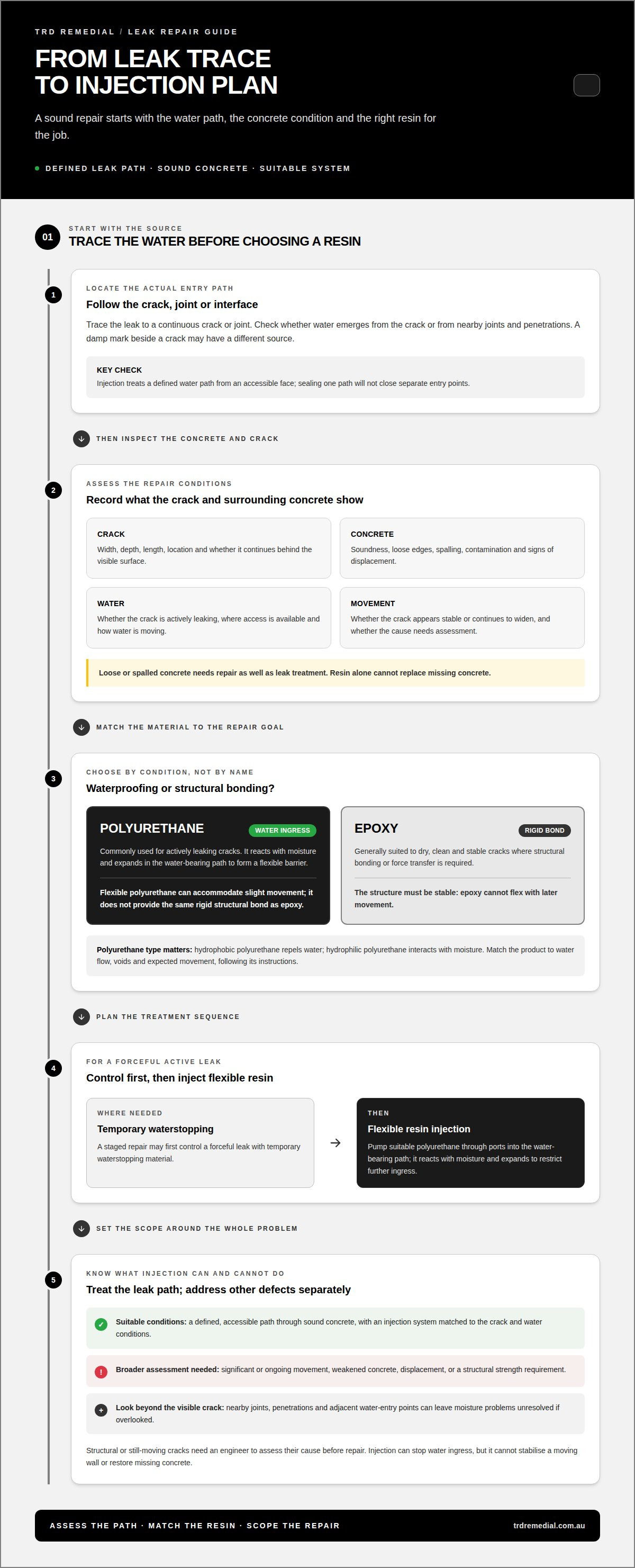
At a basement wall, slab or car-park deck, trace the leak to a continuous crack or joint, then identify access from the dry side. Injection can treat a defined path from the accessible face, including below-ground concrete where excavation behind the wall is impractical. Check whether water emerges from the crack or nearby joints and penetrations: sealing one path won’t close separate entry points. Loose or spalled concrete needs repair, not resin alone.
Active leaks and dry cracks
An active leak carries water through the crack; a dry crack has no flowing water, though concrete may retain moisture. That distinction changes resin choice. Polyurethane injection is commonly used for active leaks because water-reactive resin expands in the leak path and forms a flexible barrier. Epoxy injection generally suits a dry, clean, stable crack where rigid bonding is needed. Check for ongoing movement and deteriorated edges first: resin can’t stabilise a moving wall or replace missing concrete.
Polyurethane injection and grouts
Polyurethane injection and grout address water ingress, but the material must match the crack and water conditions. During active water leak crack injection, resin is pumped through ports into the water-bearing path; it reacts with moisture, expands and blocks further ingress. Flexible polyurethane can accommodate slight movement, making it suitable for some leaking retaining-wall and basement cracks. A staged repair may first control a forceful leak with temporary waterstopping material, then apply flexible resin. Also assess nearby joints, penetrations and weakened concrete, not just visible water.
Assessing crack width, depth, movement and location
Injection can stop water entering through an active crack, but resin cannot restore loose concrete or correct structural movement. Risks include incomplete filling, continued leakage through nearby paths and fresh cracking if the underlying cause remains active.
Begin by tracing the concrete crack and recording its width, depth, length and location. Check whether it passes through sound concrete or ends at a joint, penetration or damaged patch. For example, water appearing beside a basement wall crack may enter through a nearby construction interface instead. The injection system depends on identifying the actual water path, not just the visible damp mark.
Assess the surrounding concrete before selecting a crack injection method. Look for loose edges, spalling, contamination and signs of displacement. A narrow crack through sound concrete may provide a defined path for filling; a large or contaminated crack may not. The assessment should also establish whether water is actively leaking, where access is available, and whether the crack continues behind the visible surface.
Movement affects whether injection is suitable. Assess whether the crack appears stable or continues to widen, and consider the structure’s location and likely source of stress. Structural or still-moving cracks need an engineer to assess their cause before repair. Ongoing movement can stress the injected material or create a new crack alongside it, even if the original path has been filled.
Flexible grout can accommodate slight shifts, but it cannot compensate for significant movement or weakened concrete. An actively leaking crack may also connect to voids or adjacent water-entry points, so sealing the visible opening alone can leave moisture problems unresolved. For a project-specific review of crack width, concrete condition and movement, arrange a crack injection assessment.
How effective is polyurethane injection at sealing structural cracks under water pressure?
Polyurethane can seal water-carrying cracks under hydrostatic pressure when the resin suits the crack and surrounding concrete. The choice depends on whether the priority is stopping water ingress or restoring structural strength.
Epoxy bonding and polyurethane waterproofing
Epoxy injection is generally selected for dry, stable cracks where rigid bonding or force transfer is required. The structure must be stable because epoxy cannot flex with later movement. Polyurethane injection is more commonly used to waterproof leaking cracks, including those exposed to water pressure. It expands within the leak path to form a barrier, but doesn’t provide the same rigid structural bond as epoxy.
Hydrophobic and hydrophilic polyurethane
Hydrophobic polyurethane repels water, while hydrophilic polyurethane interacts with moisture. Both types are used in injection systems, but their response to water and expansion behaviour differ. Match the resin to the crack’s water flow, voids and expected movement, rather than choosing by name alone. Product instructions guide resin selection and application for the conditions present in the concrete.
Sealing water-carrying cracks
For an active leak in concrete, injected polyurethane enters the water-bearing path, reacts with water and expands to restrict further ingress. Flexible polyurethane can accommodate slight movement, which is useful where a crack remains exposed to moisture. Under strong water flow, a staged repair may use temporary waterstopping material first, followed by flexible resin. If structural strength restoration is also needed, that requires a separate repair assessment.
Leak stoppage and repair checks
Leak stoppage occurs as polyurethane reaches the water path, reacts with moisture and expands. Flow rate, crack geometry, water pressure and the resin system affect how quickly the path closes, so there’s no single duration for every structure. After injection, inspect the treated crack for renewed seepage and check nearby joints or penetrations for separate damp patches. A dry repair surface with no new water entry nearby indicates that the visible path is sealed. Continue monitoring for moisture or fresh cracking, particularly if the structure is moving.
Injection pressure, equipment and packer installation
Equipment, port spacing and pressure must suit the crack and resin. Active leak injection is specialist work: correct material selection and controlled pressure help the resin reach the affected path without damaging the surface.
Injection equipment and packers
A pump delivers resin through injection ports fitted with mechanical packers. The ports sit at intervals along the concrete crack, giving material access to its internal path and helping control water flow. Packers must withstand the pressure required for the chosen method. For a fine or superficial crack, low-pressure injection is generally used; higher pressure can drive resin into finer cracks or voids behind a wall or slab.
Set injection pressure, equipment and port spacing according to the resin product’s data sheet. Slow, controlled injection is generally preferable to rapid, high-pressure delivery. Excess pressure can force material out through the surface or into unintended joints instead of filling the target crack.
Packer installation
First, expose and prepare the affected surface so the crack path and port positions are clear. Install packers along the crack at intervals suited to its depth, condition and water flow. Seal the surface between ports where needed, so injected resin travels through the concrete rather than escaping externally. The prepared ports provide a controlled route for injection and help the operator follow resin movement along the crack.
For a leaking wall, the sequence is practical: inspect the crack, prepare the surface, install and seal packers, then inject through the ports. The operator adjusts pressure and progresses along the crack, watching for resin at adjacent ports or signs of flow elsewhere. Finish by closing the ports and checking the treated area for continued leakage.
An actively leaking structural crack may need careful assessment before injection. A specialist can match packers, pressure and resin to the concrete condition and water flow, then manage the injection sequence. For professional crack injection work, arrange an assessment of the affected concrete and leak path.
TRD Remedial: Carbon Fibre Strengthening
TRD Remedial provides Crack Injection for active leaks and structural cracks. Injection addresses a defined crack path, but it doesn’t, by itself, resolve every structural defect or rebuild deteriorated concrete.
Where assessment identifies a need to improve structural capacity, Carbon Fibre Strengthening or Structural Strengthening may form part of the remedial approach. If concrete around the crack is loose or damaged, Concrete Repairs address that condition alongside the water ingress work. The right scope depends on the observed defect and required repair, rather than treating every leak as an injection-only issue.
Contact TRD Remedial to discuss the crack, water entry and condition of the surrounding concrete.
Plan the next step for your structure
Stopping water entry is a practical first step, but the repair plan should also account for what the leak reveals about the structure. If you’re considering active water leak crack injection, consider the observed leak, crack condition and any signs of broader concrete or structural damage together. This gives the repair scope a clear basis and helps distinguish water control from work needed to strengthen or repair the structure.
TRD Remedial provides Crack Injection alongside Concrete Repairs, Structural Strengthening and Carbon Fibre Strengthening. These services address different needs within a remedial plan, from treating a crack to strengthening concrete where an assessment identifies that requirement.
Share the crack location and the conditions you’ve observed to start a focused conversation about the next step. Contact TRD Remedial about crack injection and move towards a considered repair plan.
Frequently Asked Questions
Why does water continue to leak through a crack after an initial repair attempt?
Water may persist because the repair sealed only the visible opening, not the full path through the concrete. For example, a basement wall can leak through a nearby construction joint or penetration after its crack is treated. Ongoing movement, weak concrete around the repair, or incomplete resin filling can also create another route. Look for new damp patches beside the repaired area, not only at the original crack.
Can injection waterproofing be used for basement and below-ground structures?
Yes. Polyurethane injection can address water ingress in below-ground concrete structures, including basement walls and slabs. It can treat a defined leak path from an accessible face, which is useful where reaching the outside of a buried wall would require excavation. The assessment should also consider water entry at joints and penetrations, since treating one crack won’t seal separate paths into the same basement.
Crack Injection Cost: What Influences Pricing?
The price depends on the case and is given after a quote request. Key factors include crack length and width, accessibility, the resin system, building height, safety access requirements and work timing. For example, a crack behind restricted access may require a different setup from one on an open slab. The affected area and repair scope also help determine what work is required.
Is Water Getting Through the Concrete?
Water ingress may appear as a damp patch, water staining, droplets or a steady flow at a crack or joint. Trace the affected area and note whether moisture appears after rain or persists in dry weather. Water can travel within concrete before becoming visible, so the wet spot may not sit directly over its entry point. Check nearby joints, penetrations and the opposite face where accessible.
Leaking Through a Basement Wall or Slab?
First, record where water appears and whether it emerges from a crack, joint or penetration. A basement slab may show moisture at a crack while the entry path runs from a nearby interface. Keep the affected area visible for assessment and note changes in flow. Injection can address a defined path in sound concrete; loose or deteriorated concrete requires repair as part of the scope.
How do you inject a crack with an active water leak?
A specialist first identifies the leak path and checks the concrete condition. They prepare the surface, install injection ports along the crack, seal between ports where needed, then pump suitable polyurethane through the ports in a controlled sequence. The operator watches for resin reaching adjacent ports or escaping elsewhere, adjusts the method to the observed flow, then closes the ports and inspects the repair for continued leakage.


