

Structural removal is no longer a matter of brute force; it is a surgical engineering discipline where precision is the only acceptable margin for error. When you're tasked with modifying a live commercial asset, the traditional "wreck and clear" mindset is a liability you can't afford. You need a method that respects the delicate balance of load-bearing elements while removing what's no longer required. This is where controlled demolition becomes the essential first step in any successful structural remediation project.
It's natural to feel a sense of unease when planning alterations in occupied buildings. You're likely worried about accidental structural collapse, vibration damage to sensitive neighbouring equipment, or the friction caused by noise and dust complaints. We understand that protecting the remaining structure is just as critical as the removal itself. This guide will show you how high-precision techniques and rigorous engineering protocols ensure your project remains stable and compliant. We'll explore the latest low-vibration methods, such as robotic removal and diamond cutting, and the safety standards that provide the certainty needed to execute complex structural changes without compromising the long-term integrity of the site.
Key Takeaways
- Distinguish between traditional wrecking and the surgical precision of controlled demolition to maintain structural stability during complex building upgrades.
- Examine how advanced diamond-tipped equipment and low-vibration technology enable millimetre-perfect removals in high-strength concrete environments.
- Evaluate the strategic advantages of precision cutting over percussive methods regarding safety, project speed, and long-term asset protection.
- Recognise high-risk scenarios where precision techniques are mandatory to facilitate complex structural alterations and building repurposing.
- Master the professional protocols required for safe execution, highlighting why slab scanning is a non-negotiable step before any structural cut is made.
What is Controlled Demolition? Defining Precision in Remedial Construction
Controlled demolition isn't about the spectacular, dust-filled collapse of a skyscraper. In the context of remedial engineering, it's a surgical, sequential removal of specific structural components. While general structural demolition and deconstruction methods often focus on total site clearance, remedial demolition serves the opposite purpose. It enables building upgrades by extracting only what's necessary while maintaining the integrity of everything that remains. This process requires a disciplined authority to manage the invisible forces at play. Every cut and every slab removal requires a deep understanding of how loads will redistribute throughout the remaining frame. The primary goal is absolute: eliminate the redundant while protecting the asset from collateral damage.
The Core Principles of Controlled Removal
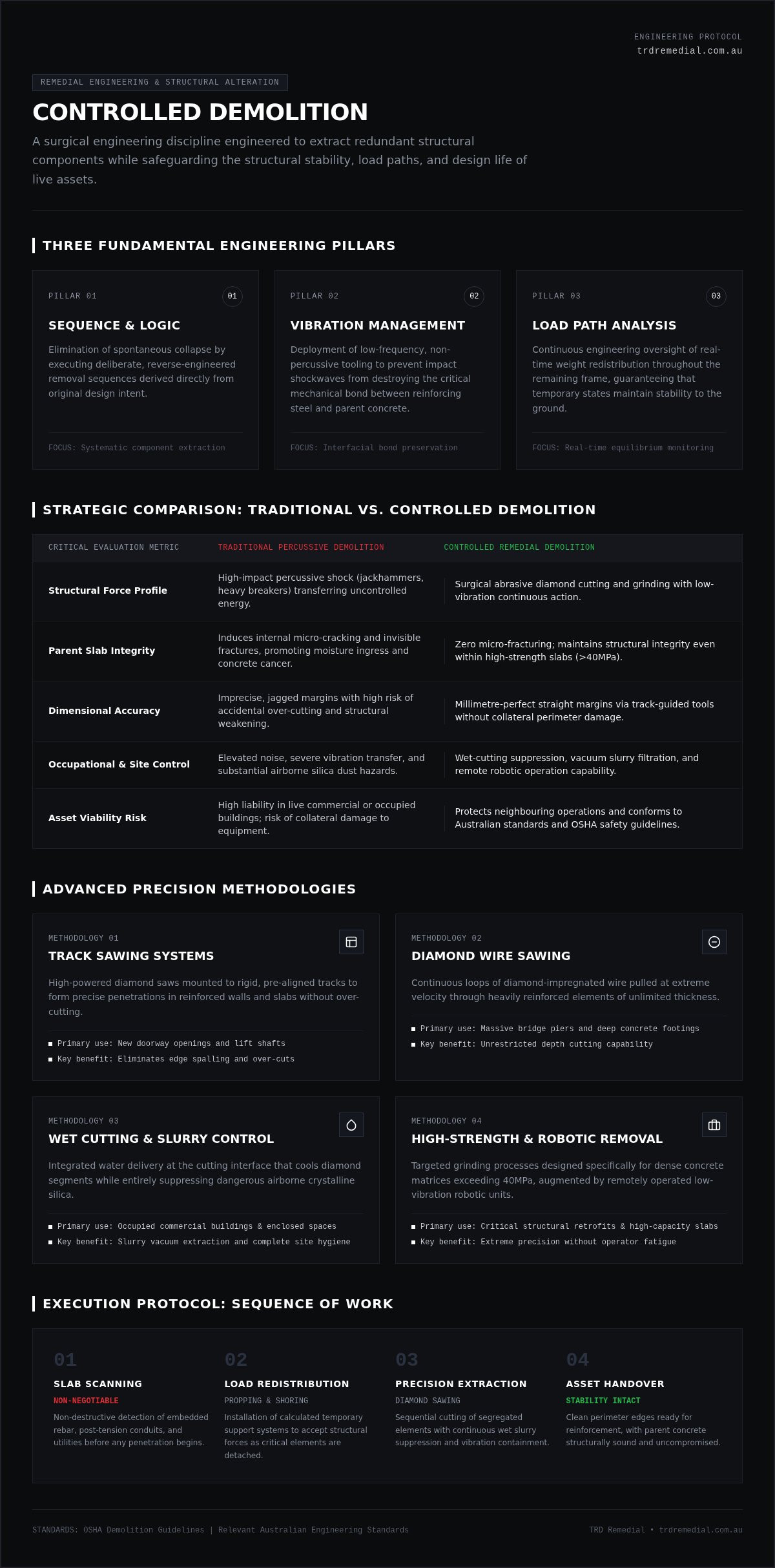
Safety in controlled demolition is dictated by logic and sequence. You can't simply start cutting; you have to follow a planned order to ensure structural stability throughout the works. The process relies on three fundamental pillars:
- Sequence and Logic: Elements are removed in a specific order to prevent unplanned collapses. We work backwards from the design intent to ensure the structure is never compromised.
- Vibration Management: High-frequency impacts can sever the bond between concrete and steel reinforcement. We use low-impact tools to keep these bonds intact, preserving the strength of the parent structure.
- Load Path Analysis: As we remove sections, the weight of the building must find new paths to the ground. We monitor these changes to ensure the building stays stable during the transition.
When "Traditional" Demolition Fails the Asset
Percussive force, like that from heavy jackhammers, is often too blunt for sensitive remedial environments. Traditional methods rely on impact, which sends shockwaves through the slab. These vibrations cause micro-cracking, invisible fractures that allow moisture to reach the rebar. Over time, this leads to concrete cancer, a costly structural defect that undermines the very upgrades you're trying to achieve.
Modern Australian building standards now favour low-impact removal because it preserves the design life of the structure. When you're working in occupied buildings or near sensitive equipment, the risk of accidental damage from traditional methods is a liability you don't need. Choosing controlled demolition isn't just about safety; it's about the long-term viability of the building. It ensures that the structural alterations you make today don't become the maintenance headaches of tomorrow.
Advanced Techniques: The Technology Behind Controlled Demolition
Precision in structural removal isn't achieved through luck. It's the result of deploying specialised equipment designed for millimetre-perfect accuracy. Diamond-tipped tools have fundamentally changed how we handle high-strength concrete, particularly slabs rated above 40MPa. These tools don't just "break" the material; they grind through it with surgical intent, preventing the micro-fractures associated with percussive tools. This high-precision technology is vital for maintaining the integrity of adjacent structures during controlled demolition while meeting strict OSHA demolition safety guidelines and relevant Australian engineering standards.
Diamond Sawing and Wire Cutting
Track sawing is the industry standard for creating precise openings in walls and slabs. By mounting a high-powered saw on a rigid track, we eliminate the risk of over-cutting and ensure perfectly straight edges for new doorways or elevator shafts. When structural elements are too thick for standard blades, wire sawing provides a versatile solution. This method uses a diamond-impregnated wire pulled through the material at high speed, making it possible to cut through massive bridge piers or deep foundations with ease. Both methods utilise "wet cutting" techniques. This involves a constant flow of water to the cutting face, which suppresses hazardous silica dust and cools the blade. Integrated slurry management systems are then used to capture, vacuum, and filter the runoff. This ensures the site remains clean and prevents high-pH slurry from entering drainage systems, maintaining compliance with environmental regulations.
Robotic Demolition and Chemical Bursting
Hazardous or confined spaces require a more sophisticated approach. Remote-operated machines, such as Brokk-style robots, deliver immense breaking power without exposing operators to falling debris or silica dust. These compact units fit through standard 920mm commercial doors and operate on electric power, eliminating diesel emissions in indoor environments. They also drastically reduce the risk of Hand-Arm Vibration Syndrome (HAVS) for the crew. For environments where even the slightest vibration is prohibited, such as active hospitals or data centres, chemical expansion or "bursting" is the preferred choice. A non-explosive expansive grout is poured into pre-drilled holes, where it exerts silent, outward pressure to crack the concrete from within. In cases involving heavy steel reinforcement that would stall traditional blades, thermal lancing can be used to melt through the material. These advanced controlled demolition techniques provide the technical capability to execute complex structural alterations in live, sensitive environments where traditional methods would be entirely unsuitable.
Controlled vs. Traditional Demolition: A Strategic Comparison
Selecting the right removal method is a strategic decision that dictates the safety and financial viability of a project. Traditional demolition relies on percussive force. This method is often perceived as a cost-effective choice, but it frequently introduces hidden structural risks that escalate later. In contrast, controlled demolition uses engineering-led techniques to isolate the works. By adhering to the Code of Practice for Demolition Work, specialists ensure that load-bearing elements are managed with technical discipline. For commercial and strata clients, the "cost vs. value" debate is often settled when they realise that precision work prevents the need for secondary structural stabilisation. While the initial setup for precision equipment might appear more complex, the reduction in total project timelines is undeniable. You eliminate the weeks of surface preparation and patching required to fix the collateral damage caused by jackhammers.
Impact Mitigation: Noise, Dust, and Vibration
The "zone of influence" for a heavy jackhammer often extends several floors, vibrating through the building's skeleton. This disruption affects neighbouring tenants and sensitive electronic equipment in ways that precision cutting does not. Maintaining business continuity is a primary concern for commercial and strata managers. If a building remains occupied, uncontrolled noise and dust are regulatory liabilities that can halt a project. Precision technology keeps the impact localised. It ensures you meet strict council noise limits while allowing the rest of the facility to operate without the threat of vibration-induced equipment failure or environmental health complaints.
Structural Integrity and Remedial Readiness
Surgical removal creates clean, square edges that simplify the concrete remediation process. Percussive force leaves behind jagged surfaces and micro-fractures. These defects allow moisture to penetrate the slab, eventually leading to corrosion and spalling. Controlled methods remove these variables. This is critical when working near post-tension (PT) cables or dense reinforcement. A single percussive blow can sever a PT cable, causing immediate structural instability. By integrating precision saws with subsurface scanning, we preserve the integrity of the remaining asset. The result is a structure that is ready for immediate alteration, free from the secondary defects that plague traditional wrecking sites.
Critical Applications: When Precision Demolition is Mandatory
There are scenarios where traditional percussive methods aren't just ill-advised; they're strictly prohibited by engineering specifications. In high-density urban environments, the margin for error is non-existent. You're often working within centimetres of live services, heritage-listed facades, or neighbouring structural foundations. In these high-stakes settings, controlled demolition is the only viable path forward. It provides the surgical accuracy required to facilitate complex structural alterations without triggering unplanned load shifts or catastrophic failures in adjacent units. When a building's purpose changes, such as converting an old industrial warehouse into modern commercial suites, precision removal becomes the backbone of the entire remediation strategy.
Structural Alterations and Capacity Upgrades
Modern building repurposing often demands the installation of new lift cores or stairwells through existing high-rise floor slabs. This isn't a simple task of "knocking a hole" in the concrete. We must manage the redistribution of weight across the remaining frame. This often involves a dual approach where we remove sections of the slab while simultaneously integrating carbon fibre strengthening to reinforce the new openings. We see this frequently in car park remediation, where height clearance issues require the removal of specific beam sections. By using precision cutting, we maintain the structural integrity of the columns while gaining the necessary overhead space for modern vehicle access.
Post-Tension Truncation and Slab Modification
Modifying a post-tensioned (PT) slab is one of the most dangerous tasks in the remedial industry. These slabs are held under immense tension by steel cables; an accidental cut can cause a cable to snap with enough force to penetrate walls or cause immediate slab collapse. You can't approach a PT slab with a jackhammer and hope for the best. Every project requires a meticulous plan for cable de-stressing and anchoring before any removal begins. This is why post tension slab repair almost always starts with a controlled removal phase. We use slab scanning to map the exact location of every tendon, ensuring the truncation is executed exactly where the engineer intended. This level of discipline ensures the safety of the crew and the long-term stability of the asset.
If your project involves high-risk structural changes, you need a partner who understands the complexities of load management. Contact our specialist team today to discuss your structural alteration requirements.
The Professional Protocol: Safety, Compliance, and Execution
Executing a successful controlled demolition project requires a transition from engineering theory to disciplined physical action. It's a methodical protocol where every step is designed to eliminate variables and protect the asset. At TRD Remedial, we integrate engineering oversight into every phase. This ensures that the removal process doesn't just meet the design intent but protects the long-term viability of the structure. A professional project plan begins with a clear understanding of the existing structure, followed by the installation of temporary support systems and a strictly sequenced removal process.
Pre-Demolition Analysis and Slab Scanning
We cannot rely solely on historical as-built drawings. Discrepancies between original plans and the actual physical structure are common, especially in older commercial assets. Therefore, a comprehensive slab scanning phase is non-negotiable. Using Ground Penetrating Radar (GPR), our specialists map internal conduits, post-tension cables, and reinforcement layouts in real-time. This subsurface data allows us to identify "no-go" zones where cutting would cause immediate structural distress. By validating these details before the first tool touches the concrete, we provide a layer of safety that traditional wrecking crews simply cannot offer.
Temporary Propping and Shoring
Structural stability must be maintained at all times during the removal process. When a load-bearing element is extracted, the weight it once carried must be safely transferred to the ground or adjacent members. We deploy engineered temporary propping and shoring systems to manage these shifting load paths. This isn't a "one size fits all" solution. Each system is calculated based on the specific weight of the slab and the intended alterations. This technical rigour prevents the sagging or cracking that often occurs when inexperienced contractors underestimate the dynamic forces involved in structural removal.
Compliance with Australian Standards
Adherence to AS 2601-2001 (The demolition of structures) is our baseline for every project. This standard dictates the safety requirements for the demolition of buildings and ensures that risk management is at the forefront of the operation. We develop project-specific Safe Work Method Statements (SWMS) for all high-risk technical demolition tasks. These documents outline the exact steps, hazards, and controls required for the site. Once the removal is complete, we conduct a final inspection and certification. This formal handover ensures the building team can proceed with confidence, knowing the structure is stable and ready for the next stage of development.
Securing the Future of Your Structural Asset
Precision structural removal is the critical first step in any successful remediation project. We've explored how advanced technology like diamond sawing and robotic removal eliminates the risks associated with traditional percussive force. By prioritising subsurface scanning and sequential load management, you ensure the building remains stable throughout the alteration process. This methodical approach transforms demolition from a destructive act into a surgical engineering discipline.
Successful controlled demolition requires more than just high-end machinery. It demands technical mastery in structural alterations and an unwavering commitment to site safety and compliance. When you choose engineered solutions for complex remedial challenges, you're investing in the long-term viability of the building rather than just managing a site clearance. This level of rigour is essential for protecting the asset's integrity while facilitating modern upgrades.
Consult the structural experts at TRD Remedial for your next precision demolition project to ensure your asset is protected by industry-leading engineering protocols. Your project deserves the certainty that only a disciplined, specialist approach can provide.
Frequently Asked Questions
What is the difference between controlled demolition and traditional demolition?
Traditional demolition relies on percussive force and gravity to raze structures, whereas controlled demolition is a surgical process used to remove specific elements while preserving the surrounding asset. It uses diamond-tipped saws and robotic equipment to achieve millimetre-perfect accuracy. This approach eliminates the uncontrolled vibration and micro-cracking associated with jackhammers. It's the preferred method for building upgrades where the structural integrity of the remaining frame is paramount for the project's success.
Is controlled demolition more expensive than standard methods?
While the initial mobilisation of precision equipment can be higher than standard methods, it often reduces the total project expenditure. You save on the extensive "patching" and remedial repairs required to fix collateral damage caused by percussive tools. By delivering clean edges and maintaining structural stability, the subsequent alteration works can begin immediately. This efficiency minimises building downtime and prevents the costly structural defects that frequently arise from traditional, high-impact removal techniques.
How do you control dust and noise during demolition in an occupied building?
We use wet-cutting technology and specialised HEPA-filtered vacuum systems to suppress dust at the source. This process captures concrete slurry before it can migrate through the building, ensuring the air quality remains safe for occupants. Noise is managed by using electric-powered robotic machinery and diamond tools, which operate at significantly lower decibel levels than traditional percussive equipment. These methods allow for essential structural work to proceed without disrupting business continuity in commercial or residential environments.
Can you perform controlled demolition on a post-tensioned slab?
Yes, controlled demolition is the only safe method for modifying post-tensioned slabs. The process involves a highly coordinated plan that includes slab scanning to locate tendons and the installation of temporary anchors. Once the cables are safely truncated and de-stressed, the concrete is removed using precision cutting. This disciplined approach prevents the catastrophic release of energy that would occur if a tensioned cable were accidentally severed by traditional demolition equipment.
What safety permits are required for controlled demolition in Australia?
High-risk demolition work in Australia requires a specific demolition license and a comprehensive Safe Work Method Statement (SWMS). All projects must comply with AS 2601-2001, which outlines the requirements for planning and executing structural removals. Depending on the site, you may also need council permits for waste management and noise control. TRD Remedial ensures all technical demolition phases are supported by engineering oversight to meet these rigorous national safety and compliance standards.
How does slab scanning improve the safety of controlled demolition?
Slab scanning identifies the exact location of internal reinforcement, post-tension cables, and utility conduits before any cuts are made. By using Ground Penetrating Radar (GPR), we eliminate the guesswork that leads to accidental strikes and structural instability. This subsurface data allows the engineering team to define "no-go" zones within the structural matrix. It provides the technical certainty required to execute complex alterations safely while protecting both the crew and the building's infrastructure.
What happens to the waste material during a precision demolition project?
Waste material is managed through a systematic deconstruction process rather than bulk wrecking. Concrete slabs and walls are often cut into manageable segments, which are then extracted using lifting equipment to minimise site mess. These segments are typically transported to recycling facilities where they are crushed for use as road base or aggregate. Any slurry produced during wet cutting is captured by vacuum systems, filtered to neutralise pH levels, and disposed of according to environmental regulations.
How long does a typical controlled demolition project take?
The duration of a project depends entirely on the structural complexity and the required shoring. While the preparation phase, including slab scanning and temporary propping, is more involved than traditional methods, the actual removal process is often significantly faster. Precision cutting allows for the rapid extraction of large concrete sections in a single piece. This efficiency reduces the overall site presence and allows subsequent trades to move in sooner, accelerating the total project delivery timeline.


