

A single leaking crack in a basement diaphragm wall is rarely just a cosmetic nuisance; it is a high-pressure gateway for reinforcement corrosion and eventual structural failure. You've likely observed the tell-tale white salt deposits or damp patches in your car park and worried about the hidden progression of concrete cancer. It is a common frustration to receive conflicting contractor quotes that vary wildly in both price and technical methodology. Mastering the nuances of polyurethane crack injection for concrete is the only way to move beyond temporary fixes and achieve a dry, stable structure.
This specialist guide provides the engineering clarity required to remediate active water ingress and protect your structural assets for the long term. We will examine the mechanics of hydrophobic resins, the precision of 45-degree staggered injection patterns, and the critical compliance requirements under AS 3600:2018. By understanding the distinction between flexible polyurethanes and rigid epoxies, you can ensure your remediation strategy aligns with rigorous building codes and provides lasting protection against the most aggressive hydrostatic pressures.
Key Takeaways
- Identify the specific indicators of active water ingress to determine when flexible remediation is required over rigid structural welding.
- Understand the chemical expansion mechanics of professional resins, which expand up to 30 times their volume to seal deep, hidden voids and fissures.
- Master the selection criteria between epoxy and polyurethane crack injection for concrete to ensure long-term stability in structures subject to thermal movement.
- Learn the technical methodology behind high-pressure injection, including the precise use of mechanical packers to arrest leaks at the source.
- Recognise how engineered injection protocols mitigate the risk of concrete cancer and protect the long-term capital value of your Australian assets.
Understanding Polyurethane Crack Injection in Structural Remediation
Polyurethane (PU) crack injection is a highly adaptable remedial technology designed to resolve fluid transmission through concrete fissures. Unlike rigid fillers, PU is a reactive polymer that transforms from a liquid to an expansive solid or foam upon contact with moisture. This makes polyurethane crack injection for concrete the industry standard for arresting active leaks in high-pressure environments. In the Australian context, where seasonal shifts and urban vibrations affect structural integrity, this method offers a flexible barrier that maintains its seal even as the concrete undergoes thermal expansion or contraction. It's a precise solution for complex assets like deep-basement car parks and retaining walls.
The primary advantage of this technique lies in its versatility. It serves two critical functions: stopping active water ingress and sealing non-structural cracks against environmental contaminants. While rigid repair methods aim to weld concrete back together, PU prioritises containment and flexibility. This is particularly relevant for Australian infrastructure exposed to high water tables or tidal influences, where a rigid seal would likely fail under the stress of hydrostatic pressure or building movement.
The Role of PU in Water Ingress Crack Repairs
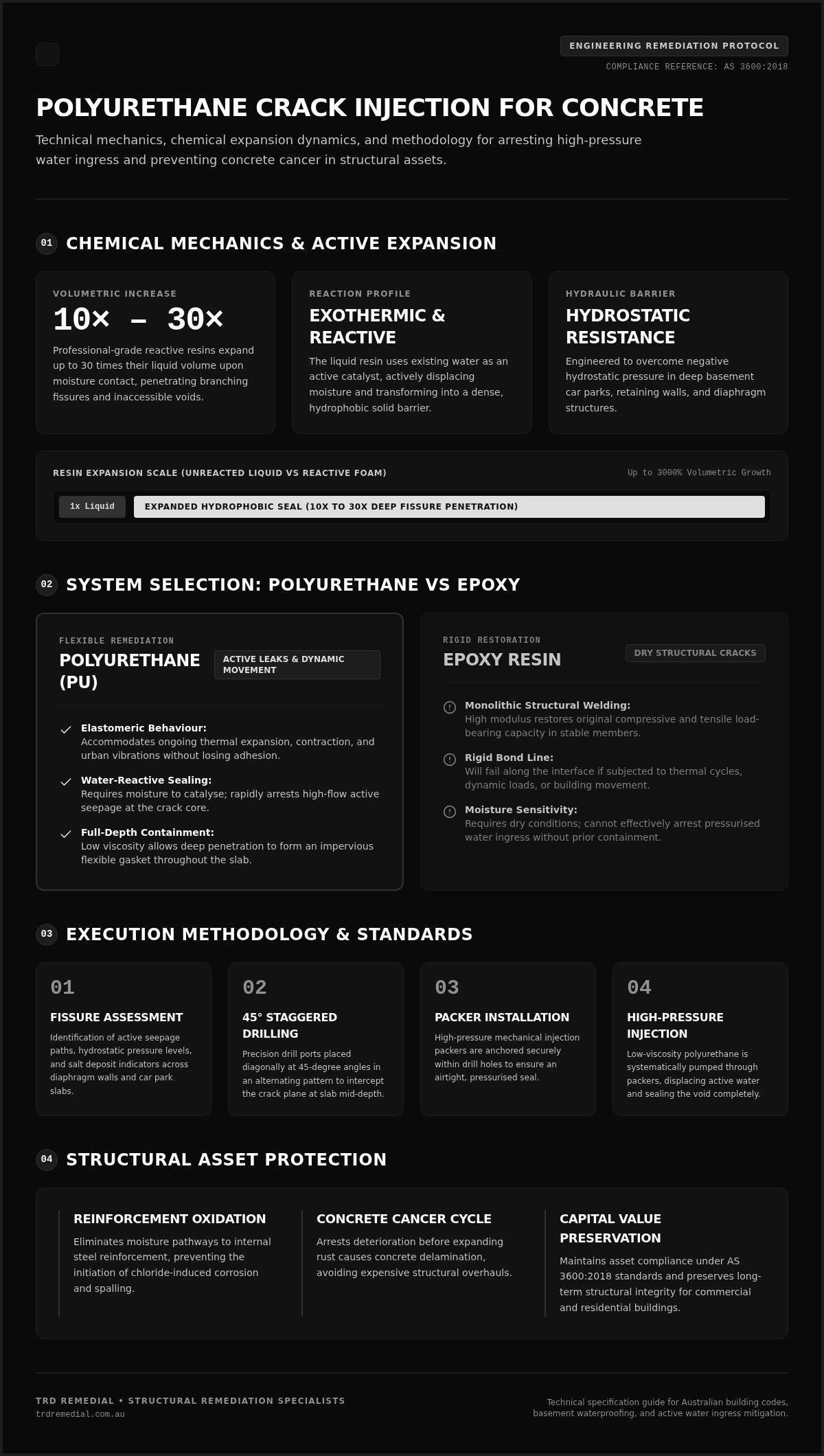
When a structure suffers from active seepage, traditional surface patches inevitably fail. They cannot withstand negative hydrostatic pressure. PU injection works by penetrating the full depth of the crack. The resin reacts with the water present, expanding rapidly to form a dense, hydrophobic seal that blocks the flow at its source. For complex water ingress crack repairs, this immediate reaction is vital. It prevents moisture from reaching the internal steel reinforcement, effectively halting the onset of chloride-induced corrosion. Professional-grade resins often expand between 10 to 30 times their original volume, ensuring that even hidden voids behind the crack are completely filled.
Non-Structural vs. Structural Crack Considerations
It's essential to distinguish between cracks that compromise load-bearing capacity and those that serve as conduits for water. Structural cracks usually require "binding" with high-modulus epoxies to restore monolithic strength. However, for cracks subject to dynamic movement or vibration, a rigid repair will simply fail along the bond line. PU is the superior choice here because it remains elastomeric. It seals the breach without attempting to weld the concrete back together. Incorporating these techniques into a broader strategy for concrete remediation ensures asset longevity by accommodating the physical realities of large-scale infrastructure. This approach stops the "concrete cancer" cycle before it necessitates expensive structural overhauls.
- Active Sealing: Reacts with water to create an immediate, pressurised barrier.
- Elastomeric Properties: Accommodates thermal movement without losing adhesion.
- Deep Penetration: Low viscosity allows the resin to reach the core of the slab.
- Asset Protection: Prevents reinforcement oxidation in aggressive environments.
The Technical Mechanics of Polyurethane Resins
The efficacy of polyurethane crack injection for concrete relies on a rapid, exothermic chemical reaction. When the liquid resin is pumped into a fissure, it encounters moisture, triggering a molecular transformation that isn't a passive filling process but an active displacement of water. The resin uses the existing moisture as a catalyst to expand and solidify; this ensures the repair is integrated into the concrete's internal structure rather than just sitting on the surface. This chemical bond is essential for maintaining a seal against the high hydrostatic pressures common in Australian basement structures.
Professional-grade resins are engineered with high expansion ratios, typically ranging from 20 to 30 times their unreacted liquid volume. This volumetric increase allows the material to penetrate deep into branching fissures and porous aggregate pockets that are otherwise inaccessible. Viscosity plays a decisive role here. A low-viscosity resin travels through hairline cracks before the reaction completes, ensuring the entire depth of the slab is sealed. Because these resins are moisture-reactive, they exhibit superior adherence to damp surfaces, forming a tenacious bond that resists delamination under pressure.
Hydrophobic vs. Hydrophilic Systems
Choosing the correct chemical system is critical for long-term success. Hydrophobic resins are the industry standard for most Australian car park and basement remediations. They repel water and require only a small amount of moisture to initiate the reaction. Once cured, they form a stable, rigid-to-flexible foam that does not shrink or swell, making them ideal for high-pressure leaks. In contrast, hydrophilic systems absorb water to create a flexible, gel-like substance. While these are effective for high-movement joints that remain constantly saturated, they risk desiccation and shrinkage during prolonged dry spells. Selecting the right resin requires a specialist assessment of the site’s water table and structural movement patterns.
Closed-Cell Foam Structure and Durability
The durability of a repair depends on the cellular structure of the cured resin. Closed-cell foams are preferred for waterproofing because each cell is an independent, sealed unit. This prevents water from migrating through the material itself, even if the surface is abraded. This structure is particularly resilient against the thermal fluctuations common in Australian coastal and inland regions. A closed-cell resin is a non-permeable barrier that prevents future chloride ingress and protects the internal steel reinforcement from oxidation. This stability ensures that once a crack is sealed, it remains sealed regardless of whether the surrounding concrete expands or contracts during seasonal shifts.
- Chemical Expansion: 20x to 30x volumetric increase to fill deep voids.
- Moisture Adhesion: Superior bonding to damp concrete compared to traditional sealants.
- Dimensional Stability: Hydrophobic resins maintain their volume without shrinking.
- Rapid Reaction: Catalysed foams can arrest active gushing water in as little as 15 seconds.
Polyurethane vs. Epoxy: Selecting the Correct Injection System
Choosing between resin systems is not a matter of product quality; it is a matter of engineering intent. In the remedial industry, the debate often centres on whether a crack requires structural welding or flexible sealing. Epoxy resins are high-modulus, rigid materials designed to restore the monolithic integrity of a structure. They possess a tensile strength that often exceeds the parent concrete, effectively "welding" the fissure shut. However, this rigidity is a liability if the structure continues to move. Polyurethane, by contrast, is an elastomeric solution engineered for remediation in dynamic environments. It prioritises water containment and flexibility over raw compressive strength.
For large-scale commercial projects, the cost-benefit analysis usually favours the system that addresses the root cause of degradation. While epoxy might seem like a permanent fix, applying it to a dynamic crack in a car park slab will likely result in a new crack forming immediately adjacent to the repair. Polyurethane avoids this secondary failure by accommodating thermal expansion. Investing in the correct system at the outset prevents the compounding costs associated with failed repairs and the rapid onset of concrete cancer.
When to Use Polyurethane Injection
Polyurethane is the mandatory choice for any environment where moisture is present or movement is expected. If you are dealing with active, gushing leaks under hydrostatic pressure, polyurethane crack injection for concrete is the only technology capable of arresting the flow in seconds. It is specifically suited for:
- Active water leaks in basements or elevator pits where moisture would prevent epoxy from bonding.
- Cracks in suspended slabs or retaining walls subject to significant vibration or thermal cycling.
- Void filling and stabilisation behind shoring wall crack injection sites to prevent soil loss and further subsidence.
When Epoxy is the Superior Choice
Epoxy remains the industry standard when the primary objective is to restore load-bearing capacity. If a crack has compromised the structural safety of a beam, column, or slab, and that crack is verified as "dormant" (non-moving), epoxy is the correct technical response. It provides the necessary substrate preparation for advanced reinforcement techniques, such as carbon fibre strengthening, which requires a rigid, monolithic base to transfer loads effectively. Use epoxy when the concrete must be returned to its original design strength and the environment is guaranteed to remain dry during the curing process.
- Polyurethane: Flexible, water-reactive, ideal for leaks and dynamic movement.
- Epoxy: Rigid, high-strength, ideal for dry structural welding and load restoration.
The Injection Methodology: Professional Execution Standards
Successful polyurethane crack injection for concrete depends entirely on disciplined execution. Before a single hole is drilled, a specialist must verify the crack's depth, width, and whether the ingress is under active hydrostatic pressure. Without this forensic diagnosis, the injection is likely to bypass the void entirely. The process requires high-pressure pumps capable of delivering resin at controlled intervals, mechanical packers equipped with non-return ball valves, and industrial-grade reactive resins. Precision is the difference between a permanent seal and a temporary patch that fails under the next heavy rain event.
The core of the methodology is the staggered drilling pattern. To ensure the resin intersects the crack at the centre of the concrete section, holes are drilled at a 45-degree angle, offset from the crack surface by approximately half the slab or wall thickness. For a 200 mm thick wall, this means drilling 100 mm away from the fissure line. By alternating these holes left and right in a "stitch" pattern, we ensure the polyurethane permeates the entire depth of the breach, rather than just sealing the surface. For projects requiring high-precision execution, engage our remedial specialists to ensure structural integrity.
Step-by-Step Injection Protocol
Adhering to a sequential protocol is vital for achieving a high-performance seal. The surface must be cleaned of debris and laitance to allow for accurate packer seating. Once the ports are drilled at the required centres, mechanical packers are tightened into place to create a pressure-tight seal. If the crack is dry but requires a hydrophilic resin, we flush the fissure with water to prime the chemical reaction. The injection then proceeds from the lowest point upward. We continue pumping until the resin reaches "refusal" or is seen discharging from the adjacent packer, confirming that the void is fully saturated.
Quality Assurance and Pressure Monitoring
Pressure control is the most critical variable during the injection phase. Professional pumps operate between 15 and 200 bar; however, excessive pressure can lead to secondary concrete spalling or resin "blow-outs." Technicians must monitor the flow rate constantly, adjusting the pressure to suit the concrete's density and the crack's width. A sudden drop in pressure often indicates the resin has found a new path or a hidden void, requiring immediate tactical adjustment. Once the resin has fully cured, the packers are removed, and the drill holes are patched with high-strength mortar to meet aesthetic and compliance standards.
- Staggered Drilling: Intercepts the crack at the core of the slab for a full-depth seal.
- Pressure Regulation: Prevents structural damage while ensuring deep resin penetration.
- Sequential Injection: Guarantees no air pockets or voids remain in the fissure.
- Surface Finishing: Restores the visual integrity of the asset after remediation.
Strategic Asset Management and Water Ingress Mitigation
Unresolved water ingress is a primary driver of asset depreciation in Australian commercial and residential portfolios. Beyond the immediate inconvenience of wet floors, persistent moisture infiltration compromises insurance coverage and triggers statutory duty-of-care issues for strata bodies. Effectively managing these risks requires integrating polyurethane crack injection for concrete into a comprehensive structural defect repair strategy. By arresting water flow early, engineers can prevent the onset of concrete cancer, the expansive oxidation of internal steel reinforcement that leads to catastrophic spalling and structural instability.
For strata managers, the priority should be a proactive maintenance schedule that identifies fissures before they become active conduits. Waiting for a visible leak often means the internal degradation is already advanced. A disciplined remedial programme ensures that small defects are stabilised using high-pressure injection, preserving the building's capital value and avoiding the punitive costs of emergency intervention. This methodical approach ensures compliance with Australian building standards and provides long-term security for the structure's inhabitants.
Remediating Multi-Level Basements and Car Parks
Below-grade structures face the constant challenge of hydrostatic pressure, where groundwater exerts significant force against diaphragm walls and slabs. In these environments, simple surface membranes are insufficient because they cannot address internal concrete fissures. We utilise polyurethane crack injection for concrete to create an internal, flexible barrier that moves with the structure. In cases of extensive failing membranes, curtain wall injection provides a solution by pumping resin through the wall to create a new waterproof envelope on the external face. To ensure precision, we recommend regular slab scanning to map subsurface conduits and hidden voids before commencing injection protocols.
The ROI of Early Crack Intervention
The financial case for early intervention is undeniable. Case data across commercial assets indicates a 70% cost premium for deferred maintenance when emergency sealing is required after structural saturation. The cost of technical crack injection is a fraction of the expenditure required for full-scale structural replacement or major spalling rectification. In post-tensioned structures, stopping water ingress is even more critical; moisture reaching the PT cables can lead to stress-corrosion cracking and sudden failure of the tensioning system. Preserving the integrity of these high-load elements requires immediate action when cracks exceed serviceability thresholds. Engaging a specialised remedial contractor ensures that the resins used meet Australian standards for longevity and that the execution follows rigorous engineering benchmarks.
Securing Structural Longevity Through Engineered Remediation
Protecting critical infrastructure from groundwater ingress requires moving past superficial treatments toward engineered solutions. Deploying polyurethane crack injection for concrete ensures that dynamic fissures remain permanently sealed against hydrostatic pressure, safely accommodating seasonal thermal movement without sacrificing adhesion. By adhering to strict execution standards like 45-degree staggered drilling, asset owners can successfully halt reinforcement corrosion before it requires expensive structural repairs.
Mitigating complex water ingress defects demands a partner with verified technical expertise and a disciplined approach to asset management. As a member of the Australasian Concrete Repair Association (ACRA), TRD Remedial delivers specialist remedial engineering protocols with comprehensive national service coverage for commercial and industrial assets. Take control of your building's structural health and prevent the progression of concrete cancer. Request a Technical Assessment from TRD Remedial today to stabilise your concrete assets and guarantee long-term structural security.
Frequently Asked Questions
Is polyurethane crack injection permanent?
Polyurethane injection provides a long-term solution for sealing cracks against water ingress. When a high-quality hydrophobic resin is used, it remains dimensionally stable and won't shrink or degrade over time. Its permanence depends on the technician's ability to achieve full-depth penetration through the concrete slab. While the resin itself is durable, the structure may develop new cracks if the underlying cause of movement isn't addressed. It's a definitive fix for the specific void treated.
How much does polyurethane crack injection cost per metre?
Project costs are determined by several technical variables rather than a flat rate. Factors such as the depth of the concrete slab, the width of the fissure, and the presence of active hydrostatic pressure influence the volume of resin required. Specialist equipment and the complexity of access also play a role in the final investment. We provide tailored assessments to ensure the remediation strategy is both cost-effective and technically sound for your specific asset.
Can I use polyurethane injection for structural repairs?
Polyurethane is primarily a sealing and waterproofing agent rather than a structural adhesive. It lacks the high tensile and compressive strength required to "weld" concrete back together for load-bearing purposes. If your goal is to restore the structural integrity of a beam or column, epoxy injection or carbon fibre strengthening is the correct choice. Use polyurethane crack injection for concrete specifically for stopping water ingress and accommodating thermal movement in non-structural fissures.
What is the difference between hydrophilic and hydrophobic polyurethane?
Hydrophilic resins are water-loving and expand by absorbing moisture to form a flexible, gel-like seal. They're useful in joints that remain constantly wet. Hydrophobic resins repel water and use only a small amount of moisture as a catalyst to form a rigid or flexible closed-cell foam. Hydrophobic systems are generally preferred for most Australian remedial projects because they don't shrink during dry cycles and provide superior dimensional stability in fluctuating water tables.
How long does it take for the injection resin to cure?
Modern injection resins are engineered for rapid reaction times to arrest gushing leaks immediately. Depending on the catalyst ratio used, the resin can begin to foam and solidify within 15 to 45 seconds of contact with water. A full cure typically occurs within minutes to a few hours. This fast-acting nature allows technicians to verify the seal in real-time and complete complex car park or basement remediations without significant downtime for the facility.
Will the polyurethane foam damage my concrete further?
Polyurethane foam won't damage concrete when injected by a specialist using calibrated high-pressure pumps. While the resin expands with significant force, the process is controlled to ensure the pressure remains within the concrete's serviceability limits. Damage usually only occurs if an untrained operator uses excessive pressure or fails to monitor the flow rate. When executed correctly, the injection stabilises the fissure and prevents the expansive force of reinforcement corrosion, actually protecting the structure's long-term health.
Can polyurethane injection be used in residential basements?
Yes, this method is the industry standard for resolving recurring water ingress in residential basements and underground garages. It's particularly effective for sealing leaking tie-bolt holes and cracks in shoring walls. Because the injection is performed from the "negative side", there's no need for expensive external excavation. It provides a clean, efficient, and permanent barrier that keeps the internal environment dry while protecting the residential asset's structural value and insurance eligibility.
Do I need an engineer report before starting crack injection?
While simple water-stopping often proceeds based on a specialist contractor's assessment, we recommend an engineering review for any cracks that appear structural in nature. An engineer can determine if the fissure is dormant or active and whether the building's load-bearing capacity is compromised. For complex assets, a formal report ensures that the polyurethane crack injection for concrete is part of a compliant, engineered remediation plan that meets Australian building standards and local regulatory requirements.


