

A cosmetic patch will never arrest an active structural defect. When asset managers confront basement water ingress, stepped masonry cracking, or expanding concrete spalling in operational facilities, treating the surface only invites catastrophic failure down the track. Selecting qualified commercial remedial contractors demands diagnostic discipline, ensuring every intervention resolves the root engineering cause rather than masking deterioration behind superficial render.
We understand the pressure of balancing critical structural interventions against tenant disruption, restricted car park access, and escalating variation costs driven by incomplete initial scopes. You shouldn't have to endure repeated disruptions or guess whether building movement signals an imminent safety hazard. This definitive guide demonstrates how to evaluate, select, and engage specialist commercial remedial contractors to rectify structural defects and protect asset longevity. We'll examine rigorous qualification frameworks, non-destructive diagnostic tools like slab scanning, and the structural benchmarks required to ensure long-term compliance with Australian building standards.
Key Takeaways
- Understand why diagnosing the root causes of structural defects prevents recurrent cracking and protects long-term asset value.
- Explore advanced remediation disciplines, including carbon fibre strengthening, slab scanning, and curtain wall injection for operational facilities.
- Apply a disciplined evaluation framework to qualify specialist commercial remedial contractors beyond headline tender pricing.
- Master the structured project lifecycle that prevents scope creep, avoids budget blowouts, and minimises tenant disruption.
- Ensure long-term structural integrity and compliance with Australian building standards through engineered, permanent solutions.
What Defines Specialist Commercial Remedial Contractors?
Commercial remedial contractors specialise in diagnosing, restoring, and strengthening existing buildings that have suffered material degradation or structural distress. Unlike standard builders focused on new construction, remedial specialists operate within the tight physical and logistical constraints of aging, operational commercial towers, multi-deck car parks, and industrial facilities. These technical practitioners bridge the gap between consulting structural engineers and active commercial sites. They interpret complex engineering designs into precise, site-specific interventions that mitigate physical risk, enforce statutory compliance, and extend an asset's design life.
Cosmetic Repairs vs Engineered Structural Remediation
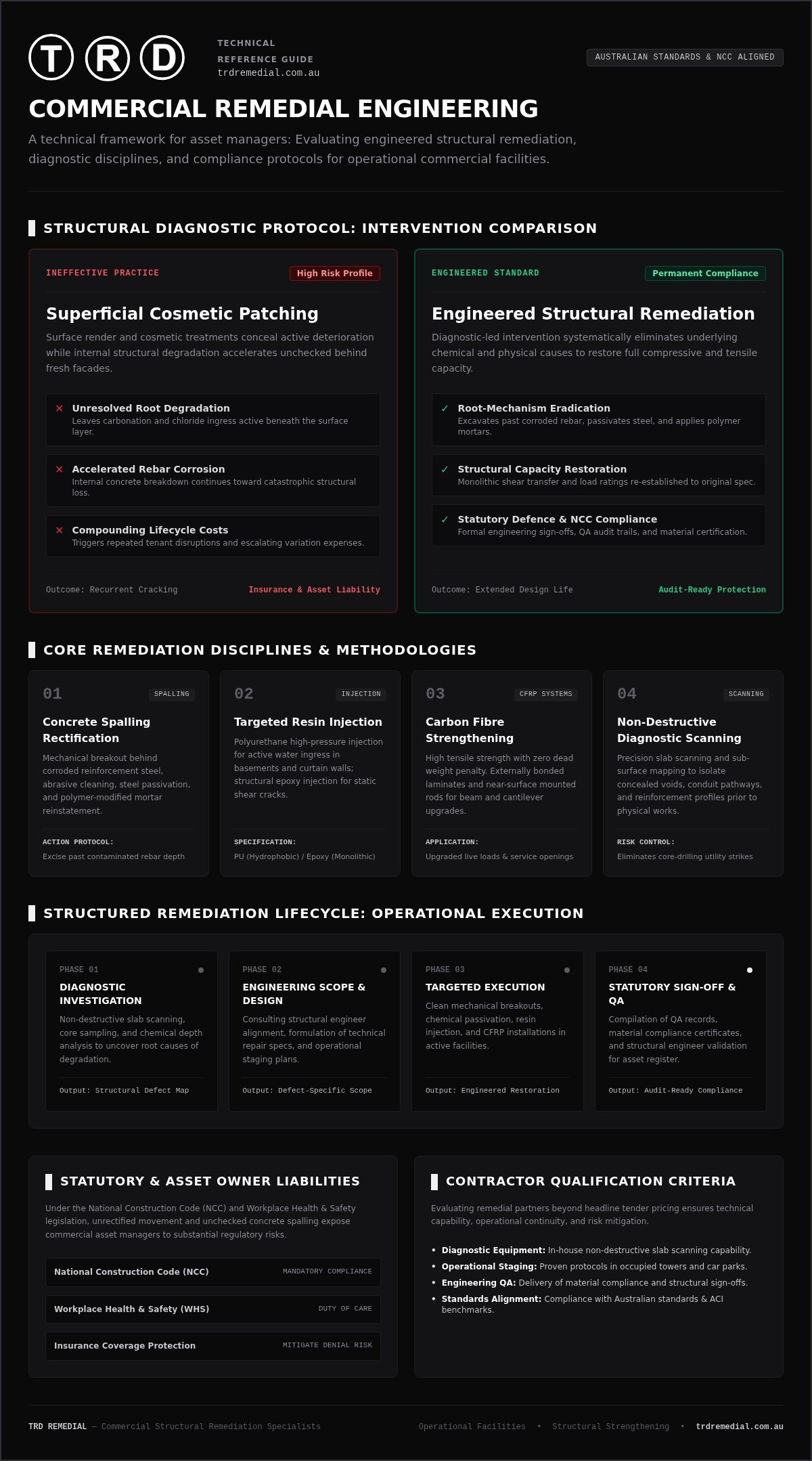
Treating structural distress with cosmetic fixes is a costly failure of asset management. Superficial patching conceals active corrosion, allowing internal concrete breakdown to accelerate unchecked behind fresh render. Engineered remediation demands diagnostic discipline. It directly addresses the chemical and physical causes of concrete degradation, including carbonation and chloride ingress, before structural capacity is irreparably compromised.
Specialist contractors systematically excise carbonated or chloride-contaminated concrete past the depth of corroded steel reinforcement, mechanically clean and treat the substrate, and reinstate the member using compatible structural repair mortars. Genuine remediation targets the underlying degradation mechanism rather than visible symptoms. Discover core methodologies in our guide to concrete remediation to see how engineered interventions restore full compressive and tensile capacity.
Regulatory Frameworks and Asset Owner Liabilities
Commercial asset managers face stringent statutory obligations under the National Construction Code. Neglected structural movement, unaddressed basement leaks, and unchecked concrete spalling introduce severe liability. When an unrectified defect causes tenant disruption, property damage, or structural instability, insurers may deny coverage, citing a breach of mandatory maintenance duties under workplace health and safety legislation.
Engaging experienced commercial remedial contractors ensures all works proceed under disciplined engineering oversight. Specialists provide detailed quality assurance records, material compliance certificates, and structural sign-offs aligned with Australian building standards. This documentation provides asset owners with an audit-ready defence during formal building condition assessments and asset transactions.
Core Technical Disciplines in Commercial Remediation
Commercial remedial contractors deploy precise technical disciplines that combine diagnostic investigation with material science. Structural remediation goes well beyond superficial maintenance; it relies on targeted chemical formulations and mechanical reinforcement systems engineered to withstand real-world operational loading cycles and cyclic environmental stresses.
Concrete Spalling Repair and Structural Crack Injection
Repairing delaminated concrete begins with mechanical breakout behind corroded rebar, followed by abrasive cleaning, steel passivation, and reinstatement using high-build, polymer-modified mortars. To manage cracking, technicians employ targeted resin systems. High-pressure polyurethane injection halts active water ingress across basement retention systems, curtain walls, and moving joints. Conversely, structural epoxy injection penetrates static fractures to restore monolithic shear transfer, adhering strictly to global structural benchmarks such as the ACI Concrete Repair Code. You can examine these injection methodologies in detail within our concrete crack repair guide.
Carbon Fibre Structural Strengthening Systems
When live loads increase or tenant requirements evolve, traditional steel beam installations often add unacceptable dead weight. Carbon fibre reinforced polymers (CFRP) provide a high-performance alternative, offering exceptional tensile strength with a negligible cross-sectional profile. Applied as externally bonded laminates or near-surface mounted rods, CFRP upgrades beam capacity, reinforces cantilevered slabs, and compensates for structural capacity lost around new service openings. Review practical design criteria in our carbon fibre strengthening overview.
Subsurface Scanning and Controlled Demolition
Structural alterations in post-tensioned commercial buildings carry acute operational risk. High-frequency ground-penetrating radar and electromagnetic slab scanning reveal embedded post-tension tendons, conduits, and rebar mats before core drilling or concrete cutting begins. When altering floor plates, controlled demolition isolates deteriorated or redundant members without transmitting destructive kinetic shock waves into adjacent structural bays. Specialists coordinate post-tension truncation, systematically destressing and re-anchoring tendons to facilitate safe layout modifications. If your facility requires engineered interventions, consulting experienced structural specialists ensures safety across every live alteration. Consult our structural slab scanning guide for non-destructive testing procedures.
How to Evaluate and Qualify Commercial Remedial Contractors
Selecting the wrong delivery partner introduces severe financial exposure and the risk of repeated structural failure. Commercial remedial contractors must demonstrate verified engineering capabilities rather than general construction track records. Lowest-price tenders frequently rely on incomplete scopes or superficial patches that fail to eradicate active deterioration mechanisms. Asset owners and facility managers require a rigorous, objective evaluation framework to qualify specialist contractors effectively.
Technical Licensing, Engineering Capabilities, and Insurances
Standard commercial builder licences do not guarantee competence in post-tension modifications, concrete chemistry, or composite strengthening. You must verify that prospective contractors hold specific credentials in structural repair alongside substantial public liability and professional indemnity coverage. Crucially, assess their internal capacity to interpret engineering documentation, produce compliant Safe Work Method Statements (SWMS), and collaborate seamlessly with consulting structural engineers during complex load redistributions.
Live-Site Risk Management and Operational Continuity
Executing heavy structural works within operational commercial buildings presents complex logistical challenges. Competent remedial teams design site logistics around continuous building operations, ensuring minimal interference with tenants and visitors. Key site controls should include:
- Dust and Air Quality Isolation: HEPA-filtered negative air units and robust physical hoarding to contain airborne particulates.
- Acoustic Management: Scheduled breakout windows and low-impact tooling to protect office and retail environments.
- Hydro-Demolition and Slurry Containment: Closed-loop recovery systems that prevent chemical runoff into municipal stormwater systems.
- Staged Access Sequencing: Zoned drop areas that maintain safe access across busy car parks, retail concourses, and loading bays.
Diagnostic Tooling and Non-Destructive Verification
A contractor's plant inventory directly reflects their technical sophistication. Tier-one remedial specialists directly operate calibrated high-frequency ground-penetrating radar, electromagnetic scanners, high-pressure multi-component injection pumps, and diamond core cutting machinery. Subcontracting every diagnostic or cutting phase introduces communication breakdowns, scheduling delays, and diluted accountability. Asset managers should scrutinise how contractors approach concealed structural defect repair challenges, verifying whether their methodologies rely on verified diagnostic data or mere visual assumptions before commencing site works.
The Commercial Remediation Project Lifecycle: Step-by-Step Execution
Engineered structural remediation requires an uncompromising, sequential process. Leading commercial remedial contractors reject guesswork, replacing ad-hoc patching with structured milestones that prevent budget blowouts and avoid unresolved secondary cracking. By enforcing transparent hold-points throughout delivery, specialists ensure every repair complies fully with the supervising structural engineer's design intent before any element is concealed.
Phase 1: Subsurface Investigation and Diagnostic Mapping
Precision begins below the surface. Before breaking ground or cutting into concrete, technicians execute detailed visual condition surveys, delamination hammer testing, and non-destructive electromagnetic cover-meter scanning. Chemical profiling follows, utilising phenolphthalein indicator sprays to evaluate carbonation depths alongside laboratory chloride ion testing on pulverised concrete dust cores. The diagnostic team compiles these findings into a detailed defect mapping schedule, quantifying exact repair volumes, concrete removal perimeters, and target reinforcement locations.
Phase 2: Substrate Preparation and Engineering Inspection Hold-Points
Defective concrete breakout proceeds with calibrated mechanical tooling, excavating material to a minimum depth of 20 millimetres behind corroded reinforcement bars to achieve complete circumference relief. Technicians abrasive-blast the exposed rebar to bright steel, eliminating active rust scale before applying an engineered zinc-rich passivating primer. Crucially, works pause at this mandatory hold-point. The project structural engineer formally inspects the excavated cavity, verifies steel cross-sectional loss, and signs off on the prepared substrate before mortal reinstatement begins.
Phase 3: Remedial Application, Testing, and Final Certification
Once approved, operatives reinstate the structural envelope using compatible polymer-modified mortars, high-pressure resin crack injection systems, or externally bonded carbon fibre composites. Quality verification doesn't end with material curing. Specialists perform direct pull-off tensile adhesion tests to verify that bonding strengths meet or exceed statutory engineering thresholds.
The project concludes with the compilation of a rigorous asset handover package. Asset managers receive complete material compliance documentation, engineer sign-off certificates, photographic QA records, and structured ongoing maintenance schedules. If you are preparing to tender critical structural works, contact our engineering team to establish an audit-ready delivery programme for your commercial asset.
Partnering with TRD Remedial for Critical Structural Solutions
TRD Remedial delivers definitive structural remediation across commercial, industrial, and residential infrastructure. Direct deployment of specialised technical capabilities ensures uncompromising site accountability and rigorous quality control. Backed by over eight years of specialised technical expertise, our team works directly alongside consulting structural engineers, commercial builders, and asset managers to resolve complex structural defects permanently. Partnering with dedicated commercial remedial contractors guarantees that every engineered intervention protects the long-term viability and statutory compliance of your built asset.
Specialised Technical Capabilities Under One Contractor
Fragmented trade scopes frequently cause scheduling friction and diluted accountability on high-pressure job sites. TRD Remedial consolidates advanced structural disciplines within a single, highly disciplined team. Our technical crews self-perform structural strengthening, carbon fibre reinforcement, concrete repairs, spalling remediation, and chemical crack injection, including specialised curtain wall injection and shoring wall crack injection.
Crucially, we integrate non-destructive slab scanning directly with core drilling, concrete cutting, wall cutting, and controlled demolition. When tenant fitouts or floor-plate modifications require new slab penetrations, our crews execute post-tension truncation with surgical accuracy, safely de-stressing and re-anchoring tendons without compromising structural equilibrium. Managing diagnostics, alteration, and reinforcement under one contract eliminates multi-trade coordination bottlenecks.
Engineered Asset Longevity Across National Portfolios
Commercial asset managers cannot afford temporary fixes that invite recurring capital expenditure. Every remediation methodology we execute is engineered for permanence, designed to withstand continuous live operational loading and aggressive environmental exposure. Our disciplined site safety frameworks and thorough quality management systems ensure full alignment with Australian building standards, insulating asset owners from statutory liability and operational disruption.
Whether your commercial asset requires dynamic water ingress crack repairs, temporary moving joints repair, or extensive structural alterations, we deliver engineered certainty from initial diagnostic review to final compliance sign-off. Contact TRD Remedial to schedule a technical appraisal with our structural remediation specialists.
Securing Structural Longevity for Commercial Built Assets
Protecting operational facilities demands looking past superficial repairs to diagnose and rectify the root causes of structural distress. Whether confronting aggressive chloride-induced spalling, moving joints, or dynamic water ingress, engaging qualified commercial remedial contractors ensures your building remains structurally sound and fully compliant with Australian building standards. A disciplined project sequence with verified engineering hold-points eliminates budget volatility while preventing recurrent degradation.
With over eight years of specialised technical expertise, TRD Remedial delivers permanent structural restoration across commercial, strata, and industrial portfolios. Our multi-disciplinary capabilities integrate non-destructive slab scanning directly with carbon fibre structural strengthening, crack injection, and controlled demolition under one accountable team. You don't have to navigate structural uncertainty or risk recurring defect costs. Engage TRD Remedial for expert structural assessment and remediation to safeguard your asset's operational future with absolute engineering confidence.
Frequently Asked Questions
What is the difference between a general commercial builder and a commercial remedial contractor?
General builders focus on new builds from clear ground, whereas commercial remedial contractors specialise in diagnosing and rectifying structural distress in existing, aging assets. While standard builders rely on sub-trades for routine construction, remedial specialists directly execute complex structural strengthening, crack injection, and spalling repairs. They possess advanced technical diagnostics to solve degradation mechanisms under live operational constraints without compromising building stability.
How do commercial remedial contractors identify hidden structural defects within concrete slabs?
Commercial remedial contractors deploy non-destructive testing, primarily high-frequency ground-penetrating radar and electromagnetic slab scanning. These instruments locate embedded post-tensioned cables, reinforcement depth, and voids beneath the concrete surface without invasive cutting. Diagnostic crews combine this subsurface mapping with acoustic hammer tapping and phenolphthalein carbonation testing to determine internal degradation boundaries before engineering any physical breakout.
Can commercial structural remediation works proceed while tenancies remain occupied?
Yes, professional remedial projects routinely proceed within live, fully occupied facilities through staged isolation. Contractors use HEPA-filtered negative-pressure air enclosures, acoustic barriers, and scheduled out-of-hours breakout shifts to control dust and noise. Zoned hoardings maintain continuous pedestrian access, parking spaces, and delivery dock operations, preventing commercial downtime while crews execute structural repairs directly adjacent to tenant spaces.
Why is carbon fibre strengthening preferred over steel plates for commercial structural upgrades?
Carbon fibre reinforced polymer (CFRP) provides exceptional tensile capacity without introducing significant dead load to aging structures. Unlike bulky structural steel plates, CFRP laminates measure mere millimetres in thickness, preserving floor-to-ceiling clearances and architectural profiles. The composite material also resists electrochemical corrosion completely and doesn't require heavy lifting rigs or complex propping systems during installation inside confined commercial spaces.
What causes recurring concrete spalling after standard patching has been completed?
Recurring spalling occurs when cosmetic repairs fail to eliminate the underlying electrochemical corrosion circuit. Standard patching often fills surface voids without breaking out concrete behind corroded rebar or passivating the oxidised steel. This untreated steel continues to expand, while the boundary between old concrete and incompatible patching mortar creates an incipient anode effect, accelerating concrete failure right alongside the new patch.
When is polyurethane injection chosen over structural epoxy injection in commercial buildings?
Polyurethane injection is selected when treating active water ingress or cracks subject to ongoing thermal movement. The resin reacts rapidly with water to create an elastomeric, expanding foam that seals wet basement retention systems, shoring walls, and cold joints. Structural epoxy, by contrast, is chosen for dry, non-moving cracks where monolithic shear strength and structural load transfer must be reinstated.
What warranties and engineering sign-offs should commercial asset managers expect after remediation?
Asset managers should expect comprehensive engineering certification from the project structural engineer confirming that all work adheres to approved specifications and Australian standards. Qualified contractors supply material manufacturer warranties covering high-build repair mortars, epoxy bonding agents, and carbon composite systems. Handover documentation must also include QA records, photographic hold-point logs, and detailed ongoing maintenance guidelines to preserve asset compliance.


