

Treating structural wall cutting as standard demolition rather than an engineered surgical intervention is the quickest way to compromise an asset's integrity. When modifying load-bearing reinforced concrete or masonry, there's zero margin for error. Striking an unmapped post-tensioned tendon, slicing through critical structural rebar, or inducing micro-fractures through uncontrolled vibration doesn't just damage adjacent finishes; it threatens structural stability. Coordinating separate contractors for scanning, temporary propping, wall cutting, and lintel strengthening only magnifies these risks, leading to severe slurry contamination, silica hazards, and expensive project downtime.
Discover how engineered wall cutting delivers vibration-free penetrations in reinforced concrete and masonry structures safely and compliantly. This specialist guide details the exact protocols required to execute complex structural alterations without incident. We unpack how combining high-resolution subsurface scanning, precision diamond track sawing, and integrated carbon fibre strengthening guarantees millimetre-accurate openings for doors, windows, and mechanical services, ensuring complete engineering compliance across your building.
Key Takeaways
- Engineered wall cutting utilising track-mounted diamond systems eliminates micro-cracking and vibration transfer, preserving the structural integrity of surrounding concrete and masonry.
- Tooling selection across track saws, diamond wire saws, and plunge chainsaws must directly align with wall thickness, reinforcement density, and strict zero-overcut corner specifications.
- A rigorous execution sequence integrating subsurface GPR scanning and engineered temporary propping prevents catastrophic strikes to post-tensioned cables and structural rebar.
- Closed-loop wet-cutting and continuous slurry vacuum extraction are essential for eliminating respirable crystalline silica risks and meeting strict environmental run-off standards.
- Engaging a unified contractor capable of managing scanning, cutting, and carbon fibre structural strengthening eliminates multi-trade scheduling delays and consolidates engineering liability.
Precision Wall Cutting: Engineered Penetrations for Reinforced Concrete and Masonry
Precision wall cutting is not simple commodity sawing; it is an engineered structural intervention. When forming openings through load-bearing structures, trade-level guesswork risks catastrophic failure. Track-guided diamond sawing systems anchor rigid guide rails directly to the concrete or masonry face, allowing high-performance diamond blade concrete saws to advance along a guided axis. This level of control produces millimetre-precise structural penetrations for fire doors, service risers, louvres, and windows. Every modification alters existing load paths, making qualified engineering oversight mandatory to ensure building stability remains intact during and after execution.
Track Sawing vs Percussive Demolition
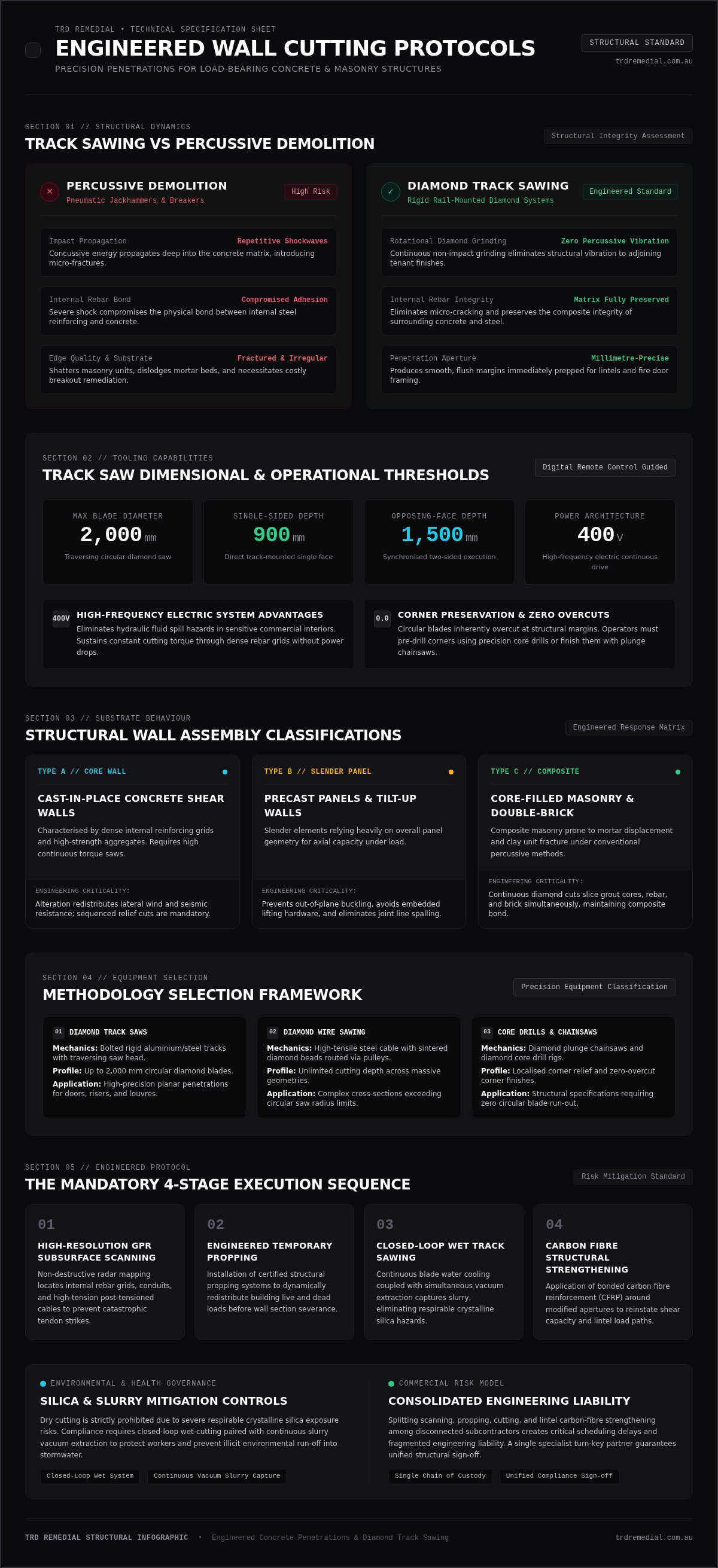
Percussive demolition using pneumatic jackhammers or hydraulic breakers relies on concussive impact. These repetitive shockwaves propagate deep into the structure, creating extensive micro-cracking throughout the concrete matrix and compromising the bond between internal reinforcing steel and the concrete. In contrast, diamond track saws cut via rotational diamond grinding under constant hydraulic or electric drive. The complete absence of percussive impact eliminates vibration transmission to adjoining tenant spaces and delicate finishes. Sawn surfaces remain structurally sound, smooth, and immediately prepared for lintel integration without requiring secondary breakout repairs.
Types of Walls Requiring Specialised Cutting
Structural assemblies behave differently under cutting loads, demanding targeted technical approaches:
- Cast-in-place concrete shear walls: Dense internal rebar grids and high-strength aggregates demand track saws with high continuous torque. Cutting through structural shear cores permanently redistributes lateral wind and seismic resistance, requiring carefully sequenced relief cuts.
- Precast panels and tilt-up walls: These slender elements rely heavily on overall panel geometry for axial capacity. Controlled wall cutting prevents out-of-plane panel buckling, avoids embedded lifting hardware, and eliminates panel spalling along joint lines.
- Core-filled masonry and double-brick: Percussive tools shatter clay bricks and dislodge mortar beds. Continuous diamond cutting slices through grout cores, reinforcement bars, and masonry units simultaneously, maintaining the composite strength of the remaining wall section.
Technical Methodologies: Selecting Track Saws, Wire Saws, and Handheld Cutters
Selecting the right equipment for structural wall cutting is an engineering calculation based on element thickness, reinforcement density, and physical clearance. High-frequency 400V electric systems have largely superseded cumbersome hydraulic packs; they eliminate hydraulic fluid spill hazards in sensitive interiors and maintain constant torque through dense steel bar grids. Circular blades inherently overcut at corners. To preserve structural integrity and prevent shear degradation, operators must pre-drill opening corners with precision core drills or finish them using plunge chainsaws.
Track-Mounted Diamond Wall Sawing
Track sawing delivers unmatched dimensional accuracy for standard to deep structural penetrations. Rigid aluminium or steel tracks bolt directly to the wall face, guiding a traversing saw head fitted with diamond blades up to 2,000 mm in diameter. This methodology achieves single-sided cut depths up to 900 mm, or 1,500 mm when cutting from opposing faces. Digital remote controls allow technicians to stand well clear of the blade rotation plane while managing vertical, horizontal, inverted, or bevelled cuts.
Diamond Wire Sawing for Extreme Wall Thicknesses
When wall cross-sections exceed the physical radius of circular blades, diamond wire sawing becomes necessary. The equipment routes a continuous high-tensile steel cable embedded with sintered diamond beads through an engineered series of directional pulleys. Diamond wire sawing carries virtually unlimited depth capability. It provides the definitive solution for cutting mass concrete, heavily reinforced counterfort retaining walls, and complex structural cores where machine access is restricted to a single perimeter.
Handheld and Ring Sawing for Confined Access
Agile penetrations in constrained locations rely on high-frequency electric or hydraulic ring saws and diamond chainsaws. Handheld ring saws cut up to 270 mm deep, while diamond chainsaws reach 400 mm to eliminate overcuts at internal junctions. Handheld flush saws allow flush cuts flat against adjoining floor slabs or soffits. Because operators directly control these units, continuous wet suppression is non-negotiable to satisfy occupational health requirements, matching the rigorous benchmarks outlined in the OSHA respirable crystalline silica standard (29 CFR 1926.1153). Engaging dedicated wall cutting contractors ensures every penetration is matched to the correct mechanical tooling without structural compromise.
Critical Engineering Prerequisites: Scanning, Propping, and Structural Integrity
Precision wall cutting must follow a disciplined engineering workflow. Modifying load-bearing concrete cannot be approached casually. To guarantee building safety, contractors must execute a strict six-stage sequence: scan, engineer, prop, cut, reinforce, and decommission. Deviating from this order risks structural instability. Isolating each phase ensures existing load paths remain secure while the physical penetrations are executed.
Non-Destructive Subsurface Wall Scanning
Cutting blindly into reinforced walls invites disaster. High-frequency Ground Penetrating Radar (GPR), operating between 1.0 GHz and 2.6 GHz, detects embedded metallic and non-metallic conduits alongside reinforcing bars up to 400 mm deep. Striking an unmapped, stressed post-tensioned tendon can cause explosive failure, ejecting steel anchors through facade skins and destroying structural balance. Comprehensive pre-cut subsurface mapping matches established slab scanning protocols, validating as-built geometry before saw anchors are drilled.
Engineered Temporary Propping and Load Transfer
Forming an opening temporarily interrupts the vertical and shear load paths carried by the wall. A certified structural engineer must calculate loads and specify temporary works prior to saw setup. Certified needle beams, acrow props, and heavy-duty shores transfer axial loads safely to lower structural tiers. Throughout the wall cutting process, optical laser levels and crack gauges monitor deflections. Propping systems must remain locked under design preload until permanent structural lintels or composite elements achieve full cure strength.
Structural Reinforcement Around Penetrations
Removing solid concrete concentrates stress at the opening's upper lintel and jamb perimeters. Engineers restore this lost load-carrying capacity using targeted structural interventions:
- Carbon fibre reinforcement polymer (CFRP): Applying engineered carbon fibre strengthening delivers tensile capacities exceeding steel while adding minimal profile thickness. CFRP laminates bond directly to the concrete surface, restoring shear capacity without encroaching into doorway head heights.
- Engineered steel lintel frames: Heavy universal beams or channel sections installed with high-strength chemical anchors anchor into the existing concrete matrix to satisfy AS 3600 shear and moment standards.
Site Environmental and Safety Controls: Silica, Slurry, and Waste Management
Executing precision structural alterations inside live facilities demands rigorous environmental hygiene. In active commercial towers, data centres, and hospitals, water egress and airborne contamination can halt operations instantly. Professional wall cutting integrates source-capture environmental controls, rigorous water containment, and engineered rigging directly into the daily scope of work.
Silica Dust Mitigation and Wet-Cutting Systems
Respirable crystalline silica particles penetrate deep into alveolar lung tissue, causing irreversible chronic health conditions. Diamond track and wire sawing systems neutralise this hazard at the source using continuous wet suppression. Regulated water delivery feeds directly into the cutting kerf, converting potential dust into manageable slurry before it becomes airborne. Where live electrical switchboards or computer rooms prohibit water, specialised dry-cutting track systems paired with high-efficiency, multi-stage HEPA extraction units capture fine particulates without compromising indoor air quality.
Slurry Containment and Environmental Disposal
Concrete cutting slurry is highly alkaline, routinely exhibiting pH levels between 11.0 and 13.0. Allowing untreated slurry to escape into stormwater drains damages natural waterways and incurs severe statutory penalties. Site teams establish multi-tier containment using physical bunds, heavy-duty floor polythene, and specialized suction rings affixed around the saw head. Industrial wet vacuums extract effluent continuously at the cut line. Mobile filtration units then separate suspended concrete fines from wastewater, enabling closed-loop water recirculation while compacting dried solid waste for compliant off-site disposal.
Rigging, Sectioning, and Controlled Removal
Managing the weight of excised structural blocks is just as vital as the cutting process itself. A solid reinforced concrete door cutout can weigh several tonnes, creating catastrophic shock loads if dropped onto an existing slab. Specialists mitigate this through deliberate geometric segmenting and sequential relief cuts:
- Engineered block segmenting: Penetrations are sectioned into transportable modules matched strictly to site crane or hoist weight limits.
- Positive mechanical rigging: Certified hoist rings and rated expansion anchors fix directly into the concrete blocks before severance cuts are finished.
- Safe lowering systems: Portable A-frame gantries and chain blocks lower severed concrete sections smoothly onto cushioned transport dollies.
This methodical extraction integrates seamlessly with broader controlled demolition procedures across complex sites. Engage TRD Remedial for engineered wall cutting to ensure complete safety and environmental compliance on your next project.
Selecting a Specialist Wall Cutting Contractor: Compliance and Capability Checklist
Engaging a contractor for structural wall cutting requires looking beyond commodity saw operators. Slicing into load-bearing elements introduces acute commercial, safety, and structural liabilities. Head contractors and asset owners must partner with technical specialists operating under rigorous engineering governance. Fragmenting subsurface scanning, temporary propping, precision sawing, and post-cut strengthening across disparate subcontractors dilutes liability. Appointing an integrated, single-source specialist unifies structural accountability and prevents costly project disputes.
Key Technical and Compliance Verification
Evaluating tender submissions requires a methodical assessment of practical capabilities. Confirm that the contractor demonstrates documented experience managing heavily reinforced shear walls and post-tensioned assemblies. Inspect their fleet to ensure high-frequency electric track saws, diamond wire systems, and flush-cut units are available to match unique access constraints. Mandate verified Safe Work Method Statements (SWMS), certified WHS management systems, and specialised public liability insurance covering subsurface structural interventions before work begins.
Integrating Remedial Repairs with Structural Cutting
Structural penetrations rarely exist in isolation from wider remedial requirements. Creating new openings often exposes underlying structural vulnerabilities, including rebar corrosion, voids, or micro-cracking within older concrete matrices. Selecting a contractor skilled in broader structural defect repair ensures teams can immediately inject cracks, remediate spalled edges, and install composite reinforcement without suspending works. Comprehensive handover documentation must follow every cut, including GPR scan logs, slurry disposal dockets, and structural engineer sign-offs.
Procurement Workflow and Next Steps
Successful wall cutting relies on detailed tender scopes that leave no operational gaps. Supply prospective contractors with architectural drawings, structural engineering specifications, and exact floor loading constraints for equipment access. Organise an early onsite assessment to evaluate electrical power supplies, drainage paths, and temporary propping configurations. Engaging an accredited specialist early streamlines site logistics, avoids unexpected variation claims, and ensures your structural alterations remain fully compliant from initial scan to final load transfer.
Executing Complex Structural Alterations with Complete Engineering Certainty
Altering load-bearing reinforced concrete and masonry demands disciplined engineering over brute force. As building designs evolve, treating structural penetrations as simple trade cutting invites micro-fracturing, costly service strikes, and compliance failures. Long-term structural integrity relies on executing an integrated sequence: mapping embedded rebar and post-tensioned cables with high-frequency GPR scanning, deploying specialised diamond track and wire sawing equipment for vibration-free execution, and reinstating load capacity through carbon fibre reinforcement.
Consolidating scanning, cutting, and composite strengthening under a single technical contractor eliminates trade friction while maintaining comprehensive compliance with Australian engineering and workplace health and safety standards. Your assets deserve uncompromising precision. Discuss your structural wall cutting project with TRD Remedial to secure disciplined project execution, verified safety, and complete structural certainty from initial scan to final load transfer.
Frequently Asked Questions
What is the maximum thickness of a concrete wall that can be cut?
Standard track-mounted diamond wall saws cut up to 900 mm from a single face, or up to 1,500 mm when opposing face access is available. For mass concrete retaining walls or structural abutments exceeding these limits, diamond wire sawing provides unlimited cut depths. The wire loop threads through pre-drilled holes, cutting cleanly through structural assemblies of virtually any thickness or rebar density.
How do you prevent over-cutting at the corners of door and window openings?
Over-cutting is prevented by core drilling the opening corners before cutting the perimeter lines. This establishes clean, radiused junction stops that circular blades cannot achieve. Alternatively, operators stop the track saw just short of the intersection and square the corners using specialised diamond plunge chainsaws. This strict zero-overcut technique preserves critical structural shear capacity at every jamb and lintel corner.
Can wall cutting be carried out inside an operational commercial building?
Yes, precision wall cutting is routinely carried out inside occupied commercial facilities. Operators use high-frequency 400V electric systems that eliminate exhaust fumes and hydraulic spill hazards. Continuous water misting paired with high-volume industrial slurry extraction neutralises airborne silica risks. Combined with acoustic curtains and scheduled workflows, this ensures surrounding tenancies and operational facilities remain completely undisturbed.
Why is GPR scanning mandatory before commencing any concrete wall cutting?
GPR scanning is essential because structural walls conceal live electrical conduits, dense rebar patterns, and stressed post-tensioned cables. Striking a tensioned tendon can cause sudden, catastrophic structural failure and severe site injuries. High-frequency radar scans map internal elements up to 400 mm deep, providing real-time data so structural engineers can adjust cut locations and verify safety before any blades touch the concrete.
How is structural integrity maintained when cutting openings in load-bearing walls?
Structural integrity is maintained through temporary load redistribution and engineered reinforcement. Certified temporary works, including heavy-duty props and needle beams, transfer vertical loads away from the cut zone. Following the wall cutting process, engineers reinstate the lost structural capacity by installing chemical-anchored steel lintels or bonding high-tensile carbon fibre polymers directly across the jambs and head of the opening.
What is the difference between diamond wall track sawing and diamond wire sawing?
Diamond track sawing utilises a rigid steel or aluminium guide rail to traverse a circular diamond blade, providing straight cuts up to 900 mm deep. Diamond wire sawing routes a continuous diamond-beaded steel cable through a custom pulley network. Wire saws provide unlimited cutting depths and cut irregular geometries where circular blades cannot fit or reach.
How is wastewater and concrete slurry managed during indoor wall cutting?
Indoor concrete slurry is controlled through closed-loop capture systems operating at the cut line. Technicians install containment bunding and vacuum collection shrouds directly around the saw track, extracting alkaline water immediately into industrial wet vacuums. The collected slurry is processed through mobile filtration units to separate concrete fines, producing clean water for reuse while solidifying hazardous alkaline cake for compliant disposal.


