

What if the neatest-looking patch is the wrong repair? Spalling concrete reinstatement methods need to address more than the visible break. Deterioration may extend beneath the surface, affecting reinforcing steel and the surrounding concrete. A quick patch or coating can hide the defect without resolving its cause.
If you’re unsure whether damage is superficial or signals deeper deterioration, that uncertainty is reasonable. The right approach depends on the condition and extent of the concrete, the state of the reinforcement and what is driving the damage. This article explains how repair methods are selected and what a considered reinstatement process involves, so you can understand the limits of each option.
We’ll follow the repair sequence from assessment and removal of unsound concrete through reinforcement treatment, reinstatement and quality control. You’ll also see how the underlying cause shapes the repair plan, when crack injection or broader structural remediation may be relevant, and why specialist assessment matters when damage could affect structural performance. TRD Remedial undertakes concrete and spalling repairs as part of project-specific structural remediation, working with builders, engineers and strata managers to coordinate technical repair work.
Key Takeaways
- Learn what concrete reinstatement restores, and why it starts with removing unsound material rather than covering the damaged surface.
- See how moisture ingress, carbonation, chloride exposure and construction defects can inform an investigation of spalling.
- Compare spalling concrete reinstatement methods and understand how damage depth and reinforcement condition influence the repair scope.
- Follow the repair sequence and see how an engineer’s specification guides concrete removal and reinforcement treatment.
- Discover how TRD Remedial tailors spalling repairs to assessment findings, the structure and project constraints.
What spalling concrete reinstatement is designed to repair
Spalling is concrete that flakes, chips or breaks away from a surface. The visible loss may be shallow, but it can also point to a deeper problem, such as deterioration around reinforcing steel. The appropriate repair depends on assessment findings, not just the size or shape of the damaged patch. Spalling alone doesn’t prove a structure has failed, but loose, cracking or changing concrete warrants a considered response.
Concrete reinstatement is the controlled removal of unsound concrete, followed by preparation and replacement with a repair system suited to the substrate, reinforcement and exposure. That distinguishes genuine reinstatement from cosmetic covering. Paint, render or a thin surface layer may conceal damage without restoring the affected concrete. Reinforcement corrosion is one of the concrete degradation processes that can contribute to cracking and spalling.
For owners and asset managers, a safety-led assessment establishes the repair scope and whether engineering input is needed. It considers the defect in context, including its location, surrounding concrete and any reinforcement that is visible or may be affected. This helps distinguish localised surface wear from deterioration that calls for structural remediation.
How spalling differs from a surface blemish
An isolated scrape or small area of surface wear may not indicate significant deterioration. Cracking, delamination, bulging or exposed reinforcement presents a different picture. These features can suggest that concrete is separating or that corrosion is affecting the steel. Rust staining near a damaged area, loose fragments or concrete that sounds hollow when assessed can also warrant closer investigation.
Appearance alone can’t establish how far deterioration extends. A small visible spall may sit above a larger area of weakened or detached concrete, while a blemish may be limited to the surface. Avoid probing or dislodging loose material yourself, particularly overhead or in a public area. Assessment helps establish the condition and extent without assuming every defect is a structural failure.
Why reinstatement is more than filling a cavity
A durable repair starts by removing unsound concrete to the boundary defined for the work, then preparing a stable substrate so the replacement material can bond appropriately. Filling over loose or deteriorated edges risks leaving compromised material in place. The repair boundary and removal depth should reflect the assessed defect, not simply the outline visible on the surface.
Reinforcement condition matters. Where steel is exposed, the repair specification may need to address its condition and protection as well as replacing the surrounding concrete. The selected materials and any protective treatment must suit the assessed substrate and exposure conditions. These decisions shape which spalling concrete reinstatement methods are appropriate, from a localised repair to a broader intervention. The method should reinstate the affected concrete as part of the structure, not merely make the surface look intact.
How assessment identifies the cause and extent of spalling
A repair plan needs to explain not only where concrete has broken away, but what may be driving the damage and whether deterioration extends beyond the visible defect. Moisture ingress can create conditions that contribute to corrosion. Chloride exposure can accelerate reinforcement corrosion, while carbonation can reduce the concrete’s protection of embedded steel. Construction defects may also leave concrete more vulnerable to deterioration. These causes can overlap, so assessment considers the structure and its exposure rather than assigning a cause from appearance alone.
Water pathways are especially relevant to the scope. An area below a joint, near a crack or exposed to recurring wetting may show damage linked to moisture movement. The visible spall is a starting point, not a reliable map of the affected area. The repair boundary should follow the assessment findings, not the outline of the visible damage. This helps determine whether a local repair is suitable or whether further investigation and a broader remediation scope are needed.
What a concrete condition assessment examines
The assessment records where damage occurs and how it is distributed. A single isolated area can indicate a different pattern from repeated cracking and material loss across a facade or soffit. The review also considers delamination, rust staining, damp areas and the condition of surrounding concrete. Where reinforcement is exposed and accessible, its condition is considered alongside the concrete that protects it.
Investigators also look for contributing conditions where practicable, including water entry points, recurring wetting, drainage paths, surface cracks and relevant construction details. Findings are considered together because one sign alone rarely establishes the cause. A structured record helps engineers relate the observed defect to the building’s exposure and define what further investigation, if any, is appropriate.
Why the repair boundary matters
Concrete that appears intact beside a spall may still be unsound or detached. If affected material remains outside the repair area, it can undermine the reinstatement or allow deterioration to continue. Engineers use assessment findings, along with observations made as removal proceeds, to determine the repair’s extent and depth. These limits are specific to the defect and structure, not a universal measurement.
The repair specification also depends on what the investigation reveals about the reinforcement and surrounding substrate. It may set out removal limits and any actions for the reinforcement, while accounting for exposure conditions. This creates a connected workflow: identify the likely cause, define the repair boundary, then use those findings to guide removal, steel treatment and concrete reinstatement. The selected spalling concrete reinstatement methods should follow that project-specific scope.
For owners, strata managers and project teams, a clear assessment record supports coordination between the engineer, builder and remediation contractor. TRD Remedial undertakes spalling repairs and structural remediation, tailoring technical work to the findings and project requirements. Where concrete deterioration needs specialist attention, specialist spalling repairs can form part of a wider, assessment-led repair plan.
Comparing spalling concrete reinstatement methods
The choice between a localised patch and a broader repair turns on the assessed condition, not simply the visible area. If deterioration is discrete and the surrounding concrete provides a sound boundary, a local repair may be suitable. Where damage extends further or reinforcement is affected, the repair scope may need to expand. The spalling concrete reinstatement methods below have different purposes and limits.
| Method | Suitable condition | Limitations | Assessment considerations |
|---|---|---|---|
| Localised patch reinstatement | Discrete damage with a suitable repair boundary. | Won’t address deterioration beyond the prepared area. | Check substrate soundness, reinforcement condition and exposure. |
| Broader or deeper reinstatement | More extensive deterioration, deeper damage or affected reinforcement. | Requires a defined scope and may involve more extensive removal. | Engineer determines removal limits and any reinforcement actions. |
| Protective coating or resurfacing | A complementary surface treatment specified for the assessed condition. | Doesn’t replace unsound concrete or reinstate missing material. | Apply only after the repair substrate and purpose are established. |
| Crack injection | A crack suited to an injection repair strategy. | Doesn’t reinstate concrete that has spalled away. | Assess the crack and its relationship to the wider defect. |
When localised patch reinstatement may suit
A patch may suit a discrete defect where assessment identifies sound concrete around the repair and a clear boundary for removal. The repair area still needs proper preparation, and loose material can’t be left beneath the reinstatement. If reinforcement is exposed, its condition informs the specified treatment. Repair material must be compatible with the prepared substrate and appropriate to the structure’s exposure. A small patch isn’t automatically a simple repair.
When damage calls for a broader repair strategy
Where deterioration extends beyond one isolated area, the engineer may specify a larger or deeper reinstatement scope. The extent depends on findings as removal proceeds, including the condition of concrete and reinforcement. Protective measures, such as a coating, may complement reinstatement when specified, but can’t make unsound concrete sound. If damage affects structural performance, the engineer determines whether strengthening or other remediation is also required.
Resurfacing addresses a surface finish or specified surface condition. It doesn’t replace concrete that has broken away. Crack injection treats suitable cracks, with the approach depending on the crack’s characteristics and purpose. Neither should be treated as a substitute for reinstatement where concrete is missing or unsound. Matching the method to the assessed defect keeps the repair scope focused on what the damaged concrete requires.
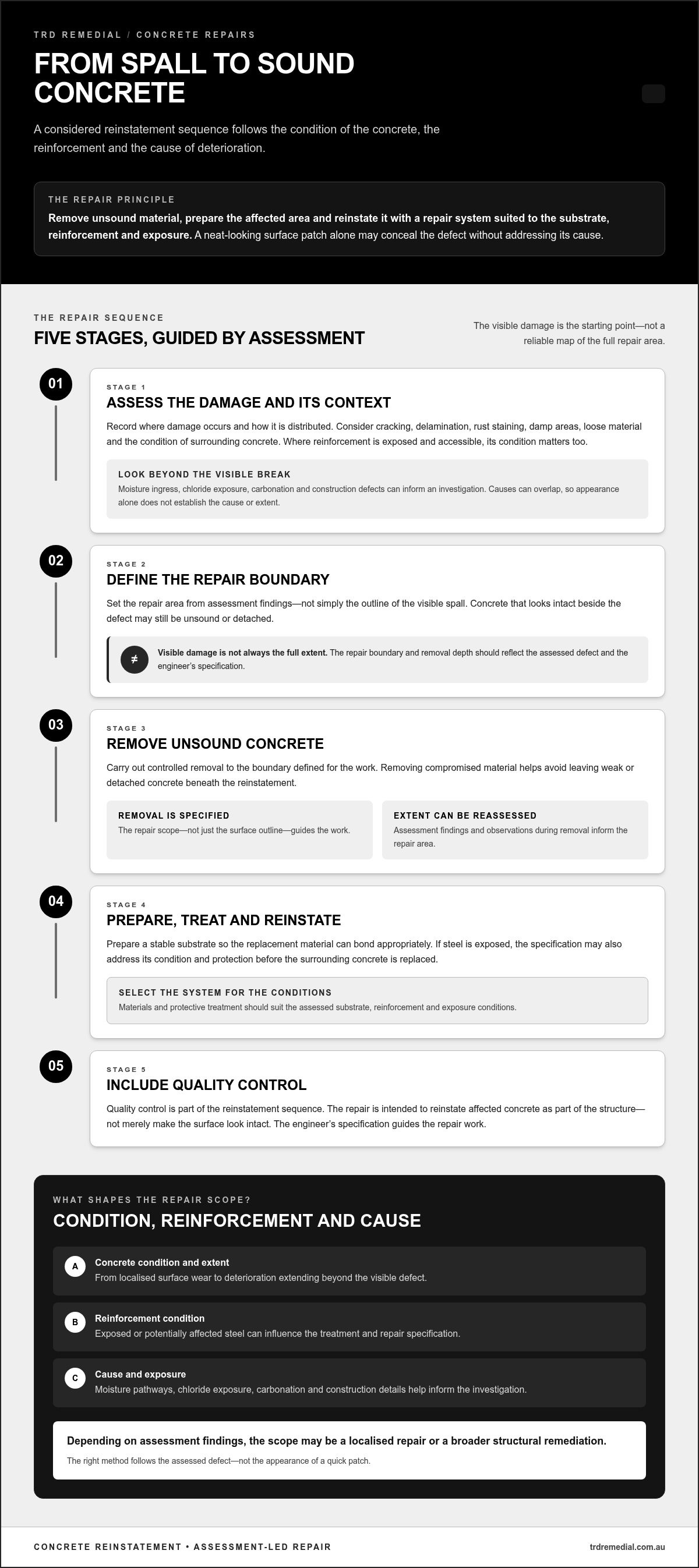
The concrete breakout and reinstatement sequence
A sound repair depends on the work happening in the right order. Assessment defines the scope; controlled removal exposes the repair area; preparation and any specified reinforcement treatment ready it for reinstatement. The engineer’s specification governs removal limits and reinforcement actions. These steps aren’t interchangeable: placing repair material before the substrate is properly prepared can compromise the repair interface.
Sequencing protects repair integrity by ensuring each stage is completed and checked before the next one covers it. The precise method, placement requirements, curing and finish depend on the repair material, structure and project specification. A practical workflow is:
- Assess and set out: Confirm the repair location and boundaries against the engineer’s specification. Record relevant site conditions and plan how work can be carried out around the surrounding structure.
- Remove unsound concrete: Break out deteriorated material in a controlled manner, stopping at the specified limits. If removal reveals conditions that differ from the assessment, pause for review rather than extending the repair without direction.
- Prepare the substrate and reinforcement: Clean and prepare exposed concrete and reinforcement as specified. Check that the repair area is ready for the chosen reinstatement system.
- Reinstate the concrete: Place compatible repair material in accordance with its specification, including the required placement method and finish.
- Cure, protect and verify: Follow the specified curing and protection requirements, then complete the relevant inspections and records before treating the repair as finished.
Breakout and preparation of the repair area
Removal methods must suit the repair location and account for surrounding concrete, reinforcement, access and site constraints. The aim is to remove unsound material without causing unnecessary damage outside the defined repair area. Once exposed, the substrate and reinforcement are cleaned and prepared to the engineer’s requirements. Any unexpected deterioration or change in reinforcement condition should be documented and referred for review before reinstatement continues.
Reinstatement, curing and verification
Placement is governed by the selected material’s specification and the repair geometry. The work needs to fill the prepared area as intended and achieve the specified finish. Curing and protection requirements vary with the material and project conditions, so don’t assume a fixed duration or generic procedure. Inspections at relevant stages help confirm that work follows the approved repair scope.
Useful quality records can include photographs before and after breakout, observations of exposed concrete and reinforcement, preparation checks, details of material placement and completion observations. The project team can use these records to track decisions and identify variations from the specified work. Verification should reflect the engineer’s requirements and repair specification.
For spalling repairs that require coordinated assessment, breakout and reinstatement, engage TRD Remedial for concrete repairs as part of a project-specific remediation plan.
How TRD Remedial approaches spalling concrete repairs
TRD Remedial undertakes spalling repairs and structural remediation for residential, commercial and industrial projects across Australia. The work is planned around the identified condition, the structure and practical site requirements. The repair scope is project-specific, rather than a standard patch applied wherever concrete has broken away.
Assessment findings inform the repair approach, including the areas requiring reinstatement and whether the defect is part of a wider structural issue. Builders, engineers and strata managers can coordinate with TRD Remedial to align technical repair work with the project scope and site needs. For a broader overview of how concrete repair fits into asset care, see the concrete remediation guide.
Integrating concrete repairs with broader remediation
A spall may be one part of a wider building defect. If assessment identifies related deterioration in adjacent concrete or other structural concerns, the repair plan can be coordinated as part of broader remediation rather than treating each visible area in isolation. Engineers determine the required scope and any additional structural measures. The structural defect repair guide explores how defect assessment can shape a remedial response.
Crack injection is relevant only where cracking forms part of the assessed problem, such as a crack associated with water ingress. It serves a different purpose from concrete reinstatement, so the methods should be coordinated where both are specified. For related information, the concrete crack repair guide explains how crack repairs fit within structural remediation.
Planning specialist repair work around project needs
Repair planning also needs to account for how work will be delivered on site. Access to the damaged area, the sequence of activities and site operating requirements can affect how the work is organised. Coordinating these practical considerations with builders, engineers and strata managers connects the technical scope to the wider project plan. The exact approach depends on the structure and assessment findings.
Clear coordination is particularly useful where repairs occur in occupied buildings or alongside other project activities. It supports decisions about where work is carried out, how affected areas relate to the repair sequence and how technical requirements are communicated between stakeholders. TRD Remedial’s concrete repairs and structural remediation are tailored to project conditions, while the specified repair scope guides the work.
Choosing among spalling concrete reinstatement methods is an engineering-led decision shaped by the defect, structure and site requirements. TRD Remedial works with project stakeholders to coordinate specialist repair work and address concrete deterioration as part of a considered remediation scope.
Discuss your concrete reinstatement project with TRD Remedial.
Move from visible damage to a considered repair plan
Before repair work begins, start with a well-informed assessment. Note where spalling is occurring, whether it appears to be changing and any surrounding signs of cracking, moisture or loose material. This context helps frame the assessment and gives the project team a clearer starting point. The right spalling concrete reinstatement methods should serve the structure’s needs, not just improve the visible surface.
TRD Remedial undertakes specialist concrete and spalling repairs as part of structural remediation for residential, commercial and industrial projects. The team works with builders, engineers and strata managers to coordinate the repair scope with project requirements, turning assessment findings into practical repair planning.
If concrete deterioration is affecting your building, take the next step with a project-specific discussion. Discuss your concrete reinstatement project with TRD Remedial and move towards a clear, considered repair plan.
Frequently Asked Questions
Can concrete spalling appear on a ceiling?
Yes. Spalling can affect overhead concrete, including soffits, and loose or detached pieces may fall. Keep people clear of the area below visibly loose material where you can do so safely, and don’t disturb it yourself. Arrange a competent assessment to establish the extent and likely cause. The repair scope should address affected concrete and any underlying deterioration identified, rather than simply covering the surface.
How long does concrete reinstatement take?
There’s no single timeframe for every spalling repair. Duration depends on the damage, access, removal needs, reinforcement condition, repair materials, curing requirements and site operations. A small isolated repair may involve a different sequence from a larger project completed in stages. The programme should be based on the assessed scope and the chosen system’s requirements. The right spalling concrete reinstatement methods therefore need to be considered alongside the project schedule.
Can spalling repairs be staged while a building remains in use?
Staging may be possible if the work area, safety controls and repair sequence can be managed around building operations. For example, a project plan might identify work zones and coordinate access to nearby rooms or facilities. The extent and location of damage, falling-material risk and access arrangements all affect what is practical. Maintaining access must not take priority over hazard management, so coordinate site controls with the relevant project stakeholders.
Can concrete spalling occur without visible rust stains?
Yes. The absence of rust staining doesn’t prove that reinforcement is unaffected or that the concrete is sound. Deterioration can be hidden beneath the surface, and different causes may not produce the same visible signs. Note any cracking, dampness, hollow-sounding areas or loose concrete, but don’t rely on appearance to determine the repair scope. Assessment can consider these observations alongside exposure conditions and any reinforcement visible in the affected area.
Is concrete spalling covered by building insurance?
It depends on the policy wording, the circumstances of the damage and the insurer’s assessment, so cover can’t be determined from the defect alone. Building owners or strata representatives can review the relevant policy and discuss the claim process with their insurer. Keep photographs, condition records and assessment documents together. A clear record of when damage was observed and how it has changed can support project discussions and help organise information for an insurance enquiry.
Can spalling concrete be repaired in wet weather?
Possibly, but weather and moisture can affect access, surface preparation, material placement and curing. Whether work can proceed depends on site conditions and the repair system’s requirements. For example, water on a prepared surface may affect whether it is ready for the specified material. Follow the repair specification and product instructions, and plan protection or changes to sequencing around actual site conditions rather than assuming all wet-weather work must stop or can continue.


