

A carbon fibre wrap can be installed to a high standard and still fail to address the structure’s actual deficiency. That is why the structural need must be understood before work begins. Engineered carbon fibre wrapping is a strengthening method, not a cosmetic treatment or an automatic fix. Its suitability depends on the member, the demands it must resist, the condition of the substrate and the intended outcome.
Confidence in the engineering and site work matters, particularly when access, occupants or ongoing operations may be affected. This guide explains how the structural need is assessed, how design decisions shape the strengthening system, and how preparation and installation translate the design into site work. It also covers verification, the method’s limitations and how carbon fibre strengthening can fit into a wider structural remediation project. Use the steps below to assess whether wrapping may suit the project and what coordination it requires.
Key Takeaways
- Engineered carbon fibre wrapping is designed around a specific structural deficiency, not applied as a one-size-fits-all treatment.
- Drawings, site observations and structural information help shape the assessment and strengthening design.
- Consider the element’s condition, access constraints and project objective when assessing whether wrapping may be suitable.
- Preparation, specified materials and planned inspections all contribute to installation quality and verification.
- TRD Remedial coordinates carbon fibre strengthening with relevant concrete repairs and technical site work.
What engineered carbon fibre wrapping does for an existing structure
Engineered carbon fibre wrapping bonds fibre-reinforced polymer to a selected structural element to help it resist a defined demand. It is not simply fabric applied to concrete. The design specifies the reinforcement’s layout, direction and extent according to the structural deficiency, element geometry, substrate condition and project requirements.
This distinction matters when a beam, column or other concrete member needs additional capacity because of a changed requirement or an identified deficiency. Assessment must establish what the reinforcement is intended to do and how it will work with the existing element. Carbon-fibre-reinforced polymer (CFRP) combines carbon fibres with a polymer matrix; its properties and applications are outlined in this Carbon-fiber-reinforced polymer overview.
Concrete repair and strengthening serve different purposes. Repair addresses deterioration or damage in the concrete. Strengthening is designed to supplement an element’s structural performance. If cracking, spalling or another defect is present, it needs assessment and may require repair as part of the project. Covering a defect with fibre does not, by itself, resolve its cause or restore unsound concrete.
How wrapping transfers structural demand
In a bonded system, resin helps transfer forces between the existing surface and the carbon fibres. The fibres can contribute tensile resistance in the directions and locations specified by the design. Depending on the member and objective, the arrangement may be intended to assist with flexural or shear demands, or to provide confinement around an element.
The effect is not automatic. Fibre orientation, coverage, bond to the substrate and the way loads travel through the structure all matter. The design needs to state the intended strengthening action. Adding material to a member without regard to these factors does not guarantee improved performance.
Where engineers may consider carbon fibre wrapping
Engineers may assess wrapping for selected concrete elements when a defined structural requirement calls for strengthening. For example, a beam, slab or column may be considered if its assessed demands and geometry suit a bonded fibre system. These are possible applications, not a presumption of suitability. The element and its supporting structure must be considered in context.
Project requirements may change, or an assessment may identify a deficiency that needs attention. The reason for the work does not determine the solution by itself. Access, surface condition, element shape and the required strengthening effect all influence whether wrapping is appropriate and how it should be detailed. The broader principles behind carbon fibre strengthening solutions sit within this project-specific assessment.
Engineered carbon fibre wrapping is one structural strengthening option, not a universal remedy. Its value depends on a clear design objective and a sound interface with the existing structure. If concrete repair is also required, coordinate that work with the strengthening approach so the installed system responds to the element’s actual condition.
How engineers develop an engineered carbon fibre wrapping design
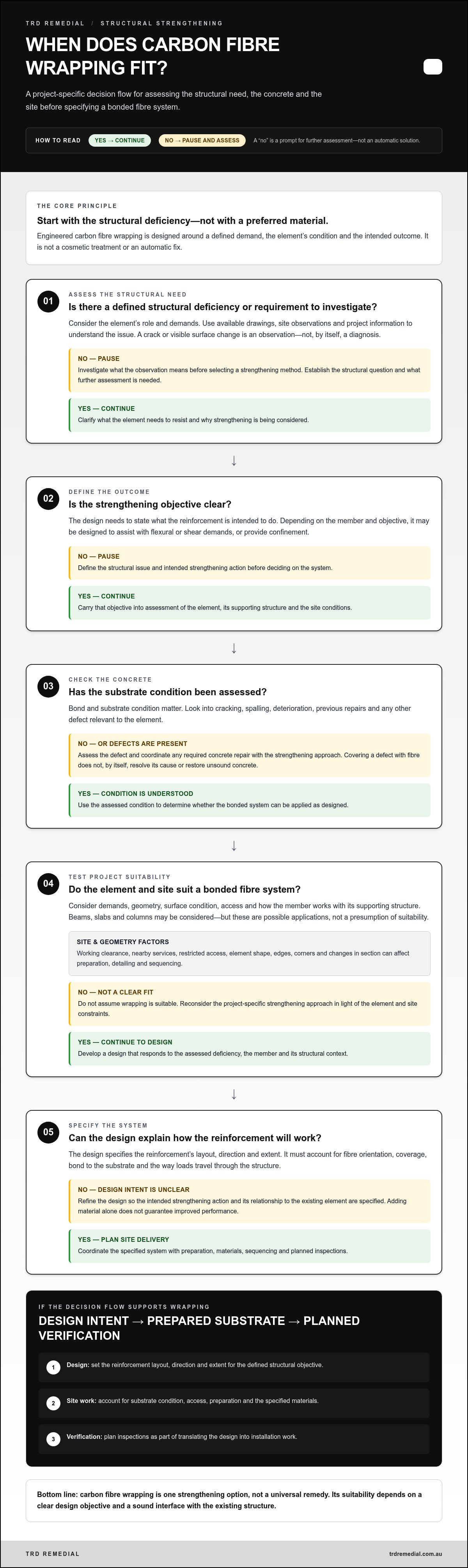
A sound design starts with the structural question, not a preferred material. A crack, deflection or visible surface change is an observation to investigate. On its own, it does not identify the cause or establish that carbon fibre is the right response. Engineers consider the element’s role, the available evidence and the demands it must meet before deciding whether strengthening is required.
The design sequence is to define the deficiency, assess the element and available evidence, set the strengthening objective, then specify an approach suited to the structure and site. This is a project framework, not a universal calculation method. The investigations and design decisions depend on the circumstances.
Start with the structural problem and available evidence
Existing drawings can help establish a member’s dimensions, reinforcement and structural arrangement. Their accuracy and relevance to current site conditions still need consideration. Inspection findings and site observations add context. The location and pattern of cracking, deterioration, previous repairs and changes to the structure can all indicate what needs further assessment.
Separate what can be observed from what still needs to be established. A crack may be a symptom, while the engineering question concerns the element’s condition, behaviour or capacity under relevant demands. Project information, such as a change in intended use or a structural alteration, may help clarify the issue. When damage forms part of a wider pattern, structural defect assessment and repair can provide context for understanding the remedial problem.
Translate assessment into a project-specific design
Once the structural issue is defined, the engineer establishes the strengthening objective and the assumptions informing the design. The proposed system must respond to the element and its connections within the structure, not just the surface selected for wrapping. The design also needs to account for the substrate, because its condition affects how the system can be applied and transfer load.
Practical constraints matter. A beam beside services, a column with limited working clearance or a slab with restricted access may affect preparation, detailing and sequencing. Geometry can influence how reinforcement is arranged around edges, corners or changes in section. These conditions do not determine the design alone, but identifying them early helps coordinate the engineering intent with the work that can be carried out on site.
Design assumptions should be clear to the people coordinating assessment and installation. If site findings differ from the information used to develop the design, raise the discrepancy and address it through the project’s engineering process. Do not change the wrapping detail informally. This keeps the specified strengthening connected to the actual element and project objective.
TRD Remedial coordinates carbon fibre and structural strengthening with relevant concrete repairs and technical site work. For projects where assessment identifies a strengthening need, explore TRD Remedial’s structural strengthening services as part of the project discussion with the engineering team.
When engineered carbon fibre wrapping may fit, and when it may not
A lightweight strengthening system is not automatically suitable for every structure. Engineered carbon fibre wrapping may be considered when an element has an assessed strengthening need and its condition, shape and site constraints can support the designed system. Suitability depends on the element, the deficiency, the design objective and whether the work can be installed as specified.
Use the framework below to organise the assessment. It is not a pass-or-fail test or a substitute for engineering judgement. Each concern needs to be considered in the context of the whole element and project.
| Factor | May support consideration | Needs further assessment |
|---|---|---|
| Project need | A specific structural deficiency or changed requirement has been identified. | The concern is unclear, or the proposed strengthening objective hasn’t been defined. |
| Substrate condition | The surface and underlying material can be assessed and prepared for the designed system. | Deterioration, cracking, moisture or contamination may affect the substrate or bond. |
| Access and geometry | The element’s shape and available work area allow the specified preparation and application to be planned. | Restricted access, obstructions or complex geometry could prevent the intended detail being installed. |
| Engineering assessment | Available information supports a project-specific design objective and approach. | Evidence is incomplete, or the observed condition raises questions that remain unresolved. |
Project conditions that influence suitability
Substrate soundness is central to the assessment because a bonded strengthening system relies on an interface with the existing element. Surface damage, loose or weak material, moisture and contamination may affect preparation or bonding. None of these observations determines the outcome alone. Their extent, cause and relevance to the design need to be understood.
Geometry and access shape the practical plan. A confined work area or irregular member may affect how the surface can be prepared and how the designed reinforcement can be placed. Planned building use matters as well: access arrangements and work timing may need coordination with occupants or ongoing operations. These factors inform constructability as well as material selection.
When a broader remediation response is needed
Wrapping should not conceal active deterioration or replace investigation into why concrete is cracking, breaking down or losing material. If the substrate is unsound, assess the condition and consider the repair requirements before finalising the strengthening detail. Otherwise, the system may not address the issue that prompted the work.
Repair and strengthening can be related but distinct parts of a project. Concrete repairs address damaged or deteriorated material; strengthening responds to an engineering objective for the element. Coordinate the work where needed so the repaired substrate and proposed reinforcement form a connected scope. This concrete remediation guide explains the broader repair context.
The practical decision is not simply whether carbon fibre is lightweight or accessible. Consider whether the assessed element, its condition and the site allow a design to address the identified need, with repair work coordinated where required.
What happens during carbon fibre wrapping installation and verification
Installation follows the project design, from surface preparation through to inspection and handover. Each stage matters. Even a correctly specified strengthening system depends on the substrate being prepared and the materials being applied as intended.
Installation quality depends on following the engineered specification, including requirements for surface preparation, system materials, application details, inspection and records. Checks and acceptance criteria are project-specific, not a universal checklist that applies identically to every structure.
Prepare the work area and concrete surface
Before application, organise the work area to provide suitable access and protect surrounding surfaces and activities. Prepare the concrete as required by the project details and specified system. Depending on the element and its assessed condition, this may involve removing unsound material, addressing identified defects and preparing the surface for bonding.
Preparation requirements vary. The substrate, existing repairs and site conditions inform the approach, so do not assume one preparation method or surface tolerance applies to every job. If the surface reveals unexpected deterioration or differs from the condition allowed for in the design, raise the issue through project coordination before covering it with the strengthening system.
Apply, inspect and document the strengthening work
Apply the specified system in line with the project details and relevant manufacturer guidance. Place materials in the locations and arrangement set out for the element. Do not substitute materials or alter the detail informally. Plan the sequence so required preparation and inspection points can be completed before later stages cover the surface.
Verification records should reflect the project requirements. Depending on the specification, the project team may document:
- Surface preparation and the condition of the substrate before application.
- The materials used and relevant product or batch identification.
- Inspection observations at specified stages and any required acceptance records.
- Variations, site observations or departures referred for resolution.
These are examples, not universal mandatory tests or records. The engineering specification and project quality requirements determine which checks apply, who carries them out and how any non-conformance is managed. Photographs or other records may support traceability where required, but they do not replace specified inspections.
At handover, project documentation can record completed work, inspection outcomes and agreed details relevant to future maintenance or asset management. If ongoing monitoring or other follow-up is specified, include it in the handover information so the asset team understands the requirement.
TRD Remedial coordinates carbon fibre strengthening with relevant concrete repair and technical site work. Discuss your carbon fibre strengthening project with the team.
How TRD Remedial delivers engineered carbon fibre strengthening
Structural strengthening needs to match the assessed deficiency and site conditions. TRD Remedial delivers carbon fibre strengthening and structural strengthening as specialist remedial work, coordinating the work with project requirements and relevant professionals. Engineered carbon fibre wrapping is not a standard detail applied to every element. The work is tailored to the project and follows the specified strengthening approach.
Coordination connects the engineering intent with the site work. Builders, engineers and strata managers may each contribute information or manage different parts of a project. Clear communication about the element, scope, access and any related concrete condition helps align responsibilities and identify issues that could affect delivery.
Coordinate strengthening with the wider remedial scope
Strengthening may form part of a broader structural remediation project. If concrete damage or deterioration is present, coordinate repair requirements with the strengthening work so the scope addresses both the element’s condition and the structural objective. TRD Remedial’s concrete repair and technical site capabilities can support this coordination where relevant.
Subsurface information may also matter if planned work could interact with concealed structural elements or services. Where investigation is relevant to the project requirements, slab scanning and subsurface assessment can inform site planning. This is not an automatic step for every strengthening project; its relevance depends on the asset and proposed scope.
Coordination is practical as well as technical. Access arrangements, the order of repair and strengthening activities, and communication with people responsible for the asset can all affect how work is organised. Raise site observations through the project team so changes remain aligned with engineering requirements rather than relying on informal alterations to the specified work.
Plan the next step for a structural strengthening project
Start with a concise project brief. Include the asset and element involved, the observed issue, any known changes to use or loading requirements, and relevant information already available. Drawings, inspection findings and records of previous repairs can help project professionals understand the context and identify what further assessment or coordination may be needed.
TRD Remedial works with the project team to coordinate carbon fibre and structural strengthening with relevant concrete remediation and technical site work. The scope is shaped around project requirements, with engineering decisions connected to the professionals responsible for structural assessment and design.
If a structural strengthening requirement has been identified, discuss an engineered strengthening project with TRD Remedial.
Set the project up for a considered next step
Before moving from a structural concern to a proposed intervention, bring the available project information together. A clear brief helps the team focus on the asset, the observed issue, the engineering objective and site constraints that could affect delivery. This gives the next discussion a practical starting point and keeps decisions connected to the structure’s needs.
Consider engineered carbon fibre wrapping within the project context, coordinating the strengthening scope with any relevant remediation work. TRD Remedial provides carbon fibre strengthening and specialist structural remediation and concrete repair, working with builders, engineers and strata managers to coordinate project requirements.
If you’re planning a strengthening project, prepare a focused brief about the asset and available information. Discuss an engineered strengthening project with TRD Remedial.
Frequently Asked Questions
Can engineered carbon fibre wrapping be applied to any concrete structure?
No. Suitability depends on the specific element and project, not on the material being lightweight or straightforward to apply. A beam and a column, for example, have different structural roles and may require different strengthening objectives. An engineering assessment considers the deficiency, geometry, concrete condition and site constraints. If deterioration is present, its cause and extent also need attention. Wrapping alone is not a diagnosis or repair.
Does carbon fibre wrapping repair damaged or deteriorated concrete?
No. Carbon fibre wrapping is a strengthening method, not a universal concrete repair. If a surface has spalled, cracked or deteriorated, the project team needs to understand the condition before deciding how to address it. Depending on the findings, repairs may be needed before or alongside strengthening. Applying reinforcement over loose or unsound material, for example, could leave the concrete problem unresolved beneath the system.
Can carbon fibre wrapping be installed while a building remains in use?
Possibly, but continued use depends on the work area, access, safety controls and installation sequence. A project in an occupied building may require temporary restrictions around the affected element or coordination with other activities. Plan arrangements around the actual scope and do not assume the work will be disruption-free. Consider the effect on occupants or operations before installation begins.
How long does engineered carbon fibre wrapping take to install?
There is no single reliable duration for every project. The programme may be affected by the number and configuration of elements, access, surface preparation, substrate condition, specified materials and work sequencing. Assessment and design also contribute to the overall project timeline, not just on-site application. Base the schedule on the defined scope and site conditions, allowing for project-specific preparation, inspection and coordination.
Does carbon fibre wrapping stop concrete deterioration from continuing?
Not by itself. A wrap does not show that moisture, corrosion or another cause of deterioration has been resolved. The project team needs to establish what is driving the concrete condition and determine whether remediation is required alongside strengthening. If water ingress is contributing to damage, for example, addressing the strengthening need alone may not resolve that separate issue. The response must reflect the cause and extent identified.
What project information is useful when planning carbon fibre strengthening?
Start with the affected element and a clear description of what has been observed, such as the location of cracking or surface damage. Structural drawings, inspection findings and photographs can provide useful context, along with information about the space’s intended use and planned works. Site access details can help with early coordination. These records inform the project discussion, but incomplete drawings or photographs do not replace an engineering assessment of the structure.


