

What if a crack that looks minor becomes more concerning because it’s widening or appearing alongside other changes? The signs of structural problems in a house aren’t always clear-cut, and it’s understandable to wonder whether a defect is cosmetic or points to a deeper issue. Its pattern, location and change over time all matter.
This checklist will help you recognise common warning signs without trying to diagnose the cause yourself. You’ll learn what to photograph and record, how to track changes, and when to seek a professional assessment, so you can take measured next steps with safety in mind.
We’ll look at cracking, uneven floors and doors or windows that begin to stick, and explain why one sign alone may not tell the whole story. If an assessment confirms a structural defect, engineered remediation may involve crack injection, concrete repairs or structural strengthening. Recognising a warning sign is the first step; determining the cause and appropriate repair requires professional assessment.
Key Takeaways
- Signs of structural problems in a house deserve attention, but a visible defect alone doesn’t confirm structural failure.
- Consider the location, pattern and progression of cracks alongside other changes around the home.
- Record what you observe with dated photographs and notes, then seek professional assessment if changes develop or concerns persist.
- Confirmed defects may be addressed through remediation methods selected for the affected element and engineered requirements.
Signs of structural problems in a house: what to look for
Use this checklist to notice changes, not to diagnose them. Cracks, sloping floors or damp patches can have more than one explanation, and a visible defect alone doesn’t prove structural failure. Note where a change appears, whether other signs occur nearby and how it develops over time. This context can help distinguish an isolated surface mark from a pattern that warrants closer attention.
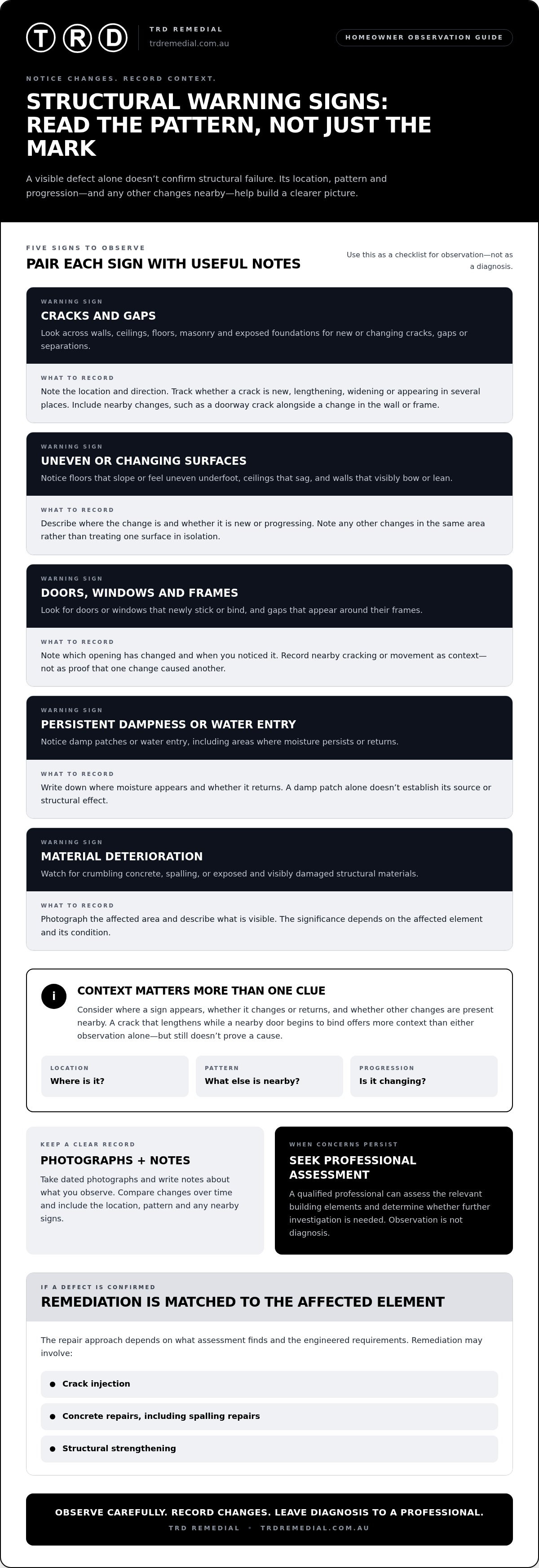
- Cracks and gaps: Check walls, ceilings, floors, masonry and exposed foundations for new or changing cracks, gaps or separations.
- Uneven surfaces: Notice floors that slope or feel uneven underfoot, ceilings that sag, and walls that visibly bow or lean.
- Changes around openings: Look for doors or windows that newly stick or bind, or gaps that appear around their frames.
- Moisture: Note persistent dampness or water entry, including where it appears and whether it returns.
- Material damage: Watch for crumbling concrete, spalling, or exposed and visibly damaged structural materials.
Cracks, gaps and changing surfaces
Cracks may appear in plaster, masonry, ceilings, floors or foundation surfaces. Record their location and direction, then observe whether they are new, lengthening, widening or appearing in several places. For example, note a crack near a doorway alongside any changes in the nearby wall or frame.
Appearance alone can’t establish the cause or structural severity. Fine surface cracking and more noticeable cracks both need context, so don’t treat a particular shape or width as a diagnosis. Consider the pattern across the house and whether other changes are developing at the same time.
Movement, moisture and material deterioration
Changes in alignment are another reason to pay attention. A floor that develops a slope, a ceiling that begins to sag, or a wall that appears bowed or leaning may warrant closer assessment, particularly if the change is new or progressing. Newly sticking doors and windows, or gaps appearing around their frames, are also worth recording.
Persistent dampness and water entry deserve attention because moisture may contribute to deterioration. A visible damp patch alone, however, doesn’t establish its source or structural effect. Crumbling concrete, spalling and exposed or damaged materials are also signs to document. Structural engineering principles concern how structures perform and remain stable, which is why assessment considers the affected element and surrounding conditions, not just the surface mark.
The most useful signs of structural problems in a house are changes considered together: their location, pattern and progression, alongside any movement, moisture or material damage. Treat this checklist as a prompt to observe carefully, not as proof of failure.
Why structural warning signs need context, not guesswork
A structural problem is an issue that may affect an element’s intended performance or stability. That doesn’t mean every crack, sticky door or damp patch signals structural damage. Visible signs are clues, not a diagnosis. A mark in a wall may be cosmetic, while a change that develops alongside movement elsewhere may warrant closer investigation.
Context makes observations more useful. Consider where a sign appears, whether it has changed or returned, and whether other changes are present nearby. For example, a crack that lengthens while a nearby door begins to bind is different from an unchanged crack with no other observed changes. That combination doesn’t prove a cause, but it gives an assessor more information than either observation alone.
When a crack may be more than a cosmetic mark
An isolated surface mark that stays much the same may have a different significance from a crack that visibly develops or recurs after repair. Neither observation confirms structural damage. Record what you can see and compare it over time, including the crack’s position and direction and whether related changes appear in the same area. Patterns are useful evidence, not diagnostic rules.
Crack width alone can’t reliably tell a homeowner how serious a defect is. The material, location, surrounding condition and any progression all matter. Avoid drawing conclusions from a single measurement or appearance. A qualified professional can assess the relevant building elements and determine whether further investigation is needed.
How moisture and movement can complicate the picture
Moisture, movement and material deterioration may appear together, but one visible sign doesn’t automatically explain another. Dampness or water entry doesn’t prove foundation failure; its location and persistence are still worth recording. Similarly, a change in a door frame alongside cracking is useful context, not proof that one caused the other.
Concrete spalling is a visible form of deterioration that warrants closer assessment, particularly where concrete is crumbling or damaged. Its extent and significance depend on the affected element and its condition. Once a defect is assessed, the repair approach can be matched to what’s been found. TRD Remedial’s concrete remediation work includes spalling repairs, crack injection and structural strengthening.
The signs of structural problems in a house become more meaningful when considered as a developing pattern rather than as isolated defects. A qualified assessment is needed to establish the likely cause, extent and appropriate response. It separates observation from diagnosis and helps ensure remediation is based on the defect and affected element, rather than guesswork.
Which signs should raise concern about structural problems?
No single observation can confirm a structural defect, but the pace of change and combination with other signs can help you decide what to do next. Use the comparison below as a practical guide, not a diagnosis. “Monitor” means keep a clear record and watch for change; it doesn’t mean a defect is safe or can be ignored.
| Observation | What to record | When to escalate for assessment |
|---|---|---|
| An isolated crack or slight sticking at a door or window | Note the date, exact location and appearance. Photograph it from the same viewpoint and record how the door or window operates. | Arrange professional advice if it changes, recurs or is joined by other signs. |
| Cracks, gaps or dampness that return or appear in several connected areas | Record each location, any visible progression, and where or when water entry or dampness occurs. | Seek prompt assessment if signs are worsening or occur alongside changes in alignment. |
| Noticeable movement in a wall, floor or ceiling | Describe what has changed and when you first observed it. Take photographs only from a safe position. | Seek prompt professional assessment, particularly if movement is developing quickly or appears with other changes. |
| Visible instability or material damage that may pose immediate danger | Don’t approach or touch the affected area to gather details. | Keep people clear and contact emergency services if there’s immediate danger. |
Signs to monitor and record
An isolated crack or a door that sticks slightly may be worth documenting, even if you haven’t noticed other changes. Write down the date and location, then take a photograph from a consistent viewpoint so later images can be compared. Note whether the door or window binds at the same point, and record any nearby dampness or water entry. This creates a useful record without assigning a cause.
Changes that call for prompt attention
Don’t wait to build a long record if a sign is visibly worsening, recurring or appearing across connected parts of the house. A developing crack together with a change in a nearby opening, for example, gives more reason to seek prompt assessment than either observation alone. Notable movement in a wall, floor or ceiling also calls for professional advice. If an area appears unstable or presents immediate danger, keep occupants away and contact emergency services as necessary.
Prioritise signs of structural problems in a house by their change, combination and potential risk, not appearance alone. Keep a record of observations that aren’t visibly worsening, but seek prompt assessment when movement develops or multiple related signs emerge. If there’s immediate danger, prioritise people’s safety over taking photographs or making further observations.
What to do when you notice signs of structural problems
A clear record helps turn a worrying observation into useful information for assessment. Don’t try to establish the cause yourself or cover up a suspected structural defect before it’s been assessed. Follow these steps, adjusting the priority if there’s an immediate safety concern.
- Document the sign. Take dated photographs from a safe position. Capture the wider area for context as well as a closer view, without touching damaged or unstable material.
- Record changes. Write down when you first noticed the issue, where it is and what has changed since. Include related dampness, water entry, surface deterioration or changes in how doors and windows operate.
- Manage immediate safety. Keep people clear of an area that appears unstable or presents a danger. Don’t enter or approach it to take more photos. Contact emergency services if there’s immediate danger.
- Seek an assessment. Arrange professional advice if signs are progressing, recurring or appearing alongside related changes. Findings can help establish whether repair, monitoring or further investigation is appropriate.
How to document changes without diagnosing them
Use the same viewpoint for repeat photographs so you can compare the area over time. Include the date and note the location, appearance and any progression you observe. Describe what you see rather than assigning a cause. For example, record that a crack has lengthened or a window now binds. Add relevant moisture or nearby material changes to your notes.
Keep the record together, with photographs and brief dated entries in order. Don’t patch, paint over, fill or otherwise alter a suspected structural defect before assessment, as this may conceal changes that matter. If something has already been repaired or covered, note that too. This information supports a clearer discussion of the observed signs, but it doesn’t replace a professional evaluation.
When specialist assessment and remediation may be needed
Assessment helps identify the defect and inform an appropriate engineered response. The findings may indicate that monitoring is suitable, further investigation is needed or repairs should proceed. The method depends on the defect and affected element. TRD Remedial undertakes concrete repairs, crack injection and structural strengthening. Professional concrete crack repair may be relevant when an assessed defect calls for that type of remediation.
When considering how assessment findings connect to remediation, keep the repair method separate from the visible sign. The method isn’t obvious from appearance alone. A crack, for instance, needs to be understood in context before a suitable repair approach is selected.
If assessment confirms that a structural defect needs remediation, TRD Remedial’s structural remediation work includes repairs informed by the defect and affected element.
How structural remediation addresses confirmed defects
Not every visible mark needs repair. The signs of structural problems in a house are a reason to investigate, but remediation should follow an assessment that identifies the defect and affected element. This distinction matters: selecting a repair from appearance alone risks treating the visible symptom without addressing the confirmed issue.
Once the findings and engineered requirements are understood, a suitable response can be determined. It may involve repair, strengthening or another form of remediation, depending on the defect, the material and the element’s role. The chosen method is specific to the project, not a one-size-fits-all solution.
Matching repair methods to the assessed defect
Different findings call for different specialist work. If assessment identifies deteriorated concrete, concrete spalling repairs may be relevant. Where a crack is suitable for injection, epoxy or polyurethane crack injection may be selected according to project requirements. If a structural element needs additional capacity, structural strengthening may be considered as part of an engineered response.
These methods aren’t interchangeable. The condition and function of the affected element inform the repair scope and technique. For example, identifying a crack doesn’t by itself establish whether injection is appropriate; the defect must first be assessed. TRD Remedial undertakes concrete repairs, crack injection and structural strengthening for remediation projects, with solutions guided by the assessed requirements.
A considered path from warning sign to repair
A measured process keeps observation separate from diagnosis and repair. The sequence is straightforward:
- Observe the visible change without assuming its cause.
- Document its location, appearance and progression.
- Assess the relevant defect and affected building element.
- Determine the response from the findings and engineered requirements.
- Complete suitable remediation where repair or strengthening is required.
Assessment findings may instead indicate that monitoring or further investigation is appropriate. Where remediation proceeds, coordination helps align the scope with project requirements. TRD Remedial works with engineers, builders and strata managers on building defects and remediation projects, bringing specialist concrete repair and structural remediation capabilities to the work.
For homeowners, the practical takeaway is that a warning sign starts a process; it doesn’t dictate the repair. The right response depends on what assessment confirms, and remediation is matched to the defect rather than guessed from a photograph or surface appearance.
Information about TRD Remedial’s structural remediation services outlines how assessed defects can inform suitable repair work.
Move forward with a clear plan
Noticing the signs of structural problems in a house can raise difficult questions, but you don’t need to answer them by guesswork. Use assessment findings to make an informed decision about the building’s condition and appropriate response. That gives you a practical basis for planning, whether the recommendation is to monitor the issue, investigate further or carry out remediation.
Where a defect is confirmed, specialist structural remediation and concrete repair can translate engineered requirements into defined work. TRD Remedial provides engineered solutions for building defects, including crack injection and structural strengthening. The approach is guided by the assessed defect and affected element, rather than a one-size-fits-all fix. Clear findings also help align the repair scope with project needs.
Learn about TRD Remedial’s structural remediation services and how specialist remediation may support the next stage of an assessed building defect. Taking a considered step puts you in a stronger position to plan with clarity.
Frequently Asked Questions
What are the most common signs of structural problems in a house?
Common signs include cracks in walls, ceilings or masonry, floors that feel uneven, sagging ceilings, visibly bowed walls and doors or windows that no longer operate as they did. Persistent dampness, crumbling concrete or exposed, damaged materials can also warrant attention. The signs of structural problems in a house are more informative when considered together, so note whether changes occur in connected areas rather than treating each mark as a separate diagnosis.
Are cracks in walls always a sign of structural damage?
No. A wall crack may be limited to a surface finish, and its presence alone doesn’t confirm structural damage. Consider whether it returns after cosmetic work, changes over time or appears alongside movement elsewhere. The material and position also matter. For instance, a crack in plaster and one through masonry involve different materials, but neither can be classified reliably from appearance alone. An assessment can establish what the observed condition means.
Can uneven floors indicate a structural problem?
Yes, an uneven floor can be a sign worth investigating, but it doesn’t establish the cause by itself. Changes may relate to the floor surface or an underlying building element, among other possibilities. Note which area feels uneven and whether the condition is new or changing. If you also notice movement in nearby walls or openings, include those observations when seeking advice so they can be considered together.
How can I tell if a wall crack is getting worse?
Compare dated photographs taken from the same position and distance, and note the crack’s visible endpoints, direction and appearance. Record when you first noticed it and describe any change, rather than relying on a single measurement to judge severity. You can also note whether new cracks or nearby changes have appeared. If comparison suggests the crack is extending or changing, arrange professional advice rather than trying to determine the cause yourself.
When should I seek professional advice about a structural defect?
Seek professional advice if a defect is visibly changing, returns after repair, or occurs with movement in a nearby wall, floor or opening. Rapid change or several related signs appearing together calls for prompt attention. A qualified assessment helps establish the cause, extent and appropriate next step, which may include further investigation. If an area appears unstable or presents immediate danger, keep people clear and contact emergency services.
What should I do if I notice signs of structural damage?
Start by making a dated record of what you’ve observed, including its location and any changes. Avoid covering, filling or altering a suspected structural defect before it’s assessed, as this can obscure its visible condition. If there’s a safety concern, keep people away from the area and don’t approach it to gather more information. Share your observations and photographs during assessment so the professional can consider changes over time.
Can water damage lead to structural problems in a house?
Persistent water entry can contribute to deterioration of building materials, but a leak or damp patch doesn’t prove structural failure. The effects depend on where moisture is present, how long the condition continues and which materials are affected. Record where dampness appears and whether it changes or returns, especially if you notice deterioration nearby. An assessment can determine whether the moisture is associated with a structural defect and what response is appropriate.
To discuss an assessed concrete or structural defect, contact TRD Remedial about specialist remediation and repair.


