

What if the most important part of a concrete penetration happens before the drill starts? With precision diamond core drilling, the proposed position and the condition of the existing structure matter as much as the opening itself. Reinforcement, post-tensioning and concealed services may not be visible at the surface, so a misplaced penetration can affect structural work and complicate the wider programme.
Planning helps manage these risks. Slab scanning can provide information about the proposed drill location, while coordination with builders, engineers and other project teams helps align the penetration with the structural alteration or remedial work around it. The aim is an accurately positioned opening that suits the project, not drilling treated as an isolated task.
This article explains how precision diamond core drilling works, when it may suit a project and how planned penetrations can help protect existing structures. It also covers scanning, site-specific decisions and coordination, so you can understand how core drilling fits into a considered concrete and remedial work scope.
Key Takeaways
- Precision diamond core drilling forms circular openings in concrete for project-specific building and remedial requirements.
- Plan the penetration by defining its position, reviewing available information, scanning where required, then drilling and inspecting.
- Choose between core drilling, percussion drilling and linear concrete cutting based on the opening shape and project purpose.
- Use scanning and engineering information to help plan around reinforcement, embedded services and post-tensioning.
- TRD Remedial’s core drilling and core holing can form part of a coordinated scope for structural alterations and complex remediation projects.
What precision diamond core drilling does in existing concrete structures
Precision diamond core drilling uses a rotating drill with a diamond-edged bit to form a circular opening in concrete. The bit cuts around the perimeter of the intended hole, separating a cylindrical section of concrete known as the core. In existing buildings, this method creates penetrations for construction and remedial requirements, rather than recovering geological samples.
That distinction matters. Exploration drilling may retrieve a core to examine rock or ground conditions. Concrete core drilling forms an opening in a constructed element, such as a slab or wall. A general overview of the tool and its different applications appears in Core drill.
The scope depends on more than the requested hole. Its diameter and position, the concrete element, access to the work area and nearby structural or service constraints all inform the approach. In an existing structure, consider the opening as part of the surrounding work, not as an isolated mark on a drawing.
Where diamond core drilling is used in remedial and building work
In structural alterations and concrete remediation, a penetration may be needed to accommodate a building service, provide access through a concrete element or enable another part of the work to proceed. The purpose and position are project-specific. Builders and engineers can coordinate drilling with other alteration tasks so the opening fits the planned sequence and the condition of the existing structure.
For example, a proposed service route through a slab needs to be considered alongside the alteration design and available information about what is embedded in the concrete. The drilling scope can then be coordinated with related activities, such as concrete cutting or repairs, where these are part of the project.
What makes diamond core drilling different from a cut opening
Core drilling creates a circular penetration. The rotating bit cuts a ring into the concrete, leaving a cylindrical core within the bit’s path. Depending on the work scope, the core is removed after drilling. This method suits a defined, round penetration rather than a long, straight opening.
Concrete cutting follows a linear path to create a slot, edge or larger section for removal. The methods therefore suit different opening shapes and project purposes. A circular penetration may suit a specific route through a slab or wall, while a linear cut may be required for a broader alteration. The required opening, the element being worked on and surrounding constraints determine which approach fits.
For existing structures, the question is not simply whether a drill can make the opening. The proposed location and purpose need to align with the wider work scope. TRD Remedial provides core drilling and core holing alongside slab scanning and other technical concrete services, supporting structural alterations and complex remediation projects.
How diamond core drilling works, from planning to the finished penetration
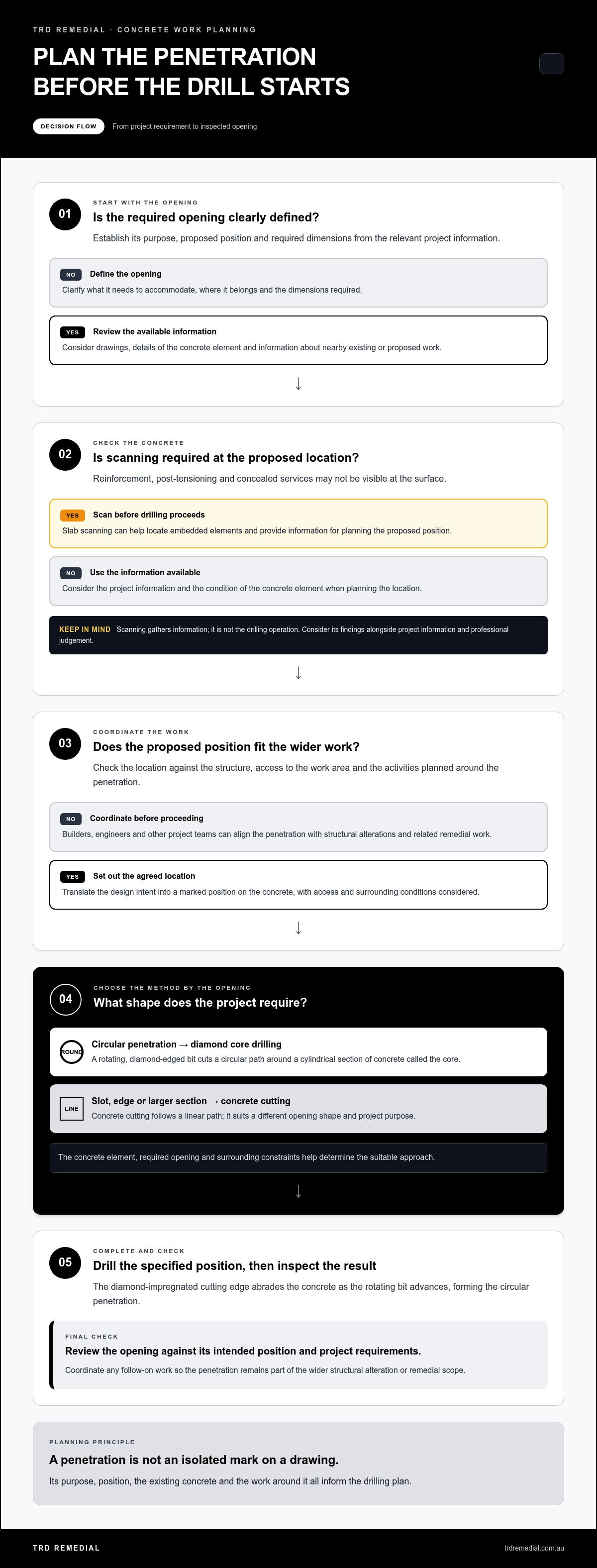
A reliable penetration starts with a defined purpose and a considered location. In an existing structure, the drawings, the concrete element and the work planned around it all inform how the drilling task is organised. Precision diamond core drilling is a sequence of decisions and checks, not simply a matter of positioning a drill over a mark.
Plan and set out the opening first so it suits both the project requirement and the structure it passes through.
The work generally follows these stages, with the sequence and controls adjusted to suit the structure and project requirements:
- Define the opening. Establish its purpose, position and required dimensions from the relevant project information.
- Review what’s known. Consider drawings, details of the concrete element and information about existing or proposed work nearby.
- Scan where required. Use scanning to help locate embedded elements before drilling proceeds.
- Drill the penetration. Set up for the specified location and use a rotating bit with a diamond-impregnated cutting edge. The diamonds abrade the concrete as the bit advances, cutting a circular path around the core.
- Inspect the result. Review the opening against its intended position and project requirements, then coordinate any follow-on work.
Set-out, access and drilling requirements
Set-out translates the design intent into a marked position on the concrete. Assess the required opening against available project information, including the element being drilled and what the opening must accommodate. For a penetration through a slab or wall, access to the work area and conditions around the drilling location also affect how the task is arranged.
These details matter to the wider programme. Builders and engineers can coordinate the penetration with structural alterations and other remedial activities, so the opening is sequenced with connected work rather than scheduled in isolation.
Why scanning may be part of the drilling sequence
Concrete can contain reinforcement, post-tensioning or building services that aren’t visible at the surface. Slab scanning can help identify embedded elements and provide information for planning the proposed location. Scanning is an information-gathering step, not the physical drilling operation. Its findings need to be considered alongside project information and professional judgement.
Where scanning forms part of the scope, the results can inform set-out before drilling proceeds. TRD Remedial’s slab scanning guide explains how scanning contributes to understanding existing concrete. Core drilling and slab scanning can be considered within one coordinated remedial work scope.
Inspection closes the sequence. Review the opening against its planned location and purpose, then coordinate further work to suit the project. The exact checks and controls depend on the concrete structure, available information and surrounding constraints.
Diamond core drilling compared with percussion drilling and concrete cutting
These methods create different kinds of openings and act on concrete in different ways. Diamond core drilling cuts a circular path, percussion drilling applies repeated impacts, and concrete cutting follows a linear path. The right option depends on the required opening, project information and surrounding structure. No method is automatically the best fit for every alteration.
Use the opening geometry and project constraints to guide method selection.
| Method | Purpose and opening shape | Typical project fit |
|---|---|---|
| Diamond core drilling | Forms a circular penetration through concrete. | A defined round opening specified for a building or remedial requirement. |
| Percussion drilling | Uses repeated impacts to break or penetrate material; the opening depends on the tool and task. | A task where an impact-based method suits the material and surrounding conditions. |
| Concrete cutting | Follows a line to create a straight-edged cut or opening. | An alteration requiring a linear cut through a concrete element. |
Use this comparison as a starting point, not a substitute for project-specific assessment. The drawings, structural requirements, purpose of the opening and conditions around the proposed work all shape the choice. In an existing building, the method also needs to fit the wider sequence of alteration and remedial activities.
When a circular drilled penetration suits the scope
A circular penetration may suit a defined route through a slab or wall where the project calls for a round opening. For example, plans may specify a penetration to accommodate a building service. Its position and dimensions should reflect the relevant drawings and structural requirements, as well as the intended alteration. Precision diamond core drilling suits this form of opening, but it isn’t a universal replacement for cutting or other methods.
Before settling on the method, consider the proposed location in relation to the concrete element and nearby constraints. This helps align the drilling work with the purpose of the opening and the sequence planned for the wider project.
When concrete cutting or another method may be more suitable
A straight-edged opening or longer cut may call for concrete cutting rather than a circular penetration. A percussion method works differently: repeated impacts break into the material, so assess its suitability against the specific task and surrounding structure. Choose the method to suit the required shape and project conditions, not out of habit.
Where an alteration requires an opening through a wall, precision concrete wall cutting may be relevant to the scope. TRD Remedial’s core drilling and concrete cutting services can be coordinated as part of structural alteration and remedial work. Considering the required opening within that broader scope helps connect the chosen method to the project’s structural requirements.
Planning a concrete penetration around reinforcement, services and post-tensioning
A proposed opening can intersect elements that aren’t visible on the concrete surface. Reinforcement contributes to the structure, while embedded electrical conduits and plumbing may be essential to building operations. Post-tensioning is another critical consideration: cutting a tendon can affect the slab’s structural behaviour. Precision diamond core drilling needs to be planned around the known structure and information available before work proceeds.
Drawings and scanning can help build an understanding of what may lie within the concrete, but neither is a complete answer on its own. Project judgement is still needed to interpret the information, assess the proposed opening and determine how the work fits the structural requirements.
Reinforcement, services and post-tensioned slabs
Reinforcement may cross a proposed drill path, and services concealed within a slab or wall may be vulnerable to damage. The location of these elements can affect whether the opening should proceed as planned or whether its position and scope need to be reconsidered in light of project information.
Post-tensioned concrete calls for particular care because tendons are part of the slab’s structural system. Their location and the implications of the proposed work need to be understood before drilling or other structural work begins. Scanning can provide useful information, but it shouldn’t be taken to detect every embedded element or replace engineering judgement. For related context on structural work involving these slabs, see the post-tension slab repair guide.
Coordination and site controls before drilling begins
Good preparation brings together project drawings, available site information, scanning results where relevant and the planned work sequence. If those inputs differ or leave uncertainty about the proposed location, address the issue within the project process before drilling starts. The aim is to make a considered decision, not to treat a scan result as automatic approval to proceed.
Site conditions matter too. Access to the work area, adjacent activities and the need to protect surrounding surfaces or operations can all influence how the task is organised. Coordination between builders, engineers and the drilling team helps align the penetration with connected structural alterations and remedial work.
Work controls should reflect the structure, site conditions and applicable requirements. Australian requirements can vary by jurisdiction and project context, so check relevant details against current, authoritative sources rather than making assumptions. This keeps planning grounded in the actual site and the requirements that apply to the work.
TRD Remedial combines core drilling and slab scanning within technical concrete and remedial scopes. Discuss your concrete penetration requirements as part of a planned structural alteration.
How TRD Remedial integrates precision core drilling into structural work
TRD Remedial provides core drilling and core holing as technical concrete services for existing structures. The work can form part of a structural alteration or complex remediation project, where a planned penetration needs to fit the project purpose and the condition of the concrete. Precision diamond core drilling is one considered element of a broader scope, rather than a task separated from the structural work around it.
Start by establishing what the opening needs to achieve and how it relates to the planned works. The required position, available project information and surrounding conditions all inform the drilling scope. TRD Remedial works with builders, engineers and strata managers to coordinate technical concrete work within project requirements.
Core drilling within a wider remedial scope
Depending on the project, core drilling may be coordinated with slab scanning to inform planning around embedded elements. Concrete cutting may be relevant where the scope calls for a linear opening or alteration, while controlled demolition may form part of a broader removal task. Each service has a distinct purpose. A project may need one method or a combination, but not every scope requires every service.
For instance, where an alteration requires a defined penetration, core drilling can form that specific opening while other activities are planned around it. If the work extends to removing a larger section of concrete, controlled demolition may be relevant to the wider scope. The controlled demolition guide explains how broader removal work differs from a targeted penetration.
Keeping these tasks distinct helps project teams plan their sequence and understand how each activity contributes to the intended outcome. Drawings, site information and coordination between the relevant parties provide context for fitting drilling into structural alterations or remediation work.
Discuss the project scope with TRD Remedial
A useful project discussion starts with the structure and the opening required. Share the project context, intended purpose and location of the penetration, along with relevant drawings or information about the proposed alteration. Details about related work, such as scanning, cutting or repairs, can also help clarify how core drilling fits within the wider programme.
TRD Remedial tailors its technical concrete work to project-specific requirements. Builders, engineers and strata managers can coordinate the proposed penetration with the surrounding structural or remedial scope, helping align the work with the project sequence. Keep the discussion focused on the structure, intended opening and activities that need to connect.
For a considered approach to a concrete penetration, discuss your core drilling project with TRD Remedial and outline the structure, required opening and project context.
Set the next structural work in motion
A proposed penetration is one decision within a larger project. Treating it as part of the work sequence from the outset gives the project team a clearer basis for aligning the opening with the alteration or remediation that follows. Precision diamond core drilling belongs within a considered scope shaped by the structure and the intended work.
TRD Remedial provides core drilling and core holing as part of technical concrete services supporting structural alterations and complex remediation projects. Builders, engineers and strata managers can bring the required opening and broader project context into the discussion, helping establish how drilling fits with related work.
Share the structure, proposed opening and project requirements with TRD Remedial to take the next step. Plan your core drilling work with a team focused on existing-structure projects. A well-considered scope gives your project a sound place to start.
Frequently Asked Questions
What is precision diamond core drilling?
Precision diamond core drilling creates a circular opening in concrete using a rotating bit with a diamond cutting edge. The method is used for defined penetrations in existing structures, such as an opening specified for a building alteration. Unlike exploration drilling, the goal is generally to form a passage through a constructed element, not retrieve geological samples. The planned location and purpose determine how the work is set out.
Is diamond core drilling suitable for reinforced concrete?
Yes, diamond core drilling can be used on reinforced concrete, but reinforcement needs to be considered when planning the opening. Drawings and scanning information may help indicate where steel is located, so the proposed position can be assessed against structural requirements. Scanning has limits and shouldn’t be treated as a complete map of the slab. The appropriate approach depends on the element and the approved project scope.
Can core drilling damage a post-tensioned slab?
Yes, drilling in the path of a post-tensioning tendon can damage it and affect the slab’s structural performance. Before work is planned, consider the tendon layout and relevant engineering information carefully. Scanning can help inform the assessment, but it doesn’t replace project judgement or establish that a location is safe by itself. If tendon positions or structural implications are uncertain, resolve that uncertainty through the project’s engineering process before work proceeds.
How does diamond core drilling differ from concrete cutting?
Diamond core drilling forms a round penetration, while concrete cutting follows a line to create a straight-edged cut or opening. For example, a defined circular route through a concrete element may suit coring, whereas a planned wall opening with straight edges may call for cutting. The shape and purpose shown in the project information help guide method selection. Consider the surrounding structure and connected work as well.
What information is needed to plan a core drilling project?
Start with the opening’s purpose, proposed position and required dimensions, along with drawings or other available information about the concrete element. Details of nearby services, reinforcement or post-tensioning can help inform the plan. It’s also useful to describe site access and any work scheduled around the penetration. For example, an opening tied to a structural alteration may need to be coordinated with the sequence of related tasks.
How much does precision diamond core drilling cost?
There isn’t one set price for precision diamond core drilling, as the scope varies between projects. Factors that can affect the work include the opening’s size and depth, the concrete structure, site access, scanning needs and how the drilling fits with other activities. To develop a project-specific scope, provide the proposed opening details, relevant drawings and site context. This gives the work requirements a clear basis for assessment.
Does diamond core drilling remove the concrete core?
Core drilling cuts around a cylindrical section of concrete, called the core. The core is commonly removed from the opening as part of completing the penetration, but how it is handled depends on the project scope and site conditions. For a through-opening, consider access and what lies on the other side, as well as how the removed section will be managed. These details can be planned with the drilling task.


