

What if the visible spall is only the surface sign of a deeper problem? A patch may improve the appearance of damaged concrete, while water ingress, chloride intrusion or corrosion of reinforcing steel continues beneath it. Durable commercial car park spalling solutions start by identifying the deterioration mechanism and site conditions, not simply covering the damage.
For asset owners, it isn’t always clear whether a broken edge is superficial or part of a wider structural issue. Recurring deterioration can expand the repair scope, while maintaining access and daily operations adds pressure to plan the work carefully. Diagnosis is the first step towards informed decisions about safety, repair extent and disruption.
This guide explains why car park concrete spalls, why assessment matters and how repair approaches differ according to the condition, cause and exposure. It also explains when concrete repairs, crack injection or structural strengthening may form part of a remediation scope. Finally, you’ll learn what to consider when coordinating safe, practical work around car park access and operations.
Key Takeaways
- Visible cracking, staining or exposed reinforcement can signal deterioration, but appearance alone can’t confirm its full extent.
- Trace possible moisture pathways and assess reinforcement condition to better understand what may be driving concrete delamination.
- Compare localised repair, crack or joint work, and broader remediation against the confirmed damage and structural requirements.
- Plan work zones, vehicle routes, pedestrian access and material handling together to support safer, more practical staging.
- Effective commercial car park spalling solutions link assessment to the repair scope, which may include concrete repairs, crack injection or strengthening.
Commercial car park spalling: what the visible damage can, and cannot, tell you
Spalling is the breakdown or delamination of concrete at its surface. It can leave areas cracked, chipped, loose or detached, and may expose reinforcing steel. Staining can also appear nearby, particularly where moisture has entered the structure. These are observable symptoms, not a confirmed diagnosis. A visual check alone can’t establish how far deterioration extends beneath the surface, what caused it or whether the structure’s capacity is affected.
The general description of Spalling is a useful starting point, but car park conditions need their own careful assessment. Similar-looking defects can have different causes. One visible patch also doesn’t show whether adjacent concrete or reinforcement is affected.
Visible spalling is evidence of concrete deterioration, not a completed structural assessment. Repair decisions should follow an investigation of the damage and its context, rather than being based on appearance alone.
Where spalling may appear in a commercial car park
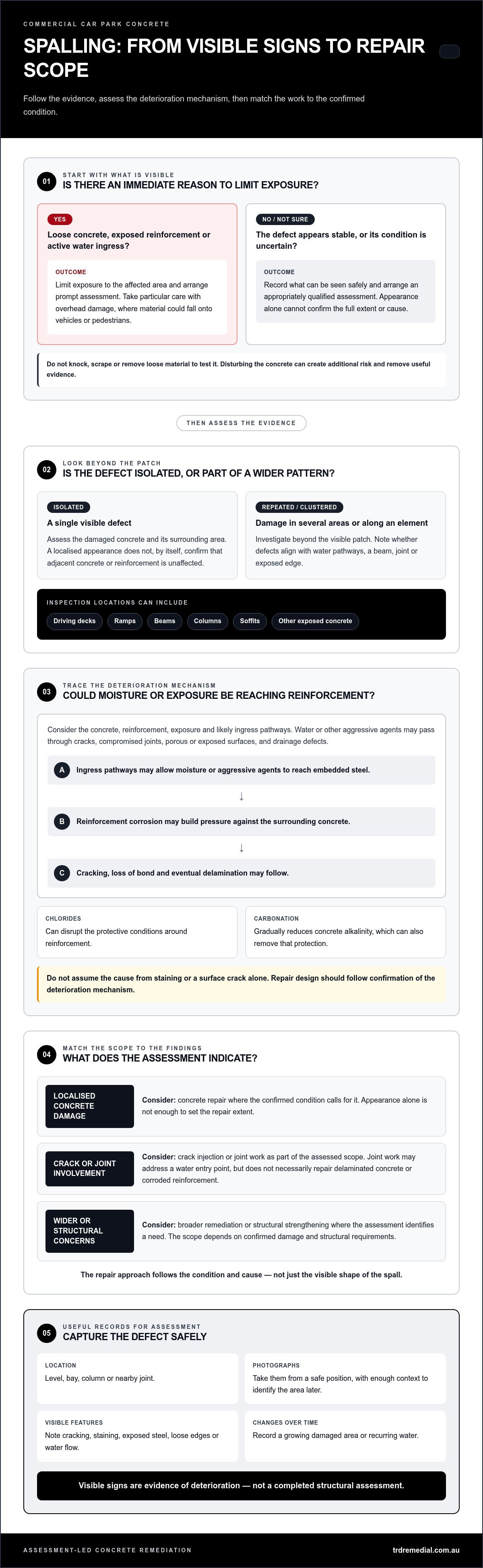
Inspection locations can include driving decks, ramps, beams, columns, soffits and other exposed concrete elements. Check the visible damage and the surrounding area for cracking, staining or further loose concrete. An overhead soffit needs particular care because detached material can fall onto vehicles or pedestrians. Keep people clear of the affected area while access and suitable controls are assessed.
A single isolated defect and a repeated pattern raise different questions. Similar damage in several areas, or recurring defects along a beam, joint or exposed edge, may warrant investigation beyond the visible patch. Record where defects cluster and whether they align with water pathways or structural elements. This information can help assessors determine whether the issue is localised or part of a wider condition.
When a visible defect needs prompt assessment
Loose concrete, exposed reinforcement and active water ingress are reasons to limit exposure to the affected area and arrange prompt assessment. Overhead damage requires particular caution. Don’t knock, scrape or remove loose material to test how firmly it is attached. Disturbing it can create additional risk and may remove evidence that helps establish the defect’s condition.
Instead, document what can be observed safely:
- Note the location, including the level, bay, column or nearby joint.
- Photograph the defect from a safe position, with enough surrounding context to identify it later.
- Describe visible features such as cracking, staining, exposed steel, loose edges or water flow.
- Record changes noticed over time, such as a growing area of damage or recurring water.
An appropriately qualified assessment determines the defect’s urgency, extent and required controls. It may involve examining the concrete and reinforcement, considering exposure and water pathways, and identifying whether further investigation is needed. For asset owners, reliable records make it easier to brief the project team and plan commercial car park spalling solutions around the actual condition, rather than assumptions based on a photograph.
Why commercial car park concrete spalls: moisture, reinforcement and exposure
Spalling often develops through a chain of deterioration rather than a single event. Water or other aggressive agents can pass through cracks, compromised joints, porous or exposed surfaces, and drainage defects. If they reach embedded reinforcement, corrosion may begin. As corrosion products build up, they can exert pressure on the surrounding concrete, leading to cracking, loss of bond and eventual delamination. The sequence and extent vary, so visible damage alone can’t identify the cause.
Two mechanisms worth distinguishing are chloride-related corrosion and carbonation. Chlorides can disrupt the protective conditions around reinforcement, while carbonation gradually reduces the concrete’s alkalinity, which can also remove that protection. Both can contribute to corrosion, but neither should be assumed from staining or a surface crack alone. An investigation considers the concrete, reinforcement, exposure and likely ingress pathways to determine which mechanisms are relevant.
Repair design should follow confirmation of the deterioration mechanism, not an assumption based on the visible spall. Without that step, a repair may address the damaged concrete yet leave an active water pathway or corrosion process unresolved.
How water ingress and movement joints contribute to deterioration
Movement joints accommodate changes in the structure, but deteriorated or compromised joints can let water reach adjacent concrete. Repeated wetting may affect the joint edges and nearby reinforcement. Traffic loading and movement can also stress these edges, contributing to cracking or breakdown around the joint. A defect beside a joint therefore calls for assessment of both the concrete and the potential water pathway.
Joint work and spall repair are related, but they are not interchangeable. Addressing a joint may help manage a water entry point, but it doesn’t necessarily repair concrete that has already delaminated or reinforcement that has corroded. Likewise, reinstating a damaged concrete area won’t necessarily resolve a compromised joint. The required scope depends on the assessment findings.
What exposure and reinforcement condition mean for assessment
Parking deck exposure can vary across an asset. An open deck, a sheltered soffit and a poorly drained area may experience different moisture conditions. Assessment should consider drainage, cracks, joints, exposed surfaces and the location of visible corrosion indicators. These patterns can help direct further investigation, but they don’t confirm the full repair boundary.
Rust staining may point to reinforcement corrosion, yet it doesn’t show how much steel or surrounding concrete is affected. A sound scope needs to establish the extent of deteriorated concrete and assess reinforcement condition where relevant. That evidence helps distinguish an isolated repair from a wider remediation need and informs whether crack injection, joint work or structural strengthening may also be appropriate.
For asset owners, this is the basis of durable commercial car park spalling solutions: connect the observed condition to its likely cause, then define work that responds to both. TRD Remedial’s commercial concrete remediation includes spalling repairs and related concrete repair work, with each project scope informed by assessment.
Compare commercial car park spalling repair scopes by condition, not appearance
A repair scope should reflect what investigation confirms, not simply the size or visibility of a spall. A small defect can sit within a wider deterioration pattern, while a larger surface break may still have a defined, local repair boundary. Before deciding how much work is needed, compare the condition of the concrete and reinforcement, any ongoing water pathway, and the structural requirements.
| Repair scope | When assessment may support it | Key considerations |
|---|---|---|
| Localised concrete repair | Damage is limited to a defined area and investigation supports a local repair boundary. | Confirm the extent of unsound concrete, reinforcement condition and repair requirements for the substrate. |
| Repair with crack or joint work | Assessment identifies a relevant crack or joint as part of the damage or water pathway. | Address the concrete defect and consider separate crack injection or joint remediation where specified. |
| Broader structural remediation | Findings indicate more extensive deterioration, affected reinforcement or structural requirements beyond a local repair. | Define the required repair extent and whether engineering assessment calls for structural strengthening. |
These are assessment-led options, not a fixed escalation path. A joint defect doesn’t automatically require broad remediation, and a visible spall doesn’t automatically need full-depth repair, strengthening or a protective system. The scope depends on verified conditions and project requirements.
When a localised concrete repair may suit the assessed defect
A local repair may suit a defect only when investigation supports a limited boundary. The specified work can include removing unsound concrete, treating reinforcement where required, reinstating the repair area and meeting the design’s curing requirements. Repair materials and methods depend on the substrate and project conditions. The objective is to match the scope to the confirmed defect, not apply an arbitrary surface patch.
Careful preparation matters. Unsound or poorly bonded concrete can undermine reinstatement, while removing more material than the assessed scope requires can add unnecessary disruption. The repair design should set out the limits and method, including how the substrate and any exposed reinforcement are to be handled.
When the scope may need crack, joint or structural work
If investigation identifies a crack or joint as a water pathway, the scope may need crack injection or joint repair alongside concrete reinstatement. These works address different parts of the problem: repairing the spall alone may leave the pathway active. Structural strengthening is a separate, project-specific response where engineering assessment identifies a structural requirement, not a default addition to every repair.
For broader context on how repair decisions fit into asset remediation, see this concrete remediation guide. When comparing commercial car park spalling solutions, consider whether the proposed scope responds to the confirmed damage, reinforcement condition, water pathway and structural requirements.
Plan car park spalling remediation around safety, access and work sequencing
Remediation in an operating car park takes more than a repair specification. Vehicle movements, pedestrian routes, overhead work, equipment access and the handling of concrete and materials all influence where work can happen and in what order. Plan these factors alongside the technical scope so that site controls and repair activities are coordinated, not improvised as work progresses.
A practical sequence gives the project team clear decision points:
- Assess and document: Record the defects, investigation findings and any access or exposure concerns relevant to the work.
- Define repair zones: Translate the findings and repair specification into work areas, including overhead or adjacent locations affected by the activity.
- Coordinate controls: Agree exclusion zones, vehicle and pedestrian routes, material movement and communication arrangements with the relevant project parties.
- Execute specified works: Carry out the assessed repair scope using the planned staging and site controls.
- Inspect and hand over: Complete the specified inspection and documentation, then communicate the status of each work area and any access changes.
Coordinate access controls and occupied-site safety
Exclusion zones may be needed around overhead defects, concrete removal and repair activities. Their location and extent should reflect the work method, surrounding access and project risks. If a work zone affects a vehicle route, parking bay or pedestrian path, coordinate the change with the asset representative and communicate it to affected users before redirecting access.
Staging decisions should account for more than the repair footprint. Consider where vehicles can turn, how pedestrians can pass safely, whether equipment can reach overhead areas and how removed concrete and incoming materials will be moved. Don’t assume every part of the facility can remain operational throughout the works. The project team should determine access arrangements for each stage.
Agree responsibilities across the asset representative, engineer, builder and remediation contractor. A project-specific risk and compliance review should identify applicable Australian requirements, approvals and work health and safety obligations for the jurisdiction and scope. A generic checklist may not address site conditions or the work method, so tailor controls to the project.
Sequence investigation, repair and close-out
Investigation findings and repair specifications should set the work boundaries and sequence. Depending on the specified method, stages may include surface preparation, concrete repair installation, curing and inspection. Requirements vary with the repair design and materials, so staging should allow the work to meet its specification before an area is returned to its intended use.
Clear handover records help the asset team track completed zones, inspections and outstanding items. For broader context on managing building defects and remedial work, see the structural defect repair guide. TRD Remedial coordinates commercial concrete repair with builders, engineers and strata managers. Discuss a car park remediation scope shaped around your assessment findings and site conditions.
TRD Remedial’s approach to commercial car park spalling solutions
Commercial car park spalling solutions should connect the condition found on site with a repair scope suited to the asset and its operating constraints. TRD Remedial is a specialist Australian contractor in structural remediation and concrete repair, working with builders, engineers and strata managers on commercial projects nationally. The work brings assessment and remediation together: understand the defect, define what the project requires, then coordinate the relevant technical works.
Depending on the findings, the scope may include spalling or concrete repairs, crack injection, or structural strengthening where engineering assessment identifies that need. Not every defect requires every treatment. A project-specific approach keeps the work aligned with confirmed damage, concrete and reinforcement condition, water pathways and access requirements.
Bring the defect, asset context and operating constraints together
A clear initial picture helps the project team frame the investigation and discuss a practical scope. Record what is known and where it occurs, without disturbing damaged concrete. Useful details include:
- Defect locations, such as the deck level, bay, beam, column or soffit.
- Photographs showing both the damage and its surrounding context.
- Known water issues, including recurring leaks, drainage concerns or visible water pathways.
- Access limits, affected vehicle or pedestrian routes, and any constraints on work zones.
- Changes observed over time, such as cracking or deterioration appearing to extend.
These details help relate defects to the asset’s layout and day-to-day use. TRD Remedial provides slab scanning to help inform assessment and planning where the project calls for it. The appropriate method depends on the question being investigated and the site conditions. If cracking also needs attention, the concrete crack repair guide provides further context on repair considerations.
Move from assessment to a defined remediation scope
TRD Remedial works with project stakeholders to shape a technical scope around assessment findings. This can involve coordinating concrete repairs with crack injection or structural strengthening where those works are specified. The sequence and boundaries should reflect the defect and project requirements, rather than treating every visible spall as the same problem. This supports clearer planning for repair areas, interfaces and access arrangements.
For an initial discussion, bring available defect records, photographs, known water issues, asset context and operational constraints. These details help clarify what has been observed and what the project needs to resolve. Discuss your commercial car park remediation project with TRD Remedial to consider a project-specific path from assessment to defined remedial works.
Turn uncertainty into a clear next step
Visible damage can make it tempting to choose a repair quickly, especially when access and daily operations are at stake. A more useful next step is to establish what decision the asset team needs to make: whether an area needs immediate controls, what further assessment will resolve uncertainty, and what information is needed to define the work. That creates a clearer basis for planning and keeps the repair scope tied to the condition of the structure.
The right commercial car park spalling solutions are shaped by evidence and project needs, not by the appearance of a patch. Bring together the defect record, assessment findings and practical constraints affecting the site. From there, planning can focus on a considered remediation pathway rather than assumptions.
TRD Remedial works with commercial project teams on structural remediation and concrete repair scopes. Start a discussion about your car park’s repair needs and take the next step towards a more informed plan.
Frequently Asked Questions
Can a commercial car park remain open during spalling repairs?
Some areas may remain accessible, but access depends on the defect location, hazards, work methods and staging plan. For example, repairs to an overhead beam may require a controlled exclusion zone below, while concrete removal may affect nearby vehicle movements. The project team determines suitable site controls, traffic arrangements and user communications. Don’t assume uninterrupted operation; assess access for each work area and stage.
Does every spall in a car park require reinforcement replacement?
No. Reinforcement replacement isn’t automatic. The required treatment depends on the condition and extent of the concrete and steel established during assessment. An engineer’s advice or the project specification determines the repair requirements. Visible rust or staining can indicate corrosion, but doesn’t by itself confirm that steel must be replaced or define the full repair area. The specification should address the findings for the particular defect and surrounding structure.
Can water entering through a car park joint cause concrete spalling?
Yes, a compromised joint can provide a pathway for water and contribute to deterioration in the concrete around its edges. That doesn’t make joint failure the confirmed cause of every nearby spall. Water may, for example, be entering through another crack or drainage issue. Depending on assessment findings, the repair scope may need to address both the water pathway and damaged concrete as separate but coordinated elements of the work.
How is the repair boundary for spalled concrete determined?
The visible edge isn’t necessarily the full extent of affected concrete. An assessment considers the surrounding concrete, reinforcement condition and signs of deterioration, with investigation methods selected to suit the structure and project. A patch line based only on what can be seen at the surface may miss affected material beyond it. The repair boundary and specification should follow the findings, not an assumed standard patch size.
How long does a commercial car park concrete repair take to cure?
There isn’t one curing period that applies to every repair. Timing depends on the specified repair material, site conditions, repair depth and project requirements. A shallow repair using one system may have different requirements from a deeper reinstatement or a different material. Follow the repair specification for curing and inspection, and coordinate access changes accordingly. The project team should determine when the repaired area can be returned to its intended use.
How often should a commercial car park be inspected for concrete spalling?
Inspection frequency should reflect the asset’s condition, exposure, maintenance plan and earlier assessment findings. There’s no fixed interval suitable for every car park. Keep records that let the asset team compare observations over time, including the location and visible extent of defects. Arrange an appropriately qualified assessment if new cracking, loose concrete, exposed reinforcement or water ingress appears, or if an existing defect changes noticeably.
Can a surface coating repair concrete that is already spalling?
A coating alone doesn’t reinstate unsound concrete or establish why it has deteriorated. Spalled areas need assessment and a specified repair approach before any additional treatment is considered. Depending on the project findings, a protective treatment may form part of a broader scope, but it isn’t a substitute for repairing damaged concrete. Effective commercial car park spalling solutions are selected for the assessed condition and project requirements, not applied as a universal coating fix.


