

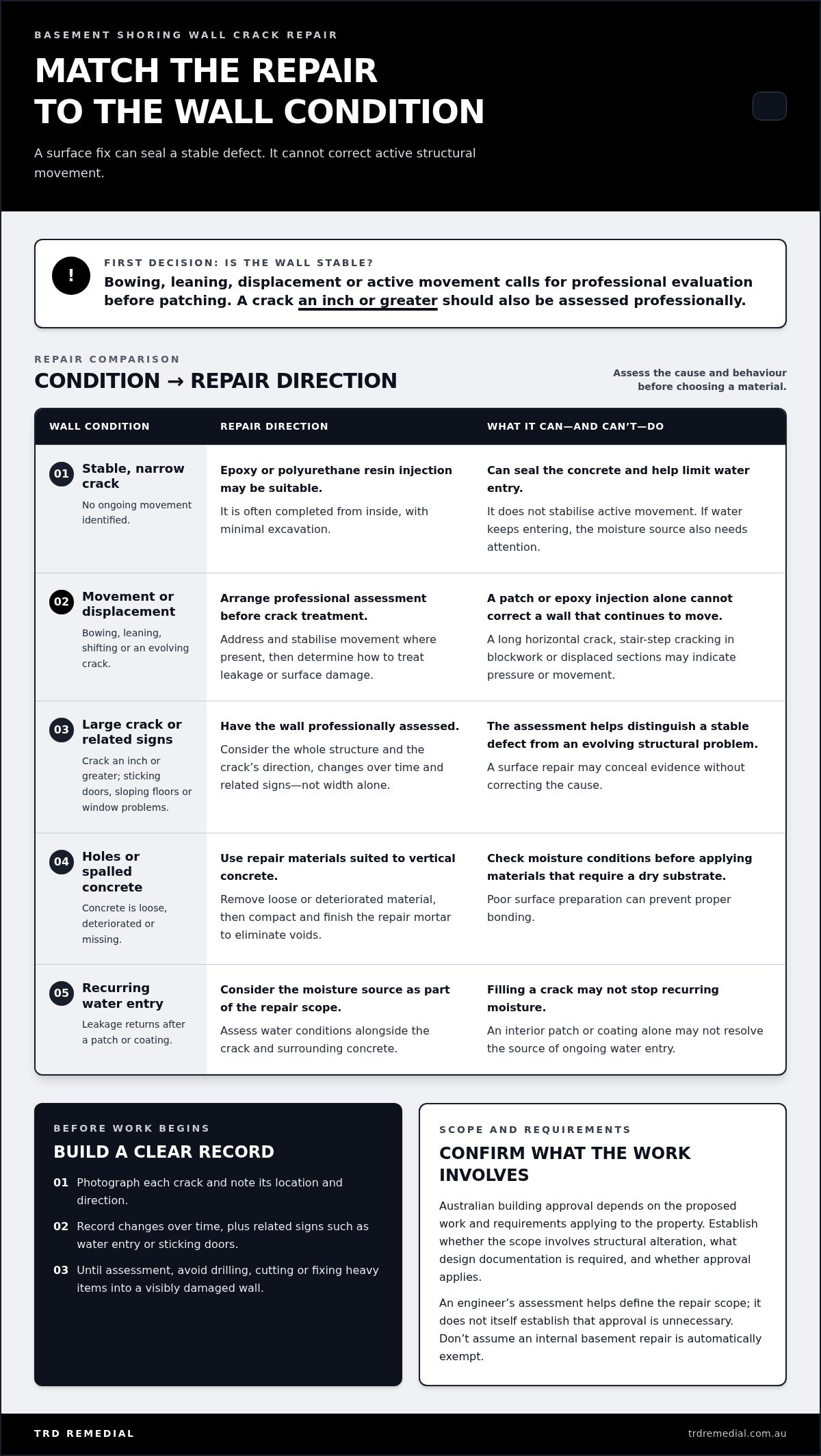
A basement wall crack isn’t always a sign of structural failure. Concrete shrinkage, settlement and pressure from surrounding soil can all contribute, while moisture and concrete deterioration can lead to holes or spalling. For basement shoring wall crack repair, the key is to determine whether the wall is stable. Bowing, leaning, displacement or active movement calls for professional evaluation before patching. A crack an inch or greater should also be assessed professionally.
It’s understandable to focus on visible damage, especially when water is getting in. But filling a crack won’t resolve the underlying issue if the wall is still moving, and a surface patch may not stop recurring moisture.
This guide explains common causes of basement wall cracks and holes, signs that can indicate movement, and how to distinguish a stable crack from one that needs structural attention. You’ll also learn when crack injection may be suitable, why moisture sources matter, and what a professional repair process considers.
Key Takeaways
- Know which signs call for prompt professional assessment, including bowing, leaning, displacement or a crack an inch or greater.
- Look beyond crack width: its direction, whether it changes and any related movement can help indicate the level of concern.
- Understand why sealing a crack may help with water entry in a stable wall, but won’t address active structural movement.
- Track changes with photographs and measurements, and consider whether water around the home may be contributing to the problem.
- Learn how the repair scope affects whether engineering input or building approval needs consideration in Australia.
When professional foundation evaluation is needed
Movement changes the repair decision. A bowing, leaning or displaced basement wall needs assessment before its cracks are patched.
Engineer and Approval Requirements
Structural work needs a different assessment from filling a stable surface crack. For an Australian basement, consider whether the proposed repair changes or reinforces the wall’s load-bearing role. A structural engineer can assess the wall’s condition and determine an approach suited to the movement, damage and surrounding ground.
Look at the whole structure, not just the visible opening. A long horizontal crack, stair-step cracking in blockwork, inward bowing or displaced sections may indicate pressure or movement that a surface repair won’t address. A crack an inch or greater should be professionally assessed. Sticking doors, sloping floors or window problems add important context.
Building approval depends on the proposed work and the requirements applying to the property. Don’t assume a repair is automatically exempt because it takes place in a basement. Before work begins, establish whether the scope involves structural alteration, what design documentation is required, and whether approval applies. An engineer’s assessment helps define the repair scope, but doesn’t itself establish that approval is unnecessary.
Prepare a clear record for assessment. Photograph each crack, note its location and direction, and record changes over time. Include related signs, such as water entry or doors that have started sticking. This evidence helps distinguish a stable defect from an evolving structural problem and informs whether reinforcement, crack treatment or more extensive repairs need consideration.
Risks of DIY and Delayed Repairs
DIY patching can conceal evidence without correcting movement. The main risks are worsening displacement, continued water entry and repair material failing because it treats the crack rather than its cause. A coating or filler isn’t a substitute for assessing a wall that bows or shifts.
Delaying assessment can allow a crack to widen or water to keep entering. Moisture may affect surrounding concrete and finishes, while recurring leakage can make it harder to tell whether the original damage is changing. If a crack grows, shifts, or appears with a sloping floor or sticking door, arrange professional evaluation before applying a patch.
Active movement should be evaluated and stabilised, not treated with epoxy alone. Crack injection may suit a narrow, non-moving crack, but it can’t correct a wall that continues to move. The repair sequence matters: assess stability first, address movement where present, then determine how to treat leakage or surface damage.
Until assessment, avoid drilling, cutting or fixing heavy items into a visibly damaged wall. Take photographs from the same position and note changes in the crack or nearby doors and windows. These practical steps preserve useful evidence without disturbing the concrete or relying on a cosmetic repair.
Basement crack repair
Repair planning starts with the cause and behaviour of the defect. A basement shoring wall crack repair plan should distinguish a stable crack from damage linked to movement, moisture or deteriorating concrete. That assessment informs the materials, preparation and scope of work.
Applicable Building Standards and Regulations
Australian building requirements depend on the property’s location and the work proposed. Sealing a stable crack differs from reinforcing a shoring wall or changing its structural role. Describe the defect and intended work clearly, then establish whether engineering documentation or building approval applies before work starts.
Keep the repair scope specific. Record whether the work involves crack sealing, structural reinforcement or concrete replacement, and include relevant engineering documents. These details help determine which requirements apply. Don’t assume an internal basement repair is automatically exempt from approval.
Choosing a Qualified Repair Contractor
Choose a contractor who can explain how the proposed work relates to the defect. The assessment should address the wall’s condition, the repair method and whether movement needs attention before crack treatment. A written scope gives you a clear basis for understanding what work is proposed and why.
Compare the repair sequence, not just the named material. Injection may suit a narrow, stable crack, while a moving wall needs its structural condition addressed. Ask for a clear description of surface preparation, material placement and how the completed repair will be assessed.
For a stable, narrow crack, epoxy or polyurethane resin injection can seal the concrete and help limit water entry. Injection is often completed from inside, with minimal excavation. It won’t stabilise active movement, so the repair must match the wall’s condition. If water keeps entering, address its source rather than relying only on an interior patch or coating.
Large holes and spalled areas need repair materials suited to vertical concrete. Remove loose or deteriorated material, then compact and finish the repair mortar to eliminate voids. Moisture conditions matter too: assess them before applying materials that require a dry substrate. Poor surface preparation can prevent proper bonding.
For basement shoring wall crack repair, first establish whether the wall is stable, then select a method for the specific defect. Where water intrusion recurs, consider the moisture source as part of the repair scope. To discuss basement crack repair options, focus on a repair approach that addresses the underlying issue as well as visible damage.
Distinguishing structural from non-structural cracks
Crack width alone can’t reliably show whether a basement wall is structurally affected. Consider its direction, location, changes over time and nearby signs, such as bowing or displaced concrete. A narrow crack that remains unchanged presents a different pattern from one that widens or shifts alongside wall movement.
Concrete shrinkage during curing can produce narrow vertical or diagonal cracks. These may remain stable once curing is complete. For example, a fine vertical line that hasn’t changed and shows no movement is less concerning than a crack that keeps opening. Its pattern is a clue, not a complete assessment of the wall.
Small vertical cracks that remain unchanged are commonly described as non-structural. Minor seepage without bowing or other movement also fits a less concerning pattern. Even so, water entry matters: a stable crack can still let moisture into the basement. Distinguish the structural question from the separate need to address persistent dampness.
Look for a combination of signs rather than judging one feature alone. A horizontal crack across the middle of a foundation wall, stair-step cracking through concrete blocks, or a crack that widens or shifts points to a more serious structural concern. Inward bowing or displaced sections increase that concern.
A basement slab has different clues. Thin, random floor cracks may result from concrete shrinkage and are often cosmetic when they remain unchanged and don’t leak. Floor cracks can also relate to settlement or heaving. A sloping floor alongside a wall crack makes the overall pattern more significant than an isolated hairline mark.
Compare the crack with the surrounding structure. Check whether nearby doors stick, windows have become difficult to operate, or the wall’s surface looks uneven. A horizontal wall crack paired with inward bowing differs from a narrow, stable vertical crack with no related symptoms. These examples can help show when a structural assessment is needed.
Record changes, not just appearance. Photograph the crack periodically from a consistent position and measure it at the same points. Note whether its ends extend, its edges shift, or new cracks appear nearby. A record can reveal gradual movement that a single inspection might not make obvious.
Use the pattern to guide the next step. A stable crack without bowing may be suitable for a repair aimed at sealing the opening. A horizontal or stair-step crack, visible wall displacement, or worsening movement calls for structural foundation crack repair, not injection alone. Treating a moving crack as a surface defect leaves its cause unresolved.
Identifying crack types and signs of movement
Crack direction can help explain what is happening, but it can’t diagnose the wall by itself. A horizontal line across a basement wall may be associated with lateral pressure against the foundation. In a block wall, stair-step cracking follows the mortar joints. Vertical and diagonal cracks can have different causes, so record their position and shape before deciding what they mean.
Movement is more likely when the crack changes or connects with other visible shifts. Look for edges that no longer align, a widening gap, displaced blocks or a wall that bows inward. Check the same area again in photographs taken from a consistent position. A single image shows the crack’s appearance; a sequence can reveal whether its length, width or alignment is changing.
Basement floor cracks need separate consideration. A thin, random line may reflect concrete shrinkage, while floor cracking can also indicate settlement or heaving. For example, a floor crack beside a wall crack, combined with a new change in floor level, gives more context than either mark alone. Note where each crack begins and ends, and whether nearby surfaces appear uneven.
- Horizontal wall crack: note whether it sits across the middle of the wall and whether the wall bows inward.
- Stair-step crack: trace its route through block joints and check for displaced sections.
- Vertical or diagonal crack: photograph its ends and compare its shape over time.
- Floor crack: record whether it is random, changing, or accompanied by settlement or heaving signs.
Use a repeatable monitoring routine. Photograph the crack from the same position, include a ruler for scale, and measure the same point each time. Write down the date and any changes in the wall, floor, doors or windows. A homeowner reported a crack opening somewhat over a 20-year span. That example shows why a dated record can add useful context to a one-off observation.
Water can complicate the picture. Record when seepage appears and whether it follows heavy rain, but don’t assume moisture proves structural movement. A wet crack without visible displacement differs from one that widens alongside bowing or shifting blocks. The combination of movement, crack pattern and water history gives a clearer basis for assessment.
Escalate the concern if photographs show widening, shifting or new cracks, or if the wall’s alignment changes. Horizontal cracking with inward bowing isn’t simply a sealing problem. Document the signs and arrange an evaluation before choosing a repair method; injection alone doesn’t stabilise an actively moving wall.
Do repairs to basement shoring walls require a structural engineer or building approval in Australia?
There isn’t one blanket answer for every Australian basement repair. The deciding factors are the wall’s structural role, the damage and the proposed work. Sealing a stable crack differs from reinforcing a moving shoring wall or altering its support. Establish those details before choosing a repair method.
A structural engineer’s input is particularly relevant when the wall bows, leans, shifts or shows progressive cracking. These signs can indicate that the repair needs to address structural behaviour, not just seal concrete. An engineer can assess the wall and document an approach suited to its condition. A crack filler alone can’t establish whether the wall is stable.
Building approval is separate from engineering advice. Requirements depend on the project’s location and repair scope. Before work starts, identify the property’s state or territory, describe the proposed work and establish which building approval process applies. Don’t assume a repair is exempt simply because it’s inside an existing basement.
Use this sequence to clarify the project:
- Record the crack pattern, wall position, water entry and any visible movement.
- Describe whether the work seals concrete, reinforces the wall, or changes its structure.
- Establish whether engineering documentation is needed for the proposed structural work.
- Confirm the applicable approval requirements for the property’s location before work begins.
For example, injecting a narrow, stable crack differs from installing reinforcement where a wall is bowing. The first task focuses on sealing a defect; the second involves the wall’s structural response. That distinction helps define the right assessment and the information needed for an approval decision.
Keep project records together. Include photographs, the engineer’s assessment where relevant, the proposed repair description and approval correspondence. If the scope changes during the work, such as moving from crack sealing to structural reinforcement, reassess the documentation and approval pathway before proceeding.
Choose a repair contractor who can explain the defect, the intended method and how the work relates to the assessment. A clear scope should distinguish crack treatment from structural correction. Ask for the proposed sequence in writing, including how the concrete will be prepared and how movement or water entry will be addressed.
For shoring wall work, arrange a structural repair assessment before treating signs of active movement as a simple surface crack. A defined scope makes the engineering and approval questions easier to resolve before repairs begin.
The applicable building approval requirements depend on the property’s state or territory and the repair scope. Establish the approval process before work begins, and whether the proposed structural work requires engineering documentation.
TRD Remedial: Carbon Fibre Strengthening
TRD Remedial provides Carbon Fibre Strengthening for projects where assessment identifies a need to strengthen concrete structures. It may form part of a broader structural strengthening approach, rather than a stand-alone response to every basement crack. The right repair depends on the wall’s condition and whether movement is active.
For a stable crack, crack injection may help seal the opening; concrete repairs address damaged or deteriorated areas. These methods serve different purposes, so the repair scope should match the assessed defect. Where movement is present, structural concerns need attention rather than a surface patch alone.
To discuss basement wall damage and potential repair options, contact TRD Remedial.
Set the next repair step in motion
A sound basement shoring wall crack repair plan should carry the assessment through to a clearly defined scope of work. Keep photographs, observations and any engineering recommendations together. This gives the repair team a practical record of the defect and keeps decisions focused on the wall’s condition, not just the visible crack.
TRD Remedial offers Crack Injection for suitable cracks, alongside Structural Strengthening and Carbon Fibre Strengthening where strengthening is appropriate. The right approach depends on the assessed repair need. A clear conversation about the damage and your desired next step can help establish what work is relevant.
If you’re ready to discuss the repair needs of your basement wall, contact TRD Remedial for an evaluation. A considered next step can help you move from concern to a defined repair plan.
Frequently Asked Questions
What Causes Cracks and Holes in Concrete Basement Walls?
Concrete shrinkage, settlement and pressure from surrounding soil can cause basement wall cracks. Moisture and deteriorating concrete can contribute to holes or spalled areas. For example, a narrow crack may form as concrete cures, while a horizontal wall crack can be associated with lateral pressure. The defect’s pattern and whether it changes help distinguish possible causes, but its appearance alone doesn’t establish the wall’s condition.
How Do You Identify Different Types of Basement Wall Cracks?
Identify a crack by its direction, position and pattern. Vertical and diagonal cracks can differ from horizontal cracks across a wall, while stair-step cracks follow the mortar joints in blockwork. Photograph the same area over time and note whether the crack widens, shifts or extends. Also record related signs, such as water entry or changes in the surrounding wall, to provide context for assessment.
How Do You Repair Large Cracks, Holes, and Spalled Concrete?
Large defects need repair materials suited to their depth and vertical position, not simply a surface smear. Remove unsound concrete, then apply and compact the repair mortar so voids don’t remain. A deep, stable crack may need a different treatment from a hole or spalled patch. If the wall is moving, address that structural issue before relying on crack filling to manage leakage.
How Should a Concrete Basement Wall Be Prepared for Repair?
Prepare the wall by removing loose concrete, dust, paint and other contaminants so the repair material can bond with sound concrete. Use a stiff-bristled brush to clear remaining debris, then assess moisture before applying products that require a dry surface. For example, injection into a damp crack may not suit a material that needs dry concrete. Preparation should match the repair product and the wall’s condition.
Should Basement Walls Be Coated After Repair?
A coating may form part of a suitable finish, but it shouldn’t conceal active cracks, ongoing water entry or structural movement. First establish whether the repaired area is stable and whether moisture still has a source. An interior coating alone won’t fix water entering through an unresolved defect. If seepage continues, the repair plan needs to address the moisture pathway rather than hide its visible effects.
What Is Structural Foundation Crack Repair?
Structural foundation crack repair addresses damage linked to movement or reduced wall stability, rather than only sealing a crack. Depending on the assessed condition, work may involve reinforcement, bracing, underpinning, foundation piers, excavation or rebuilding. Drainage and waterproofing may also be relevant to managing moisture. The repair method follows the cause and the wall’s behaviour; injection alone doesn’t stabilise a wall that continues moving.
What causes cracks in basement shoring walls in Australia?
In Australia, basement shoring wall cracks can relate to concrete shrinkage, settlement, lateral pressure from soil or deteriorating concrete. Moisture may enter through a crack or contribute to ongoing deterioration, but water alone doesn’t prove structural movement. A horizontal crack with wall bowing presents a different concern from a fine, unchanged crack. The wall’s position, surrounding ground and changes over time help clarify the likely cause.
How can you tell whether a shoring wall crack is structural or cosmetic?
You can’t reliably classify a shoring wall crack by width alone. A narrow crack that stays unchanged, without bowing or displacement, may be less concerning than one that widens or shifts. Horizontal cracking, stair-step patterns in blockwork and inward wall movement warrant particular attention. Photograph and measure the same point periodically, and record related changes in floors, doors or windows to show whether the condition is progressing.


