

What if the quickest-looking fix is the one most likely to fail again? When forklift or equipment traffic breaks down joint edges, or water and debris pass through a deteriorated gap, filling the visible damage may not address the cause. The right industrial floor joint repair solutions depend on the joint’s movement, traffic loads and site exposure.
When a joint creates a safety concern or disrupts operations, it’s tempting to focus on the visible damage. But deterioration at the joint can also point to a wider slab or subgrade issue. Start by assessing the joint and surrounding concrete, rather than assuming the gap is the only problem.
This guide explains why industrial floor joints deteriorate, how repair approaches differ and what to consider when planning remediation. You’ll learn how to distinguish local joint damage from signs of wider concrete distress, and how movement, vehicle traffic and moisture affect repair selection. It also covers the stages of a planned repair, from investigating the defect to coordinating work around facility operations. TRD Remedial carries out temporary moving joint repairs and concrete repairs as part of assessment-led work on existing assets.
Key Takeaways
- Use joint condition as a clue: deterioration may be limited to the joint or may indicate distress in the surrounding concrete.
- Match industrial floor joint repair solutions to the joint’s movement, vehicle traffic and exposure, rather than choosing a repair by appearance alone.
- Compare flexible joint treatments with repairs to damaged edges by considering movement, traffic demands and substrate condition.
- Plan repairs in sequence: inspect and diagnose the defect, prepare the joint and sound substrate, then review the completed work.
- Where project conditions require it, coordinate temporary moving joint repairs with assessment and repair of adjacent concrete.
Industrial floor joint repair solutions: what failed joints reveal
An industrial floor joint is a planned discontinuity in a concrete slab. It may allow adjoining sections to move or separate concrete placements made at different times. Its purpose depends on its design: a movement joint must accommodate movement, while other joints may primarily define where concrete placements meet. Understanding Expansion Joints can help explain why movement allowance matters in concrete structures.
Joint condition affects more than appearance. Under vehicle and equipment traffic, damaged edges can chip further and create an uneven path. Open or failed joint material can let water and debris enter, making cleaning more difficult and potentially affecting the joint and adjacent concrete. Effective industrial floor joint repair solutions start by recording what’s visible without assuming it reveals the whole problem.
Which signs point to a deteriorating floor joint?
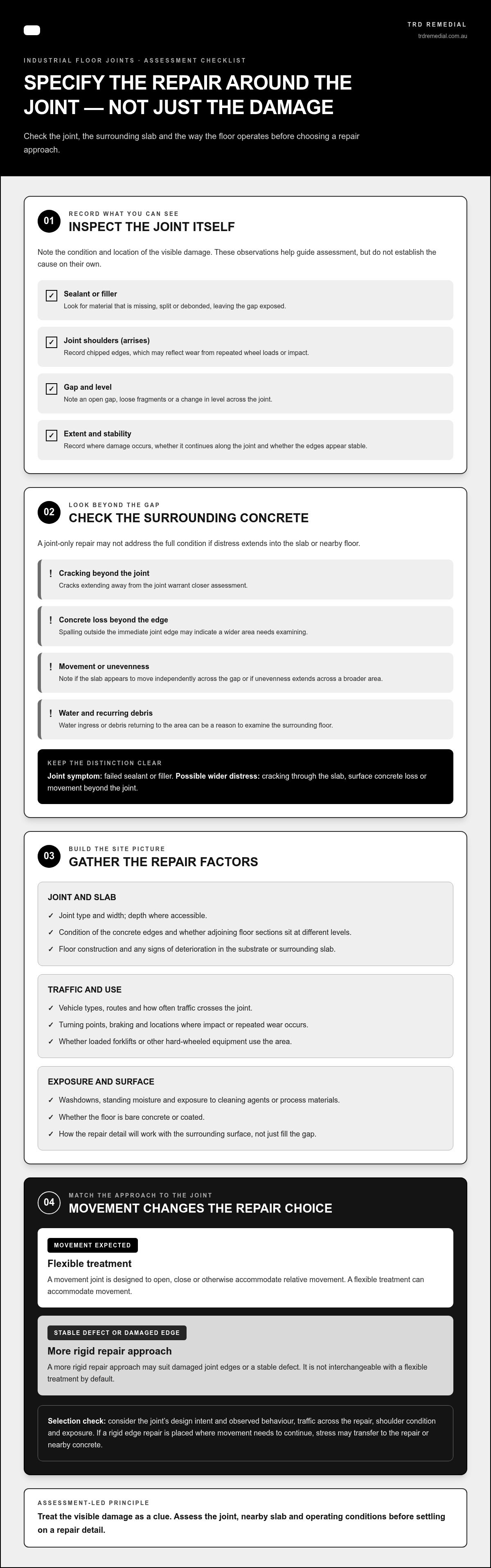
Look for missing, split or debonded sealant or filler, which can leave the gap exposed. Chipped joint shoulders, also called arrises, can indicate wear from repeated wheel loads or impact. An open gap, loose fragments or a change in level across the joint are other observable signs to record.
These symptoms describe the condition, not its cause. A broken edge may reflect repeated impact, repair material that no longer performs as intended, or deterioration extending into the slab. Note where the damage occurs, whether it continues along the joint and whether the edges appear stable. These observations help guide a technical assessment, but don’t establish a diagnosis on their own.
When is joint damage more than a surface issue?
Damage beside a joint warrants closer assessment when cracking extends away from it, concrete is spalling beyond the immediate edge, or the slab appears to move independently across the gap. Water ingress, recurring debris or a broader area of unevenness may also justify examining the surrounding floor. These signs don’t prove a deeper defect, but they can indicate that a joint-only repair may not address the full condition.
Distinguish the joint from the concrete around it. Failed sealant or filler is a joint symptom; cracking through the slab, surface concrete loss or movement beyond the joint may point to separate or related concrete distress. The distinction matters because treating only the visible gap may leave adjacent damage unresolved. Assessment should consider the joint, nearby slab surfaces and how the floor behaves under normal operating conditions.
If inspection identifies wider concrete deterioration, the scope may need to include more than joint work. TRD Remedial’s concrete repair and structural remediation capabilities support assessment-led work on existing assets. For further context on identifying and addressing wider defects, see this concrete remediation guidance.
How movement, traffic and exposure shape joint repair
A repair detail must suit the job the joint is designed to do. Some joints accommodate movement between concrete sections; others control where cracking occurs or separate placements. Treating a joint expected to move as though it were fixed can strain the repair as the slabs shift. A crack that isn’t intended to move may need a different response from a movement joint.
Traffic adds another demand. Forklifts and other hard-wheeled equipment repeatedly cross joint edges, while turning, braking and impact can concentrate wear in particular areas. The repair must account for these operating conditions as well as the joint itself. The American Concrete Institute (ACI) provides technical resources on concrete design and construction, including relevant American Concrete Institute (ACI) Guidelines. The appropriate repair detail still depends on the specific joint and site.
What site conditions matter before specifying a repair?
Build a clear picture of the joint and its surroundings. Record its type and width, its depth where accessible, the condition of the concrete edges, and whether adjacent floor sections sit at different levels. Note the floor construction and any signs that the substrate or surrounding slab is deteriorated.
Then consider how the space operates. A joint crossed often by loaded forklifts faces different demands from one in a low-traffic area. Record vehicle types, routes, turning points and locations of repeated impact. Include washdowns, standing moisture and exposure to cleaning agents or process materials, as these can affect repair materials and adhesion. Finally, identify whether the floor is bare concrete or coated. The repair detail must work with the surrounding surface, not just fill the gap.
How can joint movement affect repair-system selection?
A movement joint is designed to open, close or otherwise accommodate relative movement. A non-moving crack, by contrast, isn’t necessarily intended to act as a movement gap. The distinction matters: a flexible treatment can accommodate movement, while a more rigid repair approach may suit damaged joint edges or a stable defect. These approaches serve different purposes and aren’t interchangeable by default.
Selection should follow the joint’s design intent and observed behaviour. Consider whether movement is expected, how much traffic crosses the repair, the condition of the joint shoulders and the exposure conditions. If a rigid edge repair is placed where movement needs to continue, stress may transfer to the repair or nearby concrete. If a flexible treatment is used where damaged edges need support under traffic, it may not address the damage. No single material suits every joint.
- Movement: Identify whether the joint must remain free to move.
- Traffic: Consider vehicle type, loading and impact points.
- Exposure: Account for moisture, washdowns, chemicals and coatings.
- Substrate: Check that the concrete around the repair can support the proposed detail.
This assessment-led approach helps guide effective industrial floor joint repair solutions and avoids specifying a treatment based on appearance alone. Where a project involves a moving joint, TRD Remedial carries out temporary moving joint repairs as part of a coordinated remediation scope shaped by site conditions.
Comparing industrial floor joint repair approaches
Repair options address different conditions. Resealing or another flexible treatment may suit a joint that needs to accommodate movement and has sound edges. Where the concrete shoulders are damaged, the work may also need to reinstate those edges. If distress extends into the surrounding slab, joint treatment alone may leave the wider defect unresolved. The comparison below is a starting point, not a specification: the right approach depends on the joint’s purpose and condition.
| Approach | Movement accommodation | Traffic exposure | Substrate condition |
|---|---|---|---|
| Resealing or flexible treatment | Can suit a joint designed to move, subject to the required movement and repair detail. | Assess crossing frequency, wheel loads and impact; the treatment must suit operating demands. | Edges need to provide a suitable base for preparation and application. |
| Repair of damaged joint edges | Must preserve any movement the joint is intended to accommodate. | Relevant where repeated traffic has chipped or worn the shoulders. | Damaged concrete may need removal and repair before the joint treatment is completed. |
| Wider concrete remediation | Scope is shaped by the slab condition and cause of distress, not just the gap. | Consider the affected area and how operations load it. | May be needed where cracking, spalling or unevenness extends beyond the joint line. |
Flexible treatment or rigid repair: what is the distinction?
A flexible treatment is intended to accommodate movement at a joint designed for that purpose. A more rigid repair approach may suit damage where movement isn’t required, such as a stable, deteriorated edge. These options aren’t interchangeable. If a rigid repair restrains a moving joint, movement may place stress on the repair or adjacent concrete. A flexible treatment used where damaged edges need support may also fail to address the underlying condition.
For example, a facility might have one joint with intact shoulders but deteriorated material, while another area has chipped concrete where vehicles repeatedly cross. These illustrative scenarios point to different repair considerations, not guaranteed outcomes or universal prescriptions. Assessment should establish whether the joint is meant to move, which concrete is sound, and how traffic and exposure affect the proposed work.
When should the surrounding slab be assessed as well?
Look beyond the joint line if spalling, cracking or uneven edges continue into the slab, or if the area shows movement beyond the joint itself. These signs can broaden the scope from treating the joint to assessing and repairing adjacent concrete. The extent of work should follow the observed condition, rather than assuming every visible defect has the same cause.
Where post-tensioned construction is present, slab assessment needs to account for that construction before repair work is planned. The considerations differ from a standard slab; this post-tension slab repair guidance provides relevant context. Matching industrial floor joint repair solutions to movement, traffic and substrate condition helps define whether the scope is joint treatment, edge repair or wider concrete remediation.
A practical process for planning industrial floor joint repairs
A reliable repair plan links the observed defect to a defined scope of work, then coordinates that scope with how the facility operates. The sequence matters: choosing a treatment before understanding the joint, surrounding concrete and access requirements can lead to avoidable rework. Plan industrial floor joint repair solutions around actual site conditions, not a generic timetable.
A practical workflow gives the project team a shared basis for decisions:
- Inspect and document: Record the joint type, visible deterioration, surrounding concrete and operating environment. Note where the damage begins and ends.
- Diagnose the condition: Separate joint deterioration from defects in adjacent concrete, and identify conditions that could affect the repair scope.
- Define the repair: Set out the required treatment, preparation, work boundaries and completion checks. Where project conditions call for it, coordinate with the builder or engineer.
- Plan access and staging: Agree work zones, traffic separation, access routes and any staged handover with the facility team.
- Prepare and repair: Carry out the preparation and repair specified for the joint and substrate, protecting adjacent surfaces as planned.
- Review the completed work: Check the repaired areas against the agreed scope and record outstanding items before the area returns to the facility’s operating plan.
What happens during assessment and preparation?
Assessment should capture more than the visible gap. Document the joint’s construction and deterioration, nearby slab conditions, and relevant exposure such as washdowns or process materials. Identify access controls and adjacent services or structural considerations that could affect the work. Preparation then follows the repair detail and existing substrate: the work may differ depending on the concrete condition and specified treatment.
Sound substrate is central to repair performance. Loose or deteriorated material can undermine the repaired surface, so the planned scope should define how the joint edges will be prepared and what condition is required before repair proceeds. Preparation methods aren’t one-size-fits-all; they need to suit the specified work and surrounding floor construction.
How should repair work be coordinated around operations?
Plan with the facility team before work starts. Map the work zone against vehicle routes, pedestrian access, loading areas and nearby operations. Agree how traffic will be separated, whether access needs to be staged, and how adjacent floor surfaces will be protected. Sequencing depends on the scope, site access and operating constraints, so don’t assume a fixed duration before these factors are understood.
At completion, review the work against the agreed repair scope. Confirm that the repaired areas and their interfaces with the surrounding floor have been addressed, and document any follow-up items. This is a scope check, not a promise of service life. TRD Remedial coordinates structural remediation and concrete repair work with builders and engineers where project conditions call for it. Discuss industrial floor joint repair planning with TRD Remedial.
How TRD Remedial approaches industrial floor joint repairs
TRD Remedial is a specialist structural remediation and concrete repair contractor working on existing residential, commercial and industrial assets across Australia. Its approach to industrial floor joint repair solutions starts with the condition of the joint and surrounding concrete, then shapes the work to suit the site and its operating demands. A moving joint isn’t simply a gap to fill. The repair needs to respect its function and address any related deterioration identified during assessment.
TRD Remedial carries out temporary moving joint repairs. If inspection identifies damage beyond the joint, the scope can also include adjacent concrete and related remediation needs. This keeps the repair plan focused on the observed condition rather than treating every defect as an isolated joint problem.
What related remediation capabilities support joint projects?
The project scope depends on what assessment reveals. Concrete repairs may be relevant where surrounding concrete is damaged; crack injection may be considered where cracks form part of the assessed condition. These capabilities support remediation of existing structures, rather than a one-size-fits-all response to joint deterioration.
Technical requirements may also call for slab scanning or core drilling. These services can support suitable project needs where information about the slab or planned work is required. TRD Remedial works with builders and engineers where site conditions or the repair scope call for technical input, helping align joint work with wider remediation considerations.
What information helps define the next project step?
A clear description of the issue helps frame the project discussion. Share the joint’s location, visible damage and surrounding facility conditions, including traffic routes, washdowns or access restrictions. If available, include drawings, details of previous repairs and relevant information about the slab or surrounding concrete.
It’s also useful to note operational constraints: areas that need to remain accessible, vehicle movements near the repair and adjacent services or structural considerations. These details help establish what needs assessment and how the work may need to be coordinated. They don’t replace a technical assessment, but give the project team a more useful starting point.
- Location and condition: Identify the affected joint and describe the visible deterioration.
- Site operations: Note traffic, access requirements and relevant exposure conditions.
- Project records: Provide available drawings and previous repair details.
Use this information to discuss temporary moving joint repairs and any related concrete remediation with TRD Remedial. Discuss an industrial floor joint repair project.
Set the next repair step in motion
A deteriorating floor joint is an opportunity to make a considered decision about the asset, not just restore the visible surface. A clear repair scope can address the immediate defect while keeping the facility’s operating requirements in view. Start by establishing what the joint must do and whether the surrounding concrete needs attention too.
For industrial floor joint repair solutions, TRD Remedial brings specialist structural remediation and concrete repair expertise to existing assets. Its temporary moving joint repairs and technical concrete services support projects where the joint and adjacent concrete need to be considered together. TRD Remedial also works with builders, engineers and strata managers to coordinate remediation where project conditions require it.
Discuss your joint condition, site requirements and repair scope with TRD Remedial. Discuss an industrial floor joint repair project and take a clear next step towards addressing the issue.
Frequently Asked Questions
Can industrial floor joint repairs be completed while a facility remains operational?
Often, yes, if the affected area can be safely separated from active operations and the work can be staged. A warehouse might keep other aisles open while a repair zone is isolated, but vehicle routes and access to essential areas need careful coordination. Reopening depends on the repair method and site conditions. The work plan should specify how the area will be protected and when it can return to normal use.
What happens if a moving floor joint is filled with a rigid material?
A rigid fill can restrain a joint that needs to move. As adjoining slab sections shift, stress may build at the repair or transfer to the concrete beside it. This can lead to cracking, debonding or renewed damage, though the exact response depends on the joint and slab conditions. If a repair has failed repeatedly, review whether its detail allows for the movement the joint is designed to accommodate.
Can joint repair fix a sunken or uneven concrete slab?
Not by itself. Treating the joint may address its edges or filling, but it won’t necessarily correct a slab that has settled or moves under load. A noticeable height difference can relate to the slab, its support or other site conditions, so assess the wider area before defining the repair. For example, if a loaded vehicle causes movement at the slab edge, the issue needs investigation beyond the joint treatment.
How much disruption should a facility expect during joint repair?
Disruption depends on the repair scope, access and how the work area interacts with daily operations. The plan should account for activities such as removing deteriorated material, preparing the joint, managing dust or noise, and keeping people and vehicles clear of the work zone. The selected repair material and site conditions also affect when traffic can resume. Share operational constraints early so staging can be planned around critical routes and tasks.
Are all industrial floor joints meant to be sealed?
No. Whether a joint should be sealed depends on its design and function. Some joints need a treatment that accommodates movement or limits water and debris entry; others may have a different purpose and require a detail that preserves their intended behaviour. Applying sealant indiscriminately can interfere with that function. Check the joint design or available construction records, then assess its condition before specifying a treatment.
Can industrial floor joint repairs prevent water ingress?
A correctly specified repair can help limit water entering through a deteriorated joint, but it can’t be assumed to resolve every moisture problem. Water may also travel through nearby cracks, slab interfaces or other building elements. Assess the source and path of ingress, particularly if dampness returns after earlier repairs or appears away from the joint. This helps establish whether joint work alone addresses the observed water entry.
What information should be recorded before arranging a floor joint assessment?
Record the joint’s location, visible condition and when the issue was first noticed, along with changes such as recurring debris, water entry or damage after heavy traffic. Photographs taken from consistent viewpoints can help show the affected area and nearby slab. Note vehicle movements, washdown practices, access restrictions and earlier repairs. Available drawings or floor plans can also help identify the joint’s position within the facility.


