

What if the neatest-looking patch is the least useful response to a spalling balcony? Flaking concrete or rust staining can signal corrosion around embedded reinforcement, but visible damage alone doesn’t show how far it has spread or what is causing it. Structural concrete cancer contractors need to do more than improve the surface appearance: repair decisions should follow an assessment and a scope that addresses the defect.
If you’re unsure whether the damage is superficial, or concerned a quick patch won’t deal with the underlying issue, that uncertainty is understandable. A well-managed project coordinates engineering advice, access planning and remedial work. Depending on the findings and scope, repairs may involve removing damaged concrete, treating exposed reinforcement and reinstating the affected area. This guide explains what specialist contractors contribute, how assessment findings shape repair decisions and what distinguishes cosmetic patching from a scoped structural repair. It also covers the information and coordination that help builders, engineers and strata managers plan work around the building’s needs.
Key Takeaways
- Understand how reinforcement corrosion can progress from cracking and delamination to visible spalling.
- See how structural concrete cancer contractors contribute to assessment, scoped repairs and reinstatement.
- Learn why investigation methods and repair decisions depend on observed defects, access and project requirements.
- Recognise how clear scopes, assumptions and access planning help coordinate a remedial project.
- Explore how TRD Remedial combines spalling repairs and crack injection with structural strengthening and technical concrete services where relevant.
Concrete Cancer Contractors: Roles and Timing
Concrete cancer is a common term for deterioration associated with corrosion of steel reinforcement embedded in concrete. A small rust mark or surface chip may look cosmetic, but it can be the visible edge of a defect extending further into the structure. Equally, not every crack or blemish indicates reinforcement corrosion. Assessing the cause and extent is an important first step in deciding whether repair is needed.
Specialist structural concrete cancer contractors support owners, strata managers, builders and project teams when concrete shows signs of deterioration or an inspection identifies a concern. Their role is to investigate and carry out concrete repairs within a defined scope, coordinating with engineers and other project participants as required. Early assessment helps clarify whether the issue is localised, more extensive or related to another defect.
How concrete cancer develops inside reinforced concrete
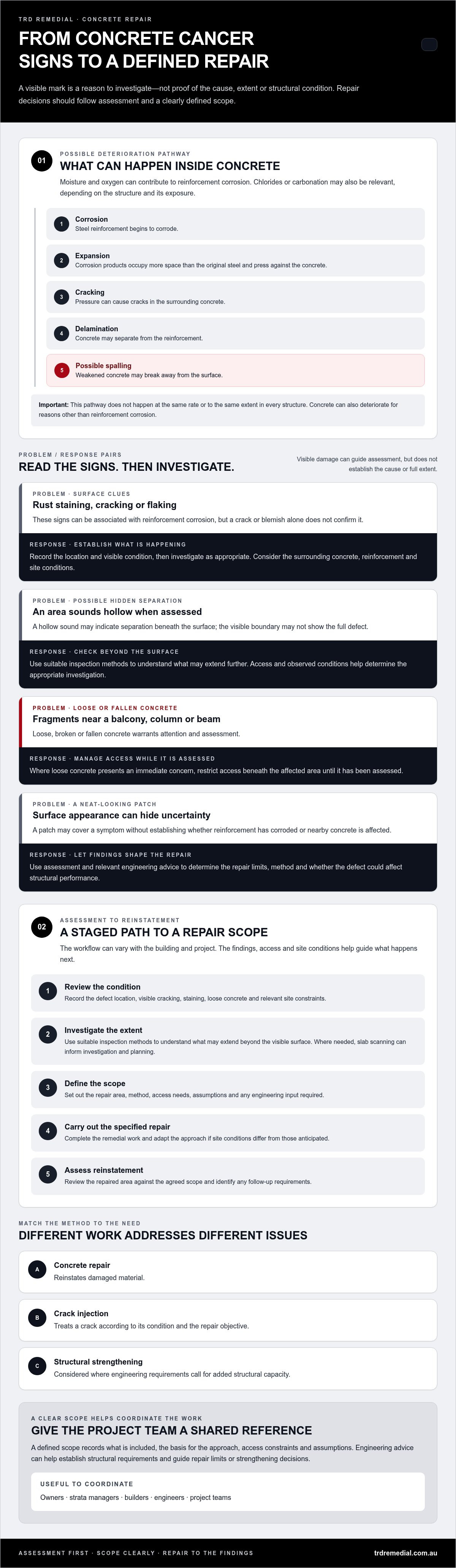
Moisture and oxygen can contribute to corrosion when they reach reinforcing steel. Chlorides or carbonation may also be relevant, depending on the structure and its exposure. As corrosion products form, they occupy more space than the original steel and press against the surrounding concrete. That pressure can cause cracking, followed by separation of the concrete from the reinforcement, known as delamination.
If weakened concrete breaks away, the resulting damage is called spalling. The progression can be described as corrosion, expansion, cracking, delamination and possible spalling, but it doesn’t happen at the same rate or to the same extent in every structure. Concrete cancer is commonly associated with reinforcement corrosion, although concrete can deteriorate for other reasons too. Concrete cancer on Wikipedia outlines the term and related forms of concrete deterioration.
Signs that warrant a structural assessment
Visible signs are reasons to arrange an assessment, not proof of a particular cause or a definitive measure of structural condition. Look for changes such as:
- Rust-coloured staining on concrete surfaces.
- Cracks, especially alongside staining or flaking.
- Areas that sound hollow when assessed, which may indicate separation beneath the surface.
- Loose, broken or fallen concrete, including fragments near a balcony, column or beam.
Damage may be concealed or extend beyond the visible area. A neat surface patch can cover a symptom without establishing whether reinforcement has corroded or surrounding concrete is affected. Assessment helps determine what needs further investigation and whether the visible defect could affect the element’s structural performance.
For owners and strata managers, this distinction can turn an uncertain maintenance concern into a clearer project decision. Builders and engineers can use the findings to define responsibilities, access needs and repair scope. Where loose concrete presents an immediate concern, restrict access beneath the affected area until it has been assessed. The repair approach should reflect the conditions found on site and relevant engineering advice.
How contractors assess concrete cancer and select a repair approach
A sound repair starts with a clear understanding of the defect. Structural concrete cancer contractors consider visible damage alongside the condition of the surrounding concrete, reinforcement and site. The aim is to turn an observed symptom into a practical scope, rather than assume a surface patch will address the cause or extent.
The workflow is usually staged, although the investigation and work required vary with the building and project:
- Review the condition: Record the defect location, visible cracking, staining, loose concrete and relevant site constraints.
- Investigate the extent: Use suitable inspection methods to understand what may extend beyond the visible surface. Access and observed conditions help determine the appropriate investigation.
- Define the scope: Set out the repair area, method, access needs, assumptions and any engineering input required.
- Carry out the repair: Complete the specified remedial work and adapt the approach if site conditions differ from those anticipated.
- Assess reinstatement: Review the repaired area against the agreed scope and identify any follow-up requirements.
From visible symptoms to a defined repair scope
Location matters. Damage at a slab edge, column or other structural element may call for different investigation and engineering input than a local surface defect. Contractors consider the apparent extent, the condition of adjacent concrete and the access available. A visual inspection can document symptoms, but it cannot by itself confirm the condition of concealed reinforcement. Where needed, methods such as slab scanning can inform investigation and planning.
Engineering advice helps establish structural requirements and guide decisions about repair limits or strengthening. A clear scope records what is included, the basis for the approach, access constraints and assumptions. This gives owners, strata managers, builders and engineers a shared reference before work begins.
Why the repair method must match the defect
Concrete repair, crack injection and structural strengthening address different needs. Concrete repair reinstates damaged material; injection treats a crack according to its condition and the repair objective; strengthening is considered where engineering requirements call for added structural capacity. These methods are not interchangeable, and specifying one does not automatically mean the others are needed.
Epoxy and polyurethane injection have different properties and are selected to suit the crack, site conditions and intended outcome. The objective might be to address a crack in concrete or manage water ingress, but the material and method need to suit the assessed condition. Selection depends on project requirements and, where applicable, engineering specifications. The same care applies to reinstatement: assess the completed repair against the defined scope, not appearance alone.
For projects requiring coordinated remedial work, TRD Remedial’s concrete repair work can be considered alongside its technical concrete capabilities.
What to look for in structural concrete cancer contractors
Choosing a contractor for concrete deterioration means looking beyond the visible patch. Structural concrete cancer contractors should work to a clear scope that connects the defect with the required repair methods and the practical demands of the site. A simple patch may suit a limited defect, but if corroded reinforcement or damaged surrounding concrete remains unaddressed, improving the surface alone may not resolve the underlying problem.
A useful capability framework focuses on four areas:
- Diagnosis: How observed defects are recorded and how further investigation is approached where needed.
- Scope clarity: What work is included, what assumptions apply and where the repair boundaries sit.
- Relevant methods: Whether concrete repair, crack injection or strengthening is matched to project requirements.
- Site planning: How access, work sequencing and site controls are considered before work begins.
These details help owners and project teams understand what a proposed repair is intended to address. A defined scope should clarify whether the work concerns a local area or a broader structural issue, and how unexpected conditions will be managed. It can also prevent different parties from making conflicting assumptions about access, sequencing or the extent of reinstatement.
Technical capability beyond surface patching
TRD Remedial undertakes spalling repairs, crack injection and structural strengthening as part of its structural remediation and concrete repair work. The appropriate method depends on the condition identified and the project scope. A repair may require more than replacing visibly damaged material, while injection or strengthening may address separate needs identified during assessment and engineering coordination.
Technical capabilities can support specific scopes. Slab scanning can assist with investigating or planning work in concrete; core drilling can create openings for defined structural alteration requirements. These methods support investigation or construction where appropriate, but they do not replace concrete cancer repair. Keeping that distinction clear helps the team understand what each activity is intended to achieve.
Coordination, safety and scope clarity
TRD Remedial works with builders, engineers and strata managers on residential, commercial and industrial projects. Coordinating these roles helps align the repair scope with engineering input, building access and the sequence of site work. Planning should identify affected areas, access constraints, work boundaries and relevant site controls before repairs begin.
For example, a balcony repair may involve access arrangements, protection of adjacent areas and coordination with other work. Clear documentation helps owners understand what is included and supports builders and engineers in managing site interfaces. TRD Remedial’s structural remediation capabilities bring concrete repair, crack injection and strengthening into a coordinated project scope, with technical services used where the defined work requires them.
How a concrete cancer project moves from assessment to reinstatement
A concrete cancer project involves more than carrying out a repair. Owners, strata managers, builders, engineers and contractors need a shared plan for the work, access and decisions on site. The sequence varies with the building and scope, but separating planning from repair helps clarify responsibilities before work begins.
A general project pathway may include:
- Agree the scope: Define work areas, repair boundaries, responsibilities and relevant engineering input.
- Plan site access: Identify how workers, materials and equipment will reach the affected area, and which parts of the building may be affected.
- Prepare the work area: Establish appropriate work zones, site controls and communication arrangements before repairs start.
- Coordinate the works: Sequence activities around access constraints, other work and building use, while managing changes that arise on site.
- Review and record completion: Assess the reinstated area against the agreed scope and document project-specific outcomes or follow-up items.
This pathway isn’t a fixed checklist for every building. Some projects involve a localised work area; others require coordination across several affected locations or trades. Structural concrete cancer contractors translate the agreed scope into practical site planning, while engineering decisions remain guided by relevant project advice.
Planning remedial works in an occupied building
In an occupied building, access and communication can shape how work is organised. A repair affecting a balcony, for instance, may require entry arrangements, temporary restrictions around the work zone and clear information for residents about affected areas. The plan should also consider the movement of people and materials, protection of nearby areas and the order in which work zones are opened and completed.
Strata managers can coordinate building information, resident communication and access arrangements, while builders help align the remedial programme with other site activities. Engineers contribute relevant scope information and technical direction. Clear responsibilities and timely updates make it easier to respond if concealed conditions or access constraints differ from the initial plan. Duration and disruption depend on the specific project, so consider them in relation to its scope and site conditions rather than assuming them in advance.
Completing work and recording the outcome
At completion, the repaired areas should be reinstated and reviewed against the defined scope. The review and records required depend on project arrangements and engineering requirements. Useful handover information may include the work areas addressed, agreed variations, relevant inspection records and identified follow-up actions. These records give owners and project teams a clearer account of what was completed, while recognising that documentation and inspection requirements vary by project.
For coordinated concrete remediation from planning through reinstatement, TRD Remedial’s concrete repair services form part of the project’s remedial work.
TRD Remedial’s approach to structural concrete cancer contracting
Concrete cancer work calls for a response shaped by the defect and the building, not a standard patch applied in isolation. TRD Remedial is a specialist structural remediation and concrete repair contractor, working with engineers, builders and strata managers on residential, commercial and industrial projects. Its work is aligned with the project scope and relevant engineering input.
A coordinated capability for complex remedial scopes
TRD Remedial undertakes concrete repairs, spalling repairs, crack injection and structural strengthening. These capabilities address different repair needs, and the project scope determines which are relevant. Repairing spalled concrete is distinct from injecting a crack or strengthening a structural element. Not every defect requires every method.
Some scopes also call for technical concrete work alongside the repair. Slab scanning may support investigation or planning, while core drilling and concrete cutting can be used for defined openings or alterations. Controlled demolition may form part of a carefully scoped remedial project. These are supporting capabilities, not automatic steps in every concrete cancer repair.
For owners and project teams, a specialist contractor can coordinate relevant concrete repair and technical work within a defined scope. The method and extent of work remain specific to the site, observed conditions and engineering requirements.
Prepare the information that helps define the next step
A clear starting brief helps the project team understand the defect and practical context. If available, gather:
- Locations of visible cracking, staining, loose concrete or previous repairs.
- Photographs showing the defect and surrounding area.
- Existing engineering assessments, inspection notes or repair documentation.
- Known access constraints, occupancy considerations and relevant site information.
These details help frame the discussion, but they don’t replace a site-specific assessment. TRD Remedial tailors its project response to the building, scope and information available, coordinating with relevant project stakeholders. Sharing existing reports about a proposed repair can help connect the intended work with site conditions and access requirements. If there’s no report, a concise description of what has been observed is still a useful starting point.
Clear information supports a focused discussion about the work required, the people involved and how the project can proceed. Learn about TRD Remedial’s structural remediation services.
Give your remedial project a clear starting point
After identifying a concern, bring the available information together rather than settling on a repair method too early. A clear project brief helps the team focus on the building’s needs, relevant engineering advice and practical site constraints.
For owners and strata managers, this may mean gathering inspection notes, photographs, previous repair records and access details. Builders and engineers can add scope information and technical requirements. A shared picture helps structural concrete cancer contractors understand the project context and coordinate their contribution.
TRD Remedial provides specialist structural remediation and concrete repair, working with builders, engineers and strata managers. Its capabilities include concrete repair, crack injection, structural strengthening and technical concrete services, brought into a project where they fit the defined scope. The work can be shaped around site and project requirements rather than assuming every defect needs the same treatment.
Bring together the observed damage, building information and any existing reports, then discuss your structural repair project with TRD Remedial.
Frequently Asked Questions
How much do structural concrete cancer contractors charge?
Costs for structural concrete cancer contractors depend on the condition and requirements of the individual project, so there’s no reliable universal figure. The extent of affected concrete, difficult access, investigation needed, repair methods and reinstatement all influence the work involved. A local defect with straightforward access, for example, differs from damage requiring investigation across several areas. A project-specific scope defines the tasks and provides a meaningful basis for understanding the work.
Can concrete cancer return after repairs?
Concrete cancer can recur if conditions that contributed to corrosion remain or affect the repaired area again, but recurrence isn’t inevitable. The risk depends on the original cause, how the repair scope responds to identified deterioration and continuing exposure to moisture or other relevant agents. Assessment and suitable remediation aim to address the defect found. Ongoing maintenance and site conditions still matter, so owners should follow any project-specific inspection or maintenance recommendations.
Is concrete cancer covered by building insurance?
Whether building insurance covers concrete cancer depends on the policy wording, the cause of the damage, applicable exclusions and the circumstances of the claim. Policies can treat gradual deterioration differently from damage linked to a sudden event, but the wording and facts determine how a claim is considered. Review the relevant policy sections and discuss the specific circumstances with your insurer or broker. Keep reports, photographs and repair records available to support that discussion.
Who is responsible for concrete cancer repairs in a strata building?
Responsibility in a strata building depends on where the defect sits, the strata plan, building arrangements and the state or territory rules that apply. A defect affecting a shared structural element may raise different responsibility questions from one within an individual lot, but location alone may not settle the matter. Check the strata plan and relevant records with the strata manager, then obtain legal or governance advice suited to the scheme before agreeing how repair decisions and costs are managed.
How long do concrete cancer repairs take?
Repair duration varies with the damage, investigation required, access, scope, curing requirements and whether the building remains occupied during the work. A small accessible repair and a project involving several locations or restricted access won’t follow the same programme. The project-specific plan should set out the sequence, access arrangements and constraints that could affect progress. If findings change the work plan, additional conditions may also alter the sequence.
Does concrete cancer always mean a building is unsafe?
Visible concrete cancer doesn’t, by itself, establish that a building is unsafe. The level of concern depends on the affected element, defect extent and findings from a suitable assessment. A surface mark cannot show the full condition of concealed concrete or reinforcement. If you observe cracking, rust staining, loose material or fallen fragments, arrange an appropriate professional assessment. Until the condition is understood, avoid assumptions about either safety or the repair needed.
Can concrete cancer be repaired while a building remains occupied?
Repairs may be possible while a building remains occupied, but this depends on the work location, access, site controls and repair requirements. A contained work area may be managed differently from work requiring access restrictions or separation from residents. Planning with the strata manager, builder and other relevant stakeholders can help coordinate notices, entry and sequencing. The project plan should identify affected areas and controls; uninterrupted access or occupancy shouldn’t be assumed.


