

What if the main risk in an industrial strengthening project isn’t the repair method, but choosing it before the structure’s capacity and site demands are understood? Industrial structural strengthening starts with diagnosis. Without a clear picture of the cause and extent of a capacity concern, it’s difficult to define the right scope or plan work around ongoing operations.
Safety, access and disruption are practical concerns. Industrial assets have operating requirements that can shape how investigation and remedial work are staged. The right approach is project-specific: it considers the structure, the loads it must carry and the site constraints that affect delivery.
This guide explains the assessment and design pathway, how strengthening methods are matched to structural needs, and what to consider when planning the work. It also covers how slab scanning, carbon fibre strengthening and concrete repairs can support a coordinated scope. The aim is to clarify the decisions required before work begins and how specialist contractors can coordinate with engineers, builders and asset stakeholders.
Key Takeaways
- Identify project drivers such as changed loads, new equipment, structural alterations and deterioration before defining the work scope.
- Understand how engineers assess a structure’s condition, intended use and available information.
- Compare carbon fibre systems, steel reinforcement and other engineered interventions against project demands, rather than relying on a universal ranking.
- Use a practical planning checklist to coordinate work zones, access, sequencing and communication with facility stakeholders.
- See how industrial structural strengthening can be delivered through coordinated contracting, with TRD Remedial working alongside engineers, builders and asset stakeholders.
Industrial structural strengthening: when does an existing asset need it?
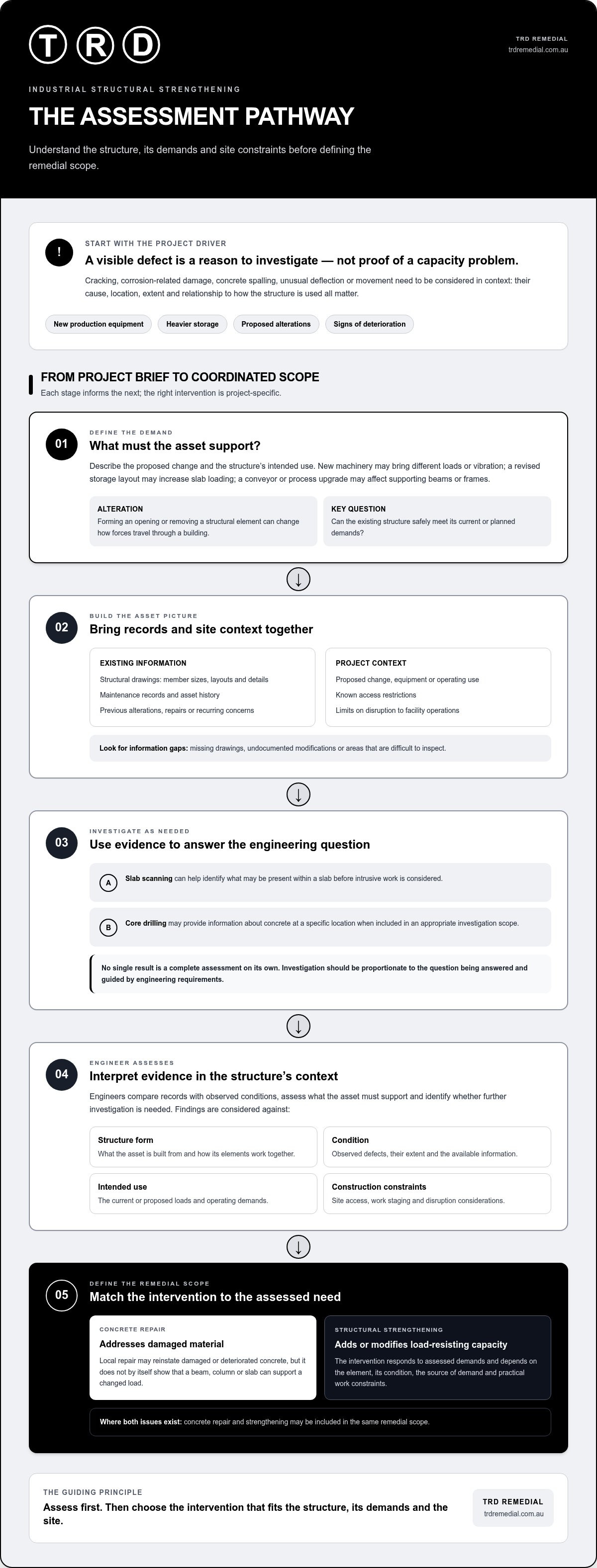
An industrial asset may need strengthening when its current or planned use places demands on the structure that its existing capacity may not meet. Triggers can include new production equipment, heavier storage, a proposed alteration or signs of deterioration. First establish what the structure needs to support, then assess whether it can safely meet those demands.
Industrial structural strengthening isn’t automatically required because a crack appears or concrete begins to spall. These signs are reasons to investigate, not proof of a capacity problem. Their cause, location and extent, as well as their relationship to how the structure is used, all matter. A broad understanding of structural engineering helps explain why decisions depend on how materials and structural elements work together, not appearance alone.
What can trigger strengthening work in an industrial facility?
Changes to a facility can change the loads on its structure. New machinery may introduce different loads or vibration; a revised storage layout may increase the load on a slab; and a conveyor or process upgrade may affect supporting beams or frames. Alterations, such as forming an opening or removing a structural element, can also change how forces travel through a building. Each proposal needs to be assessed in the context of the specific structure and its intended use.
Deterioration can also prompt an assessment. Cracking, corrosion-related damage, concrete spalling, unusual deflection or movement may point to a local defect, a broader condition issue or another cause. A warehouse slab, plant platform and processing facility frame face different operating conditions, so the same symptom does not establish the same need in every asset. Document and investigate the observed condition before selecting an intervention.
Strengthening, repair and remediation: how do they differ?
Structural strengthening adds or modifies load-resisting capacity to meet assessed demands, while concrete repair addresses damaged material and may not change the structure’s overall capacity. Local concrete repair can reinstate damaged or deteriorated concrete, but it doesn’t, by itself, show that a beam, column or slab can support a changed load.
Strengthening may involve adding or modifying reinforcement so a structural element can meet its assessed performance requirements. The suitable intervention depends on the element, its condition, the source of the demand and practical constraints around the work. Where an asset has both damaged concrete and a capacity concern, repair and strengthening may be included in the same remedial scope.
Remediation is the broader process of addressing a defect or condition issue. It can include investigation, concrete repairs and strengthening where the assessment identifies a structural need. Understanding the distinction helps prevent a visible defect from being treated as the whole problem, or a repair from being mistaken for evidence of increased capacity. The structural defect repair guide explains how defect investigation fits into remedial engineering.
How engineers assess industrial structures before strengthening
A sound strengthening scope begins with a defined brief, not a preferred product or a single site observation. The engineer needs to understand what the asset must support, what has changed and what information is available about its existing structure. Strengthening design must respond to assessed site conditions: the structure’s form, condition, intended use and construction constraints determine which intervention is appropriate.
What information informs an industrial strengthening assessment?
An assessment brings together existing records and current site information. Structural drawings can show member sizes, layouts and details, while maintenance records and asset history may reveal previous alterations, repairs or recurring concerns. The project brief should describe the proposed change, such as new equipment or a revised operating use, and note known restrictions on access or disruption.
Engineers compare those records with observed conditions and identify gaps. These might include missing drawings, undocumented modifications or areas that are difficult to inspect. The gaps help determine whether further investigation is needed and what form it should take. The scope should be proportionate to the question being answered, with investigations guided by engineering requirements rather than assumptions about a standard set of tests.
How scanning and concrete investigation support the scope
For work involving concrete, slab scanning and core drilling can provide technical information to support investigation and planning. Scanning can help identify what may be present within a slab before intrusive work is considered. Core drilling may provide information about concrete at a specific location when it forms part of an appropriate investigation scope. The engineer determines how findings relate to the structure and proposed intervention. No single result is a complete assessment on its own.
This evidence can help determine where work should take place, which existing elements may affect the intervention and whether initial assumptions need revision. TRD Remedial provides slab scanning, core drilling and concrete services to support coordinated project work. The slab scanning guide explains how scanning can contribute to understanding subsurface conditions.
Investigation planning also needs to reflect the live site. Access to the structure, operating equipment, restricted areas, work zones and interfaces with other trades can affect what can be examined and when. Discuss these constraints early so the investigation is practical and its findings can be related to the right locations and operating conditions.
The assessment pathway should lead to a documented scope that records relevant information, identified limitations, the required intervention and construction interfaces. Engineering decisions remain tied to the evidence and project requirements. General overviews, such as the Concrete Society’s Methods for strengthening concrete structures, can introduce possible approaches, but they don’t replace a project-specific assessment.
For projects involving investigation and remedial work, TRD Remedial’s structural remediation capabilities support coordination with engineers, builders and asset stakeholders.
Choosing an industrial strengthening method: compare the project demands
There’s no universal best method for industrial structural strengthening. The right option addresses the assessed structural requirement and can be designed and delivered within the asset’s physical and operational constraints. Geometry, access, substrate condition, required performance and construction sequencing all affect the comparison. Material characteristics alone don’t show how a complete engineered system will perform.
The table outlines broad considerations, not a design recommendation. An engineer must verify the intervention and its details against the specific structure and project requirements.
| Approach | What to consider |
|---|---|
| Carbon fibre strengthening | May suit some structural applications where the design calls for a strengthening system fitted to the existing element. Consider geometry, substrate condition, access to the work face and system design details for each project. |
| Steel reinforcement | May be considered where an engineered design uses additional or modified steel elements. Available space, fixing and connection details, interfaces with existing members and construction sequence can affect feasibility. |
| Other engineered interventions | Depending on the assessment, the scope may involve structural alterations, concrete repairs or a combination of measures. The engineer defines how the work addresses the identified requirement and interacts with the existing structure. |
Where might carbon fibre strengthening fit?
Carbon fibre strengthening is an engineered option for suitable applications, not a default solution for every slab, beam or column. Its suitability depends on the element, assessed demand, existing surface and design requirements. Site access and the space available to prepare and work on the relevant area also matter. TRD Remedial provides carbon fibre strengthening as part of its structural remediation work. The carbon fibre strengthening guide offers further context on this approach.
How do site constraints change the comparison?
A method that meets the engineering brief must also be workable at the facility. Restricted access may affect how materials and equipment reach the work area. Live operations can limit where work zones are established, while sequencing may need to account for nearby activities and interfaces with other trades. These factors can shape the practical scope without changing the structural requirement itself.
Substrate condition and design requirements need project-specific review. A material’s general properties don’t prove that a complete system will achieve the required result on a particular asset. The design needs to address how the intervention connects to existing elements and what preparation or associated repairs are involved.
The appropriate solution depends on engineering assessment and project conditions. Compare options against the documented requirement, site constraints and proposed sequence, then verify the selected design details before work starts. This keeps method selection grounded in the structure and the demands it must meet.
Planning industrial strengthening around safety and ongoing operations
On an operating site, the work plan matters as much as the technical scope. Industrial structural strengthening can affect access, nearby activities and trade interfaces, so safety planning and applicable project requirements need attention before site work begins. The plan should reflect actual facility conditions. It can help manage disruption, but it shouldn’t be treated as a promise that operations will continue unchanged.
What should the project team coordinate before site works?
Asset stakeholders understand facility operations and access needs. Engineers define technical requirements and design direction. Builders and specialist contractors coordinate construction activities, work areas and interfaces. Clear responsibilities help the team resolve issues without making assumptions about who controls a task or decision.
Before mobilisation, agree on the work area, access arrangements, sequencing and how proposed activities relate to ongoing operations. For example, a work zone near a regular movement route may need a different access plan from a contained area with limited interaction. The facility team should communicate operational restrictions, while the project team explains planned activities and any changes that could affect site users.
A practical pre-start checklist can make these discussions more specific:
- Work zones: define the work area, boundaries and interfaces with active facility spaces.
- Access: coordinate entry routes, deliveries and access to the structure with relevant site stakeholders.
- Sequencing: agree how strengthening and associated tasks will be staged, including dependencies between activities.
- Interfaces: identify where the scope meets existing services, other trades or facility processes, and clarify who coordinates each interface.
- Communication: set out who shares updates, how changes are raised and how affected stakeholders receive relevant information.
- Safety and compliance: address project-specific controls, site procedures and applicable requirements before work proceeds.
This checklist supports coordination but doesn’t replace project-specific safety planning. If conditions change, such as access becoming restricted or an adjacent activity shifting, the relevant parties need a clear process to review the sequence and controls.
How should technical works be integrated with strengthening?
Related remedial and concrete work should be planned as part of the wider scope, not left until later. Slab scanning may inform the location of proposed work; core drilling, concrete repairs or structural alterations may also form part of an engineered package where relevant. Coordinate their timing and interfaces with the strengthening activity and the site’s operating constraints.
Cutting, drilling and demolition can affect existing structural elements and nearby work areas. These activities must follow project-specific controls and direction, with responsibilities and sequencing understood by the parties involved. TRD Remedial coordinates specialist contracting work with engineers, builders and asset stakeholders as part of remedial projects.
More information about TRD Remedial’s coordinated site delivery approach is available on the company website.
Delivering industrial structural strengthening with TRD Remedial
Industrial structural strengthening involves more than installing a selected reinforcement system. The scope needs to connect the assessed condition and engineered requirements with safe, practical site delivery. TRD Remedial is a specialist structural remediation and strengthening contractor, working with engineers, builders and asset stakeholders to coordinate remedial work around the structure and its operating environment.
What does a coordinated specialist scope bring together?
A clear scope translates project information into defined contracting work. It aligns investigation findings and engineering requirements with the physical work area, access arrangements, sequencing and facility interfaces. Engineers establish design requirements; the specialist contractor carries out the defined remedial work in coordination with the project team. Keeping these roles clear supports orderly delivery and distinguishes design responsibility from construction execution.
TRD Remedial’s relevant capabilities include structural strengthening and carbon fibre strengthening, alongside slab scanning, core drilling and concrete repairs. These services can support complex remedial projects where investigation or associated concrete work forms part of the agreed scope. They aren’t a standard package for every asset. The required work depends on project findings and engineering direction.
For example, a scope may call for strengthening at a defined location and concrete repair in an adjacent area, or scanning and core drilling may be relevant to planned work. The project team can coordinate these activities with builders and asset stakeholders so work areas, access and construction interfaces are understood. Each service should have a defined purpose within the overall scope.
A well-defined scope also helps distinguish included work from related activities that need separate coordination. Clear work locations, sequencing information and communication pathways reduce reliance on assumptions during delivery. If site conditions or operational constraints affect the planned work, the relevant parties can address the interface through the project’s agreed processes.
What is the next step for an industrial strengthening project?
Start with a concise outline of the asset and why work is being considered. Include the proposed change or intended use, known structural concerns, available project information and operational constraints, such as restricted access or areas that need to remain available. These details give the project team a practical starting point for discussing the contracting scope alongside the engineering requirements.
TRD Remedial brings specialist contracting capability to structural remediation and strengthening projects, coordinating with engineers, builders and asset stakeholders. A defined scope helps clarify the required work, how related services fit and which site conditions need to shape delivery. It also keeps decisions tied to the assessed need rather than assumptions about a particular method or service.
For industrial structural strengthening, a clear project outline helps move the discussion from uncertainty to a defined scope. TRD Remedial’s focus on structural remediation and concrete repair supports a practical pathway from project needs to coordinated remedial work.
Set your asset up for its next operating demands
Strengthening decisions can shape how an industrial asset is used beyond the construction period. Record the basis for the intervention so the people responsible for operating and maintaining the facility can refer to it later. A concise record of intended use, agreed scope and relevant site constraints can help keep future decisions connected to the asset’s requirements.
As production needs evolve, proposed changes to equipment, loads or structural elements deserve early consideration. Including those changes in asset planning can help identify when further engineering input may be needed, before a new demand becomes an urgent site issue. The aim isn’t to predict every future change, but to establish a disciplined approach to reviewing them.
For industrial structural strengthening, the next step is to define the project need and the site conditions that will shape delivery. TRD Remedial’s specialist focus on structural remediation and concrete repair supports coordinated remedial work based on the project scope.
Frequently Asked Questions
When is industrial structural strengthening required?
Industrial structural strengthening may be required when an existing asset needs to meet changed demands, support new equipment or address an assessed structural concern. A planned production change, for example, could prompt a review of a supporting element. Cracking or deterioration is a reason to investigate, not a diagnosis by itself. The project team needs to establish what the structure is expected to do and whether repair, strengthening or another response is appropriate.
What is the difference between structural strengthening and concrete repair?
Concrete repair addresses damaged or deteriorated material, while structural strengthening targets performance against assessed requirements. A project may need one intervention or both. Repairing a spalled area, for example, may address local concrete damage but won’t automatically resolve a separate concern about the element’s capacity. The scope should state the purpose of each task so repair work isn’t mistaken for strengthening, or vice versa.
Can industrial strengthening work be carried out while a facility remains operational?
It may be possible, depending on the asset, work area, access, sequence and site controls. A work zone beside an active production area may require different coordination from a separated section of the facility. The project team should plan around actual operations and assess any necessary restrictions. No delivery plan should assume uninterrupted activity: safety, access and construction requirements may affect how work is staged.
How is the right industrial strengthening method selected?
Select a method by comparing the assessed structural need with the asset’s condition and project constraints. Engineers consider the required performance alongside geometry, available work space, substrate condition and construction sequencing. For example, the layout around a structural member may influence which interventions are practical. A general material comparison can help frame the options, but it can’t replace project-specific engineering advice or establish that one method is always superior.
Is carbon fibre suitable for every industrial structure?
No. Carbon fibre strengthening suits some applications, but its suitability depends on the structure, condition, design requirements and site constraints. A material’s general characteristics alone don’t show how a complete engineered system will perform on a particular asset. The project assessment needs to establish whether the proposed application fits the element and required outcome. If it doesn’t, another engineered intervention may be more appropriate.
What information should we prepare before discussing an industrial strengthening project?
Prepare any available drawings or records, the proposed change, known concerns and operational constraints. Note areas with access limits or activities that could affect site work. Complete records aren’t essential before an initial project discussion; an outline of what is known and uncertain can help identify useful next steps. Don’t treat an old drawing as proof that the structure remains unchanged.
Do industrial strengthening works always require slab scanning or core drilling?
No. Slab scanning and core drilling may support a particular investigation or remedial scope, but they aren’t automatic requirements. Scanning may be considered where proposed work needs information about a slab, while core drilling may be relevant when the project scope calls for it. The decision should reflect available information, planned work and engineering direction, with site controls guiding how any investigation is carried out.
Planning industrial structural strengthening? Contact TRD Remedial to discuss your project scope, including the asset, proposed change and site constraints.


