

The most critical phase of concrete coring happens well before the diamond barrel ever touches the slab. Engaging professional core drilling services isn't simply about cutting round holes through floors and walls; it's a calculated engineering operation where structural stability hangs on millimetre precision.
Every site manager and engineer knows the acute stress of risking buried post-tension cables, live electrical conduits, or vital reinforcing steel. Beyond the immediate danger of structural strikes, the operational disruptions of uncontrolled slurry migration, hazardous respirable crystalline silica dust, and surface damage from poorly anchored rigs can bring a project to an immediate halt. Discover how engineered core drilling services deliver surgical concrete penetrations while safeguarding structural integrity and site safety. This guide outlines the essential technical standards, from non-destructive pre-drilling subsurface investigation to complex inverted coring and national Safe Work compliance, ensuring your penetrations meet strict engineering tolerances without compromise.
Key Takeaways
- Understand why non-percussive diamond coring is essential to eliminate micro-cracking and preserve structural concrete strength.
- Learn why certified core drilling services must incorporate pre-drilling non-destructive testing to verify paths around post-tension cables and conduits.
- Discover how to match specific rig systems, from high-cycle electric to hydraulic plant, to vertical, horizontal, and inverted penetrations.
- Implement dual-containment wet extraction protocols to ensure absolute compliance with national Safe Work standards for respirable crystalline silica.
- Apply an engineering-led contractor selection framework to eliminate project delays, hidden structural damage, and costly remediation works.
What Defines Professional Core Drilling Services in Modern Construction?
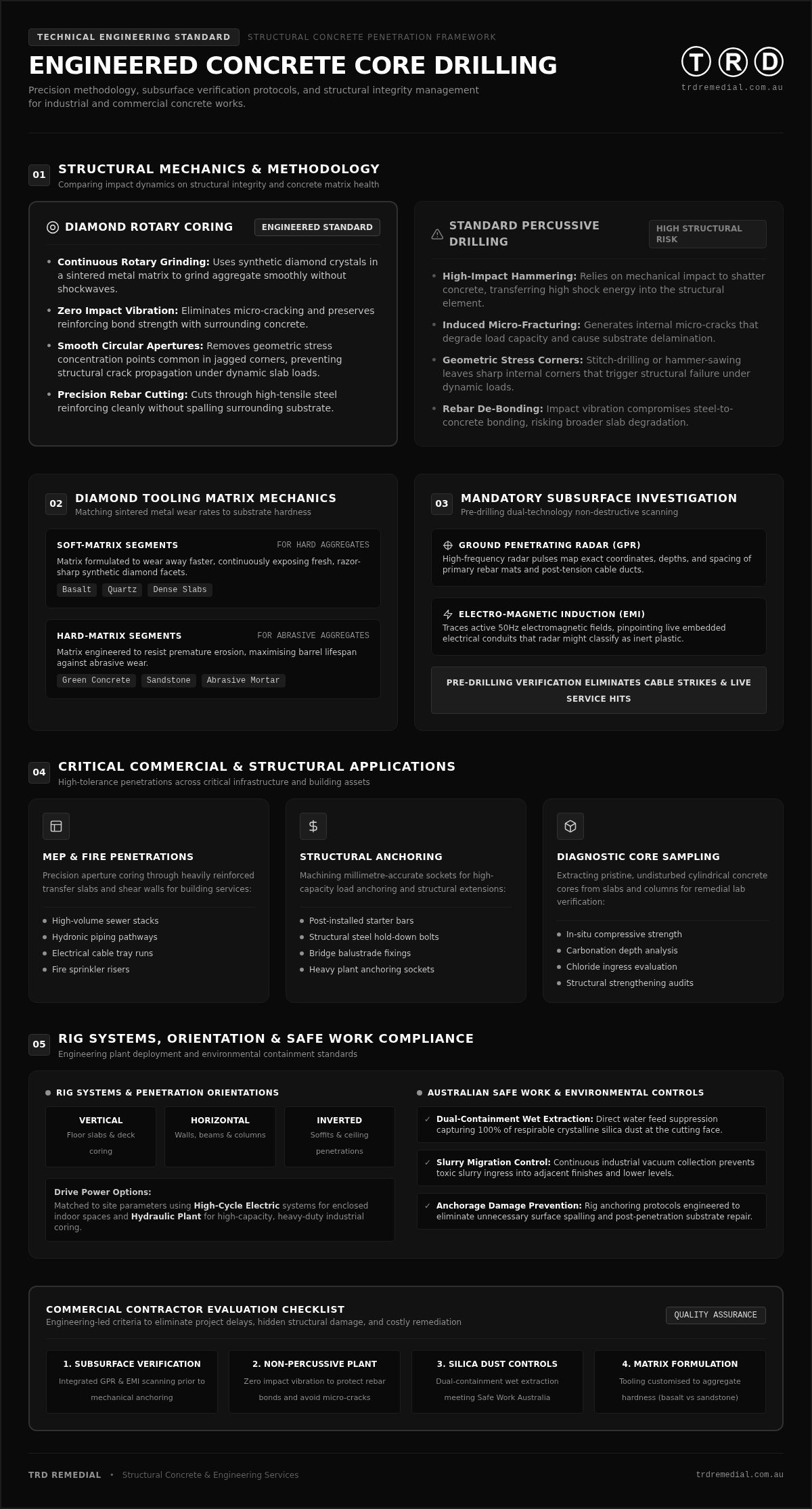
Professional core drilling is the controlled process of cutting precise cylindrical openings through reinforced concrete, precast panels, and masonry using a hollow, diamond-tipped drill bit. Unlike standard percussive drilling, which relies on high-impact hammering to shatter substrate, an engineered core drill operates via rotary grinding. Percussive methods generate severe shockwaves that induce micro-fracturing, compromise reinforcing bond strength, and cause concrete delamination. In contrast, specialist core drilling services rely on continuous rotary diamond abrasion. This produces perfectly smooth, dimensionally accurate apertures without transferring impact vibration to surrounding structural elements.
Beyond standard utility openings, structural engineers frequently commission core drilling to extract pristine cylinder samples from existing slabs and columns. These extracted cores undergo laboratory testing to verify in-situ compressive strength, carbonation depth, and chloride ingress, providing verifiable data for structural asset management.
The Mechanics of Diamond Core Tooling
Industrial core barrels feature segments formulated from synthetic industrial diamond crystals suspended within a sintered metal powder matrix. As the barrel rotates, the metal matrix wears away at a calculated rate, continuously exposing fresh, razor-sharp diamond facets that grind aggregate and cut through high-tensile rebar without spalling. Tool selection requires careful engineering analysis:
- Soft-matrix segments: Engineered for extremely hard, dense aggregates like basalt and quartz, wearing faster to consistently expose fresh diamonds.
- Hard-matrix segments: Designed for abrasive substrates such as green concrete and sandstone, resisting premature erosion to maximise barrel life.
Crucially, creating smooth circular profiles eliminates the sharp interior corners inherent to stitch-drilling or hammer-sawing, entirely removing the geometric stress concentration points that typically trigger structural cracking under dynamic slab loads.
Critical Applications Across Commercial and Industrial Sectors
Modern structural specifications demand strict tolerances that basic cutting contractors cannot meet. Engineered coring provides exact penetrations for complex commercial, industrial, and infrastructure requirements:
- Mechanical, electrical, plumbing, and fire services: Cutting exact apertures for high-volume sewer stacks, hydronic lines, cable tray pathways, and fire sprinkler risers through heavily reinforced transfer slabs.
- Structural anchoring and hold-down systems: Machining precision vertical and horizontal sockets to secure high-capacity post-installed starter bars, structural steel hold-down bolts, and bridge balustrades.
- Diagnostic core sampling: Extracting undisturbed concrete cores required by remedial engineers to evaluate concrete matrix health prior to specifying structural strengthening.
Mandatory Subsurface Investigation: Mitigating Risks Before Coring
Blind core drilling remains one of the most reckless practices in structural alteration. Treating concrete coring as a casual plant hire task rather than an engineered structural intervention routinely leads to severed conduits, compromised load paths, and catastrophic safety breaches. To maintain strict alignment with any recognised industry safety standard, pre-drilling verification must occur before any mechanical anchor is driven or core barrel touches the slab surface. Elite core drilling services integrate multi-disciplinary subsurface investigation directly into their workflow, eliminating the friction and miscommunication inherent to hiring disparate scanning and cutting outfits.
Integrating Ground Penetrating Radar with Electro-Magnetic Induction
High-resolution subsurface profiling requires a dual-technology protocol. High-frequency Ground Penetrating Radar (GPR) penetrates structural slabs to map the precise coordinates, depths, and spacing of primary rebar mats and post-tension ducts. Operating in tandem, Electro-Magnetic Induction (EMI) traces active 50Hz electromagnetic fields, locating live, embedded electrical services that radar alone might misclassify as inert plastic conduit.
Once scanned, technicians apply standard on-slab drafting conventions. They clearly delineate structural steel baselines, post-tension draping lines, and utility pathways in high-visibility marker paint. By completing professional slab scanning before positioning plant, engineering teams verify clear drilling zones down to structural tolerances of plus or minus five millimetres.
The Hazards of Striking Post-Tensioned Tendons
Striking an unbonded post-tension tendon under hydraulic load causes an explosive release of stored energy. The severed cable can violently erupt through the slab top or anchor face, endangering personnel and instantly destressing the floor system. Even in bonded systems, slicing a tendon removes designed tensile capacity across the entire structural bay, precipitating unacceptable deflections and immediate serviceability failures.
- Service strikes: Severing conduit risks high-voltage electrocution, arc flashes, and immediate site-wide operational shutdowns.
- Primary rebar truncation: Cutting top-mat negative moment steel near columns induces sudden shear failures.
- Engineered remediation: When unexpected structural rebar or steel elements are severed or compromised during site works, remedial teams must implement externally bonded carbon fibre strengthening composites to restore slab shear and flexural capacity.
Partnering with an engineering-led contractor like TRD Remedial ensures complete end-to-end management, seamlessly uniting pre-pour subsurface scanning with precision drilling and structural reinforcement under a unified safety protocol.
Advanced Core Drilling Methodologies: Matching Tooling to Substrate Demands
Executing penetrations across complex commercial and civil structures requires configuring plant to suit specific substrate realities. Selecting the right setup separates basic diamond drillers from engineered core drilling services. Whether coring through a mass retaining wall, drilling upward into a suspended slab soffit, or isolating structural sections adjacent to controlled demolition zones, rig configurations must match strict mechanical tolerances.
Wet Coring vs Dry Diamond Coring Applications
Continuous wet diamond coring remains the primary standard for heavily reinforced concrete. Pressurised water flushed through the spindle lubricates the cutting face, cools the diamond segments, and suspends concrete swarf into a manageable slurry. This extends tool life and accelerates cutting speeds through high-tensile steel.
Dry diamond coring fills a critical role where water ingress introduces massive commercial risk. Utilizing specialized dry-cutting barrels paired with high-flow M-class or H-class vacuum extractors, this method operates safely inside live data centres, hospital switchrooms, and finished tenancies. Penetration speeds are naturally lower and barrel wear rates accelerate, but dry coring completely mitigates water damage to critical sub-floor assets.
Specialised Inverted, Horizontal, and Deep-Barrel Techniques
Standard down-hole slab coring represents only a fraction of structural demands. Confined spaces and complex refurbishments introduce severe geometry challenges:
- Inverted ceiling coring: Drilling bottom-up into slab soffits requires high-pressure mechanical props and specialised circular slurry-collector rings sealed against the concrete. This prevents water draining into the motor housing and protects operators below.
- Deep-barrel infrastructure coring: Penetrating deep bridge abutments, foundation footings, or dams relies on modular barrel extensions. Technicians core sequentially, snapping and extracting cylindrical slugs in stages to reach depths exceeding two metres.
- Precision stitch drilling: When site constraints prevent track-mounted wall saws from establishing overcut-free service risers, operators drill overlapping core holes around the perimeter. This creates large rectangular or irregular apertures through walls up to a metre thick without inducing edge micro-cracking.
Power Plants: Electric, Hydraulic, and Pneumatic Rig Selection
Selecting the drive mechanism dictates delivered torque, crew safety, and site viability across diverse operational environments.
| Rig Type | Power Source | Diameter Capacity | Best Use Environment |
|---|---|---|---|
| High-Cycle Electric | Single-phase / 3-phase 415V | Up to 350mm | Internal commercial fitouts, basements, and confined risers requiring high power-to-weight ratios. |
| Hydraulic | External hydraulic power pack | 400mm to 1000mm+ | High-torque civil infrastructure, mass retaining walls, and underwater or submerged operations. |
| Pneumatic | Compressed air line | Up to 250mm | Hazardous facilities, petrochemical plants, and mines requiring completely spark-free, intrinsically safe plant. |
Safety, Compliance, and Environmental Controls in Concrete Coring
Environmental and safety compliance on modern construction sites extends well beyond basic personal protection. Concrete coring involves aggressive rotational forces, alkaline slurry generation, and the constant threat of respirable airborne hazards. Professional core drilling services manage these variables through rigorous engineering controls, beginning with how rigs anchor to the concrete. Where rough structural slabs allow, heavy-duty mechanical drop-in anchors provide rigid lateral resistance. For architectural finishes, post-tensioned decks, or slabs with bonded waterproofing membranes, teams deploy non-marking vacuum bases equipped with continuous pressure monitoring to lock the rig firmly without puncturing the surface.
Managing Respirable Crystalline Silica Risks
Respirable crystalline silica (RCS) is a critical health hazard across the Australian construction sector. Cutting or grinding concrete generates microscopic particles that penetrate deep into lung tissue, prompting strict national workplace exposure standards enforced under Safe Work Australia model regulations. Compliant contractors eliminate dry airborne dust at the source through mandatory engineering controls. Technicians utilise continuous water suppression or fully shrouded systems paired with certified H-class HEPA extraction units. Operators also undergo regular fit-testing for tight-fitting half-face particulate respirators, ensuring airborne exposure remains strictly controlled during all penetration activities.
Slurry Capture, Neutralisation, and Disposal
Concrete slurry produced during wet diamond cutting presents severe environmental risks. With an alkaline pH often exceeding 11, untreated slurry runoff is corrosive to aquatic ecosystems and permanently damages public stormwater drainage infrastructure. Uncontrolled slurry migration also causes severe slip hazards and ruins finishes on lower levels.
- Dual-containment extraction: Drillers affix specialised rubber suction collars directly around the coring aperture, pairing them with heavy-duty wet industrial vacuums to swallow slurry the instant it flushes from the kerf.
- On-site sedimentation and neutralisation: Extracted liquids pass into site containment tanks where buffering agents lower pH levels back to neutral before water recycling.
- Regulated disposal: Concrete fines dry into inert solid cakes, which teams catalog and haul to licensed disposal facilities in accordance with environmental protection laws.
Mitigating statutory liabilities demands rigorous procedural execution. To protect your site from safety breach notices and costly environmental remediation, engage TRD Remedial for certified coring and structural contracting delivered to strict national compliance benchmarks.
Evaluating Specialist Core Drilling Contractors: Commercial Selection Framework
Procurement teams frequently make the mistake of awarding concrete coring packages based solely on hourly hire rates. This transactional approach introduces immense commercial and structural risk. When an unqualified operator severs a post-tension tendon, ruptures a high-voltage conduit, or floods a switchroom with uncontrolled slurry, the initial savings evaporate instantly against catastrophic rectification costs. Professional core drilling services demand evaluation as high-risk engineering interventions, requiring rigorous contractor vetting before plant mobilises to site.
Contractor Due Diligence Checklist
Commercial builders and structural engineers should apply a strict qualification matrix when auditing specialist drilling operators:
- Comprehensive insurance policies: Verify verified certificates of currency for public liability, professional indemnity, and workers compensation coverage specifically encompassing high-risk structural penetrations.
- Plant verification and electrical compliance: Confirm current test tags on all high-cycle electric plant, documented preventive maintenance logs, and certified inverted slurry-containment collars.
- Substrate competency: Assess proven past performance across post-tensioned decks, transfer slabs, and high-strength concrete assets.
- Pre-start administrative governance: Require robust, site-specific Safe Work Method Statements (SWMS), respirable crystalline silica exposure control plans, and formal penetration permit sign-offs before setting anchors.
The Turnkey Advantage: From Scanning to Remediation
Fragmented sub-contracting creates operational friction and divides liability. When one party scans the slab, another runs the core drill, and a third carries out patching, accountability scatters the moment a buried asset is struck or an aperture drifts out of engineering tolerance. Engaging a single specialist eliminates these interface risks completely.
A unified technical contractor manages the complete life cycle of the penetration. Specialist teams execute non-destructive slab scanning, verify clear drill paths, set precision diamond rigs, and capture slurry within a single managed workflow. If internal honeycombing, voiding, or carbonation is uncovered during coring, an in-house remedial engineering team can immediately inspect the defect, detail a repair methodology, and apply carbon fibre reinforcement or structural repairs without stalling site progress.
TRD Remedial delivers this integrated capability nationally, providing principal contractors and asset managers with elite technical coring, subsurface scanning, and structural strengthening backed by disciplined engineering precision.
Engineered Precision for Your Next Structural Penetration
Concrete penetrations should never compromise the structural design or safety compliance of an asset. Moving past transactional equipment hire toward engineered core drilling services safeguards your project against catastrophic post-tension strikes, service disruptions, and airborne silica hazards. Genuine precision lies in the technical discipline applied before cutting begins. Rigorous non-destructive slab scanning, substrate-matched diamond matrix selection, and dual-containment slurry systems ensure every penetration meets strict engineering tolerances without damaging adjacent concrete.
When structural modifications demand surgical execution, working with an elite contractor eliminates operational interface risk. Consult with TRD Remedial for engineered core drilling and structural solutions. With multi-disciplinary capabilities uniting pre-drilling radar scanning, high-tolerance diamond coring, and remedial reinforcement, your project gains the technical certainty it deserves.
Frequently Asked Questions
How deep can commercial diamond core drilling penetrate reinforced concrete structures?
Standard core barrels typically penetrate depths between 400mm and 500mm in a single pass. However, professional core drilling services utilise modular barrel extensions to core through elements exceeding two to three metres. Operators advance the cut incrementally, snapping and extracting cylindrical concrete cores in sections before extending the barrel. This staged approach maintains exact rotational alignment across mass retaining walls, bridge abutments, and thick footing slabs.
Can core drilling be safely performed in finished commercial buildings without water damage?
Yes, technicians execute coring safely within occupied tenancies by using specialized dry diamond systems or dual-containment wet extraction. In sensitive environments like operational data centres or switchrooms, dry-cutting barrels paired with certified H-class dust extractors eliminate water hazards completely. Where wet coring is structurally necessary, rubber suction rings coupled with high-lift wet industrial vacuums capture the cooling water at the collar, leaving surrounding finishes dry.
Why is concrete scanning considered mandatory before undertaking any core drilling?
Subsurface scanning with Ground Penetrating Radar and Electro-Magnetic Induction is critical to detect concealed conduits and reinforcement before setting drill anchors. Slabs contain post-tension cables, live electrical services, and primary rebar mats. Coring without prior verification introduces extreme risks of electrocution or sudden structural failure. Pre-drilling scanning marks clear drill targets within tight tolerances, protecting site workers and maintaining structural design compliance.
What is the standard diameter range for commercial core drilling barrels?
Commercial core barrels generally range from 12mm up to 1000mm in diameter, matched to the specific penetration requirement. Sockets between 18mm and 50mm typically accommodate chemical anchors and conduit runs. Diameters from 100mm to 250mm suit mechanical pipes, fire sprinkler risers, and drainage plumbing. For apertures exceeding 400mm, high-torque hydraulic or three-phase electric rigs are deployed to drill large-format infrastructure openings safely.
How is concrete slurry safely managed and disposed of during wet core drilling?
Slurry is captured immediately at the drill kerf using fitted containment rings connected to high-volume wet extraction units. Because raw concrete slurry has a caustic pH often exceeding 11, it cannot legally enter stormwater networks. Extracted liquids are diverted to settlement containers for acid neutralisation, allowing solids to settle out. Dried slurry cakes are then transported to licensed waste management facilities under environmental protection regulations.
What happens if a core drill accidentally severs a steel rebar or structural tendon?
All drilling must stop immediately so an engineering team can assess the compromised structural capacity. Slicing reinforcing steel or post-tension tendons alters the slab's load-distribution paths, risking severe deflection or localized shear failure. Remediation requires non-destructive testing to verify the extent of the defect, followed by engineered reinforcement solutions such as externally bonded carbon fibre strengthening or post-tension truncation to safely restore structural capacity.
Can diamond core drilling be completed upside down through ceiling soffits?
Yes, inverted core drilling is routinely performed on basement soffits, bridge decks, and suspended slabs using specialized inverted rig assemblies. Technicians secure the drill column using mechanical ceiling-jack bracing or heavy-duty anchors to counteract gravity. The rig utilizes sealed circular collector rings with active suction, which prevents caustic water from entering the motor housing, protects operators from falling debris, and ensures continuous barrel lubrication.


