

What if a visible crack is only a symptom, and a surface repair leaves the underlying structural problem untouched? Cracks, concrete damage and movement can be unsettling, but appearance alone can’t confirm the cause or level of risk. Sound structural defect rectification starts with evidence, not assumptions.
It’s reasonable to want clear answers before work starts, especially when an incorrect repair could leave the underlying issue unresolved. The right approach depends on an appropriate assessment, relevant engineering advice and a repair scope suited to the structure and its condition. This guide explains how concerns are investigated, how rectification options are selected and what information can help you make a sound decision.
You’ll also learn what to expect as a specialist contractor works with engineers, builders and occupants to plan and deliver a repair. TRD Remedial provides specialist concrete repair and structural remediation services, including crack injection, spalling repairs and structural strengthening. Understanding how these roles fit together can help you coordinate the project and check whether a contractor’s capabilities match the required scope.
Key Takeaways
- Structural defect rectification should address the verified cause of damage, not just conceal what’s visible.
- Record cracking, movement or concrete damage, then use the site history and an appropriate professional assessment to guide investigation.
- Match the repair method to the diagnosed defect, structural requirements, substrate condition, access and project constraints.
- Before work begins, clarify the approved scope, sequencing, site access, occupant communication and any required temporary works.
- Check that the specialist contractor’s technical capabilities align with the engineered scope and that roles are coordinated with project stakeholders.
Structural defect rectification: what it means and when it is needed
A crack, bulge or patch of damaged concrete can raise an immediate question: is this cosmetic deterioration, or could it affect the structure? Appearance can flag a concern, but it can’t confirm the cause or severity. Structural defect rectification involves investigating the issue and addressing it with a repair suited to the structural need, rather than simply covering the visible damage.
What counts as a structural defect?
A defect may be structural when it affects, or could compromise, how building elements transfer loads, remain stable, resist deterioration or perform their intended structural role. Examples that warrant assessment include cracking in concrete or masonry, movement, concrete delamination or spalling, and exposed reinforcement that may be corroding. These signs don’t prove a structural defect on their own.
Finish damage can look similar to a more serious issue, and structural movement may also cause cracks in finishes. A photograph can help record a change, but it can’t reliably establish what is happening within a wall, slab or other element. Background on structural integrity and failure helps explain why a building’s ability to perform depends on more than its visible surface.
Why the visible symptom is not the whole diagnosis
The same symptom can have different causes. Cracking or concrete damage may be associated with moisture, corrosion, movement, overloading or construction details, among other possibilities. The cause, extent and implications need to be assessed by appropriately competent professionals. The investigation should reflect the affected element, site conditions and available records.
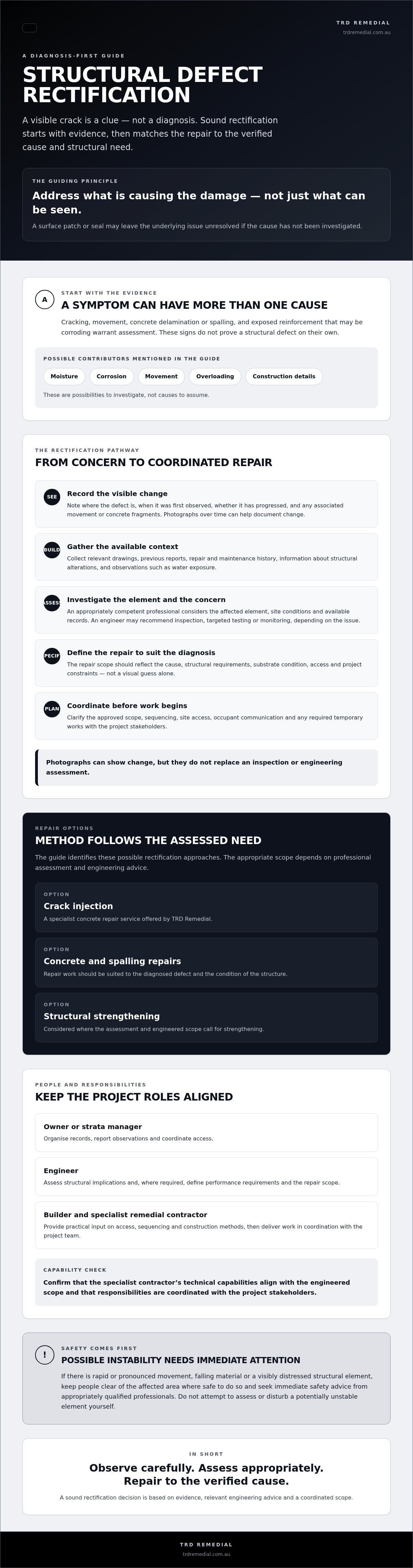
Structural defect rectification is a diagnosis-first process: establish the likely cause and structural requirements, then select a repair that addresses them. Sealing or patching a surface without understanding why it deteriorated may leave the source of the problem in place. Depending on the professional assessment and engineering advice, repair may involve concrete repairs, crack injection or structural strengthening. The right scope can’t be selected from a visual guess alone.
Record where the damage appears, whether it changes over time, and any associated movement or concrete fragments. If there are signs of possible instability, such as rapid or pronounced movement, falling material or a visibly distressed structural element, keep people clear of the affected area where safe to do so and seek immediate safety advice from appropriately qualified professionals. Don’t attempt to assess or disturb a potentially unstable element yourself.
How structural defects are assessed before rectification
A clear assessment turns an initial concern into a repair scope that can be reviewed and delivered. The process isn’t one-size-fits-all. Investigation depends on the type of defect, potential risk, access to the affected element and available building information.
What information helps establish the cause?
Start by recording what’s visible and what has changed. Note the defect’s location, when it was first observed, whether it has progressed, and any maintenance or repair history. Photographs taken over time can help document changes, but they don’t replace an inspection or engineering assessment.
Gather relevant building records, such as available drawings, previous reports and information about structural alterations. Record water exposure and other site observations too, without assuming they caused the defect. This context can help the project team decide what further investigation is appropriate.
Depending on the issue, the project engineer may recommend a site inspection, targeted testing or monitoring over time. Not every defect needs the same tests. Each method should answer a specific question, such as whether damage extends beyond the surface or whether movement is ongoing. For broader context, see this structural defect repair guide.
Who should assess and specify the rectification?
The owner or strata manager can organise records, report observations and coordinate access. The engineer assesses structural implications and, where required, defines performance requirements and the repair scope. Builders and specialist remedial contractors can provide practical input on access, sequencing and construction methods, then deliver work in coordination with the project team. Their advice on methods should support, not replace, the engineer’s assessment or design.
Before work proceeds, confirm who is responsible for the design, approvals and any required checks. Applicable Australian Standards, National Construction Code provisions and approval requirements depend on the project and should be verified by the relevant professionals. Site-specific safety planning is also essential, with controls chosen for the work, building and site conditions.
Once the assessment defines the scope, a specialist contractor can help plan how the work will be carried out. If concrete repair, crack injection or structural strengthening is being considered, TRD Remedial’s remedial capabilities can be considered as part of the project team’s coordination.
Choosing a structural defect rectification method that fits the cause
The repair method should follow the engineering assessment, not the appearance of the damage alone. Selection depends on the diagnosed defect, required structural performance, substrate condition, site access and project constraints. Methods aren’t interchangeable, and no treatment suits every structure. The engineer’s specification and site conditions govern the final approach.
| Method | May be considered for | Key selection factors |
|---|---|---|
| Concrete repair | Assessed deterioration or damaged concrete, including spalling | Extent and condition of the concrete, reinforcement condition, preparation and repair scope |
| Crack injection | Cracks where an engineered injection treatment is specified | Crack characteristics, moisture conditions, cause and required performance |
| Structural strengthening | Situations where assessed structural capacity or performance needs to be addressed | Design requirements, existing structure, access and installation constraints |
| Other engineered interventions | Defects or site conditions that require a different or combined approach | Engineering design, investigation findings, safety controls and project sequencing |
Concrete repair and crack injection
Concrete repair may be specified when an investigation identifies deteriorated or damaged material that needs rectification. The repair scope should account for the condition of the surrounding concrete and any reinforcement, rather than treating a damaged patch as an isolated surface issue. TRD Remedial provides concrete repairs and spalling repairs as part of its remedial capabilities.
Crack injection is another possible treatment, but the injection material must suit the crack and project requirements. Epoxy and polyurethane systems have different properties and uses. Selection depends on factors such as the crack’s condition, moisture and intended outcome. Don’t assume injection will restore structural performance without the relevant assessment and specification. For more detail, see this concrete crack repair guide or the broader concrete remediation guide.
Structural strengthening and enabling works
Where an engineer identifies a need to address structural capacity or performance, strengthening may form part of the repair scope. Carbon fibre strengthening is one available technique, but its suitability depends on the structure and engineering requirements. It isn’t a universal substitute for other interventions.
Some projects also require enabling works. Slab scanning may help inform planned work in concrete; core drilling, concrete cutting or controlled demolition may be considered where specified. These activities need to align with the engineered scope, access constraints and site safety planning. Effective structural defect rectification is a coordinated process: confirm the method, prepare the work area and deliver the specified intervention without substituting an unapproved repair.
Planning structural defect rectification: scope, safety and project checks
A sound repair can still be disrupted by unclear responsibilities, restricted access or work that doesn’t match the approved scope. Before structural defect rectification starts, align the engineering requirements with practical site conditions. Rectification planning must align the specified repair with site constraints and safety controls.
What to confirm before work begins
Check that the defect assessment, repair scope and relevant drawings are current and understood by the project team. Confirm who approves the methodology, coordinates the work and reviews any design or scope changes. Agree on inspection points and the quality records required, such as photographs or work documentation, before they become difficult to obtain.
Plan the work sequence around access, material handling, other site activities and any required temporary works. Temporary support or other controls must suit the engineer’s design and actual site conditions. For occupied buildings, agree which areas may be affected, how occupants will be informed, and who will communicate changes or access restrictions.
Unexpected conditions can emerge once work exposes concealed areas. Establish a clear process for recording them, notifying the relevant project professionals and pausing affected work until the appropriate review or direction is provided. Don’t let an informal site decision change an engineered repair without proper consideration.
How to assess a specialist remedial contractor
Ask contractors questions that relate directly to the specified work and building conditions. Their answers should clarify capability, coordination and delivery, without replacing the project engineer’s role.
- What experience do you have with this repair method and comparable structural conditions?
- How will your proposed methodology follow the engineer’s drawings and specification?
- How will you coordinate access, sequencing and hold points with the engineer, builder, strata manager or other stakeholders?
- What site safety controls and quality records are proposed for this scope?
- How will unexpected conditions or requested changes be recorded, communicated and referred for review?
- Can your team deliver the related concrete repairs, crack injection, strengthening or enabling works included in the scope?
Look for clear, specific answers and an approach that fits the project, rather than broad assurances. TRD Remedial works with builders, engineers and strata managers on structural remediation and concrete repair projects. Its role and proposed work can be discussed as part of the project team’s planning at TRD Remedial.
Working with TRD Remedial on structural defect rectification
Once an engineering report or other professional assessment defines the required work, the next step is finding a specialist contractor whose capabilities match the scope. TRD Remedial delivers structural remediation and concrete repair for residential, commercial and industrial projects, coordinating with builders, engineers and strata managers during remedial works.
That coordination connects the specified repair with site access, work sequencing and other project requirements. TRD’s role is to deliver the agreed specialist works, not to replace the project engineer’s assessment or design. The repair method and any changes to the scope should remain consistent with the relevant engineering direction.
Matching TRD capabilities to the defined scope
The work required depends on the defect and project specification. For example, assessed concrete deterioration may call for concrete repairs or spalling repairs. Crack injection or water ingress crack repairs may be relevant where the investigation and specification support that approach. These treatments aren’t automatic choices based on a visual symptom alone.
If the engineering scope calls for increased structural capacity or performance, structural strengthening or carbon fibre strengthening may be considered. Technical concrete services can also support particular work plans: slab scanning may inform planned concrete works, while core drilling, concrete cutting or controlled demolition may be specified as enabling works. The engineer’s requirements, substrate condition, access and safety planning guide whether these capabilities are appropriate.
For complex scopes, confirm how the contractor will coordinate with the project engineer and other stakeholders, including builders or strata managers. Clear communication helps the team manage access, sequencing and conditions that differ from what was anticipated.
The next step for owners and project teams
Prepare information that will help the project team understand the scope. Useful material may include defect photographs, inspection or engineering reports, relevant drawings and a concise description of what has changed and when. Note known access restrictions, occupancy requirements and project deadlines. This information supports an initial discussion, but doesn’t replace professional assessment.
Owners, strata managers and builders can involve the relevant engineer when discussing proposed works, particularly if the repair scope is not yet defined or needs clarification. For an assessed defect, the available information can help a specialist contractor understand the concrete repair, injection, strengthening or enabling works required. A clear brief helps establish whether the defined scope aligns with the contractor’s capabilities for structural defect rectification.
Move from assessment to a defined repair plan
Visible damage is a prompt to investigate, not a diagnosis. Effective structural defect rectification starts by establishing the likely cause, obtaining appropriate engineering advice and matching the repair method to structural requirements and site conditions.
Before work begins, make sure the scope, responsibilities, access arrangements and safety controls are clear. A well-coordinated project gives engineers, builders, strata managers and the specialist contractor a shared understanding of the work and how changes will be reviewed.
TRD Remedial is a specialist structural remediation and concrete repair contractor, with capabilities including concrete repairs, crack injection and structural strengthening. The team works with builders, engineers and strata managers to coordinate remedial works against the defined project scope.
Have defect photographs, available reports or drawings, and a brief description of the issue ready. Discuss your structural remediation requirements with TRD Remedial to take the next step towards planning the specialist work your property needs.
Frequently Asked Questions
What is structural defect rectification?
Structural defect rectification is the process of investigating a defect and carrying out an appropriate repair to address the diagnosed issue. It’s not simply covering visible damage. The assessment considers whether the defect affects load transfer, stability, durability or the structure’s intended performance. The repair method should follow the professional assessment and, where required, the engineer’s specification, rather than being chosen from appearance alone.
How do you know if a crack is a structural defect?
You can’t confirm whether a crack is structural from its appearance or a photograph alone. Record its location, when it appeared, whether it’s changing, and any associated movement or damage. Cracking can affect finishes, but may also relate to a structural concern, so an appropriately qualified professional should assess it in context. If there are signs of possible instability or falling material, keep people clear where safe and seek immediate safety advice.
Who is responsible for assessing structural defects?
A suitably competent professional, often a structural engineer, should assess the defect’s cause and structural implications and specify repair requirements where needed. The owner or strata manager can help organise access and provide relevant records; builders and specialist remedial contractors can contribute information about construction methods and how specified work can be delivered. Responsibilities vary by project, so confirm who assesses, approves, coordinates and reviews the repair scope before work starts.
Can structural defects be repaired without fixing the underlying cause?
A visible symptom can sometimes be patched or concealed without addressing why it developed. That may leave the cause unresolved and allow damage to recur or progress. The appropriate response depends on assessment: moisture, corrosion, movement, overloading or construction details may be among the factors professionals investigate. Structural defect rectification should follow diagnosis, with a repair scope that addresses the identified issue and meets the engineer’s requirements where applicable.
What methods are used for structural defect rectification?
Methods depend on the diagnosed defect, structural requirements, substrate condition, access and project constraints. Options may include concrete repairs for assessed deterioration, crack injection where specified, or structural strengthening, including carbon fibre strengthening where suitable. Slab scanning, core drilling, concrete cutting or controlled demolition may be needed as enabling works. These approaches aren’t interchangeable; the project engineer’s specification and site conditions should guide selection and delivery.
How long does structural defect rectification take?
There’s no reliable standard timeframe for structural defect rectification. Duration depends on the defect, investigation requirements, repair design, access, site conditions, sequencing and coordination with occupants or other work. Ask the project team for a programme based on the assessed scope, including investigation, approvals or reviews where relevant, site preparation, repair and inspection points. Confirm how unexpected conditions could affect sequencing before work begins.
What should I ask a structural rectification contractor?
Ask about experience with the specified repair method and comparable structural conditions. Request an explanation of the proposed methodology, how it will follow the engineer’s scope, and how the contractor will coordinate access, sequencing and inspection points with project stakeholders. Clarify the proposed safety controls and quality records, and how unexpected conditions or changes will be documented and referred for review. Check that the contractor’s capabilities match the defined work.


