

What if the neatest-looking crack repair is the wrong one for the problem? Choosing epoxy crack injection contractors shouldn’t come down to who promises the quickest fill. A crack may be structural, moving or linked to an underlying issue that a surface repair won’t resolve.
It’s reasonable to want a lasting repair and clear evidence that the proposed method suits the defect. Epoxy injection may be appropriate in some cases, but the crack’s condition, movement, moisture and likely cause all matter. A competent specialist assesses these factors before recommending a repair, rather than treating every crack the same way.
This guide explains when epoxy injection may be suitable, what a contractor should examine and how to compare the proposed method and scope. You’ll also learn what to expect during preparation, injection and completion checks, and which questions can help you spot a proposal that focuses on filling the crack without addressing the repair context. The aim is an informed decision, not simply a sealed surface.
Key Takeaways
- Epoxy injection is a specialist repair option, not a default response to every crack. The right choice depends on the defect and the repair objective.
- Ask how the contractor will assess crack access, substrate condition, moisture and any observed movement before confirming a method.
- Compare epoxy crack injection contractors by the reasoning behind their recommendation, the work included and excluded, and the completion records they’ll provide.
- Help the assessment by gathering previous repair details, leak history and relevant inspection documents before work is planned.
- Look for a proposal that links the observed defect to a clear scope, suitable repair method and documented completion.
When should you engage epoxy crack injection contractors?
Epoxy crack injection introduces resin into a selected crack in concrete to fill and bond the crack as part of a defined repair objective. It isn’t suitable for every crack. A contractor or engineer should assess the defect, site conditions and intended outcome before confirming the repair method.
The resin is an adhesive material; epoxy resin is used in a range of applications. In concrete repair, the key question isn’t simply whether resin can be injected. It’s whether the method suits the crack and the problem the repair is intended to address.
What can a crack tell you about the repair problem?
Location, width, pattern and moisture are useful observations, but they aren’t a diagnosis. A crack near an opening, a branching pattern, dampness or visible change over time can guide an assessment, but no single sign confirms the cause or the right repair. Cracks that appear to move, recur after repair or change with site conditions warrant professional attention.
Record what you observe, including when the crack appeared, whether it changes and any associated water ingress. Share relevant building history, such as previous repairs or inspection findings. This gives the contractor or engineer context that a one-off visual check may not provide.
When might epoxy injection be considered?
Epoxy injection may be considered when an assessment finds that the crack and repair objective are compatible with the method. The decision should account for the crack’s characteristics and site conditions, rather than relying on appearance alone. Ask the specialist to explain what they observed and why the proposed method fits.
Clarify the intended outcome. A repair aimed at addressing a structural defect is not automatically the same as one intended to control water ingress. The proposal should state its objective and explain whether further investigation or a different repair approach may be needed. A surface seal can conceal the visible opening without resolving the condition behind it.
TRD Remedial provides epoxy and polyurethane crack injection as part of its broader concrete repair and structural remediation work. For more context on assessing the defect and repair options, see this professional concrete crack repair guide. Discussing the crack with epoxy crack injection contractors before setting the scope can help establish whether injection is appropriate.
How epoxy crack injection contractors assess and plan a repair
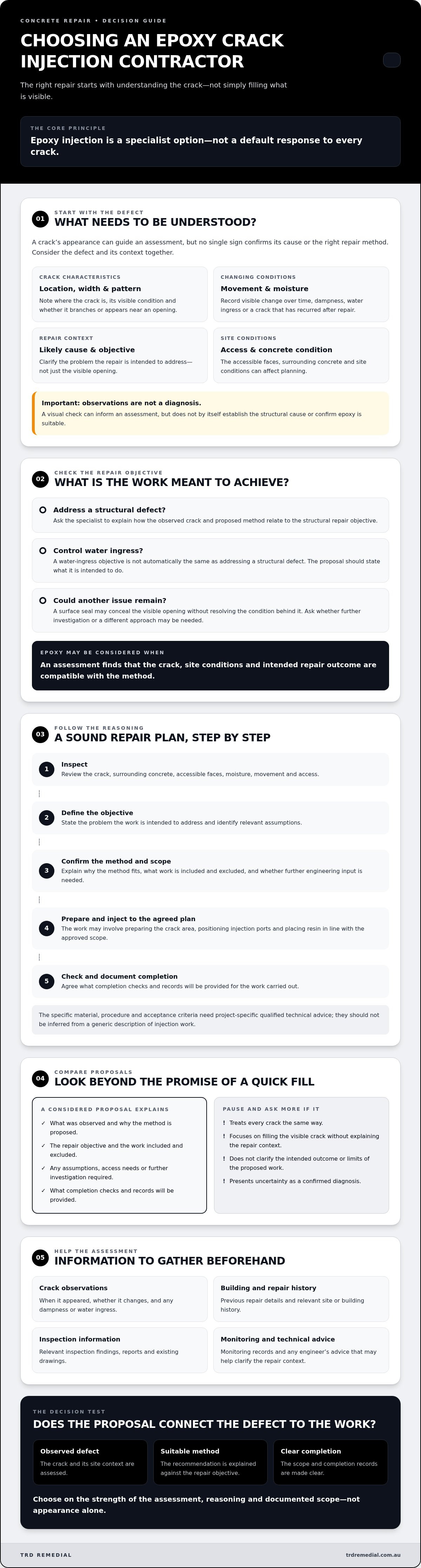
A sound repair plan follows a clear sequence: inspect the crack, define the repair objective, confirm the method, then prepare and inject in line with the agreed scope. Starting injection before establishing what the work needs to achieve can leave important questions about the defect and repair unresolved.
What should the contractor inspect before recommending epoxy?
Assessment should consider the crack’s location, visible condition and accessible faces, as well as the surrounding concrete. Access may affect how the work can be carried out. Moisture, signs of movement and the substrate condition also matter when planning. A visual inspection can inform an assessment, but it doesn’t by itself establish the structural cause or confirm that epoxy is suitable.
Ask what information could help clarify the repair context. Existing drawings, inspection reports, monitoring records and an engineer’s advice may be relevant, particularly if the crack has changed or the proposed work has a structural objective. A competent specialist should identify assumptions and explain where further engineering input is needed, rather than presenting uncertainty as a confirmed diagnosis.
How does the repair plan move from assessment to injection?
Once the objective and method are confirmed, the contractor should explain the planned preparation, access requirements and injection approach. At a high level, the work may involve preparing the crack area, positioning injection ports and placing resin in line with the approved repair scope. The specific material, procedure and acceptance criteria must be confirmed through qualified technical advice for the project. They shouldn’t be inferred from a generic description of injection work.
Before work begins, check that the proposal records what is included, what is excluded and whether engineering review or other verification is required. The American Concrete Institute’s Concrete Repair Guide offers broader context on selecting repair materials and methods. Project-specific decisions still need appropriate technical confirmation.
Completion checks should match the agreed scope. Ask what evidence will be provided, such as a record of the work completed and any verification steps specified for the project. Clear documentation helps builders, engineers, strata managers and owners understand what was done and what the repair was intended to achieve.
TRD Remedial undertakes epoxy and polyurethane crack injection as part of its concrete repair and structural remediation work. If you’re preparing a repair scope, you can discuss the crack injection requirements with a specialist contractor.
How to compare epoxy crack injection contractors
Compare the reasoning behind each recommendation, not just the quoted scope. Epoxy injection isn’t appropriate for every crack. A sound proposal should link the contractor’s observations to a clear repair objective and explain why the proposed method suits the situation. If it doesn’t, ask for clarification before comparing price or appointing a contractor.
| What to compare | What a clear proposal should explain |
|---|---|
| Diagnosis | What was observed, what remains uncertain and what supports the recommendation. |
| Proposed method | Why the method suits the stated repair objective and what could lead to a different recommendation. |
| Scope | The defined work area, preparation approach and work included. |
| Exclusions | Assumptions, work not included and any further investigation or engineering input required. |
| Completion records | What work records or agreed verification evidence will be provided at completion. |
Questions to ask before appointing an injection contractor
Use the discussion to test how well the proposed work fits the defect, rather than seeking a predetermined answer. Ask:
- What findings support the recommended injection method?
- What new information or site condition could change that recommendation?
- Who will arrange or provide any required engineering advice, approvals and coordination?
- What access, site controls or disruption should be planned for, and who is responsible for each?
Clear answers can reveal gaps before work starts. If a contractor can’t explain the link between the observed defect and the repair objective, ask for a more specific rationale.
What should a credible repair proposal explain?
Look for a defined work area, a description of the proposed preparation and a clear basis for the selected material and method. The proposal should state its limitations, assumptions and exclusions, along with any follow-up requirements. These details make it easier to distinguish scopes that use similar language but cover different work.
For wider context on how defects fit into a remedial response, read this structural defect repair guide. When comparing epoxy crack injection contractors, favour the proposal that makes its reasoning and evidence easiest to assess, not simply the one that promises a quick fill.
What to prepare before epoxy crack injection work begins
Good preparation gives the contractor a clearer picture of the defect and helps the project team plan around the building. Before appointing epoxy crack injection contractors, gather the information you have and identify who can answer questions about access, site coordination and building history. You don’t need to diagnose the crack yourself. Useful records and observations can help inform the assessment.
Information to share during the initial project discussion
Prepare a concise record of the building type, the crack’s location and what you’ve observed. Clear photographs can show its position and any visible changes over time. Include relevant details such as when the crack was first noticed, whether water ingress has occurred and whether earlier repair work was carried out.
Share available documents, including drawings, engineering advice, inspection findings and records of previous repairs. Identify the people involved in the project, such as the builder, engineer or strata manager, and confirm who should receive updates or provide information. This can reduce delays caused by missing records or uncertainty about who is coordinating decisions.
Planning access, coordination and repair records
Before work is scheduled, confirm how the contractor will access the repair area and whether the building is occupied or has other constraints. Discuss how the work area will be coordinated with residents, building users or other project activities, where relevant. Don’t assume a standard access or isolation plan applies. Access arrangements and safety controls depend on the site and agreed work method.
Agree in advance what completion information the contractor will provide and who will keep it. Depending on the scope, records may describe the work carried out, the repair area and any stated limitations or follow-up requirements. Keep this documentation with the building’s maintenance and defect records so it’s available for future inspections or repair planning.
Preparation checklist:
- Record the crack location, known history and any observed changes.
- Gather photographs, previous repair records, drawings and inspection documents.
- Confirm the relevant site contacts and project responsibilities.
- Discuss access, occupied-area constraints, work-area coordination and site controls.
- Agree how completed work and any limitations will be documented.
With this information organised, the discussion can focus on the defect, site conditions and required repair scope. Discuss a crack injection project with TRD Remedial.
Choosing a specialist contractor for epoxy crack injection
The right choice rests on more than the proposed injection work. Look for a contractor who can explain the crack assessment, link the recommended method to a defined repair objective, set out a clear scope and provide agreed completion records. Comparing epoxy crack injection contractors on these points helps you assess whether a proposal fits the defect, rather than simply comparing how much work each quote describes.
Epoxy injection is one specialist repair option, not a universal response to cracking. The crack’s condition, building context and intended outcome should inform the recommendation. If the proposal doesn’t explain its reasoning or identify where technical advice is needed, ask for clarification before proceeding.
When broader structural remediation expertise matters
Recurring, extensive or consequential cracking may warrant investigation beyond the visible crack. Wider concrete deterioration or other defects may affect the repair scope. A contractor’s ability to consider the defect in its building context can inform the discussion, while any required engineering assessment should be clearly identified.
Project coordination matters too. Builders, engineers and strata managers may need to share records, confirm responsibilities and align decisions before work begins. Where cracking appears alongside wider concrete deterioration, this concrete remediation guide offers further context.
A practical checklist for your final contractor decision
Before appointing a specialist, check that the proposal makes the following clear:
- Diagnosis: What was observed, what remains uncertain and whether further investigation or engineering input is required.
- Objective and method: What the repair is intended to achieve, why the method is proposed and what its limitations are.
- Scope and coordination: The work included, responsibilities, access arrangements and relevant site coordination.
- Completion records: What documentation or agreed verification evidence will be supplied when the work is complete.
Choose the proposal whose technical reasoning and defined scope best match the project requirements, not simply the one with the shortest description. TRD Remedial provides epoxy and polyurethane crack injection, alongside structural strengthening and concrete remediation. These services support a discussion focused on the defect and repair context, with the appropriate scope determined for the project.
To discuss your requirements, contact TRD Remedial about crack injection.
Make your next repair decision with confidence
A strong proposal explains the defect, states the repair objective and shows why the recommended method fits. Treat epoxy injection as a specialist option, not an automatic answer to every crack. When comparing epoxy crack injection contractors, look for a clear scope, transparent limitations and completion records that match the agreed work.
TRD Remedial provides epoxy and polyurethane crack injection alongside structural remediation and concrete repair services. The team works with builders, engineers and strata managers to help project stakeholders discuss the defect, site conditions and required repair scope.
Bring together the crack history, relevant records and your questions before starting a project discussion. A clear assessment is a practical first step towards an informed repair plan. Discuss your crack injection requirements with TRD Remedial.
Frequently Asked Questions
When is epoxy crack injection suitable for concrete?
Epoxy crack injection may be suitable when an assessment confirms the crack and repair objective are compatible with a rigid resin injection method. It’s commonly considered for stable cracks where the aim is to bond the concrete, but suitability depends on factors such as moisture, access, substrate condition and observed movement. Ask epoxy crack injection contractors to explain what supports their recommendation and what limitations apply. A crack’s appearance alone can’t confirm the right repair.
Can epoxy injection stop a crack from moving?
Epoxy injection may bond the faces of a suitable crack, but it doesn’t necessarily stop the forces or conditions causing movement. If movement continues, the crack may reopen or new cracking may develop nearby. The contractor or engineer should assess whether movement is present and establish the repair objective before recommending a method. Share any monitoring records or changes you’ve observed. Don’t treat injection as confirmation that the underlying cause has been resolved.
Is epoxy crack injection a waterproofing repair?
Not automatically. Injection may form part of a crack repair, but whether it addresses water ingress depends on the crack, site conditions, material and defined scope. A proposal should state whether the objective is structural repair, controlling water entry or another outcome. If water is actively entering, describe where and when it occurs and ask the contractor to explain why the proposed method suits those conditions. The visible crack alone doesn’t establish the source of moisture.
How do contractors assess a concrete crack before injection?
Contractors assess the crack’s location, visible pattern, accessible faces, surrounding concrete, moisture and any signs of change or movement. They may also ask for drawings, inspection reports, previous repair details and relevant engineering advice. A visual inspection can inform the assessment, but it doesn’t necessarily establish the crack’s structural cause. Provide photographs and building history where available, and ask the contractor to identify uncertainties or further technical input needed before confirming a repair method.
What should an epoxy crack injection contractor include in a proposal?
A useful proposal identifies the observed defect, intended repair objective, recommended method and the reasoning behind it. It should define the work area, preparation and material basis, along with assumptions, exclusions and limitations. Check who is responsible for any engineering input or approvals, what site access is required, and what completion records will be provided. The proposal should also flag follow-up or verification requirements, rather than implying that injection alone resolves every underlying condition.
How long does epoxy crack injection take to complete?
Completion time varies with the crack’s extent and access, preparation needs, site conditions and the agreed repair scope. Any required material curing or project-specific checks can also affect when work is considered complete. Ask the contractor to distinguish the time needed for on-site injection from any curing, verification or follow-up period. Request a schedule based on the assessed site and proposed method, rather than relying on a generic duration for all crack repairs.
Do I need an engineer before arranging crack injection?
Not every crack injection project will require the same level of engineering input, so confirm this for the specific defect and repair objective. If cracking is recurring, extensive, changing or potentially consequential, ask whether an engineer should assess it before the method is selected. The contractor should clarify what falls within their scope and who is responsible for arranging technical advice. If you already have engineering reports or drawings, share them during the initial project discussion.


