

What if a visible crack is only the symptom, not the real problem? In residential building defect rectification, repairing the surface without understanding the cause can leave movement, moisture or concrete deterioration unresolved. Damage may look minor while its source or structural significance remains unclear.
A sound repair starts with diagnosis. The findings help define the defect, identify what needs attention and establish whether the appropriate response is a targeted concrete repair, crack injection, water ingress remediation or structural strengthening. The right approach depends on the cause, the condition of the building and the outcome required.
This 2026 guide explains the steps from identifying a defect through investigation, scope development, repair and handover. It compares rectification approaches by purpose and practical considerations, and outlines the information that helps shape a suitable project scope. You’ll also see how specialist remediation, including concrete repairs and water ingress crack repairs, can address different defects without treating a cosmetic patch as a complete solution.
Key Takeaways
- Learn how a defect’s location, pattern and progression can help distinguish structural concerns from surface deterioration or water ingress.
- Use a structured investigation process to turn observations and available building records into a clearer repair scope.
- Compare concrete repairs, crack injection, water ingress remediation and structural strengthening by their purpose and verification needs.
- Understand how access, work zones, sequencing and resident communication can be planned throughout residential building defect rectification.
- See how TRD Remedial’s concrete repair and structural remediation services can support residential projects, from spalling repairs to strengthening.
Residential building defect rectification: what it addresses and why diagnosis matters
Residential building defect rectification is the investigation and repair of a building defect’s underlying cause and its effects. The aim is to address more than the visible mark or damaged finish. The appropriate response depends on what is happening within the building and which elements are affected.
Structural defects can involve elements that support or stabilise a building, such as concrete slabs, beams or walls. Other issues may involve water entering through a crack or joint, concrete deterioration, or damage limited to a surface finish. These categories can overlap. Water ingress, for example, may contribute to deterioration, while a crack may be confined to a finish or indicate movement that needs further assessment.
A crack, leak or spalled patch is evidence to investigate, not a diagnosis on its own. Its position, pattern, surrounding materials and history can help distinguish routine maintenance from a defect that warrants technical investigation. Renovation can improve damaged or outdated structures, but defect rectification focuses on identifying the specific mechanism and defining a repair that responds to it.
Which residential building defects may need specialist rectification?
Concrete spalling occurs when a section of concrete breaks away, sometimes exposing reinforcing steel. Cracking may appear in concrete, masonry or finishes. Water ingress can show as damp patches, staining or recurring moisture, while deterioration may include surface breakdown or materials losing their integrity. Each symptom can have several possible causes, so appearance alone can’t establish which repair is appropriate.
A minor finish issue may be suitable for routine maintenance if there’s no sign of an underlying defect. Recurring moisture, a crack that changes over time, or concrete loss that exposes reinforcement calls for closer assessment. The distinction matters: a surface treatment may improve appearance, but it won’t resolve an underlying structural or moisture-related cause.
Why treating the symptom alone can leave the problem unresolved
A repair may not last if the condition that caused the damage remains active. Patching a damp area without addressing the path of water entry, for instance, may leave the surface vulnerable to further damage. Similarly, filling a crack without understanding whether movement is continuing may conceal the opening while the cause persists.
Diagnosis connects observed damage with a suitable intervention. It helps establish whether the scope should focus on concrete repair, crack injection, water ingress remediation or structural strengthening, and what needs to be assessed after the work. Repair selection should follow diagnosis. This sequence helps ensure remedial work targets the defect mechanism and affected building element, rather than simply covering the evidence.
How residential building defects are investigated before repairs begin
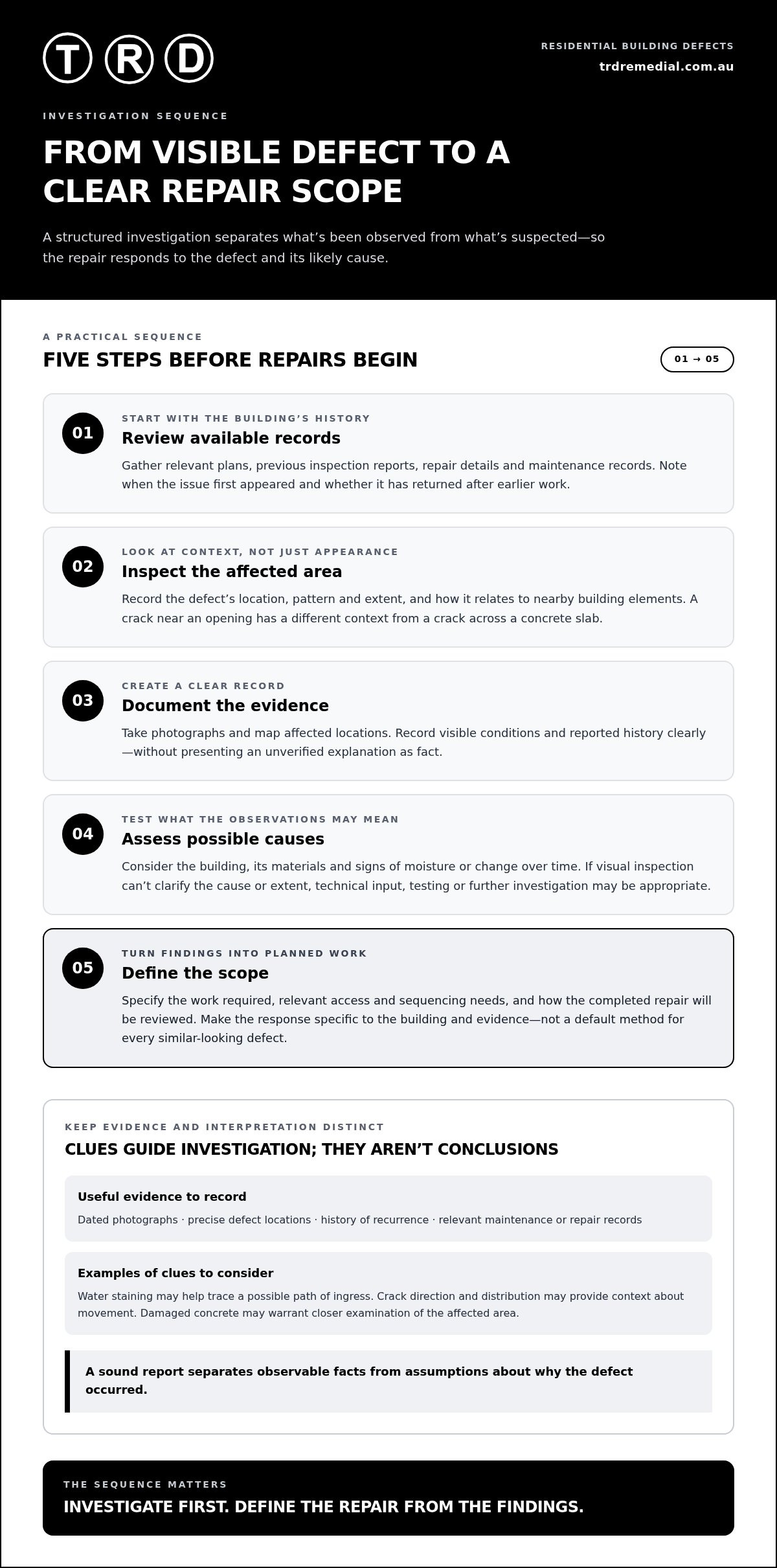
A clear investigation turns scattered observations into evidence that can guide a repair scope. For residential building defect rectification, the process should distinguish what has been observed from what is suspected, then identify whether further technical input is needed before work is specified.
A practical investigation sequence
- 1. Review available records. Gather relevant plans, previous inspection reports, repair details and maintenance records. Note when the issue first appeared and whether it has recurred after earlier work.
- 2. Inspect the affected area. Record the defect’s location, pattern and extent, and consider how it relates to nearby building elements. A crack near an opening, for example, has a different context from a crack across a concrete slab.
- 3. Document the evidence. Take photographs and map the affected locations. Record visible conditions and reported history clearly, without presenting an unverified explanation as fact.
- 4. Assess possible causes. Consider how the damage relates to the building, its materials and any signs of moisture or change over time. Technical input, testing or further investigation may be appropriate if visual inspection alone can’t clarify the cause or extent.
- 5. Define the scope. Use the findings to identify the work required, relevant access and sequencing needs, and how the completed repair will be reviewed. Make the response specific to the building and evidence rather than applying a default method to every similar-looking defect.
What evidence helps establish the defect’s cause?
Useful evidence includes dated photographs, precise defect locations, a history of recurrence and relevant maintenance or repair records. Water staining may help trace a possible path of ingress; crack direction and distribution may provide context about movement; damaged concrete may warrant closer examination of the affected area. These are clues, not conclusions. A sound report separates observable facts, such as the position and appearance of damage, from assumptions about why it occurred.
Turning findings into a coordinated scope
The building representative can provide records and coordinate access, while an engineer may assess technical implications and a remedial contractor can contribute to planning the repair work. Clear coordination helps align the findings with practical conditions, including occupied areas, work zones, resident access, safety and the order of tasks. If further investigation is needed, the scope can account for it before repair work proceeds.
For broader context on how technical assessment informs remedial work, read this structural defect repair guide. TRD Remedial works with builders, engineers and strata managers on residential diagnosis and repair, connecting observed defects with a considered remedial scope.
Comparing residential defect rectification methods by cause and purpose
Different defects need different interventions. Repairing damaged concrete may not stop water entry, while sealing a crack won’t necessarily address movement or a structural capacity issue. The right method depends on the assessed cause, the building element and the intended outcome, not simply on which repair looks most substantial.
| Method | Defect mechanism | Intervention purpose | Key considerations and verification |
|---|---|---|---|
| Concrete repair | Concrete is damaged, deteriorated or spalling. | Repair affected concrete and address the condition identified by assessment. | Establish the extent and cause of damage, then review the repaired area against the agreed scope. |
| Crack injection | A crack requires treatment based on its characteristics and the repair objective. | Inject a suitable material into the crack as part of the specified repair. | Consider the crack’s condition, the surrounding material and whether epoxy or polyurethane injection suits the project requirements. Verify the work against the defined repair criteria. |
| Water ingress remediation | Water is entering through a crack or another identified path. | Address the route of ingress, which may involve water ingress crack repairs. | Understand where water is entering and assess the relevant area after the repair using the agreed project checks. |
| Structural strengthening | Assessment identifies a structural capacity requirement. | Reinforce the affected element to meet the project’s specified structural needs. | Strengthening requires a defined structural objective and a suitable repair scope. Review the completed work against that scope. |
Choosing between concrete repair, injection and water ingress remediation
Concrete repairs address damaged or deteriorated concrete after assessment establishes the extent of the affected area. Injection is a different intervention: epoxy and polyurethane are distinct options, and selection depends on project conditions and the purpose of the repair. Where water ingress is involved, the scope needs to address the identified entry path rather than only the visible damp patch. For more detail, see the concrete remediation guide and concrete crack repair guide.
When structural strengthening may be required
Strengthening forms part of a rectification scope when assessment identifies a structural capacity requirement. Carbon fibre strengthening is one possible technique, not a default response to every crack or damaged surface. Its suitability depends on the structural objective and project-specific requirements. Read the carbon fibre strengthening guide for technique-specific information.
For residential building defect rectification, the most visible or extensive repair isn’t automatically the right one. TRD Remedial delivers concrete repairs, crack injection, water ingress remediation and structural strengthening, with the scope shaped by the defect and the building. Explore TRD Remedial’s remedial services to see how these approaches relate to residential repair work.
What a residential building defect rectification project involves
A well-managed residential building defect rectification project moves from an agreed scope to planned site work, repair, review and handover. This sequence gives owners, building representatives and the delivery team a shared understanding of what will be done, how the work will be managed and what records will be provided.
Planning rectification work in an occupied residential building
Before work begins, the scope is translated into practical site arrangements. In an occupied building, this may include coordinating access to affected homes or common areas, notifying residents about relevant work, defining work zones and agreeing how building representatives will communicate changes. The plan should reflect the repair requirements and site conditions.
Sequencing matters. Work areas may need to be isolated while repairs are carried out, and tasks can be organised to manage access and avoid unnecessary disruption where practicable. Safety arrangements, access constraints and the relationship between repair tasks all inform the plan. The scope and programme should be set for the specific project, based on the site and work required.
From agreed scope to handover
- Confirm the scope: Set out the locations, repair activities, responsibilities and any project-specific checks informed by the assessment.
- Prepare the site: Coordinate resident access, work zones, notices and the order of tasks with the building representative.
- Complete the rectification: Carry out the specified repair work, keeping relevant parties informed about progress or site conditions that affect the agreed approach.
- Review and hand over: Record completed work, relevant observations and checks required by the project scope, then provide clear close-out information to the relevant owners or managers.
For example, a repair affecting a shared area may require different access coordination from work inside an individual residence. The work plan should make clear which areas are affected and how residents will be kept informed. If site conditions differ from those anticipated, documenting the observation and agreeing on the response helps maintain a traceable project record.
Handover information helps owners and managers understand what was repaired and where. Depending on the project, records may include descriptions of completed work, photographs, relevant observations and the results of specified checks. The handover should accurately reflect the agreed scope and completed work.
TRD Remedial works with builders, engineers and strata managers to deliver residential structural remediation and concrete repair. Explore TRD Remedial’s rectification approach for support connecting an assessed defect with a coordinated repair scope.
How TRD Remedial approaches residential building defect rectification
Residential building defect rectification requires a repair scope that reflects the building and the defect, not a one-size-fits-all response. TRD Remedial delivers specialist structural remediation and concrete repair for residential buildings, working with builders, engineers and strata managers to connect diagnosis with practical remedial work.
Specialist services for different defect requirements
Where assessment identifies concrete deterioration or spalling, concrete repairs can address the affected area through a scope suited to the observed condition. For cracks, epoxy or polyurethane crack injection can be selected according to the project’s requirements. These options have different applications, and the appropriate approach depends on the defect and repair objective.
Water ingress crack repairs address issues where water is entering through a crack. Structural strengthening may form part of the scope where the identified defect calls for a structural intervention. Carbon fibre strengthening is one available technique, but it isn’t a default treatment for every crack or damaged surface. Diagnosis helps determine which service, or combination of work, fits the project.
From an observed defect to a defined remedial scope
A useful starting point is a clear record of what’s visible and known. Note the defect’s location, appearance and extent, and include photographs and any known history of recurrence or previous repairs. This information helps establish context for technical discussions, but it shouldn’t be treated as a diagnosis on its own.
TRD Remedial works alongside builders, engineers and strata managers to support diagnosis and deliver specialist remediation. For complex residential scopes, coordination helps align the assessed defect, selected repair and site requirements. The resulting scope can set out the work required for the affected building element without assuming that a visible symptom has only one possible cause.
Bring together the available records, photographs and repair history to help frame the project discussion. TRD Remedial can develop a repair approach around the defect and building conditions, with the scope based on assessment.
Discuss your residential defect rectification project with TRD Remedial.
Make the next repair decision with confidence
Effective residential building defect rectification starts with understanding the cause, not just covering visible damage. A structured investigation helps define the issue, record relevant evidence and establish a scope suited to the building. From there, the repair method can be selected for its purpose, whether that involves concrete repair, crack injection, water ingress remediation or structural strengthening.
Planning also matters. Clear coordination around access, work areas, sequencing and handover helps owners and building managers understand how the repair will proceed and what work has been completed.
TRD Remedial provides specialist structural remediation and concrete repair for residential buildings, working with builders, engineers and strata managers on diagnosis and repair. To discuss a defect and its rectification, contact TRD Remedial about your residential building defect rectification project.
With the right evidence and a defined scope, you can take a practical next step towards addressing the defect with confidence.
Frequently Asked Questions
What is residential building defect rectification?
Residential building defect rectification is the process of investigating a defect and repairing its cause and effects. It may involve assessing a crack, water ingress or deteriorated concrete, then defining work suited to the affected building element. The repair could include concrete repairs, crack injection or structural strengthening, depending on the findings. Diagnosis helps ensure the work addresses the identified condition rather than simply covering visible damage.
How do you know whether a building defect is structural?
You can’t reliably confirm a structural defect from appearance alone. The location, pattern, extent and progression of damage can provide useful clues, but a crack may affect only a finish or relate to a deeper issue. Record what you observe and any changes over time. Where damage involves a structural element or its significance is unclear, technical assessment can help establish its nature and inform the next step.
Can a building crack be repaired without fixing its cause?
Yes, a crack can be filled or covered without resolving what caused it, but the damage may recur if movement or moisture continues. The appropriate response depends on the crack’s characteristics, the surrounding material and the repair objective. Injection may be considered after assessment, while an ongoing source of water entry may require water ingress remediation. Repair selection should follow diagnosis, not the crack’s appearance alone.
What is the difference between concrete repair and structural strengthening?
Concrete repair addresses damaged or deteriorated concrete, such as a spalled area, according to the assessed condition. Structural strengthening is considered when assessment identifies a need to address the capacity of a structural element. The two interventions have different purposes, though they may both form part of a project scope. Strengthening methods, including carbon fibre strengthening, aren’t universal solutions and should be selected for the project’s structural requirements.
How long does residential building defect rectification take?
There’s no single timeframe for residential building defect rectification. Duration depends on the defect, the investigation required, the repair method, site access and how work can be sequenced, particularly in an occupied building. A clear scope and programme can be set once the project requirements and site conditions are understood. Further investigation or changes arising from site findings may also affect the work sequence or timeframe.
What information should I prepare before discussing a building defect?
Prepare the defect’s location, a description of its appearance and photographs showing the affected area. Note when it was first observed, whether it has changed or recurred, and any previous repairs or relevant maintenance records. If available, gather inspection reports or building information related to the area. Separate what you’ve directly observed from assumptions about the cause. This gives the project discussion a useful, evidence-based starting point.


