

What if the visible leak is nowhere near the point where water enters the façade? Water around an internal frame or finish can trace back to another part of the curtain wall, so patching the visible area may leave the source untreated. Curtain wall injection can address an identified water pathway, but the right repair depends on understanding how water is moving through the building envelope.
Persistent leaks can damage internal finishes and disrupt building use. Yet the cause is not always clear from the symptoms alone. This guide explains what curtain wall injection involves, when it may suit a defect, and how investigation can shape a practical remedial scope.
You’ll learn what to record, which findings can influence the repair approach, and what to consider when planning access and work around building operations. TRD Remedial works with builders, engineers and strata managers to investigate and address façade water ingress through an engineered remedial scope. The focus is on treating the identified problem, not just the place where water appears.
Key Takeaways
- Curtain wall injection targets an identified water pathway. The defect, substrate and site conditions help determine the treatment approach.
- Injection, joint or sealant repair, and broader envelope remediation suit different defect patterns and scopes.
- Recording where and when leaks occur, and whether they follow rain or other changing conditions, can help guide investigation.
- A clear repair sequence connects symptom records and assessment with scope definition, access planning, site works and review.
- TRD Remedial provides curtain wall injection and water ingress remediation through a project-specific approach.
Curtain Wall Injection: What It Is and What a Leak Can Reveal
Curtain wall injection is a remedial method for addressing water pathways associated with a curtain-wall assembly. It involves placing a suitable injection material into an identified pathway or treatment zone. The method and material depend on the defect and site conditions, so injection is not a universal fix for every façade leak. A curtain wall system forms part of a building’s external envelope, where components and connections work together to manage exposure to weather.
Dampness around a frame, joint or façade interface shows that moisture has reached the interior, but it doesn’t establish where water entered. Water can move through or along joints, interfaces or defects before becoming visible. It may also travel behind façade elements and emerge some distance from the entry point.
Water ingress symptoms show where moisture has appeared, but they don’t necessarily reveal the source of entry.
How water can travel through a curtain wall
The building envelope is the external boundary between indoor spaces and outdoor conditions. Internal paint, plasterboard and flooring sit behind it. Water that reaches these finishes may have passed through a gap or defect elsewhere, then travelled along a concealed route. A stain beneath a window, for example, doesn’t prove that the window joint is the entry point. The pattern is useful evidence, but it is not a diagnosis.
Record where dampness appears and when it occurs. Note whether it follows rain or other changing conditions, and whether it recurs near joints, frames or connections between façade elements. These details can help focus an investigation, although similar symptoms can result from different pathways.
When injection may be considered
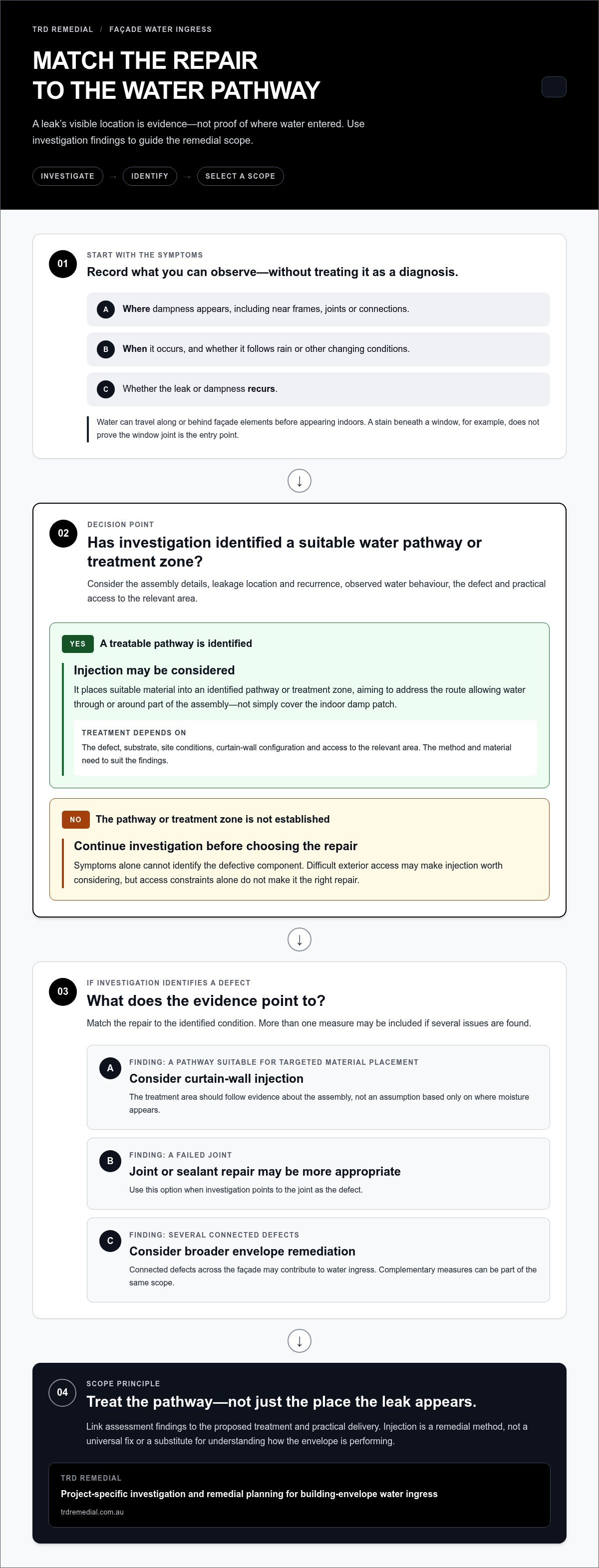
Injection may form part of a remedial scope when investigation identifies a suitable water pathway or treatment zone. Suitability depends on the curtain-wall configuration, the location and nature of the defect, access to the relevant area and the assessment findings. If the exterior surface is difficult to reach, injection may be worth considering, but access constraints alone don’t make it the right repair.
The next step is to connect the symptoms with the likely pathway and the condition of the façade. Depending on the findings, injection may be a targeted treatment or one part of broader joint or envelope remediation. Establishing the likely cause first helps avoid treating the visible dampness while leaving the water path unresolved.
How Curtain Wall Injection Addresses Water Ingress
When investigation identifies a likely water pathway or treatment zone, curtain wall injection may be used to place suitable material in that area. The aim is to address the route allowing water to pass through or around part of the assembly, rather than simply cover the damp patch visible indoors. The injection material and application method need to suit the substrate, the defect and the conditions at the site.
This matters because a curtain wall is one part of a connected building envelope system. A local defect can affect how water is managed across adjoining components and interfaces. Injection is a remedial method, not a substitute for understanding how the envelope is performing or why water is entering.
Effective injection depends on targeting the identified water pathway, not just treating the place where the leak becomes visible.
The role of diagnosis in selecting an injection approach
Inspection findings help establish where water may be entering, how it could be travelling and which area may need treatment. Assessment can consider the curtain-wall assembly details, the location and recurrence of leakage, observed water behaviour and practical access to the relevant zone. These findings inform the proposed scope and help match the repair to the defect.
For example, dampness near an internal frame may prompt investigation of the frame and nearby interfaces, but the symptom alone can’t identify the defective component. The treatment area should follow evidence about the assembly, rather than an assumption based only on where moisture appears.
Injection and other façade repair measures
Injection may suit an identified pathway that can be treated through targeted material placement. Joint or sealant repair may be more appropriate when investigation points to a failed joint. Broader envelope remediation may be considered if several connected defects contribute to water ingress. These approaches address different conditions, and complementary measures may form part of the same scope when more than one issue is found.
Material choice and application need to account for the substrate and defect, as well as access and the surrounding assembly. A sound treatment plan links the diagnostic findings to the proposed repair and its practical delivery, rather than assuming one method will suit every leak.
For related context on injection in a different remedial setting, read this concrete crack repair guide. The repair scope depends on the specific structure and defect. TRD Remedial’s curtain wall injection service connects investigation with project-specific treatment planning for building-envelope water ingress.
Curtain Wall Injection or Another Repair? Compare the Options
A recurring leak doesn’t automatically call for injection or the same repair detail each time. The right response depends on what investigation identifies: a treatable water pathway, a failed joint, or several related defects across the façade. Use this comparison to understand the options, then match the scope to the actual findings.
| Approach | Defect it may address | Investigation and scope considerations |
|---|---|---|
| Injection | An identified water pathway or treatment zone that can be treated through injection. | Findings need to establish the likely pathway and treatment area. The substrate, assembly details and access can influence the method and material selected. |
| Joint or sealant repair | A joint or interface where investigation indicates a defect in the connection or seal. | Assessment should distinguish the affected joint from nearby components and consider whether adjoining interfaces also contribute to water entry. |
| Broader envelope remediation | Multiple or connected defects affecting the way parts of the façade manage water. | The scope may need to address more than one pathway or component. It should be defined around the relationships between defects, not just the most visible symptom. |
When targeted injection may suit the identified defect
Curtain wall injection may suit a defect when investigation points to a treatable pathway or specific zone. Access, the substrate and the nature of the leakage all inform whether injection is suitable and how the work should be planned. A recurring leak alone doesn’t establish the material or treatment detail required. Those decisions should follow the evidence and conditions of the project, rather than a standard recipe for every façade.
When joints or wider envelope work may also matter
A failed joint and a pathway behind or beside it may call for different, or complementary, measures. If a repair addresses only one visible defect while a connected route remains untreated, water ingress may persist. A broader scope should also be based on findings, not assumed. The remedial plan should match the identified defects and how they relate to each other.
For wider context on assessing building issues and defining remedial work, see the structural defect repair guide. It explains why diagnosis should shape the repair scope, rather than choosing a method based on symptoms alone.
From Leak Investigation to Injection: The Remedial Work Sequence
A considered work sequence connects the observed leak to a practical repair scope. For curtain wall injection, the stages typically move from documenting symptoms to investigation, scope definition, access planning, remedial works and review. Each stage informs the next. If the water path remains uncertain, further investigation may be needed before treatment is specified.
What an effective assessment needs to establish
Start with a clear record of the problem. Note where water appears, when it occurs and any relevant weather or building operating conditions. Photographs and maintenance records can help show whether the issue is isolated or recurring. Treat these observations as useful information for assessment, not proof of a particular façade defect.
Assessment can then relate the symptoms to nearby joints, interfaces and available information about the curtain-wall assembly. Useful details include the affected components and any previous repairs. If the observations don’t establish a likely entry route, the investigation should identify what further information or examination is needed instead of assuming the visible leak marks the source.
Planning and carrying out remedial injection
When findings support a treatment approach, they help define the treatment area, work sequence and access requirements. Planning should account for the building’s use, safe access to the work zone and protection of occupants and surrounding areas. Builders, engineers, strata managers and other relevant project stakeholders can coordinate access and timing so remedial work fits operational needs and limits avoidable disruption.
During delivery, the scope should guide the work on site. Material and application details depend on the assembly, substrate, identified defect and site conditions, so they need to be determined for the project. After the work, review the treated area against the documented symptoms and agreed scope. If water ingress continues, those findings can guide the next assessment and help refine the investigation.
Check any standards or compliance statements against the applicable Australian requirements and project conditions before relying on them. This keeps repair documentation grounded in the work undertaken.
For a project-specific discussion of investigation, access and remedial scope, discuss curtain wall injection with TRD Remedial.
TRD Remedial’s Approach to Curtain Wall Injection
Persistent façade water ingress calls for a clear connection between investigation findings and the remedial work. TRD Remedial provides curtain wall injection and water ingress remediation. The project-specific scope starts with understanding the reported issue and relevant façade details, then planning work around the identified defect and site conditions.
This approach supports builders, engineers and strata managers coordinating remedial decisions with technical and building-operation requirements. It keeps the proposed scope grounded in the evidence, rather than assuming every leak needs the same treatment.
A project-specific remedial scope
The proposed work is shaped by the investigation findings, including the suspected water pathway, affected components and practical access to the treatment area. Where injection is appropriate, it can be planned as a targeted measure. If findings point to a joint or another related defect, water ingress or joint remediation may also form part of the scope. The measures depend on the project, because no single specification suits every curtain-wall assembly.
Connecting diagnosis, treatment planning and site delivery helps stakeholders understand what the work is intended to address and how it fits the building. TRD Remedial works with project teams to coordinate the remedial scope and its delivery, using the symptoms as a starting point for investigation rather than treating them as a complete diagnosis.
Prepare for a useful project discussion
A concise record can make early project conversations more productive. Note where water appears and whether the issue recurs. Record relevant conditions at the time, such as weather or building operations, and take dated photographs if practical. These details describe the symptoms without needing to identify the cause.
Gather any relevant façade or building information available, such as assembly details, maintenance records and notes about previous repairs. Include access constraints or operational considerations that may affect planning. This gives the project team a useful starting point for discussing investigation, scope and coordination.
To discuss your project, contact TRD Remedial about your curtain wall injection project and share the leak location, recurrence and conditions you’ve recorded.
Take the Next Step Towards a Targeted Façade Repair
Persistent water ingress needs more than a patch where moisture appears. Investigate the likely entry path, assess the curtain-wall assembly and shape the repair scope around the findings. Curtain wall injection may suit an identified pathway, while joint repairs or broader remediation may be needed for other defects.
TRD Remedial provides curtain wall injection and water ingress remediation, working with builders, engineers and strata managers on project-specific remedial solutions. Recording where and when leaks occur, along with relevant façade details and previous repairs, gives the project discussion a practical starting point.
For help assessing the issue and planning a remedial scope, discuss your curtain wall water ingress issue with TRD Remedial. Share the leak location, recurrence and any relevant building information to start a project discussion.
Frequently Asked Questions
What is curtain wall injection?
Curtain wall injection is a remedial technique for addressing identified water pathways associated with a curtain-wall assembly. Suitable material is introduced into a targeted area, with the approach shaped by the defect and site conditions. It is not a universal system for every façade. Investigation helps establish whether injection suits the suspected leak source, the assembly and the wider repair scope.
Can curtain wall injection stop a building leak?
It can address water ingress when investigation identifies a pathway suitable for injection. Whether it is the right method depends on the façade assembly, the location and nature of the defect, access and any contributing issues. A visible internal leak doesn’t establish where water entered. Diagnosis should guide the remedial scope and identify whether complementary measures, such as joint repairs, may also be relevant.
How does curtain wall injection work?
The reported water ingress is investigated to identify a suitable treatment area. Injection material is then applied to the targeted pathway or zone using an approach selected for the project conditions. Materials and methods can vary between façades. The objective is to address the diagnosed water path, rather than conceal an internal stain or damp area without resolving its cause.
Is curtain wall injection suitable for every façade leak?
No. Façade leaks can arise from different joints, interfaces or defects, and water may appear inside some distance from its entry point. Injection may suit a pathway that investigation identifies as treatable this way. A failed joint or multiple connected defects may call for another measure or a broader scope. The findings, not the appearance of the leak alone, should guide the repair approach.
What is the difference between curtain wall injection and sealant repair?
Injection targets a diagnosed pathway or zone within or behind an assembly. Sealant repair generally addresses a joint or interface at an accessible surface. The methods respond to different conditions, although a project may require both if investigation identifies separate or connected defects. The choice depends on the defect, assembly details and site conditions, not simply on where dampness appears indoors.
What information helps assess curtain wall water ingress?
Record where water appears, when it occurs and whether conditions such as rainfall or building use seem relevant. Photographs, available façade or building details, and notes about previous repairs can also provide useful context. These observations help frame an investigation but don’t prove the entry point. Together, they can help the project team assess the likely water pathway and plan a suitable remedial scope.
How long does curtain wall injection take?
There is no single timeframe for curtain wall injection. Duration depends on the investigation findings, treatment scope, access requirements and coordination with building operations. The work sequence may also include preparation and review. A project-specific assessment is needed to establish a suitable programme, so don’t assume every leak can be treated in one visit. Clear information about access and site conditions can help inform planning.


