

What if a crack that looks minor points to a problem that needs more than a surface repair? Cracking, spalling concrete and water ingress can result from a localised defect or a wider issue. Appearance alone won’t confirm the cause, which is why building remediation services should begin with careful investigation, not a prescribed fix.
If you’re responsible for a building, you want confidence that proposed work will address the underlying cause, not just conceal visible damage. The right approach depends on what’s affected, the extent of the defect and any structural risks that need assessment by the appropriate professionals.
This guide explains what specialist remediation can include, when further investigation may be needed and what a sound diagnosis and repair plan should cover. It also outlines how to compare contractors by their relevant experience, proposed methods and coordination with builders, engineers and strata managers, so you can assess your options more clearly.
Key Takeaways
- Learn what building remediation services can address, and why visible damage alone doesn’t identify the right repair.
- Understand the stages from recording a defect to investigation, repair planning and review, with the responsible engineer guiding technical requirements.
- Compare concrete repair, crack injection, strengthening and water-ingress work by the conditions they may suit, then confirm the method with a qualified professional.
- Plan for access, noise, dust, water management and work sequencing before remedial work begins on an occupied site.
- Use targeted questions about experience, scope, exclusions and coordination to assess whether a contractor is suited to your project.
What building remediation services cover and when a building needs them
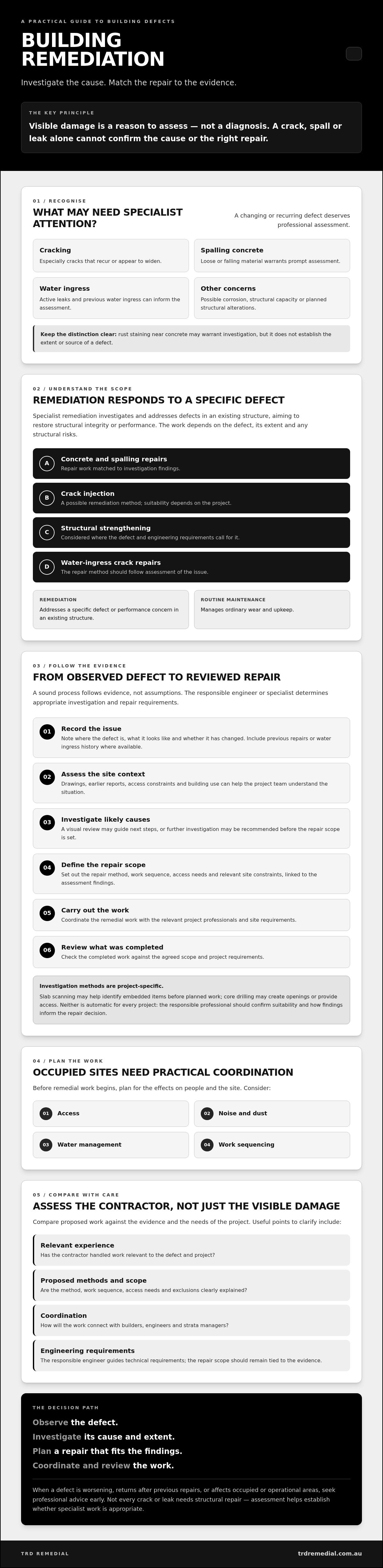
Building remediation is specialist work to investigate and address defects in an existing structure, with the aim of restoring its structural integrity or performance. Depending on the defect and scope, it can include concrete repairs, spalling repairs, crack injection, structural strengthening and water-ingress crack repairs. Routine maintenance generally manages ordinary wear and upkeep; remediation responds to a specific defect or performance concern. It’s also distinct from new construction, because the focus is on repairing or modifying what’s already there.
A visible symptom is a reason to assess, not a diagnosis. A crack, for example, doesn’t reveal its cause or whether it affects structural performance. Specialist building remediation services should be matched to investigation findings and, where required, input from the responsible engineer. Broader Disaster restoration services can involve recovering buildings after events such as water or fire damage, while structural remediation focuses on addressing defects in existing building elements.
Which building defects can require specialist remediation?
Common triggers include cracking, spalling concrete, water ingress, signs that may indicate corrosion, concerns about structural capacity and planned structural alterations. These conditions can have different causes, and appearance alone can’t confirm what work is needed. For instance, rust staining near concrete may warrant investigation, but it doesn’t establish the extent or source of a defect.
Pay attention to changes over time. Cracks that recur or appear to widen, active leaks, visible movement, or loose or falling material warrant prompt professional assessment. The observed symptom must be distinguished from its underlying cause before a repair method is selected. Not every crack or leak requires structural repair, but an assessment can establish whether specialist work is appropriate.
When should a property owner involve a remediation specialist?
Seek advice early if a defect is worsening, returns after previous repairs or affects occupied or operational areas. Early input can clarify whether further investigation or a specialist repair is needed, rather than leaving the decision to assumptions. This is particularly relevant before planned structural alterations, when the existing condition and proposed work need to be considered together by the appropriate project professionals.
Coordination matters. Builders, engineers and strata managers may each hold relevant information about the building, proposed works or site access. A specialist contractor can contribute technical remediation and repair expertise alongside these stakeholders, while the responsible engineer determines engineering requirements. This helps keep the repair scope tied to the evidence, not just the visible damage.
How building remediation moves from defect investigation to an engineered repair
A sound repair process follows evidence, not assumptions. Building remediation services typically move through a sequence: record the issue, assess site conditions, investigate likely causes, define the repair scope, carry out the work and review what was completed. The responsible engineer or specialist determines what investigation is appropriate and what repair requirements apply to the project.
What happens during a building defect assessment?
Assessment starts with the available information: where the defect is, what it looks like, whether it has changed, and any history of previous repairs or water ingress. Drawings, earlier reports, access constraints and the building’s use can also help the project team understand the context. A visual review may guide the next steps, or further investigation may be recommended before the repair scope is set.
Methods depend on the defect and project requirements. For example, slab scanning may help identify embedded items before planned work, while core drilling may be needed to create openings or provide access. These aren’t automatic steps for every project. The responsible professional should confirm whether they’re suitable and how the findings will inform the repair decision.
How is a remediation scope developed and checked?
Once the cause and extent of a defect are better understood, the scope can specify the repair method, work sequence, access needs and relevant site constraints. For example, a concrete repair scope should identify the affected area and explain how the repair relates to assessment findings, rather than simply calling for visible damage to be covered. The specification should respond to the diagnosed cause, not just the symptom.
The engineer sets or confirms the engineering requirements, while the builder and specialist contractor coordinate delivery, access and sequencing. Before work starts, clarify who is responsible for each decision, what is excluded and how unexpected conditions will be managed. After completion, the team can record the work carried out and undertake any checks agreed for the project. Confirm applicable technical standards and regulatory requirements with the qualified project professional.
For a specialist perspective on repair and technical concrete work, review TRD Remedial’s remediation capabilities.
How to compare building remediation methods without choosing by symptom alone
A crack, leak or area of damaged concrete doesn’t point automatically to one repair. Compare proposed building remediation services by asking what defect has been established, what the work is intended to achieve and what evidence supports the method. Moisture, movement, substrate condition and engineering requirements can all affect material and method selection.
| Defect context | Possible service category | Questions to confirm |
|---|---|---|
| Damaged or spalled concrete | Concrete repairs or spalling repairs | What condition is present beneath the visible damage, and what preparation and repair scope are specified? |
| A crack requiring treatment | Epoxy or polyurethane crack injection | Has the cause and movement behaviour been assessed? Why is this injection material appropriate for the location and conditions? |
| A structural capacity concern | Structural strengthening, potentially including carbon fibre strengthening | What performance requirement has the engineer identified, and how does the proposed strengthening address it? |
| Water entering through a building element | Water-ingress crack repairs or other relevant remedial work | Has the water pathway been traced, and will the proposed work address the source as well as the affected area? |
When might concrete repair, crack injection or strengthening be considered?
These are distinct interventions, not interchangeable fixes. Concrete repair addresses a damaged concrete element; crack injection treats a crack according to its assessed condition and requirements; strengthening is considered when the structure needs additional capacity or reinforcement. The engineer or specialist should match the approach to the cause, substrate condition, movement, moisture exposure and required performance. For more detail, read this concrete remediation guide, concrete crack repair guidance or information on carbon fibre strengthening.
How should water ingress and structural alterations be assessed?
Water can travel from its entry point, so treating only the damp or damaged area may leave the pathway unresolved. Investigate the affected building element and conditions before selecting water-ingress work. Where moisture is associated with mould, the remediation plan should account for the source of moisture, affected materials and suitable work-area controls. Confirm the appropriate approach with the project professionals responsible for the site.
Before cutting or modifying a structural element, confirm the proposed work with the responsible engineer and check whether scanning is required to locate embedded items or post-tensioning. See this slab scanning guidance for more context. The project professional should confirm the method and requirements for the specific structure.
What to plan before building remediation work begins on an occupied site
Remedial work in an occupied building needs more than a technical scope. Access routes, work sequencing, noise, dust, water management and nearby occupants can all affect how the job is delivered. Arrangements depend on the site, repair method and applicable requirements, so confirm them with the relevant project professionals before work starts.
Plan access early so the team can organise work around building operations and identify constraints before they affect the programme.
What information helps contractors plan a remedial project?
Give the contractor relevant information early, including defect photographs, engineering reports, available drawings, access limitations and known repair history. These details help the team prepare questions and identify potential constraints, but they don’t replace an inspection or engineering advice.
Agree who is responsible for practical arrangements. For example, clarify who controls site access, any required permits or isolations, and communications such as resident notices. Responsibilities may sit with different parties, so make ownership clear rather than assuming the contractor or building manager will handle every item.
How can work be coordinated in an active building?
Discuss whether work can be staged around occupants, business operations and other contractors. A noisy or dusty task near an occupied area may need different timing or separation from work in an isolated zone. The contractor and building manager should also agree site-specific safety and containment controls, including how affected areas will be managed and how water from the work will be controlled.
Before work begins, establish how the team will communicate progress, access changes and emerging issues. The client or building representative, engineer, builder and specialist contractor should understand their respective roles. Building remediation services may uncover conditions that weren’t visible at the outset, so agree how these will be assessed, who can approve changes and how scope revisions will be documented before additional work proceeds.
- Access: Confirm entry routes, work areas and any restrictions on moving equipment or materials.
- Sequencing: Identify dependencies with other trades and areas that must remain operational.
- Site controls: Agree how noise, dust, water and access to affected areas will be managed.
- Changes: Set a clear process for recording unexpected conditions and confirming any revised scope.
For technically complex work, coordinated planning helps align site constraints with the repair scope. Discuss remedial project requirements with TRD Remedial as part of your contractor assessment.
How to choose a building remediation services contractor and take the next step
A contractor’s service list is only a starting point. For technically complex work, assess whether their relevant experience, proposed scope and site planning match the defect and project requirements. A clear proposal should explain what work is included, what is excluded, how responsibilities are divided and how the contractor will coordinate with the engineer and other project professionals.
What questions should you ask a remediation contractor?
Use these questions to compare proposals and clarify how the work will be managed:
- Investigation: How does the proposed work relate to the identified defect and available assessment findings? Is further investigation required before the scope can be confirmed?
- Experience: What comparable remedial work has the contractor completed, and what was their role?
- Scope and exclusions: Which areas and tasks are included? What assumptions, exclusions or dependencies could affect delivery?
- Coordination: Who will liaise with the engineer, building manager and other contractors about technical input, access and work sequencing?
- Safety and site planning: What site-specific controls are proposed, and who needs to agree or manage them?
- Unexpected conditions: How will new findings be assessed, documented and approved if the work differs from the agreed scope?
Look for answers specific to your building, not broad assurances. The contractor should explain the proposed method in plain language and identify decisions that remain subject to engineering input or site inspection.
How can TRD Remedial support a specialist remediation scope?
TRD Remedial works with builders, engineers and strata managers on residential, commercial and industrial remedial projects. Its relevant capabilities include concrete repairs and spalling repairs, epoxy and polyurethane crack injection, structural and carbon fibre strengthening, slab scanning, core drilling, concrete cutting, controlled demolition and water-ingress remediation. The appropriate service depends on the project assessment; not every scope requires every capability, and the contractor doesn’t replace the responsible project engineer.
Before shortlisting, prepare a concise brief with the defect location, available reports or drawings, access constraints and the outcome you’re seeking. Use it to discuss what is known, what needs confirmation and how the proposed work could be coordinated.
If you’re assessing a remedial scope, discuss your remediation project with TRD Remedial to explore the relevant technical work and information needed for the next step.
Make your next remediation decision with confidence
Visible damage is a reason to investigate, not a repair specification. Start by understanding the defect and its cause, then match the work to engineering requirements and the building’s site conditions. A clear scope should also set out access, sequencing, responsibilities and how unexpected findings will be handled.
Choosing a contractor means looking beyond a broad service list. Check relevant technical experience, ask how the proposed method relates to assessment findings, and clarify exclusions and coordination with project professionals. This helps you assess whether building remediation services suit your asset and the issue at hand.
TRD Remedial works with builders, engineers and strata managers on residential, commercial and industrial projects across Australia. Its specialist capabilities include concrete repairs, crack injection and structural strengthening, with the appropriate work determined by project requirements.
If you’re considering remedial work, discuss your building remediation requirements with TRD Remedial. Share the defect details and available project information to identify a practical next step.
Frequently Asked Questions
What do building remediation services include?
Building remediation services include specialist work to address defects in existing structures and restore their performance. Depending on assessment findings, this may involve concrete repairs, spalling repairs, epoxy or polyurethane crack injection, structural or carbon fibre strengthening, and water-ingress crack repairs. Technical work such as slab scanning or core drilling may also support a scope. The appropriate services depend on the defect, site conditions and requirements established by the responsible project professionals.
When should I contact a building remediation contractor?
Contact a remediation contractor for advice if a defect is recurring, worsening or affecting an occupied or operational area. Active leaks, apparent movement, or loose or falling material warrant prompt professional assessment. Consider specialist input before planned structural alterations, too. These signs don’t confirm the cause or mean structural repair is always needed, but timely assessment can help determine whether further investigation or a specific remedial scope is appropriate.
How is the right building remediation method selected?
Select the right method by assessing the defect and its cause, then matching the intervention to the building element and required performance. The project professional may consider movement, moisture, substrate condition, available drawings and site constraints. Concrete repair, crack injection and strengthening address different needs, so they aren’t interchangeable. The responsible engineer or specialist should confirm whether further investigation is required and set or review the technical repair requirements.
Can building remediation work be completed while a building is occupied?
It may be possible, depending on the repair scope, site conditions and how work affects occupants and operations. Before starting, the project team should plan access, sequencing, noise, dust, water management and controls around affected areas. The client or building manager, engineer and contractor should agree responsibilities and communication arrangements. Some activities may require restricted access or staged work, so confirm the practical approach for your site rather than assuming disruption can be avoided.
What is the difference between building remediation and routine maintenance?
Routine maintenance generally covers planned upkeep and ordinary wear, such as keeping building elements serviceable. Remediation is specialist work directed at an identified defect or performance concern, with the aim of repairing or strengthening the affected structure or element. The distinction depends on the work required, not just the visible symptom. Assessment helps establish whether a concern calls for routine attention, further investigation or a defined remedial repair.
How do I compare building remediation contractors?
Compare contractors by their relevant experience with the defect type and building context, then review the detail of their proposed scope. Ask what findings support the method, what work is excluded, what assumptions affect access or sequencing, and how safety planning and engineering input will be coordinated. Clarify how unexpected conditions and scope changes will be documented and approved. A technically capable contractor should explain the proposed approach clearly and identify what still needs confirmation.
Does every concrete crack need injection or structural repair?
No. A crack’s appearance alone doesn’t establish its cause, whether it’s changing or whether it affects structural performance. Some cracks may not require injection or structural repair, while others need further investigation. Note the crack’s location and any visible change, and seek professional assessment if it appears to widen, recurs after repair or occurs alongside movement or water ingress. The appropriate engineer or specialist can determine whether repair is needed and which method suits the findings.


