

Strata Structural Repairs: A Guide for Owners Corporations
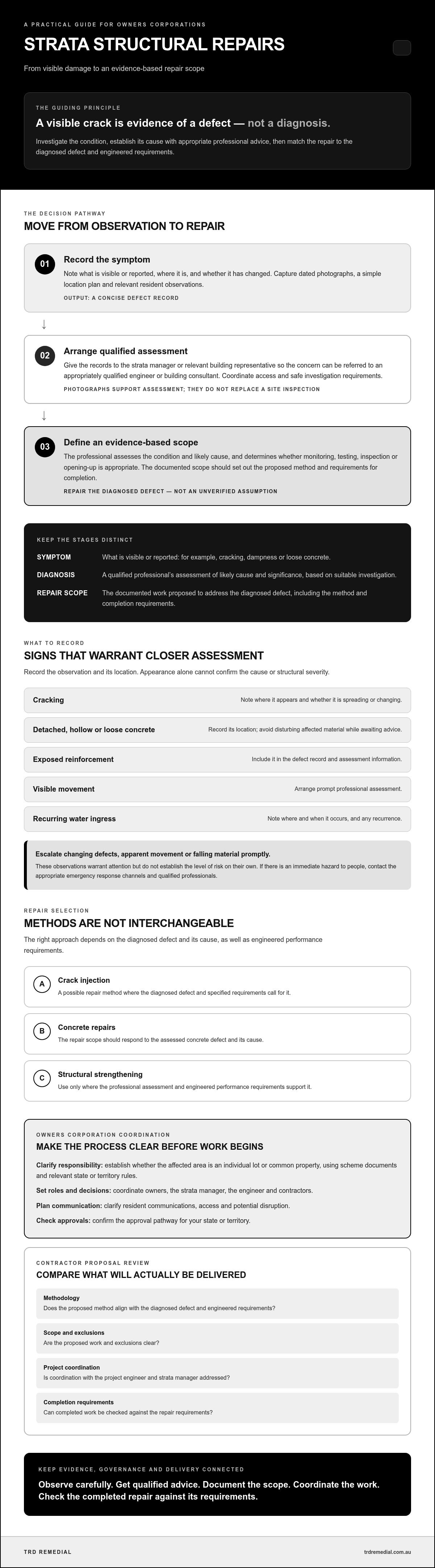
A visible crack is evidence of a defect, not a diagnosis. For an owners corporation, the challenge is to determine whether it signals a structural concern, what action is needed and how to coordinate a safe, durable repair. A considered approach to structural repair for strata starts with reliable evidence, not assumptions.
It’s understandable to be concerned about urgency, disruption and the cost of getting the work wrong. Owners, strata managers, engineers and contractors may each have a role. Decisions are easier to manage when responsibilities, technical advice and records are clear.
This guide explains how to assess a suspected defect, establish its priority with appropriate professional advice and coordinate next steps through the owners corporation. It also covers how to compare remedial contractor proposals, plan for disruption and check that completed work meets the repair requirements. From crack injection and spalling repairs to structural strengthening, the right method depends on the defect and its cause. Evidence, governance and engineered delivery need to stay connected throughout.
Key Takeaways
- For structural repair for strata, treat visible damage as a reason to investigate, not proof of the underlying cause or severity.
- Record symptoms and arrange a qualified assessment so the repair scope is based on evidence and professional advice.
- Match the repair method to the diagnosed defect and engineered performance requirements. Crack injection, concrete repairs and strengthening aren’t interchangeable.
- Clarify roles, decisions and resident communications before work begins, and check the approval pathway for your state or territory.
- Compare contractor proposals for methodology, scope, exclusions and coordination with the project engineer and strata manager.
Structural repair for strata: recognise the issue and establish its priority
Structural repair for strata addresses a defect or impaired structural performance in shared property. Start by identifying what has been observed and where it is located. In a strata scheme, it matters whether an affected area is an individual lot or common property. The strata title system provides a general overview, but the scheme’s documents and relevant state or territory rules should guide decisions about a specific area.
A crack, damp patch or piece of loose concrete is a symptom, not a confirmed explanation. Similar signs can have different causes, and appearance alone can’t establish structural severity. Record the exact location, approximate extent, nearby moisture or exposed reinforcement, and whether the condition has changed. Dated photographs and a simple location plan help an engineer or building consultant assess the issue and monitor changes.
Which signs should prompt a closer structural assessment?
Record cracking, concrete that appears detached or hollow, exposed reinforcement, visible movement and recurring water ingress. Note where and when each sign appears, whether it is spreading or recurring, and any relevant observations from residents. Don’t assume a crack has one particular cause or that a surface symptom reveals the condition beneath it. Consistent records give a qualified professional a clearer starting point.
When should a strata scheme escalate a concern?
Arrange prompt professional assessment if there is apparent movement, falling material or a defect that is changing. These observations warrant attention, but they don’t establish the level of risk on their own. Photographs can support an assessment, but they can’t replace a site inspection or justify a remote diagnosis. If there’s an immediate hazard to people, contact the appropriate emergency response channels and qualified professionals rather than relying on an online opinion.
Keep the initial response measured and documented. Pass the location plan, dated images and notes to the strata manager or relevant building representative so the concern can be referred to an appropriately qualified professional. Avoid disturbing affected material while waiting for advice, and follow professional direction about access or other precautions.
Three terms to distinguish
- Symptom: What’s visible or reported, such as cracking, dampness or loose concrete.
- Defect diagnosis: A qualified professional’s assessment of the likely cause and significance, based on suitable investigation.
- Repair scope: The documented work proposed to address the diagnosed defect, including the method and requirements for completion.
Separating these stages helps the owners corporation avoid turning an unverified assumption into a repair brief. The next step is to use the recorded observations to support an evidence-based assessment.
How investigation turns a strata defect into a repairable scope
A useful repair scope follows a clear chain of evidence. The strata manager can organise records and access, while an appropriately qualified engineer or building consultant assesses the condition, investigates likely causes and identifies any further work needed. The Strata Defects Rectification Guide also outlines a structured approach to identifying, documenting and rectifying building faults.
Use this sequence to move from an initial report to a scope that contractors can price and deliver against:
- 1. Record symptoms. Gather dated photographs, a location plan, resident reports and available records of previous repairs. Output: a concise defect record.
- 2. Arrange qualified assessment. Provide the records and coordinate access for the engineer or building consultant. Output: an assessment plan that considers access, occupancy and safe investigation requirements.
- 3. Establish the cause. The professional assesses affected elements and observed conditions, then determines whether inspection, monitoring, testing or opening-up is appropriate. Output: findings that distinguish confirmed observations from assumptions and identify information still needed.
- 4. Define the repair scope. Translate the findings and performance requirements into documented work, including relevant constraints and interfaces. Output: a scope the owners corporation can use to compare proposals.
- 5. Document decisions. Keep the assessment, recommendations, approvals and scope together in the project record. Output: a traceable basis for the next decision.
What should a structural assessment establish?
The assessment should identify the affected elements, describe their observed condition, consider the likely cause and state whether further investigation is required. The engineer or building consultant determines whether testing, opening-up or monitoring is suitable for the specific issue. Records should separate site observations and confirmed findings from assumptions, limitations and recommendations. This prevents an early possibility from being treated as a proven cause.
How do testing and scanning support repair planning?
Investigation planning needs to account for occupied areas, access limitations, possible water sources and previous repairs that may conceal or alter evidence. Slab scanning can help locate embedded services or reinforcement before intrusive work is considered. Core drilling or concrete testing should only proceed when specified by the project team. For more on the role of scanning, see this slab scanning guide.
A well-defined scope gives the owners corporation a sound basis for selecting a contractor. If the project team identifies relevant remedial work, it can review concrete repair and structural strengthening capabilities as part of that process.
Compare structural repair options by cause, performance and disruption
The repair method should follow the diagnosed cause and the project engineer’s performance requirements, not simply the visible finish or the lowest-priced proposal. Crack injection, concrete repairs and structural strengthening address different conditions. They aren’t interchangeable, and selecting the wrong method may leave the underlying issue unresolved.
Use the comparison below to frame discussions with the engineer and remedial contractor. These are possible approaches, not a diagnosis or prescribed solution. Suitability depends on project-specific assessment, design and existing building conditions.
| Defect context | Potential method | Professional input | Disruption to consider |
|---|---|---|---|
| Assessed concrete deterioration, including spalling or exposed reinforcement | Concrete repairs or spalling repairs | Engineer to define the extent of repair and required performance | Access, noise, dust and temporary restrictions around the work area may need planning |
| A crack assessed as suitable for injection | Crack injection, with material and method selected for the specified purpose | Project engineer to confirm the crack’s cause, treatment objective and suitability | Access to the affected surface and any preparation or curing requirements may affect residents |
| Assessment identifies a structural capacity or performance requirement | Structural strengthening, potentially including carbon fibre strengthening | Engineer to specify the design and confirm the method is suitable for the element | Work zones, access and coordination with occupied areas depend on the design and site conditions |
When might concrete repair or crack injection be considered?
Spalling repairs may be considered where assessment identifies concrete deterioration, including exposed reinforcement. Crack injection is a separate approach. The project engineer should specify its intended application and whether epoxy or polyurethane injection is appropriate. Material choice should reflect the assessed condition and repair objective, not a general rule based on how a crack looks. For broader context, read this concrete remediation guide.
When might structural strengthening be part of the scope?
Strengthening may be considered when the assessment identifies a capacity or performance requirement that the repair scope needs to address. Carbon fibre strengthening is one capability offered by TRD Remedial, but its suitability depends on engineering design and the existing structure. The carbon fibre strengthening guide provides method-specific detail.
For the owners corporation, compare proposals against the engineer’s scope and ask contractors to identify assumptions, exclusions, access needs and resident impacts. This makes differences between proposed methods easier to evaluate and helps keep the selected structural repair for strata aligned with project requirements.
Coordinate strata approvals, residents and works before repairs begin
A well-managed structural repair for strata depends on clear decisions and practical coordination, as well as a technically sound scope. Before work starts, map who will organise information, review technical details, communicate with residents and make or record decisions. Roles and approval pathways vary, so check the requirements that apply to the scheme’s state or territory rather than assuming one process fits every building.
- Strata manager: Coordinate records, meeting processes, resident communications and access arrangements in line with the scheme’s procedures.
- Committee and owners corporation: Consider the assessment, options and proposed scope, then document decisions and delegated actions through the applicable process.
- Engineer or building consultant: Provide technical advice, clarify repair requirements and identify what evidence should be reviewed during and after the work.
- Remedial contractor: Explain the proposed methodology, site requirements, programme and coordination needs, and work with the project team on delivery.
This is a practical coordination map, not a statement of universal legal duties. Confirm the approval pathway and any statutory requirements for the relevant state or territory before the owners corporation commits to a scope.
What should the committee confirm before approving a scope?
Check that the proposed work aligns with qualified technical advice and that the scope identifies exclusions, assumptions and unresolved conditions. Establish who will review the contractor’s methodology, site controls, programme and completion evidence. If the proposal differs from the engineer’s recommendations, ask for the difference and its technical basis to be clarified before recording a decision.
Keep a concise decision record: assessment findings, options considered, the selected scope, reasons for the decision and who is authorised to take each next step. This provides a clear reference if the scope or site conditions change.
How can strata managers reduce disruption during remedial works?
Plan logistics with the project team before residents are affected. Confirm access routes, work-area boundaries, parking arrangements, noise expectations and any temporary restrictions required for the specific job. Identify occupied areas and building services that may affect sequencing or access, and agree with the relevant professionals how those constraints will be managed.
Set out what residents need to know, when updates will be issued and who will receive enquiries. Agree how changed conditions, access issues or delays will be escalated, and keep notices and updates on file. Clear communication won’t remove every inconvenience, but it helps residents understand what to expect and gives the project team a consistent way to respond.
TRD Remedial’s information on structural repair requirements can be considered alongside the project engineer’s scope and the strata manager’s coordination plan.
Select a structural repair contractor and verify the completed work
A suitable contractor should be able to explain how its proposal responds to the documented scope, rather than offering a method based only on a brief description or photograph. Compare proposals against the same technical requirements and clarify differences before appointment. Relevant remedial experience matters, particularly when work needs to be coordinated with an engineer, strata manager and residents in an occupied building.
What should a strata repair proposal make clear?
Look for a defined work area, preparation requirements, proposed repair methods, access assumptions and explicit exclusions. The proposal should also describe relevant site controls, quality checks and communication responsibilities. Ask each tenderer to identify assumptions that could affect the scope, such as concealed conditions or access limitations. If proposals omit essential details or use different assumptions, request clarification before comparing them.
Check how the contractor will work with the project engineer and strata manager. Agree who reviews the methodology, how inspection points will be arranged and what records will be provided as work progresses. These details help the owners corporation assess whether a proposal aligns with the intended repair, rather than relying on price or a broad description of services alone.
What evidence should the strata scheme retain after repairs?
Before work begins, confirm with the project team what completion evidence is required and who will review it. Depending on the scope, the handover may include inspection findings, records of completed work and relevant product or methodology information. Document outstanding items, maintenance recommendations and responsibility for follow-up. Keep these records with the assessment, approved scope and project decisions so future building reviews have a traceable reference.
TRD Remedial is an Australian specialist contractor with capabilities including concrete repairs, spalling repairs, crack injection and structural strengthening. These are potential delivery options, not a substitute for project-specific assessment or engineering design. The selected method should remain consistent with the engineer’s requirements and the conditions found at the building.
A disciplined close-out matters. If conditions change during the work, ask the contractor and project engineer to record the issue, its effect on the scope and any agreed response before proceeding on a changed basis. The owners corporation can then retain a clear record of what was specified, completed and handed over.
For specialist structural remediation or concrete repair, contact TRD Remedial.
Move from defect report to a coordinated repair
A reliable structural repair for strata begins with evidence: record what’s visible, seek qualified assessment and use the findings to define a clear repair scope. The method should address the diagnosed cause and meet the project engineer’s requirements, while the owners corporation coordinates approvals, resident communication and site access.
Choose a remedial contractor whose proposal explains its methodology, exclusions, quality checks and approach to working with the project team. Keep decisions and completion records together so the owners corporation can track what was recommended, approved and carried out.
TRD Remedial provides specialist structural remediation and concrete repair services and works with strata managers, builders and engineers. With clear evidence, defined roles and technically appropriate delivery, your owners corporation can move from a defect report to a coordinated repair.
Discuss your structural repair requirements with TRD Remedial.
Frequently Asked Questions
What does structural repair for strata include?
Structural repair for strata includes work to address a defect or impaired structural performance in shared property. Depending on professional assessment and the repair design, it may involve concrete repairs, spalling repairs, crack injection or structural strengthening. These methods address different conditions, so the right scope depends on the diagnosed cause, the engineer’s requirements and the building’s existing condition. It should not be selected on appearance alone.
Who is responsible for structural repairs in a strata building?
For a defect affecting common property, the owners corporation will generally coordinate decisions about investigation and repairs, with the strata manager helping administer the process. Responsibility can depend on where the affected element sits, the scheme’s strata plan and applicable state or territory rules. Check the scheme documents and obtain appropriate advice before deciding who must act or fund the work. Avoid assuming a shared wall or slab is automatically common property.
How do you know if a crack in a strata building is structural?
You can’t reliably determine whether a crack is structural from its appearance or a photograph alone. Cracking may have different causes, and its position, pattern, surrounding materials and changes over time all provide relevant context. Record its location and extent, take dated photographs and note any movement or recurrence. A qualified engineer or building consultant can assess the evidence and advise whether further investigation is needed.
Can residents stay in a building during structural repairs?
Residents may be able to remain, but this depends on the assessed condition, repair method, work area, access needs and any safety controls specified for the project. Some work may require temporary restrictions or changes to access; the project team should explain these before work begins. The owners corporation and strata manager can coordinate notices and arrangements. Don’t assume a building is safe to occupy, or must be vacated, based on photos alone.
How does an owners corporation compare structural repair quotes?
Compare proposals against the same documented scope, not price alone. Check that each defines work areas, preparation, repair methodology, access assumptions, exclusions, quality checks and expected completion records. Ask how the contractor will coordinate with the project engineer and strata manager, and clarify omissions or differing assumptions before comparing. A proposal should respond to the engineer’s requirements. If the methods differ, seek technical clarification before the owners corporation selects one.
Do strata structural repairs need an engineer?
Many structural repair projects need input from an appropriately qualified engineer to assess the defect, identify further investigation and specify performance requirements. The extent of advice depends on the condition and proposed work. The engineer can also help clarify inspection points and the evidence needed at completion. Confirm project-specific requirements with relevant professionals, and check any approval or statutory requirements that apply in the scheme’s state or territory.
How long do structural repairs in strata take?
There’s no reliable standard duration for strata structural repairs. Timing depends on the defect, investigation and design needs, access, resident occupancy, work scope, site conditions and coordination with the project team. Ask contractors to state their programme assumptions, dependencies and how changed conditions or delays will be communicated. The owners corporation should also allow time for assessment, decisions and approvals under the applicable scheme process, rather than treating construction duration as the full project timeline.
What records should strata keep after structural repairs?
Keep the assessment and repair scope, owners corporation decisions, contractor proposal, relevant methodology and product information, inspection findings, completion records and handover documents. Record any outstanding items, maintenance recommendations and who is responsible for follow-up. Store these with dated photographs and project communications so future managers, engineers or contractors can understand what was identified, approved and completed. Confirm with the project team which records apply to the specific repair.


