

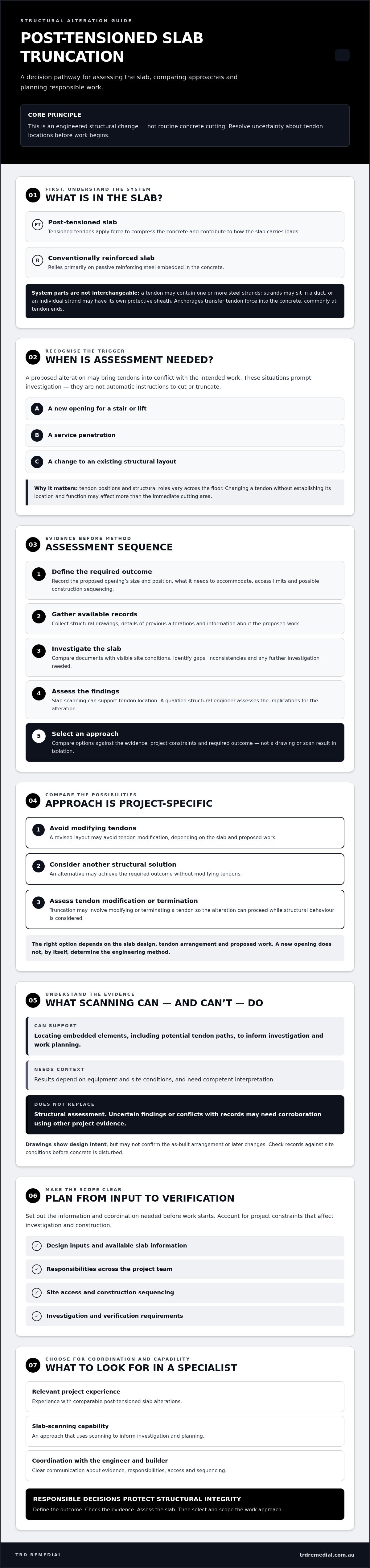
Post-tensioned slab truncation is an engineered structural change, not a cutting task. Choosing between post tensioned slab truncation techniques depends on where the tendons run, how the slab behaves and what the proposed opening or alteration will do to the structure. Cutting in the wrong place can create serious risks, so uncertainty about tendon locations must be resolved before work begins.
Before comparing methods or contractors, establish what the alteration needs to achieve and what is known about the slab. This guide explains the main approaches and trade-offs, the investigation and engineering inputs that should inform a responsible scope, and the capabilities to look for in a specialist. It also explains how reviewing records and scanning the slab can help identify tendon locations before concrete is cut. TRD Remedial provides slab scanning, post-tension truncation and related concrete works for structural alteration projects, working with builders, engineers and strata managers. The focus is informed decision-making, coordinated work and protecting the integrity of the structure.
Key Takeaways
- Recognise when an opening or structural alteration needs an engineered truncation plan, rather than treating it as routine concrete cutting.
- Use records, site investigation and structural assessment to inform decisions before selecting a work approach.
- Compare post tensioned slab truncation techniques with options to avoid tendons or use an alternative structural solution.
- Set out design inputs, responsibilities, access, sequencing and verification requirements in the work scope.
- Check a contractor’s relevant project experience, slab-scanning capability and approach to coordinating with the engineer and builder.
When does a post-tensioned slab alteration require truncation planning?
Post-tensioned slab truncation is an engineered change to a slab’s post-tensioning system, not ordinary concrete cutting. It may involve modifying or terminating a tendon so a planned alteration can proceed while the slab’s structural behaviour is considered. Whether truncation is needed depends on the slab design, tendon arrangement and proposed work. In some cases, a revised layout or another structural solution may avoid modifying tendons.
A post-tensioned slab uses tensioned tendons to compress the concrete; a conventionally reinforced slab relies primarily on passive reinforcing steel embedded in the concrete. This distinction is useful when identifying the type of structure, but systems and layouts vary. An overview of prestressed concrete explains the principle of using tensioned steel to introduce compression.
What changes when a slab contains post-tensioning tendons?
Tendons are steel components tensioned to apply force to the slab. A tendon may contain one or more steel strands. Depending on the system, strands may sit inside a duct, or an individual strand may have its own protective sheath. Anchorages transfer tendon force into the concrete, commonly at tendon ends. These are different parts of the system, not interchangeable terms.
Tendons contribute to how a slab carries loads, and their position and structural role can vary across the floor. Altering a tendon without establishing its location and function may affect more than the immediate cutting area. The proposed work therefore needs to be assessed against the specific slab, rather than relying on assumptions about a typical layout.
Which building alterations can prompt a truncation assessment?
A proposed opening for a stair or lift, a service penetration, or a change to an existing structural layout can bring tendons into conflict with the intended work. These are reasons to investigate, not automatic instructions to cut or truncate. The required outcome might be a new opening, for example, but the engineering method for achieving it must be determined separately.
Drawings can help explain the original design intent, but may not confirm the slab’s as-built arrangement or later changes. Check which records are available, compare them with site conditions and identify what further investigation is needed before concrete is disturbed. Slab scanning can support tendon location, while a qualified structural engineer assesses the implications for the alteration. The right post tensioned slab truncation techniques can only be considered once the project’s evidence, constraints and required outcome are understood.
How do engineers assess a post-tensioned slab before selecting a technique?
A reliable assessment follows a clear sequence: define the alteration, gather records, investigate the slab, assess the findings and select an approach. This gives the project team a sound basis for comparing post tensioned slab truncation techniques, rather than treating a scan result or drawing as a stand-alone instruction to cut.
Start by defining the required outcome and constraints. Record the proposed opening’s size and position, what it needs to accommodate, available access and how the work could be sequenced around other site activities. Note any limits on access or construction staging that could affect the investigation or work. The team can then identify the evidence needed to assess feasibility.
What information should the project team gather first?
Collect available structural drawings, records of previous alterations and details of the proposed work. Compare documents with visible site conditions, noting inconsistencies or gaps that need further investigation. Access restrictions and construction sequencing matter too, as they may affect how the slab can be investigated and how work can be carried out. The Post-Tensioning Institute guides offer additional industry reference material on evaluating and restoring post-tensioned structures.
What can slab scanning establish, and what can it not establish?
Scanning can help locate embedded elements, including potential tendon paths, to inform investigation and work planning. Results depend on the equipment used and site conditions, and need competent interpretation. If findings are uncertain or conflict with records, the team may need to corroborate them with other project evidence.
A scan does not establish a tendon’s structural capacity or condition, nor does it prove by itself that a proposed cutting location is safe. It contributes evidence, but does not replace structural assessment. For more detail on the investigation process, see this guide to slab scanning and subsurface structural analysis.
Responsibilities should be explicit. The structural engineer assesses the design implications and determines the engineering requirements for the alteration. The builder coordinates the broader construction scope and site sequencing. A specialist contractor can provide relevant investigation and concrete work, with responsibilities and information handovers agreed by the project team before work starts. Confirm who interprets scan findings, who authorises the work scope and how changed site conditions will be referred for review.
TRD Remedial provides slab scanning and post-tension truncation for structural alteration projects. Project teams can review its slab scanning and truncation capabilities when identifying specialist support for investigation and works.
Which post-tensioned slab truncation approaches should project teams compare?
There isn’t one standard answer for every slab. The options below are a high-level comparison, not construction instructions or recommendations. Their feasibility depends on the existing design, site evidence and proposed alteration. Before selecting a method, the structural engineer should confirm the terminology, design implications and requirements for the specific project.
When might redesign or tendon avoidance be considered?
Changing an opening’s position, size or scope may reduce its interaction with existing tendons. This can preserve more of the existing arrangement, but may limit design flexibility or conflict with architectural needs, services and construction constraints. The engineer must assess whether a revised layout still meets the project’s functional and structural requirements.
When might engineered tendon termination or another solution be assessed?
If the required alteration cannot reasonably avoid the tendons, the engineer may assess a project-specific termination or a different structural solution. The review needs to consider the slab’s behaviour, the tendon’s role, anchorage requirements and effects on adjacent parts of the slab. These are design considerations, not standard procedures or automatic recommendations.
Comparison assumptions: This table is for early option discussions only. It assumes the alteration and slab details remain subject to project-specific engineering review. Access, sequencing and verification requirements will depend on the selected design and site conditions.
| Option | Structural and investigation considerations | Access, sequencing and verification considerations |
|---|---|---|
| Redesign to avoid tendons | Assess whether records and investigation support a revised position or scope, and whether the change meets project requirements. | Compare the access and construction implications of the revised layout. Check that the final location aligns with the design and site evidence. |
| Engineered tendon termination | Requires project-specific review of the tendon’s structural role, proposed anchorage and effects on adjacent slab behaviour. | Consider access to the work area and how the engineered scope can be carried out and checked. Define verification requirements before work starts. |
| Alternative structural solution | Assess how the alternative addresses the required function and affects the slab and connected structural elements. | Compare its site access and sequencing needs with the other options, then confirm how the completed work will be verified. |
Use this framework to compare post tensioned slab truncation techniques without assuming one approach will suit every project. The preferred option should follow the engineering assessment, not convenience alone.
What should a safe truncation scope cover from planning to verification?
A safe scope turns the selected engineering approach into coordinated work, with clear responsibilities and agreed checks. It should connect the design information, site findings, access arrangements and work sequence. Post tensioned slab truncation techniques should not proceed on assumptions that have not been reviewed by the project team.
What should be agreed before work begins?
Confirm the approved design information and define exactly what the work includes and excludes. Record site access arrangements, communication contacts and how the builder, structural engineer and specialist contractor will coordinate. Agree who reviews scanning findings and what happens if site conditions differ from available records or the approved scope.
Responsible parties should also agree the sequence, project-specific risk controls and exclusion arrangements before work starts. These should address the risks identified for the site and proposed work. If an investigation finding or site condition falls outside the agreed assumptions, the process for pausing and referring it for review should be clear.
- Design inputs: Identify the approved information and engineering requirements that govern the scope.
- Investigation: Document relevant scanning findings, uncertainties and how discrepancies will be reviewed.
- Responsibilities: Name who provides, reviews and approves information, and who communicates changes.
- Delivery: Confirm access, sequencing and the agreed risk and exclusion controls before work begins.
Where the alteration also involves repair or remediation, the project team can refer to this guide to post-tension slab repair guidance as a related resource.
How should the completed alteration be checked and recorded?
Inspection and verification requirements must suit the project design and be confirmed with the structural engineer. Avoid relying on a generic checklist or assumed acceptance criteria. Agree in advance what needs to be inspected, who will undertake or review those checks, and what evidence is required to close out the work.
Discuss retaining records such as investigation and scanning findings, approved design changes, relevant work records, inspection outcomes and completion documentation. The precise records will vary by project. Clear, accessible documentation helps future teams understand what was altered and what information should inform later maintenance or structural changes.
TRD Remedial provides slab scanning and post-tension truncation as part of structural alteration work. Review its scanning and truncation capabilities when defining specialist contractor responsibilities and scope boundaries.
How do you choose a post-tension truncation contractor for your project?
The right contractor should be able to explain how their work fits the project scope, how they communicate with the structural engineer and builder, and how they respond if site findings differ from expectations. Experience matters, but so does clarity. Before appointment, define who is responsible for engineering decisions, investigation, construction coordination and authorising changes.
What evidence should you request from a prospective contractor?
Ask for examples of relevant post-tension truncation work, particularly projects with similar alteration requirements. Use practical questions to understand how the contractor will contribute to this job:
- Relevant experience: What comparable project work have you completed, and what was your scope?
- Investigation: What scanning capability and other investigation inputs are proposed, and how will findings be documented and communicated?
- Coordination: How will you work with the project structural engineer and builder, and who refers discrepancies for review?
- Scope and sequencing: What is included or excluded, what site access is required, and how will the proposed sequence be coordinated?
- Approvals and changes: Which approvals or engineering inputs must be in place before work proceeds, and how will changes to the agreed scope be managed?
Look for answers that distinguish the contractor’s work from the engineer’s design responsibilities. A clear proposal should identify assumptions, boundaries and required inputs, rather than leaving critical decisions to be resolved on site.
How can TRD Remedial support post-tensioned slab alteration work?
TRD Remedial provides post-tension truncation, slab scanning, core drilling and concrete cutting. These capabilities can support project teams planning structural alterations, with technical work coordinated alongside the builder and structural engineer. Confirm the proposed scope, responsibilities and required engineering inputs for your particular project.
Compare contractors on relevant experience, investigation approach and communication, not just the method they propose. The suitability of post tensioned slab truncation techniques depends on the project-specific design and assessment, so the contractor’s role should be clear before appointment.
To discuss project requirements and request a scope review, contact TRD Remedial about your post-tension truncation requirements.
Plan the alteration with confidence
Post-tensioned slab work should start with the required alteration and the evidence needed to assess it, not an assumption about where tendons run. Structural assessment helps project teams compare post tensioned slab truncation techniques, including whether the design can avoid tendons, requires an engineered termination or calls for another solution.
A clear scope also sets out who is responsible for engineering decisions, site investigation, work sequencing and verification. Agreeing these roles helps builders, engineers and specialist contractors coordinate the alteration with care.
TRD Remedial provides post-tension truncation, slab scanning, core drilling and concrete cutting, and works with builders, engineers and strata managers on structural alterations. To discuss your project requirements, contact TRD Remedial about your post-tension truncation requirements.
With the right investigation, engineering input and specialist support, your team can make informed decisions and move the alteration forward with greater confidence.
Frequently Asked Questions
What is post-tensioned slab truncation?
Post-tensioned slab truncation is an engineered alteration to a slab’s post-tensioning system, generally considered when planned building work interacts with tendons. It isn’t simply cutting concrete: tendons are tensioned steel components that contribute to how the slab behaves. The required outcome and slab design determine whether truncation is appropriate or whether redesign or another structural solution should be assessed.
Can you cut a post-tensioned slab without damaging tendons?
It may be possible to plan concrete cutting that avoids tendons, but no one should assume a location is clear without project-specific investigation. Review available records and use suitable scanning to help locate embedded elements, then have the findings interpreted alongside the proposed work and structural requirements. Scanning alone doesn’t establish that a cutting location is safe. Don’t start cutting or coring until the work scope has been assessed and agreed.
How do engineers choose a post-tension truncation technique?
Engineers consider the proposed alteration, available drawings and investigation findings, tendon locations and structural role, site access, sequencing and verification needs. They may assess redesigning the work to avoid tendons, an engineered tendon termination or an alternative structural solution. The suitable option depends on the specific slab and project requirements. Comparing post tensioned slab truncation techniques should be part of this assessment, not a substitute for it.
What happens if a post-tensioning tendon is damaged?
A damaged tendon can create a serious safety and structural concern because it is under tension and contributes to the slab’s behaviour. Stop the affected work, keep people clear of the area and notify the site supervisor, structural engineer and relevant specialist contractor. Don’t touch, attempt to repair or continue working around the tendon until the project team has assessed the situation and agreed what happens next.
Is slab scanning enough before post-tensioned slab truncation?
No. Slab scanning can help locate embedded elements, but results depend on equipment and site conditions and need competent interpretation. A scan doesn’t confirm a tendon’s capacity or condition, nor does it independently establish that cutting is safe. Engineers should consider scanning alongside available structural records, the proposed alteration and any discrepancies observed on site. Agree what further investigation or corroborating evidence is needed before work proceeds.
Who should approve post-tensioned slab truncation work?
The project structural engineer should assess the structural implications and confirm the engineering requirements for the proposed alteration. The builder and specialist contractor should coordinate construction planning and carry out their agreed responsibilities, but these roles don’t replace engineering decisions. Before work begins, confirm who reviews investigation findings, who authorises changes to the agreed scope and what project-specific approvals or checks are required.
What should a post-tension truncation contractor scope include?
A clear scope should identify the proposed work, approved design inputs, investigation findings and any assumptions or exclusions. It should also set out access needs, sequencing, communication responsibilities, project-specific risk controls and how discrepancies will be referred for review. Agree with the engineer what inspection, verification and completion records are required. Clarify the contractor’s role alongside the builder’s and engineer’s so design decisions and construction tasks aren’t confused.


