

A crack can be a visible symptom, not the problem that needs fixing. A fine hairline may be cosmetic, but widening cracks, water ingress or signs of movement deserve closer attention. If you’re searching for foundation crack repair, start by establishing what may be causing the crack before choosing between injection, sealing or concrete repair.
The right repair depends on the cause, whether it is ongoing and what the work needs to achieve. This guide explains what crack patterns and surrounding conditions may indicate, what an assessment should establish, and how those findings can inform a repair. Epoxy or polyurethane injection and concrete repairs address different conditions, so the appropriate method requires a project-specific assessment. TRD Remedial specialises in crack injection and concrete remediation.
Key Takeaways
- Use a crack’s pattern and surrounding conditions as clues, not as a diagnosis. A visual check alone can’t confirm whether the issue is cosmetic or structural.
- Before choosing foundation crack repair sydney options, establish the likely cause and what the repair needs to achieve.
- Compare injection, sealing and concrete repair by their purpose and limitations. The right method depends on the crack and a project-specific assessment.
- Prepare clear photographs, when the crack appeared, any leak observations and previous repair details to help inform an assessment.
- Check that the proposed scope explains the observed issue, repair objective and method. TRD Remedial’s crack injection and concrete repair capabilities may be relevant after assessment.
Foundation crack repair: what different cracks may indicate
Foundation crack repair should be selected after assessing the crack, the structure around it and its likely cause. The aim isn’t simply to cover a visible line. A suitable repair needs to address the relevant issue, whether that means limiting water entry, repairing damaged concrete or responding to a structural concern. The assessment should guide the method, rather than assuming one treatment suits every crack.
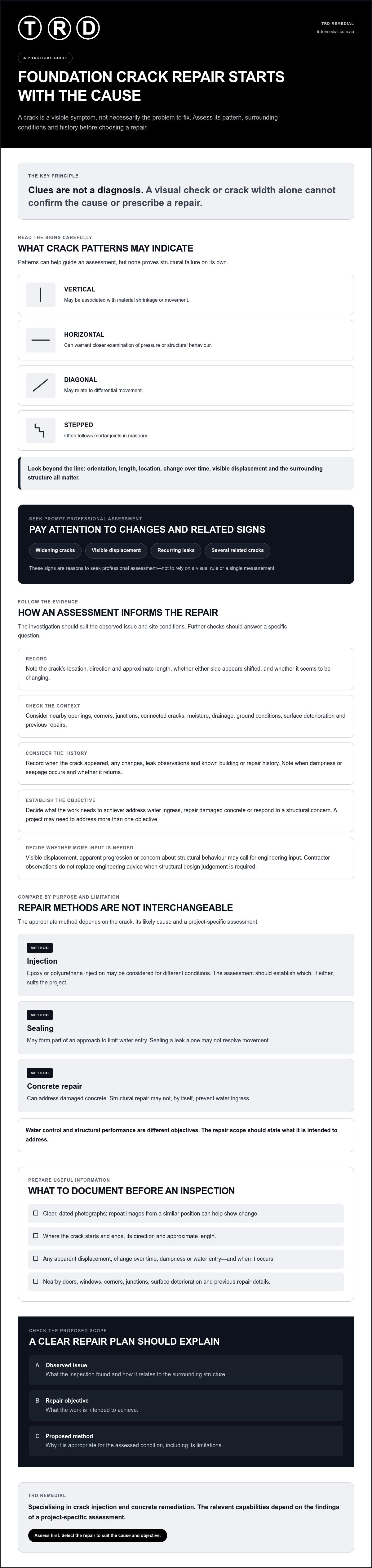
Crack appearance offers clues, not a diagnosis. Vertical cracks may be associated with material shrinkage or movement; horizontal cracks can warrant closer examination of pressure or structural behaviour. Diagonal cracks may relate to differential movement, while stepped cracks often follow mortar joints in masonry. None of these patterns alone proves structural failure. Crack width alone cannot identify the cause or prescribe a repair.
Assessors consider orientation, length, location, changes over time and visible displacement, where one side of a crack sits out of alignment with the other. Cracks near openings, corners or junctions need to be considered alongside the surrounding structure. Widening cracks, displacement, recurring leaks or several related cracks are reasons to seek prompt professional assessment, not to rely on a visual rule or a single measurement.
Which foundation crack patterns deserve closer assessment?
Record where each crack starts and ends, its direction, whether it crosses a wall or floor, and any change you’ve noticed. Note nearby doors, windows, corners or junctions, and whether the surfaces appear offset. These details help an assessor understand the pattern across the structure. A single crack’s position or width can’t establish a universal safety threshold; its significance depends on the broader evidence.
When can water ingress change the repair question?
Staining, dampness and active seepage are useful observations to document. Note when they occur and whether they return. Stopping water entry and restoring structural performance are different objectives, though a project may need to address both. Sealing a leak alone may not resolve movement, while structural repair may not, by itself, prevent water ingress. For more on repair considerations, see this professional concrete crack repair guide.
How professionals assess the cause before foundation crack repair
A reliable assessment follows the evidence before treatment. The process generally starts by recording the crack and its history, then checking the surrounding structure and conditions that may be contributing to it. The assessor considers plausible causes, decides whether further investigation or engineering judgement is needed, and defines what the repair must achieve.
That context matters. A crack that appears unchanged may call for a different response from one that is lengthening or accompanied by displacement. Moisture patterns, drainage near the building, ground conditions and previous repairs can also influence the investigation. Not every site needs the same tests, so investigation methods should suit the observed issue and site conditions rather than be assumed in advance.
What information should an initial inspection consider?
Before an inspection, record the crack’s location, direction and approximate length, whether either side appears to have shifted, and whether it seems to be changing. Note dampness or water entry, surface deterioration, nearby joints and any known building or repair history. Take clear, dated photographs. Repeat images from a similar position can help show whether the visible condition has changed.
The assessor then considers how the crack relates to the wider structure. They may look at nearby openings and junctions, connected cracks, drainage and moisture conditions, or signs of earlier repair. If a leak is present, its timing and location can help distinguish a water-entry concern from evidence that may need broader structural review. Further investigation should answer a specific question; an irrelevant test can’t substitute for a sound diagnosis.
When should an engineer assess a foundation crack?
Seek engineering input if there’s visible displacement, apparent progression or concern about how the structure is behaving. A suitably qualified specialist can help assess the issue, but contractor observations don’t replace engineering advice when structural design judgement is required. Inspection findings should inform the next step, not be treated as a repair specification without appropriate review. For wider context on assessing building issues, read this structural defect repair guide.
A clear repair objective might be to address water ingress, repair concrete or respond to a structural concern. The objective should follow from the evidence. For additional background, consult this reference source. If crack injection or concrete repair may be relevant, you can discuss these repair options with TRD Remedial after the cause and objective have been considered.
Compare foundation crack repair methods by cause and objective
Repair methods are not interchangeable. Epoxy injection may be considered where a selected concrete crack needs structural bonding. Polyurethane injection may suit some water-ingress conditions. If concrete is deteriorated or displaced, injection alone may not address the damage. The choice depends on the crack’s cause, activity, moisture conditions, substrate condition and required performance.
The repair material must match the crack’s cause and the required performance. Assessment should establish the objective before a method is specified.
| Method | Repair objective | Potentially suitable conditions | Limitations and prior assessment |
|---|---|---|---|
| Epoxy injection | Bond selected cracks in concrete. | May be considered when structural bonding is appropriate and the crack and concrete are suitable. | Crack activity, moisture and substrate condition need assessment. Injection shouldn’t be assumed to resolve ongoing movement. |
| Polyurethane injection | Address water entry through selected cracks. | May be considered for assessed water-ingress conditions. | It may not resolve the source of water or a separate structural concern. Conditions at the crack influence suitability. |
| Concrete repair, including breakout and reinstatement where required | Repair damaged or deteriorated concrete. | May be needed where the surrounding concrete is compromised, rather than the issue being limited to a crack. | The extent of damage and repair scope need to be established before work. It isn’t a universal alternative to injection. |
| Further structural remediation | Respond to a broader structural issue identified through investigation. | May be required where displacement or continuing movement indicates a concern beyond the crack itself. | The underlying cause and required performance should be defined first; a surface or injection repair may not address them. |
When might epoxy or polyurethane crack injection be considered?
These systems serve different objectives. Epoxy may be appropriate for bonding a selected concrete crack, while polyurethane may be considered where water ingress is the concern. Neither should be prescribed by appearance alone. Crack activity, moisture conditions and the state of the surrounding concrete affect system selection. Injection alone shouldn’t be assumed to stop continuing movement or address every source of water entry. A technical reference source can provide further context, but it can’t replace project-specific assessment.
When may concrete repair or further structural work be needed?
Where concrete is damaged, deteriorated or displaced, the repair may need to extend beyond filling the crack. Continuing movement calls for investigation of the cause before cosmetic work or injection is selected. The scope should state what is being repaired and what performance is intended. For related repair context, see this concrete remediation guide.
What to expect from a foundation crack repair assessment and scope
A useful assessment turns observations into a defined repair objective and a clear scope of work. Before arranging a discussion, gather information that helps explain the crack’s history and current condition. You don’t need to diagnose it yourself. Accurate records can help a specialist understand what you’ve noticed and identify what needs closer inspection.
Prepare a short record of:
- Clear photographs showing the crack’s location and nearby surfaces, with dates if possible.
- When you first noticed it and whether its appearance seems to have changed.
- Any dampness, staining or active water entry, including when it occurs.
- Known repairs, previous inspections and relevant building history.
- Access constraints or areas that may be difficult to inspect.
These details provide context, but they don’t replace an on-site assessment where one is needed. The proposed scope should connect the observed condition to the intended repair, rather than naming a material or method without explaining its purpose.
What should a clear repair scope explain?
Ask the contractor to describe the crack condition and the function of the proposed repair. The scope should set out relevant preparation, the planned injection or concrete repair steps, and any access requirements. It should also identify limitations, unresolved causes and recommended further investigation. If water is present, clarify how it will be managed during the work and whether follow-up inspection is recommended.
Clear boundaries matter. Confirm what work is included, what is excluded and what findings could change the scope once preparation begins. If the repair addresses water entry, ask whether structural performance is also part of the objective or remains a separate concern. A documented scope helps everyone understand what the proposed work is intended to do.
How can owners compare contractor recommendations?
Compare the diagnosis and repair objective, not just the product name or quoted method. Ask what observations support the recommendation, how crack activity, moisture and concrete condition affect system selection, and what could limit performance. Check that any unresolved cause or further investigation is clearly identified, rather than obscured by a confident-sounding repair description.
Before work proceeds, confirm who is responsible for site access and preparation, how water will be managed, and what follow-up is proposed. These points help expose differences between scopes that might otherwise appear similar. If the recommendations don’t explain why a method suits the observed condition, request clarification before choosing a contractor.
Once you’ve documented the symptoms, you can discuss a crack repair assessment with TRD Remedial. Its crack injection and concrete repair capabilities may be relevant, subject to the project’s specific conditions and repair objectives.
Choose a specialist for foundation crack repair and take the next step
Make the decision in order: identify the symptoms, establish the likely cause, define the repair objective, then select a specialist whose capabilities match the work required. A crack that needs water-ingress control may call for a different response from damaged concrete or a concern about structural performance. The method should follow an informed assessment, not a one-size-fits-all recommendation.
Before engaging a contractor, check that they can explain the basis for their recommendation and identify when another professional’s input may be needed. A clear discussion should distinguish what the proposed repair is intended to address from issues that remain unresolved.
What should you ask before proceeding with repair?
Ask how the contractor distinguishes structural repair from water-ingress control, and whether engineering input or further investigation is recommended before work begins. Request a plain explanation of the proposed method, intended outcome, limitations and site requirements. If the scope doesn’t explain why the method suits the observed condition, ask for that reasoning before you proceed.
- What observations support the proposed repair?
- Does the work address water entry, concrete condition, structural performance, or more than one objective?
- What access, preparation or water-management arrangements are required?
- Are there unresolved causes or conditions that could affect the proposed work?
These questions help you compare recommendations on their technical rationale, not just on the repair product or method named.
How can TRD Remedial help with crack remediation?
TRD Remedial undertakes crack injection and concrete repairs, including epoxy and polyurethane injection, water-ingress crack repairs and concrete remediation. Which, if any, is appropriate depends on the crack and project conditions. The team works with builders, engineers and strata managers on remedial projects, supporting a coordinated approach where different expertise is required.
Not every foundation crack will suit these repair capabilities, and an online description can’t establish a diagnosis. Share the crack’s location, visible symptoms, any water entry and known repair history so the issue can be considered in context. If the condition suggests structural movement, clarify whether engineering advice or further investigation should come before repair selection.
To discuss your requirements and whether crack injection or concrete repair may be relevant, contact TRD Remedial to discuss your crack repair requirements.
Make your next repair decision with confidence
A crack’s appearance is a starting point, not a diagnosis. The right repair pathway depends on the likely cause, the condition of the concrete and the repair objective. A sound scope should explain the recommended method, what it is intended to address and any limitations or further investigation required.
TRD Remedial provides epoxy and polyurethane crack injection, water-ingress crack repairs and concrete remediation for residential, commercial and industrial projects. The team works with builders, engineers and strata managers, with the repair approach determined by the specific project rather than assumed in advance.
If you’ve documented the crack and its surrounding conditions, take the next step: discuss your foundation crack repair requirements with TRD Remedial. A clear conversation can help establish whether its crack injection or concrete repair capabilities may be relevant. Start with the evidence, ask direct questions and move forward with a repair decision grounded in the condition of your structure.
Frequently Asked Questions
Are foundation cracks always a sign of structural damage?
No. Some cracks may be cosmetic or related to changes in materials, while others can reflect movement or damage. The pattern, location, surrounding condition and any change over time all matter. A crack’s appearance or width alone can’t confirm structural failure. If it’s widening, displaced, recurring with water ingress or accompanied by other related cracks, arrange a professional assessment to establish what it may indicate.
Can foundation cracks be repaired with epoxy injection?
Yes, epoxy injection may be suitable for selected concrete cracks where structural bonding is an appropriate objective. It isn’t a universal fix. The crack’s activity, moisture conditions and the condition of the surrounding concrete affect whether injection is suitable. If movement is continuing, the underlying cause may need investigation before repair. A project-specific assessment should establish the objective and appropriate method before work is specified.
How much does foundation crack repair cost?
There isn’t a reliable single price for foundation crack repair because the scope depends on the cause, crack condition, access and work required. A repair limited to a suitable crack differs from work involving deteriorated concrete, water ingress or a broader structural concern. Ask for a written scope that describes the observed issue, repair objective, proposed method and exclusions. Compare recommendations on their technical reasoning, not price alone.
What happens if a foundation crack is left unrepaired?
The outcome depends on the cause and whether the condition changes. A stable, non-structural crack may remain much the same, while ongoing movement or water entry could contribute to further damage or persistent dampness. Don’t assume either outcome from appearance alone. Record dated photographs, note leaks or changes, and seek assessment if the crack widens, shows displacement, returns after repair or appears with other concerning signs.
Is polyurethane injection suitable for every leaking foundation crack?
No. Polyurethane injection may be considered for selected water-ingress conditions, but suitability depends on the crack, moisture conditions, substrate and repair objective. A leaking crack doesn’t automatically mean injection alone will resolve the water source or any structural issue. Assessment should clarify whether the priority is stopping water entry, addressing concrete damage or responding to structural behaviour, and whether more than one objective needs attention.
When should an engineer inspect a foundation crack?
Seek engineering input when movement, visible displacement or broader structural behaviour is uncertain. An engineer can provide design judgement where the repair decision depends on structural performance. A contractor’s observations can help describe the condition and potential repair work, but they don’t replace engineering advice where it’s needed. Widening cracks, related cracking or recurring water entry are useful reasons to arrange prompt assessment rather than rely on a visual guess.
How do I choose a foundation crack repair contractor?
Choose a contractor who can explain the observed condition, likely cause, repair objective and why the proposed method suits the project. Ask about limitations, site requirements and whether engineering input or further investigation is recommended. For foundation crack repair sydney enquiries, relevant specialist capabilities may include crack injection and concrete repairs, but not every crack will suit those services. TRD Remedial works with builders, engineers and strata managers on remedial projects.


