

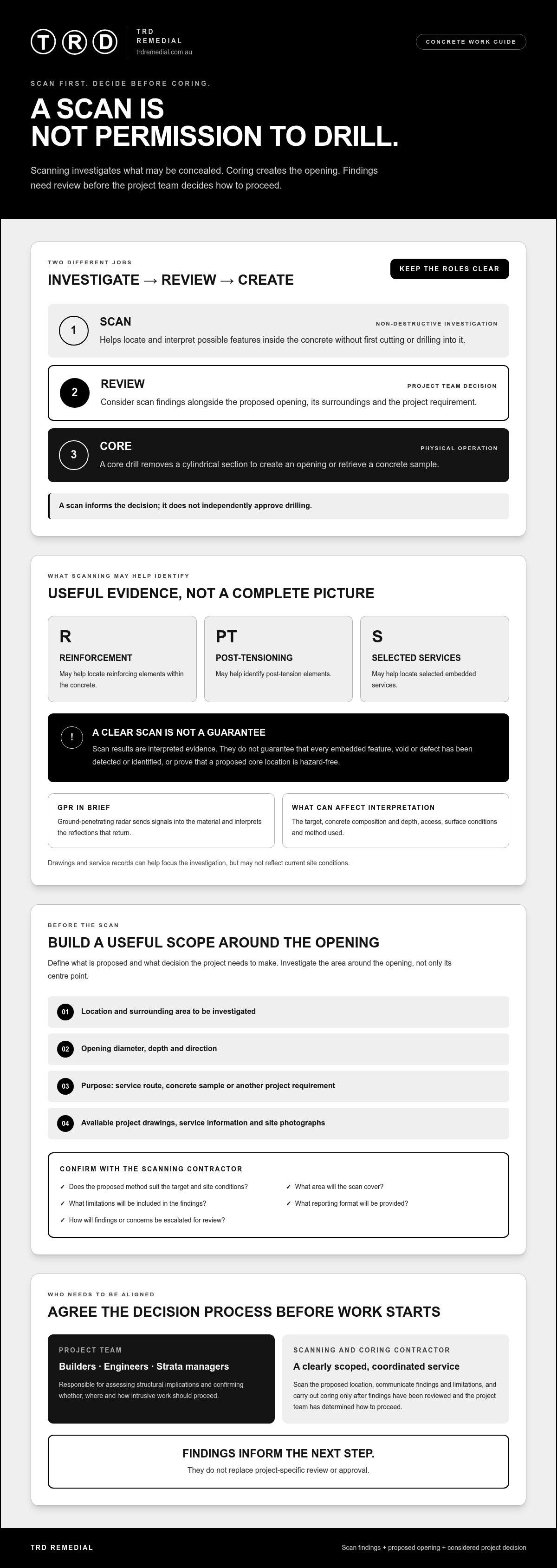
A scan is not permission to drill. Concrete scanning and coring work together only when scan findings are considered alongside the proposed opening and used to guide a controlled decision. Scanning can help identify concealed reinforcement, post-tensioning and services, but results have limits. They don’t guarantee that every embedded feature has been detected or identified.
If you’re planning an opening, it’s understandable to be unsure what lies inside the concrete. Drawings may not show current site conditions, and a scan result alone doesn’t establish that coring is safe to proceed. This article explains what scanning and core drilling each do, what they can and can’t establish, and what to confirm before intrusive work begins.
You’ll also learn what information helps define the scope, including the proposed opening and available project drawings, and how findings should inform the next step. TRD Remedial provides slab scanning and core drilling, supporting builders, engineers and strata managers with coordinated concrete work. The aim is to support a clear, considered decision before drilling starts.
Key Takeaways
- Understand how scanning investigates concrete before coring removes a cylindrical section, and why the methods serve different purposes.
- Learn why scan findings are interpreted evidence, not a complete picture of every feature embedded in a slab.
- See how concrete scanning and coring can be scoped around the proposed opening, its surroundings and the project decision required.
- Prepare dimensions, depth, orientation, purpose, drawings and site photographs to help define a useful scope.
- Know what to clarify with a contractor, including scan coverage, reporting format, limitations and how findings will be escalated.
Concrete Scanning and Coring: What Each Service Does Before an Opening
Before creating an opening in a concrete slab or wall, the project team needs to understand what may be concealed in the proposed work area. Concrete scanning is a non-destructive investigation that helps locate and interpret features within concrete without first cutting or drilling into it. Ground-penetrating radar (GPR) is a commonly used method. The Ground-Penetrating Radar (GPR) overview explains the underlying technology, which sends signals into a material and interprets the returning reflections.
Coring is the physical operation. A core drill removes a cylindrical section of concrete to create an opening or retrieve a sample. In a coordinated concrete scanning and coring scope, scanning investigates the proposed location. Coring creates the opening only after findings have been reviewed and the project team has determined how to proceed.
What does concrete scanning look for inside a slab or wall?
Scanning may help locate reinforcement, post-tension elements and selected embedded services. This information can help the responsible project team assess a proposed core location and decide whether its position needs to change. For example, findings near a planned opening may require further review rather than an immediate instruction to drill.
Results depend on the target, concrete conditions, access and method used. A scan is interpreted evidence, not a complete image of everything inside the structure. It can’t be assumed to identify every embedded item, void or defect. The scope should reflect the specific question the project needs answered.
What is concrete coring used for?
Coring creates a defined, circular opening, for example, for a planned service route, or retrieves a concrete sample for investigation. The opening’s diameter, depth and position depend on the project requirement and relevant approval. Consider these details alongside scan findings, rather than selecting them in isolation.
A core is different from general concrete cutting or demolition. It removes a cylindrical section at a specified location rather than opening up a broader area. That precision doesn’t make the work automatically suitable: the responsible project team must still assess structural implications and confirm whether, where and how the intrusive work should proceed.
Keep the roles clear: scanning helps inform the decision; coring carries it out. Scan findings don’t independently approve drilling. Builders, engineers, strata managers and the scanning and coring contractor need a clear scope and agreed decision process before work starts.
How Concrete Scanning Works, and Why It Cannot Guarantee a Clear Core Location
Ground-penetrating radar (GPR) sends signals into concrete and interprets the reflections that return. An operator uses those responses to assess possible embedded features, but the result is not a complete image of the slab or wall. It’s evidence to inform a specific decision, not proof that a proposed core location is hazard-free.
Interpretation depends on what the project needs to locate, the concrete’s composition and depth, surface access and surface conditions. A target may be difficult to distinguish or assess in some conditions. Drawings and previous service records can help the scanning contractor understand the structure and focus the investigation, but they may not reflect what is currently present on site.
Turn the proposed opening into a useful scan scope
Before scanning, define the intended opening’s location, diameter, depth and direction, as well as its purpose. Identify the area around it that needs investigation, not just the centre point. Share available drawings and service information, and ask the contractor to confirm whether the proposed method suits the target and site conditions, what the scan will cover, and what limitations will be included in the findings.
For example, a proposed service opening calls for a different decision from a core intended for concrete sampling. The purpose helps determine what information the project team needs from the scan and who must review it. If coring is for sampling or testing, the ASTM C42/C42M method relates to obtaining and testing drilled cores. It doesn’t replace project-specific approval or establish that a location is suitable for drilling.
Does a clear scan authorise concrete coring?
No. A scan result does not independently approve intrusive work. The responsible project team must assess the findings, relevant approvals and structural implications before deciding whether and how to proceed. Post-tensioned concrete and structural elements need appropriate review. Drawings, available service information and any required isolations also remain relevant. A scan is not a substitute for these project controls.
If findings are unclear, or potential reinforcement, post-tension elements or services affect the proposed opening, pause and escalate the decision to the appropriate project representative. The next step may be to clarify the scope, seek engineering review or reconsider the opening’s position. TRD Remedial’s slab scanning guide provides further context for planning an investigation. For a coordinated concrete scanning and coring scope, you can also review slab scanning and core drilling as related services.
Concrete Scanning vs Coring: Match the Method to the Project Decision
Scanning and coring are linked, but they answer different questions. Scanning investigates what may be inside or around a proposed opening. Coring physically creates that opening or retrieves a sample. The right sequence depends on the project purpose, the concrete and the decision that needs to be made.
| Consideration | Concrete scanning | Concrete coring |
|---|---|---|
| Purpose | Investigate concealed features that may affect a proposed core or fixing. | Create a defined opening or retrieve a cylindrical sample. |
| Method | A non-destructive investigation using a suitable scanning method. | Controlled drilling removes a cylindrical section of concrete. |
| Output | Interpreted findings for the specified scan area and target. | A physical opening or a concrete core for the intended investigation. |
| Next decision | Determine whether findings support the proposed location, need further review or prompt a change. | Complete the approved work to the agreed size, depth and position. |
| Project input | Proposed core dimensions, depth, orientation, purpose and relevant records. | Confirmed scope and direction from the responsible project team. |
When should scanning happen before coring?
Scan before coring when concealed reinforcement, post-tension elements or services could affect the intended opening. Define the scan area using the actual core dimensions, depth and orientation, and consider the surrounding concrete rather than specifying only a centre point. Findings may support further review, prompt a revised location or indicate that more assessment is needed. They don’t authorise drilling by themselves.
How do post-tensioning and structural changes affect the decision?
Suspected post-tensioning is a critical input. Don’t treat a potential tendon location as a routine obstacle to work around. Structural drawings, project records and engineering advice may be needed to assess the proposed alteration and its implications. If records and scan findings don’t align, refer the discrepancy to the responsible project team before work proceeds. Read the post-tension slab repair guide for further context.
The purpose of a core also matters. A service opening has a defined route and installation requirement; an investigation core is taken to support examination or testing. These are distinct scopes, and the same location, dimensions or decision process may not suit both. In a coordinated concrete scanning and coring scope, scanning informs the review, while coring remains a separate intrusive step that requires the project team’s appropriate assessment and approval.
How to Prepare a Concrete Scanning and Coring Scope
A useful scope starts with the proposed opening, not a broad request to “scan the slab”. Give the scanning contractor enough detail to assess what needs investigating, where it is, and what decision the scan needs to inform. This helps align scan coverage with the intended coring work while leaving review and approval with the responsible project team.
Prepare the scope in sequence
1. Define the opening. Mark its location and provide the required diameter, depth and orientation. Explain its purpose, such as a service route or concrete sampling, and identify nearby proposed fixings or openings.
2. Share site information. Provide clear photographs of the work area and any available structural drawings, post-tension information, service records and previous scan results. Mark known structural elements, services and sensitive areas. Treat drawings and records as useful context, not confirmation of current site conditions.
3. Describe site constraints. Flag access restrictions, occupancy, nearby activities and interfaces with other trades. Identify known services that may require isolation and confirm who is responsible for arranging it. The contractor needs to understand the actual work area and project conditions before the scope is finalised.
4. Agree the scan scope and deliverables. Confirm the proposed coverage around the opening, the target features being investigated, the method’s suitability and any reporting format or limitations. Ask what happens if findings are unclear or indicate a potential conflict. This sets expectations before the scan takes place.
5. Review findings before intrusive work. Agree who will interpret the results, who has authority to approve coring, and how findings will be communicated to the drilling team. Confirm project-specific procedures, required isolations, access controls, approvals and work interfaces. Check the applicable state or territory WHS requirements for the project rather than assuming one set of requirements applies nationally.
Make the scan-to-core handover explicit
A scan report is an input to the project decision, not an instruction to drill. If findings raise concerns about services, post-tensioning or structural elements, pause the proposed work and refer the matter to the appropriate project representative. Record any agreed changes to the location or scope before coring proceeds.
Builders, engineers and strata managers planning concrete scanning and coring can discuss a scanning and coring scope with TRD Remedial, including the proposed opening, available records and project constraints.
Engaging a Concrete Scanning and Coring Contractor for Controlled Work
A coordinated scope depends on more than having scanning and core drilling available. Consider whether the contractor has relevant experience with the structure, proposed work and site constraints, then clarify how scan findings will be reviewed before coring is considered. A defined process helps builders, engineers and strata managers coordinate the contractor’s work with the responsible project team.
What should a clear service scope include?
Before engagement, confirm the details that will shape the investigation and any potential intrusive work:
- Proposed work: Mark each scan location and describe the intended core, including its dimensions, depth, orientation and purpose.
- Coverage and targets: Agree what area around each proposed opening will be scanned and which features the investigation is intended to assess.
- Site conditions: Identify access limits, occupancy, nearby work, known services and any changes that could affect the scope.
- Findings and decisions: Confirm the reporting format, stated limitations, who reviews the results and how unexpected findings will be escalated.
- Responsibilities: Identify who arranges any required isolations, engineering review, approvals and authorisation before coring proceeds.
Ask how the contractor will communicate findings that are unclear or differ from available drawings and records. Also establish what happens if site conditions change between scanning and drilling. The scan informs the decision; it doesn’t replace the project team’s assessment or approval.
How can scanning and coring fit into remedial works?
In structural alterations or remediation investigations, scanning may help assess a proposed opening, while coring can create a service opening or retrieve a sample if that work is approved. What follows depends on the investigation results and the responsible project team’s assessment. Don’t assume further engineering or repair work before findings are reviewed.
TRD Remedial provides slab scanning and core drilling, alongside related technical concrete services, and works with builders, engineers and strata managers. If the scope extends beyond a defined core to broader material removal, the controlled demolition guide may be relevant.
For a project-specific discussion about concrete scanning and coring, contact TRD Remedial to discuss your project. Share the proposed opening, available records and site constraints so the scope and decision points can be clarified with the project team.
Make Your Next Concrete Opening a Controlled Decision
Concrete scanning and coring are most effective as coordinated steps in a project plan. Scanning can inform the assessment of concealed features, but findings have limitations and don’t provide automatic approval to drill. Define the proposed opening clearly, share relevant drawings and site information, and agree who will review the results and authorise intrusive work.
The key is a clear handover: understand scan coverage and limitations before coring proceeds, and consider engineering review or further investigation where findings call for it. This gives the project team a firmer basis for deciding how to proceed without treating a scan as a guarantee.
TRD Remedial provides both slab scanning and core drilling, and works with builders, engineers and strata managers on concrete projects. Discuss your concrete scanning and coring requirements with TRD Remedial to outline the proposed work and coordinate next steps. With a defined scope and the right people involved, you can approach the opening with greater clarity and control.
Frequently Asked Questions
What is concrete scanning and how does it work?
Concrete scanning is a non-destructive investigation used to assess possible features concealed within a slab or wall. A common method, ground-penetrating radar (GPR), sends signals into the concrete and interprets the reflections that return. The operator uses this information to assess potential reinforcement, post-tension elements or selected services in the specified area. Findings are interpreted evidence, not a complete image, so they can inform planning but can’t guarantee every embedded feature has been located.
Can concrete scanning detect post-tension cables and reinforcing steel?
Scanning may help locate post-tension elements and reinforcing steel, but detection and interpretation depend on the target, concrete, access, surface conditions and method used. A result shouldn’t be treated as proof that a tendon or bar is absent from an area. Provide available structural drawings and post-tension information to the scanning contractor, then have the responsible project team review the findings before deciding whether intrusive work can proceed.
Does a clear concrete scan mean it is safe to core?
No. A clear-looking scan does not independently establish that coring is safe or authorised. The responsible project team needs to assess the scan findings alongside structural information, available service records, required isolations and applicable approvals. If the proposed location involves suspected post-tensioning or structural elements, seek appropriate review before drilling. If findings are unclear or conflict with project records, pause and escalate the decision rather than treating the scan as permission to proceed.
How deep can concrete scanning detect embedded objects?
There isn’t one reliable depth figure that applies to every scan. The achievable investigation depends on the scanning method and equipment, the target’s characteristics, concrete composition, access and surface conditions. Ask the contractor to confirm whether the proposed method is suitable for the target and depth relevant to your work, and to explain coverage and limitations in the findings. Don’t assume an area beyond the effective scope has been cleared.
What is the difference between concrete scanning and core drilling?
Scanning investigates the concrete without first cutting or drilling it. Core drilling is an intrusive operation that removes a cylindrical section to create an opening or obtain a sample. Scanning may help assess a proposed core location, while coring physically carries out the approved work. The methods have different purposes: scan findings inform a project decision, but don’t replace structural review, approval or the agreed drilling scope.
Do concrete slabs need scanning before core drilling?
Whether scanning is needed depends on the project, the proposed opening and what may be concealed in the slab. If reinforcement, post-tensioning or services could affect the location, scanning can help inform the assessment before drilling. Check project requirements with the responsible team and provide relevant drawings or service information. A scan doesn’t guarantee a hazard-free location, so findings and any required approvals still need to be reviewed before coring proceeds.
What information should I provide when requesting concrete scanning and coring?
Provide the proposed location, opening dimensions, depth, orientation and purpose, such as a service route or concrete sample. Include marked-up drawings, photographs of the work area, available structural and post-tension information, service records and previous scan results. Flag access restrictions, occupancy, nearby sensitive areas and known services. Ask the contractor to confirm scan coverage, reporting format and limitations, and agree who reviews findings and authorises any intrusive work.


