

A repair focused only on visible damage can miss the cause beneath it. With concrete cancer in apartments, cracking or spalling may be the first sign of corrosion affecting steel reinforcement, but the surface alone can’t show how far deterioration extends. The right response starts with understanding the defect and its structural context.
It’s understandable to want a clear answer when concrete breaks away or rust stains appear. Those signs warrant prompt professional assessment, not guesswork or alarm. In a strata building, responsibility for repairs can also be unclear, particularly when the affected area connects an individual lot with shared structural elements.
This guide explains the warning signs to watch for, the moisture-related and construction factors that can contribute to deterioration, and why an isolated patch may not resolve the underlying problem. You’ll also learn how an engineer can assess the extent of damage and inform a coordinated repair plan, from investigating the source to concrete repairs, spalling repairs or structural strengthening where required. The aim is a practical pathway from initial concern to technically informed remediation.
Key Takeaways
- “Concrete cancer” describes deterioration linked to reinforcement corrosion; the term alone doesn’t confirm structural danger.
- Moisture can contribute to corrosion and concrete damage, but the specific cause needs investigation.
- In concrete cancer in apartments, the visible defect may not reveal the full extent of deterioration or what is driving it.
- Build a clearer record by noting where damage appears, when it changes, any water entry and previous repairs.
- Repair methods should follow an engineered scope, which may involve removing unsound concrete, addressing reinforcement and reinstating the concrete.
Concrete cancer in apartments: what the term means and what residents may notice
Concrete cancer is a common, non-technical term for concrete deterioration associated with corrosion of the reinforcing steel embedded within it. As the steel corrodes, it can expand and place pressure on the surrounding concrete, contributing to cracking, hollow areas or pieces breaking away. The term isn’t a diagnosis of structural safety. Hearing it doesn’t, by itself, establish that a building element is unsafe.
“Concrete cancer describes deterioration associated with corroding reinforcement; it is not a diagnosis of how extensive the damage is or what repairs are required.” A visible mark can prompt investigation, but it can’t show the condition of steel concealed inside the concrete or confirm the cause. A general overview of what the term means explains how reinforcement corrosion and other processes can contribute to concrete deterioration.
What concrete cancer can look like in an apartment building
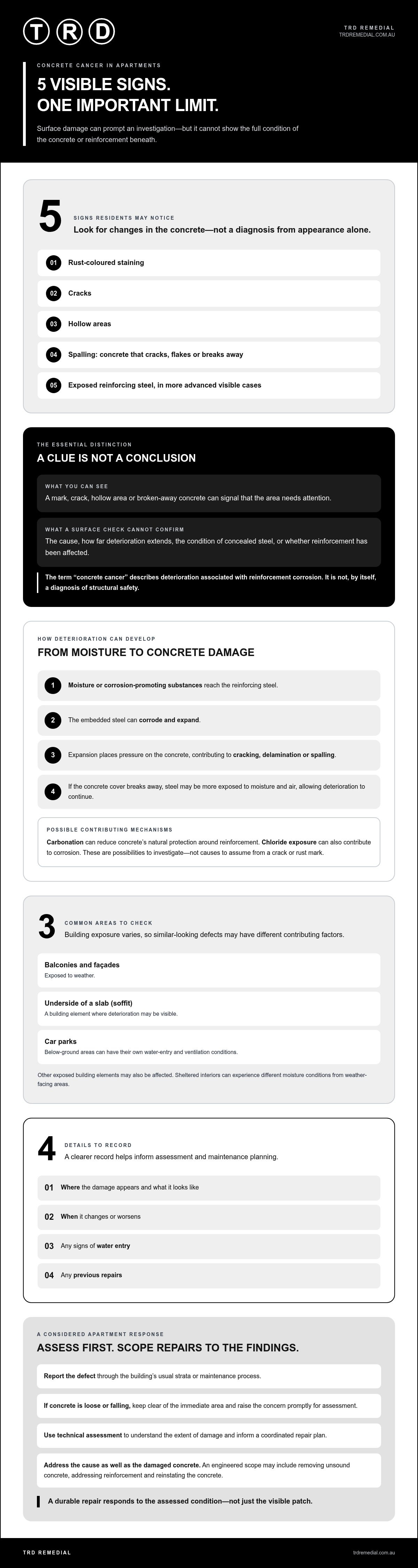
Residents may notice rust-coloured staining, cracks, hollow areas, or spalling, where the surface cracks, flakes or breaks away. In more advanced visible cases, reinforcing steel may be exposed. These signs can occur on balconies, the underside of a slab (the soffit), in car parks or on other exposed building elements.
A stain or crack isn’t proof of concrete cancer. Water can leave marks, and cracks can have different causes. Even where concrete has broken away, a visual check alone can’t establish how far deterioration extends or whether reinforcement has been affected. Don’t treat a photograph or surface symptom as a definitive diagnosis.
Why apartment defects need a considered response
In an apartment building, a defect may be near a resident’s home, above a shared walkway or within a car park. It can affect more than one area of the building, so it needs to be considered as part of maintenance planning. The visible damage is a symptom; understanding the underlying condition calls for technical assessment.
Record the location and appearance of the sign, then report it through the building’s usual strata or maintenance process. If concrete is loose or falling, keep clear of the immediate area and raise the concern promptly for assessment. Don’t assume from appearance alone that an element is safe or unsafe. A considered assessment helps establish the defect’s extent and informs an appropriate repair response.
How concrete cancer develops: moisture, reinforcement corrosion and concrete damage
Concrete helps protect embedded reinforcing steel from the surrounding environment. That protection can be compromised when moisture and substances that promote corrosion reach the steel. As corrosion develops, the steel can expand, placing pressure on the surrounding concrete and contributing to cracking, delamination or spalling. If the concrete cover breaks away, reinforcement may become more exposed to moisture and air, allowing deterioration to continue.
What happens when reinforcing steel corrodes
Corrosion is a process, not a conclusion that can be drawn from every crack or rust mark. Carbonation can reduce concrete’s natural protection around reinforcement, while chloride exposure can also contribute to corrosion. These are possible mechanisms, not assumptions: identifying which applies requires investigation. A review of chloride-induced corrosion describes how chlorides can affect steel reinforcement embedded in concrete.
Cracks may allow more water or contaminants to enter, but their presence alone doesn’t prove active corrosion or a loss of structural capacity. Rust staining can be a clue, not a complete assessment. The condition of the reinforcement, the depth and extent of damage, and the concrete around it all matter.
Why apartments can have different exposure conditions
Exposure varies across a building. Balconies and façades face weather, while sheltered interiors may encounter different moisture conditions. Below-ground parking areas can have their own water-entry and ventilation conditions. These differences help explain why similar-looking defects may have different contributing factors.
Assessment should consider more than the damaged patch. Cracks, joints, drainage performance, signs of water ingress and the history of previous repairs can all help build a clearer picture. For example, recurring dampness near a joint may point to a water pathway that needs attention alongside concrete damage. The relevant cause and repair scope depend on site-specific findings.
A durable repair addresses both the damaged concrete and the conditions contributing to its deterioration. Treating only the visible surface may leave an underlying source of moisture or corrosion unaddressed. Investigation helps determine the appropriate response, which may include concrete or spalling repairs and attention to water ingress-related defects. For an overview of concrete repair and remediation, consider how the repair approach fits the building’s assessed condition.
Does visible concrete damage show how serious apartment concrete cancer is?
No. A small patch of staining or a narrow crack may look minor, but the surface doesn’t reveal the full condition of the concrete or reinforcement beneath it. Conversely, visible damage doesn’t automatically mean an element has lost structural capacity. In concrete cancer in apartments, appearance is a reason to investigate, not a reliable measure of severity.
An engineer or qualified remediation professional can assess the defect in context. The review may consider where damage occurs, how far it extends, the condition of surrounding concrete and reinforcement, and whether moisture or another exposure is contributing. This helps distinguish an isolated surface issue from deterioration that needs a broader repair scope.
| Observed sign | What it may indicate | What assessment can clarify |
|---|---|---|
| Small crack or rust-coloured mark | Possible moisture movement or reinforcement corrosion, among other causes | Whether corrosion is present and how far the affected area extends |
| Hollow-sounding or bulging concrete | Possible separation within the concrete | The extent of unsound concrete and whether reinforcement is affected |
| Concrete breaking away or steel exposed | Loss of concrete cover and increased exposure of reinforcement | The condition of the steel, surrounding concrete and required repair scope |
| Recurring water entry or changing cracks | A continuing moisture pathway or developing movement may need investigation | Likely contributing conditions and whether further technical assessment is needed |
When should apartment stakeholders act?
Report loose or falling concrete, exposed reinforcement, recurring water entry and cracks that appear to be changing promptly through the building’s usual strata or maintenance channels. If concrete may fall, keep residents and visitors clear of the area rather than approaching it to inspect or touch the material.
If there’s an immediate danger to people, contact emergency services and alert building management or the relevant building-safety contact. Don’t try to determine structural safety from a photo or make repairs before the area has been assessed.
What an assessment needs to establish
A considered assessment records the defect’s location and extent, examines nearby concrete and reinforcement where accessible, and considers likely exposure conditions, including signs of water entry. If visual inspection can’t resolve key questions, further testing or carefully planned opening-up may be considered. The appropriate engineer determines structural capacity and documents the findings and repair requirements. That evidence gives apartment stakeholders a sound basis for planning next steps, rather than relying on appearance alone.
How apartment owners and strata teams can organise a concrete cancer response
A clear process turns an initial concern into an informed repair plan. For concrete cancer in apartments, owners and strata teams can keep the response organised by recording what they see, reporting it through the building’s established process, arranging technical assessment, then using the findings to define and plan the work.
- Record the signs: Take dated photographs and note the exact location, any changes, signs of water entry and previous repairs if known.
- Report the concern: Send the record to the building manager, strata manager or other established contact so it can be logged and followed up.
- Arrange assessment: Organise technical review to understand the defect, its extent and likely contributing conditions.
- Define the scope: Use the findings and relevant engineering documentation to establish repair areas, access requirements and work sequencing.
- Plan the works: Coordinate site arrangements, resident communication and management of shared spaces.
Common-property boundaries and decision processes vary between Australian jurisdictions and individual schemes. Avoid assuming who is responsible for a repair, who must approve it or how costs are allocated. Those matters should be handled through the scheme’s established processes and appropriate advice. The technical record still plays an important role: clear observations and assessment findings help decision-makers understand the work required.
From first report to a defined repair scope
Once a concern is reported, technical findings help turn observations into a defined scope. The assessment may identify the extent of affected concrete, the repair areas, access needs and any contributing conditions that the project team should address. This gives the team a practical basis for planning, rather than relying on a brief description or isolated photograph. The scope should reflect the assessed condition and relevant engineering documentation.
Planning works around residents and shared spaces
Remediation in an occupied building needs site coordination. Planning may include arranging access, isolating work areas, communicating with residents and maintaining safe movement through shared spaces. A remedial contractor can coordinate technical work with the project team and site requirements. The sequence and duration depend on assessment findings, access and other project-specific conditions, so they should be planned for the building rather than assumed in advance.
For broader context on repair planning and building upkeep, see Concrete Remediation: The Essential Guide to Structural Repair and Asset Longevity. The TRD Remedial website provides an overview of its concrete remediation services.
How engineered concrete cancer repairs restore damaged apartment elements
Repair should follow assessment and an engineered scope, not a standard patch applied wherever damage is visible. For concrete cancer in apartments, the scope needs to define the affected area, the condition of the reinforcement and any contributing factors identified by the project team. This helps align the repair work with the defect rather than simply hiding its surface signs.
Why surface patching may not resolve the underlying issue
A cosmetic patch can cover a mark or crack while leaving unsound concrete, affected reinforcement or a contributing moisture pathway unaddressed. A defined repair scope sets out where material must be removed and reinstated, based on the assessed condition. The required boundaries may extend beyond what can be seen at the surface. Repair methods and expected outcomes depend on project-specific findings, so no service life or performance result should be assumed without supporting evidence.
What a specialist remediation scope may involve
Work is guided by the assessment and project documentation. Depending on the findings, the repair sequence may include:
- Removing unsound concrete to expose the affected area and reinforcement.
- Assessing and treating reinforcement as specified in the repair scope.
- Reinstating the concrete and completing the repair to the required details.
- Addressing related cracks or structural requirements where the engineered solution calls for it.
Crack injection may be considered for suitable cracks, while structural strengthening may form part of the solution where the engineering findings support it. Neither is a default treatment for every case. The method must match the defect, its cause and the function of the affected building element.
TRD Remedial undertakes concrete repairs and spalling repairs, with crack injection and structural strengthening capabilities that can support a coordinated remediation response. The work can be carried out in collaboration with engineers, builders and strata managers, with the repair scope guiding how the damaged element is addressed.
Suspect a concrete defect in your apartment building? An assessment and engineered repair scope can help clarify the appropriate response.
Move from concern to a coordinated repair plan
Visible cracking, rust staining or spalling is a reason to act, but it can’t show the full extent or cause of deterioration. With concrete cancer in apartments, technical assessment helps identify affected areas and contributing conditions, while dated observations and clear reporting help owners and strata teams organise a considered response.
Repairs should follow an engineered scope, not simply cover what’s visible. Depending on the findings, the work may involve concrete spalling repairs, crack injection or structural strengthening. The right approach is specific to the building and the defect.
TRD Remedial works with builders, engineers and strata managers on coordinated remediation, with capabilities including concrete repair, slab scanning, crack injection and structural strengthening. If your building has a suspected concrete defect, take the next step with a technically informed approach. Discuss your apartment concrete remediation project with TRD Remedial.
A clear assessment and organised repair pathway can help stakeholders make informed decisions and move forward with confidence.
Frequently Asked Questions
What is concrete cancer in an apartment building?
Concrete cancer is a common term for deterioration associated with corrosion of reinforcing steel embedded in concrete. Moisture or other conditions can contribute to corrosion; as the steel expands, it may place pressure on surrounding concrete and lead to cracking, hollow areas or spalling. The term isn’t a diagnosis of the defect’s extent, nor does it automatically mean the building is unsafe. Assessment is needed to identify the cause and repair scope.
Is concrete cancer in an apartment building dangerous?
It can pose a risk if concrete is loose or falling, or if deterioration affects a structural element, but appearance alone can’t confirm the level of risk. Don’t assume a small defect is minor or that every stain means structural danger. Report suspected deterioration promptly for assessment. If concrete may fall, keep people clear of the area and notify building management; if there’s immediate danger to people, contact emergency services.
What are the signs of concrete cancer on an apartment balcony?
Possible signs include rust-coloured staining, cracks, hollow-sounding or bulging concrete, pieces of concrete breaking away, and exposed reinforcing steel. Look for changes over time and note any recurring water entry, but don’t treat a crack or stain as proof of corrosion. Record the balcony location and date photographs, then report the observations through the building’s established strata or maintenance process for appropriate assessment.
Can concrete cancer be repaired without replacing the whole concrete element?
Often, repairs can be limited to affected areas, but the method depends on the assessed condition and engineered scope. Work may involve removing unsound concrete, addressing affected reinforcement and reinstating concrete. If deterioration is more extensive, the repair approach may need to address a wider area or include structural strengthening. An engineer’s findings help establish the appropriate boundaries and whether localised repair is suitable.
Who is responsible for concrete cancer repairs in an apartment building?
Responsibility depends on the location of the defect, the scheme’s documents and the applicable jurisdiction. Structural elements and shared areas may be treated differently from finishes within an individual lot, so don’t assume responsibility based only on where damage is visible. Report the defect through the building’s established process. The owners’ corporation or relevant strata body can consider the scheme records and obtain appropriate advice on responsibility and approvals.
How is concrete cancer assessed in an apartment building?
Assessment examines the defect’s location and extent, surrounding concrete, reinforcement where accessible, and possible exposure conditions such as water entry. An appropriately qualified engineer can determine what further investigation is needed and assess structural capacity. If visual inspection leaves uncertainty, testing or carefully planned opening-up may be considered. Findings and repair requirements should be documented so the remediation scope responds to the actual condition, not just visible symptoms.
Can concrete cancer return after repairs?
Deterioration may recur if affected areas or contributing conditions, such as a continuing moisture pathway, haven’t been adequately addressed. No repair should be treated as a guarantee against future damage. The scope should be based on assessment, define the repair boundaries and consider relevant contributing factors. Following the project documentation and reporting new signs of cracking, staining or spalling helps stakeholders respond if conditions change.


