

Expanding polyurethane water leak sealing can stop water moving through hairline cracks, joints and voids in concrete. A low-viscosity resin enters the leak, reacts with water and expands into foam, forming a flexible, watertight seal. This makes injection a practical option for active leaks, including those under pressure.
A visible damp patch may be only the surface sign of a deeper water path. Sealing the opening from the outside may not address the route through the concrete, so understanding how injection reaches and fills defects is important when choosing a repair.
This article explains how water-reactive polyurethane foam expands and cures, why it can be used in wet conditions, and where it helps control water ingress in concrete structures. It also covers how injection is used for cracks and high-pressure leaks, and what factors determine whether it suits the problem.
Key Takeaways
- Pressure injection can drive polyurethane resin into leaking cracks, joints and voids, where expansion helps seal paths carrying water through concrete.
- Water-reactive foam can cure in wet or submerged conditions, making it relevant to structures exposed to groundwater and ongoing leakage.
- Assess the leak’s location, water pressure and the condition of the concrete to understand where injection may help control water ingress.
- Where a repair also needs structural support, TRD Remedial’s crack injection, concrete repairs and structural strengthening can address related defects; carbon fibre strengthening is another option for strengthening concrete structures.
Sealing hairline cracks and high-pressure leaks
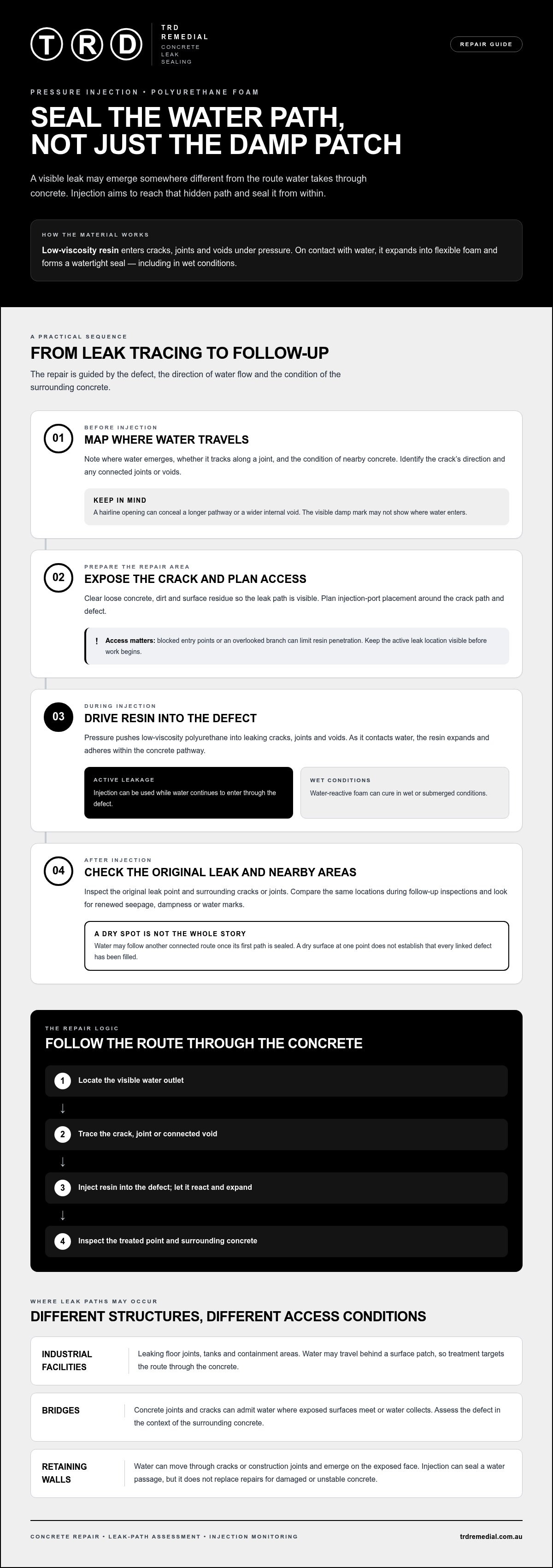
Before injection, map the crack, remove loose material and plan access for controlled application. Afterwards, monitor for renewed seepage and moisture in the surrounding concrete.
Pressure injection drives polyurethane resin into leaking concrete cracks, joints and voids. A hairline crack can conceal a longer water pathway through the structure. Resin enters that pathway under pressure, then expands and adheres as it reacts with water. This makes injection useful for active leaks, including those that continue during the repair. The aim is to reach the defect, not simply cover the visible damp mark.
Preparing a Leaking Crack
Crack preparation means exposing the leak path and creating access for controlled injection. Clear loose concrete, dirt and surface residue around the crack so the repair area is visible. Identify the crack’s direction and any connected joints or voids. Injection ports provide entry points for resin, with placement guided by the crack path and defect. Preparation matters because blocked access or an overlooked branch can limit penetration. Keep the active leak location visible before work begins.
With high-pressure leakage, injection must account for water moving through the defect. Pressure pushes the low-viscosity resin into the crack, while expansion helps it fill irregular spaces and adhere within the concrete. A hairline opening may feed a wider internal void, so the visible width alone does not show the full leak path. The location, direction and persistence of water flow help shape the repair. Foam can seal the route even when water continues to enter during injection.
Monitoring Before and After Injection
Monitoring records the leak’s condition before treatment and checks the repair afterwards. Note where water emerges, whether it tracks along a joint, and the condition of the surrounding concrete. After injection, inspect the original leak point and nearby cracks or joints for seepage. Water may follow another connected route once its first path is sealed. A dry surface at one point does not establish that every linked defect has been filled.
Compare the same locations during follow-up inspections. Look for renewed dampness, water marks or leakage on adjacent concrete surfaces. If water reappears, its position can help identify an untreated branch or separate defect. Record observations consistently, including changes in visible seepage. Expanding polyurethane water leak sealing is most useful when injection targets the actual water path, and monitoring helps assess the result across the affected area.
Use in industrial facilities, bridges and retaining walls
Polyurethane injection can target water paths in concrete structures exposed to demanding conditions. The right application depends on the leak’s location, the concrete defect and how water moves through it.
In industrial facilities, injection can repair leaking floor joints, tanks and containment areas. For example, a joint in a concrete processing floor can provide a route for wash-down water or groundwater. In a tank or bund, water escaping through a crack can undermine its ability to contain liquid. Injected resin enters the defect and reacts with water, expanding to fill the path. The repair targets the leak route through the concrete, rather than covering only its visible exit point. This distinction matters when a surface patch would leave water travelling behind it.
Bridges present a different setting. Concrete joints and cracks can admit water where exposed surfaces meet or water collects. Injection can address a leaking concrete defect, with the location and extent of the pathway guiding the repair. A bridge deck joint, for instance, needs assessment in the context of the surrounding concrete, not as an isolated damp mark. Water may emerge away from where it enters, so tracing the route helps direct treatment.
Retaining walls hold back soil, and water can move through cracks or construction joints. A leak may appear on the exposed face while its entry point is on the retained side. Polyurethane foam expands inside the defect after contacting water, helping seal the passage. Injection is relevant when water is entering through concrete. It does not replace repairs for damaged or unstable concrete, which require attention to the underlying condition.
For each structure, identify the defect and nearby water outlets before selecting an injection approach. Industrial floor joints, tank cracks, bridge connections and retaining-wall joints each present different access and flow conditions. Those details influence where resin enters and how the repaired area should be inspected afterwards. A concrete leak review can help establish the repair scope. For related structural issues, explore concrete repair options suited to the affected structure.
Water-reactive curing and foam expansion
Water-reactive polyurethane changes from injected liquid into sealing foam inside a concrete defect. Its response to moisture shapes how it fills the leak path.
Water-Reactive Curing
Water-reactive curing occurs when injected polyurethane resin contacts water and forms foam. The low-viscosity liquid can penetrate cracks and voids, reaching spaces beyond the visible surface. This is useful for active leaks because the resin reacts within the damp defect. It can also cure in wet or submerged conditions, when drying the concrete first is not practical.
After injection, the resin reacts rapidly with water to create a flexible, watertight seal. The cure typically takes minutes, allowing inspection soon after application. For example, a damp basement crack can receive injection while water remains present. The foam forms within the concrete pathway rather than relying on a dry surface bond.
Foam Expansion
Foam expansion is the increase in resin volume as it reacts with water. The resulting closed-cell foam occupies space within cracks and voids. This matters because concrete defects are rarely uniform channels. Expansion allows the material to fill irregular sections and adhere along the leak path, helping interrupt water movement.
Expansion also explains why injection requires controlled placement. Resin must enter the defect before it reacts, then expand where water is present. In a connected crack, foam can fill sections beyond the injection point. The exact path depends on the crack, water flow and internal voids. Foam can therefore seal more than the visible opening alone.
Once cured, the closed-cell structure helps limit water passage through treated cracks and joints. Polyurethane’s flexibility supports a watertight seal within the defect. Its reaction with water makes the method suitable for damp concrete, including submerged areas. These characteristics explain why polyurethane injection is used for active water ingress, rather than as a surface coating over the leak.
Polyurethane water-stop foam for sealing leaks
Water-stop foam is injected into concrete defects to restrict water ingress. Its suitability depends on the leak path, substrate and repair objective.
Foam and Resin Suitability
For active leaks, water-reactive polyurethane resin expands after contacting water. Its low viscosity helps it enter cracks and voids before curing. This is useful when water is still moving through concrete, such as in a leaking basement wall. The defect’s width, water flow and internal spaces influence whether foam can reach the pathway.
Water-reactive polyurethane is used in concrete basements, parking structures and tanks. It is also applied in tunnels, subways, dams and reservoirs exposed to groundwater or retained water. The structure’s material and leak location matter: a leak through a concrete joint presents a different access point from water emerging through a broad surface defect.
Durability Compared with Other Repairs
Durability describes how well a repair continues to control water under its exposure conditions. Polyurethane forms a flexible, closed-cell seal, while epoxy, cement grout and membranes serve different repair functions. No single material is automatically more durable for every defect. For example, injection addresses a pathway inside concrete, while a membrane covers a surface.
Polyurethane’s closed-cell structure, strength and chemical resistance support sealing cracks and joints. The result depends on whether injection reaches the leak path and suits the defect. These materials are not interchangeable: a moving joint, structural crack and surface waterproofing problem may need different treatments.
Injection Equipment and Materials
Injection equipment delivers resin through ports installed along an accessible crack. A typical setup includes polyurethane resin, an injection pump, connecting hoses and injection ports or packers. These components enable controlled delivery into the defect rather than onto the concrete surface.
For example, a leaking basement crack may need ports positioned along its route. The injection team feeds resin through those access points using a pump. The port arrangement and resin choice depend on the defect and water movement. This is not a surface-only coating process.
Risks and Limitations
Risks and limitations arise when foam expands beyond the intended pathway or misses the leak route. Sealing one outlet may leave connected cracks untreated. Injection controls water ingress through defects; it does not correct every cause of concrete damage or replace structural repairs.
Australian building standards and licensing obligations depend on the project, location and type of work. There isn’t enough information here to identify one universal requirement for polyurethane injection. Expanding polyurethane water leak sealing is suited to concrete leakage, not every waterproofing or structural issue.
Injection can seal leaks in concrete basements and tanks, and is used in water-retaining structures. Pool or foundation suitability depends on the leak’s location, concrete condition and access. For a concrete ingress assessment, discuss water ingress crack repairs.
TRD Remedial: Carbon Fibre Strengthening
TRD Remedial provides Carbon Fibre Strengthening when a concrete structure needs strengthening beyond leak sealing. Polyurethane injection can address water ingress through a crack, while strengthening work addresses a separate structural concern. These repairs serve different purposes, so identifying both issues helps define the required work.
Where a leak coincides with damaged concrete or reduced structural capacity, Crack Injection, Concrete Repairs or Structural Strengthening may also be relevant. Carbon Fibre Strengthening is an option when the work requires strengthening concrete. The appropriate approach depends on the defect and the structure’s needs.
For a concrete leak or related strengthening requirement, contact TRD Remedial or visit trdremedial.com.au.
Plan the repair beyond the leak
A sound repair plan starts by distinguishing water ingress from structural damage. Sealing a leak may address the water pathway, while weakened concrete can require separate remediation. Keeping both needs in view helps define the right scope of work instead of treating every visible defect as the same problem.
Expanding polyurethane water leak sealing can be part of the plan when water enters through concrete. If the structure also needs attention, TRD Remedial offers Crack Injection, Structural Strengthening and Carbon Fibre Strengthening. To get started, outline where water appears and which concrete defects are visible, so the repair discussion can focus on the affected structure and its needs.
Contact TRD Remedial about leak sealing to discuss the repair scope. A clear assessment gives you a practical starting point for addressing water ingress and related concrete concerns.
Frequently Asked Questions
How Polyurethane Foam Injection System Solves Structural Leakage Problems?
Polyurethane injection controls water ingress through cracks, joints and voids in concrete. The resin enters the defect and reacts with water, forming a seal within the pathway. This addresses leakage, not structural capacity. If cracking also indicates weakened concrete, that issue needs separate assessment and may require structural strengthening rather than waterproofing alone.
What Problems Do Leak Seal Products Solve?
Leak-sealing products help control water passing through defects in concrete, including cracks and joints. They can address persistent seepage that returns after surface drying or patching. They do not correct every source of moisture: condensation, roof leaks and plumbing faults have different causes. Identifying where water enters helps distinguish a concrete leak from another moisture problem.
How does expanding polyurethane injection seal water leaks in concrete?
Expanding polyurethane water leak sealing places resin inside a water-bearing defect, where it reacts and expands. For example, resin injected into a damp concrete joint can occupy connected gaps that are not visible at the surface. Its closed-cell foam restricts water movement through the treated pathway. Injection targets active leaks; it does not restore structural strength.
What are the steps for injecting polyurethane to seal a leaking crack?
The injection sequence is assess, prepare, inject and inspect. A specialist first traces the crack and identifies access points. Loose material is cleared, then ports are positioned along the defect. Resin is pumped through the ports, with placement guided by water movement. After curing, the repair area and nearby surfaces are inspected for continued seepage.
How long does polyurethane injection take to cure and stop a leak?
Polyurethane resin typically cures within minutes, so the treated area can be inspected soon after injection. Curing and confirming that leakage has stopped are separate checks. The inspection looks at the original outlet and nearby concrete, where water may find another connected route. Any continued seepage helps identify whether further treatment is needed.


