

Concrete cancer doesn’t automatically make a building unsafe, but advanced deterioration can put its structural integrity at risk. Whether it’s safe to live in a building with concrete cancer depends on the damage’s extent and location. Arrange an assessment if you suspect deterioration, especially if concrete is breaking away or structural elements appear affected.
Cracks, rust stains or crumbling concrete can be unsettling, but these signs don’t show how serious the problem is. Concrete cancer involves corrosion of reinforcing steel, which can cause the surrounding concrete to crack, separate and fall away. Similar-looking defects can have different causes, so a visual check alone can’t confirm what’s happening inside the structure.
This article explains what concrete cancer is, how it can affect building safety and which warning signs need attention. It also explains how spalling differs from other defects and why the extent and cause of deterioration matter when deciding what to do next.
Key Takeaways
- Concrete cancer involves corrosion of reinforcing steel, which can crack, separate and dislodge the surrounding concrete.
- Safety depends on the damage’s severity and location; an assessment can identify the affected area, likely cause and repair needs.
- Rust stains, bulging, cracking and crumbling concrete are warning signs to take seriously, but they don’t confirm the cause on their own.
- Spalling can be linked to reinforcement corrosion, while other concrete defects may have different causes and require different responses.
- When structural strengthening is needed, carbon fibre strengthening may form part of a suitable repair approach.
What is Concrete Cancer?
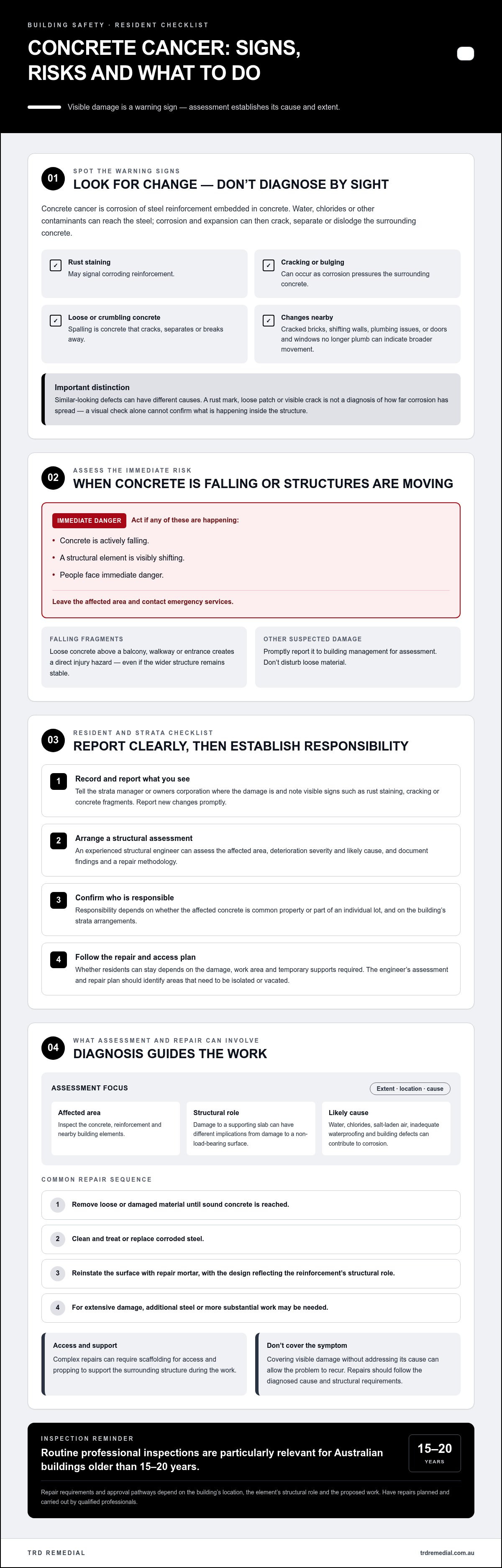
Concrete cancer is corrosion of the steel reinforcement embedded in concrete. Water, chlorides or other contaminants can reach the steel, causing it to corrode and expand. The resulting pressure can crack the surrounding concrete, separate it from the structure and cause pieces to break away. This visible damage is called spalling. A rust mark or loose patch is a warning sign, not a diagnosis of how far the corrosion has spread.
What Australian building standards and regulations apply to concrete cancer repairs? Repair designs need to account for applicable building requirements, the element’s structural role and the proposed work. The relevant requirements and approval pathway depend on the building’s location and the repair scope.
A structural engineer assesses the affected area, the severity of deterioration and its likely cause. They may inspect the concrete, reinforcement and nearby building elements, then document their findings and a repair methodology. For example, a report can distinguish localised corrosion from deterioration affecting a wider slab. That diagnosis guides the repair. Covering visible damage without addressing its cause can allow the problem to recur.
Concrete repair commonly involves removing loose or damaged material until sound concrete is reached, cleaning and treating or replacing corroded steel, then reinstating the surface with repair mortar. The repair design should reflect the reinforcement’s structural role. Extensive damage may require additional steel or more substantial work. Complex repairs can also require scaffolding for access and propping to support the surrounding structure during the work.
Who is responsible for concrete cancer repairs in an Australian strata building? Responsibility depends on whether the affected concrete is common property or part of an individual lot, and on the building’s strata arrangements. Residents should report suspected deterioration to their strata manager or owners corporation so the issue can be assessed and responsibility for repairs established.
What steps should residents take if concrete cancer is found in their building? Promptly report the location and visible signs, such as rust staining, cracking or concrete fragments, and don’t disturb loose material. The owners corporation or building manager can arrange an assessment by an experienced structural engineer and plan any required remedial work.
Can residents stay in a building during concrete cancer repairs? It depends on the damage, the work area and any temporary supports required. An engineer’s assessment and repair plan should identify areas that need to be isolated or vacated while work, scaffolding or propping is in place.
Early assessment can limit further deterioration and help keep repairs proportionate to the damage. Routine professional inspections are particularly relevant for Australian buildings older than 15-20 years. Repairs should be planned around the diagnosed cause, structural requirements and access conditions, then carried out by qualified professionals rather than treated as DIY work.
Safety risks in buildings with concrete cancer
Concrete cancer becomes a safety concern when corrosion weakens reinforcement or damages a load-bearing element. The severity, location and movement of the affected area all matter when assessing risk to residents.
What are the signs and causes of concrete cancer in apartments and homes? Rust stains, cracking, bulging and delamination can indicate deterioration. Water, chloride contamination, salt-laden air, inadequate waterproofing and building defects can contribute to corrosion.
When should residents evacuate or contact emergency services because of concrete damage? If concrete is actively falling, a structural element is visibly shifting, or people face immediate danger, leave the affected area and contact emergency services. Promptly report other suspected damage to building management for assessment.
Structural risks of untreated concrete cancer
Untreated corrosion can weaken both the reinforcement and the surrounding concrete, increasing the risk of structural failure. The risk depends on the affected element and how much sound material remains. For example, deterioration in a supporting slab may have different implications from damage to a non-load-bearing surface. Arrange a structural inspection to establish whether the damage affects stability.
As deterioration progresses, visible cracking may occur alongside cracked bricks, shifting walls, plumbing issues, or windows and doors that are no longer plumb. These changes don’t prove concrete cancer, but they can indicate broader movement. An engineer’s assessment can relate observed changes to the affected structure and determine whether access to nearby areas should be restricted.
Spalling and concrete damage
Spalling is concrete that cracks, delaminates or breaks away, sometimes exposing corroded reinforcement. A loose fragment above a balcony, walkway or entrance creates a direct injury hazard, even if the wider structure remains stable. Falling material and underlying corrosion are separate concerns: removing debris alone doesn’t establish the element’s structural condition.
Owners and strata managers should record where fragments fall, note new cracks and report changes promptly. An inspection can determine whether spalling is localised or part of more extensive deterioration. If the cause remains active, the damage can continue to spread, increasing the affected area and making repairs more substantial.
For residents, the risk isn’t limited to collapse. Falling concrete can injure people below, while water ingress and ongoing deterioration can disrupt access or affect nearby building components. Keep people clear of visibly loose concrete and don’t touch exposed reinforcement. Report the location and visible changes to the building manager or owners corporation for assessment.
In a strata building, prompt reporting helps owners organise an inspection and consider whether temporary restrictions are needed. Record the affected surface and nearby changes, such as a new crack or door that sticks. Report suspected concrete damage so the concern can be directed towards assessment rather than left to worsen unnoticed.
Water and contaminant ingress and reinforcement corrosion
Water and contaminants can pass through concrete and reach embedded steel, starting a process that threatens a property’s structural integrity. Finding the entry point matters because corrosion can continue while moisture or contaminants remain present.
Water and contaminant ingress
Concrete can admit moisture and contaminants through cracks, porous areas, construction joints and defects in protective coatings. In a coastal Australian property, salt-laden air can also accelerate corrosion after chlorides reach the steel reinforcement.
Balconies, rooftops and wet areas are exposed to repeated moisture, particularly when waterproofing is damaged or poor drainage lets water persist. A leak near a slab edge, for example, can carry water towards embedded steel. Tracing the entry path helps identify what needs attention, rather than treating only the damp patch.
Reinforcement corrosion
Concrete cancer is corrosion of reinforcing steel that can crack, delaminate and break away the surrounding concrete. As steel corrodes, it expands; the pressure acts against the concrete cover and can create cracks parallel to the reinforcement.
Chlorides can disrupt the protective conditions around embedded steel. The chloride threshold at which corrosion of reinforcing steel begins is approximately 0.2%-0.4% of cement mass. Once corrosion starts, rust staining or cracking may appear at the surface, while the depth and spread of corrosion remain hidden.
A structural engineer assesses the cause and extent of damage before selecting a repair approach. For chloride contamination, an engineer may recommend cathodic protection as an electrochemical treatment. Where carbonation or inadequate concrete cover contributes, the repair method may differ. The mechanism matters: a surface patch alone may not stop corrosion if contaminants remain active around the steel.
Waterproofing defects and corrosion
Failed waterproofing can allow ongoing water penetration, carrying contaminants towards reinforcement and contributing to corrosion. A deteriorated membrane over a concrete balcony is one example: water may enter through the exposed slab and worsen existing cracks.
Repairs should address both the concrete damage and the source of moisture. Depending on the diagnosed cause and location, this may involve repairing the affected concrete and restoring the protective barrier. If water continues to enter after a patch is applied, corrosion can develop again beneath the repaired surface.
Concrete cutting and drilling can also expose concrete to moisture if the cut or drilled area is left untreated and unsealed. Proper sealing helps limit water ingress at these openings. In an existing building, note where leaks recur, whether staining changes after rain, and which concrete surfaces remain damp. These observations can help an engineer investigate likely entry routes and plan repairs that protect the structure.
Visible warning signs such as cracking and spalling
Concrete cancer can show through changes to concrete surfaces, but visible signs alone can’t establish the cause or severity. In Australian homes and apartments, note where each change appears and whether it spreads or worsens.
Visible signs of concrete cancer
Visible signs include rust stains, cracks, bulging concrete, delamination and pieces breaking away. Other clues may appear first, such as bubbling render, leaks on internal walls or an expanding wall. These signs matter because deterioration may be developing beneath a surface that still looks mostly intact.
Check concrete elements around balconies, slabs, columns and car parks, and record the location of each mark. For example, a rust stain beneath a balcony and a nearby crack provide useful details for an inspection. A qualified professional can assess the concrete and determine whether the signs indicate corrosion or another defect.
- Rust marks: orange or brown staining on concrete, often near a crack or exposed reinforcement.
- Cracks: fissures in concrete, particularly where they run near reinforcing steel or appear alongside other changes.
- Bulging or delamination: a raised or hollow-sounding surface that may indicate concrete separating from the material beneath.
- Spalling: concrete that has cracked, crumbled or broken away, sometimes leaving steel visible.
- Other changes: bubbling render, recurring leaks on internal walls or walls that appear to be expanding.
Rust stains, cracking and bulging
Rust stains can form as corrosion products move through the concrete and reach its surface. Cracks may develop as corroding steel expands and presses against the surrounding concrete. Bulging or delamination can indicate that the surface layer is separating, so a nearby stain, crack and raised patch deserve attention.
The pattern and location help an assessor decide what to examine. For instance, a crack near a slab edge with rust staining differs from an isolated hairline mark on a wall. Changes after rain, recurring moisture or fresh fragments beneath a concrete element can also indicate whether the condition is active.
Don’t chip away at a bulging patch or try to expose reinforcement. Disturbing loose concrete can dislodge fragments and obscure evidence of the defect. Keep people clear of visibly loose material, photograph the area from a safe position and report it to the building manager or owners corporation.
In severe cases, spalling can expose reinforcement or cause concrete fragments to fall. The risk depends on the affected element and extent of damage, not simply the size of the visible mark. A qualified assessment can establish whether surface signs relate to concrete cancer, another construction defect or a separate source of moisture.
Record the location, appearance and any changes over time, then arrange a professional inspection through the appropriate building contact. In a strata property, owners and residents can share dated photographs and note recurring leaks or newly visible cracks. These details give the assessor specific observations to investigate, rather than relying on a single view of the surface.
Distinguishing spalling from other concrete defects
Spalling describes concrete breaking, flaking or separating from a surface; it doesn’t identify the cause by itself. Distinguishing concrete cancer from other defects matters because remedial work must address the actual cause of the damage.
Concrete spalling in strata buildings
In strata buildings, concrete spalling occurs when concrete cracks, delaminates or breaks away, sometimes exposing reinforcing steel. Corrosion can cause this damage, but impact or another local defect may also leave a chipped surface.
Location provides useful context. Spalling beneath a balcony with rust staining and exposed steel raises different questions from a small chip beside a recent surface impact. In either case, the visible loss doesn’t show how much material is affected beneath the surface.
In a strata property, record the affected element, such as a balcony edge, car park beam or ceiling, and report it to building management. A structural engineer can assess the area, nearby concrete and whether reinforcement is involved. Extensive damage needs particular attention because deterioration may extend beyond the concrete that has fallen away.
Cracks, spalling and rust stains
Cracks are splits in the concrete; rust stains are discolouration; spalling is the loss of concrete material. They can appear together when corroding steel expands and pushes against its concrete cover, but no single sign confirms concrete cancer.
Compare the pattern and surrounding surface. A crack accompanied by rust staining and loose or bulging concrete warrants investigation for reinforcement corrosion. A crack without these accompanying signs may have another cause, while a fresh impact chip may not involve steel. These visual differences can guide an inspection, but they can’t confirm what is happening inside the concrete.
Other defects can look similar at first glance. Cracked render may affect only the finish, while a crack in concrete involves the underlying material. A damp mark can point to water ingress, but moisture alone doesn’t prove reinforcement is corroding. A qualified assessment can distinguish surface damage from deterioration that reaches the structural concrete.
Useful details to record include the defect’s exact location, whether it is on a slab, wall or column, and whether loose material or rust is present. Photograph the area without disturbing it, and note recurring moisture or visible changes. These observations help an assessor compare the defect’s appearance with the concrete and reinforcement beneath it.
Don’t fill a crack or cover a spalled patch before the cause is assessed. A cosmetic repair can hide evidence while leaving corrosion or water ingress active. Where concrete cancer is identified, remediation should remove damaged material, treat or replace affected steel as required, and reinstate the concrete. Arrange an assessment of concrete spalling to determine the appropriate repair approach.
TRD Remedial: Carbon Fibre Strengthening
TRD Remedial provides Carbon Fibre Strengthening when a building assessment identifies a need to strengthen a concrete element. The appropriate repair depends on the damage, its cause and the structural engineer’s recommendations. Carbon fibre strengthening may form part of a broader structural repair plan, alongside work to address active corrosion or water ingress.
For other diagnosed defects, TRD Remedial also carries out Structural Strengthening, Crack Injection and Concrete Repairs. These services address different problems, so the repair approach should match the affected material and the required structural outcome.
If your building needs concrete repair or strengthening, contact TRD Remedial to discuss the work.
Take the Next Step Towards a Safer Building
Whether it is safe to live in a building with concrete cancer depends on the affected structure’s condition and the controls needed while repairs are planned. The practical next step is to turn visible concerns into a clear work scope, helping owners and building managers make informed decisions about access, priorities and remediation.
TRD Remedial can address diagnosed structural repair needs with Carbon Fibre Strengthening, Structural Strengthening and Crack Injection. The right service depends on the defect and repair plan, not the appearance of a crack or stain alone.
If you’re responsible for a property with suspected concrete deterioration, bring the observations and assessment findings together before deciding on remedial work. Contact TRD Remedial to discuss your building and its concrete repair needs.
A considered next step can turn uncertainty into a practical plan for the building.
Frequently Asked Questions
How much does it cost?
Concrete cancer repair costs vary with the affected area, the cause, access requirements and the work needed to restore the structure. A localised patch and repairs involving extensive reinforcement damage have different scopes. Repair costs depend on the work required, with assessment findings and the repair methodology helping define that scope. Addressing water ingress and underlying corrosion can also affect the work involved.
What is concrete cancer in Australian buildings?
Concrete cancer describes deterioration involving corroding steel reinforcement and damage to the surrounding concrete. It is a damaging process, not a diagnosis based on one mark. For example, a rust-coloured stain may prompt an investigation, but an assessment needs to establish whether steel corrosion is present and what is causing it. Exposure to moisture and coastal salts can contribute in Australian buildings.
Is it safe to live in a building with concrete cancer?
Whether it’s safe to live in a building with concrete cancer depends on the severity and location of the damage. Localised, minor deterioration may not make a building unsafe, while advanced damage can pose a structural risk. A loose balcony soffit, for instance, can threaten people below even if the affected apartment remains occupied. Follow any access restrictions set after an assessment, and promptly report new movement or falling material.
What structural risks can concrete cancer cause if left untreated?
Untreated concrete cancer can weaken reinforcement and concrete, potentially leading to structural failure. The practical risk differs between a non-load-bearing surface and a support element carrying building loads. In a car park, for example, deterioration in a beam could affect the structure’s capacity, while loose concrete creates a falling-material hazard. Continued corrosion can also extend the damage and make repairs more involved.
How is concrete cancer assessed and diagnosed in Australia?
A structural engineer assesses suspected concrete cancer by examining the affected element, visible deterioration and likely cause. The investigation should establish the damage’s extent and whether reinforcement or structural adequacy is affected. A remedial engineering report can set out the likely cause and repair methodology. For a pre-purchase inspection, visible signs can be recorded as part of the property’s condition assessment and investigated further if deterioration is suspected.
Who should inspect concrete cancer: a structural engineer or building inspector?
A structural engineer is the appropriate specialist to assess the severity and structural implications of suspected concrete cancer. A building inspector can identify and record visible concerns during a property inspection, such as cracking or staining, but that alone doesn’t determine the reinforcement’s condition. For a strata building, the owners corporation can arrange an engineer with relevant concrete deterioration experience to inspect affected common property and inform repair planning.
How much does concrete cancer inspection and repair cost in Australia?
Inspection and repair costs depend on different scopes of work, so there isn’t one combined price. Inspection costs depend on the areas requiring assessment, access and the investigation needed to identify the cause and extent. Repair costs then reflect the affected elements, reinforcement condition, access and required remediation. A quote request can set out the relevant costs once the scope is established; extensive damage requires a broader repair scope.


