

A resin-filled crack isn’t automatically a structurally repaired crack. Structural crack epoxy resin bonding can restore continuity in suitable concrete, but only when the defect is stable and its cause is understood. If movement is ongoing, bonding the visible line may conceal a problem rather than resolve it.
Whether a crack is structural, active or cosmetic can’t be determined from appearance alone. The decision depends on site evidence, including the crack’s location, condition and history. This guide explains what epoxy bonding can and can’t achieve, which assessment findings influence repair selection, and how diagnosis, preparation, injection and verification fit into a controlled remediation process. Understanding these distinctions helps prevent a repair method being mistaken for a solution to the underlying cause.
TRD Remedial delivers specialist crack injection as part of an engineered repair scope, coordinating with builders, engineers and strata managers where required. You’ll also learn how epoxy bonding compares with other crack-repair approaches and why identifying the source of cracking comes before selecting a resin. The aim is a repair designed for the defect and the structure, not a quick fix that simply hides the evidence.
Key Takeaways
- A crack’s appearance alone can’t establish whether it is structural or identify its cause.
- Structural crack epoxy resin bonding aims to reconnect suitable cracked concrete, but its success depends on assessment and project-specific repair requirements.
- Movement and water ingress raise different questions that must inform the repair approach.
- A documented, step-by-step assessment helps guide specification, repair and verification.
- TRD Remedial integrates crack injection into coordinated structural remediation with engineers, builders and strata managers.
What structural crack epoxy resin bonding is designed to achieve
A fine line in concrete may be a surface crack, while a crack extending through a load-bearing element may have structural implications. Width, shape and position can help guide an investigation, but none identifies the cause on its own. Cracking may relate to movement, loading, restraint, construction or another condition. Treat its appearance as evidence to record, not a diagnosis.
Structural crack epoxy resin bonding is intended to reconnect suitable cracked concrete by introducing resin into the crack, rather than simply covering its visible face. Where the crack condition and repair design support this approach, cured resin can bond the opposing surfaces and help restore continuity across the defect. This describes the intended repair function, not a universal promise of strength or performance.
The result depends on the crack’s condition, the engineer’s design intent and preparation suited to the repair. If the concrete is contaminated, the crack is moving or the underlying cause remains active, filling the visible line doesn’t prove the structure has been restored or the cause resolved. Epoxy is a repair material, not a substitute for diagnosis.
How structural bonding differs from surface crack sealing
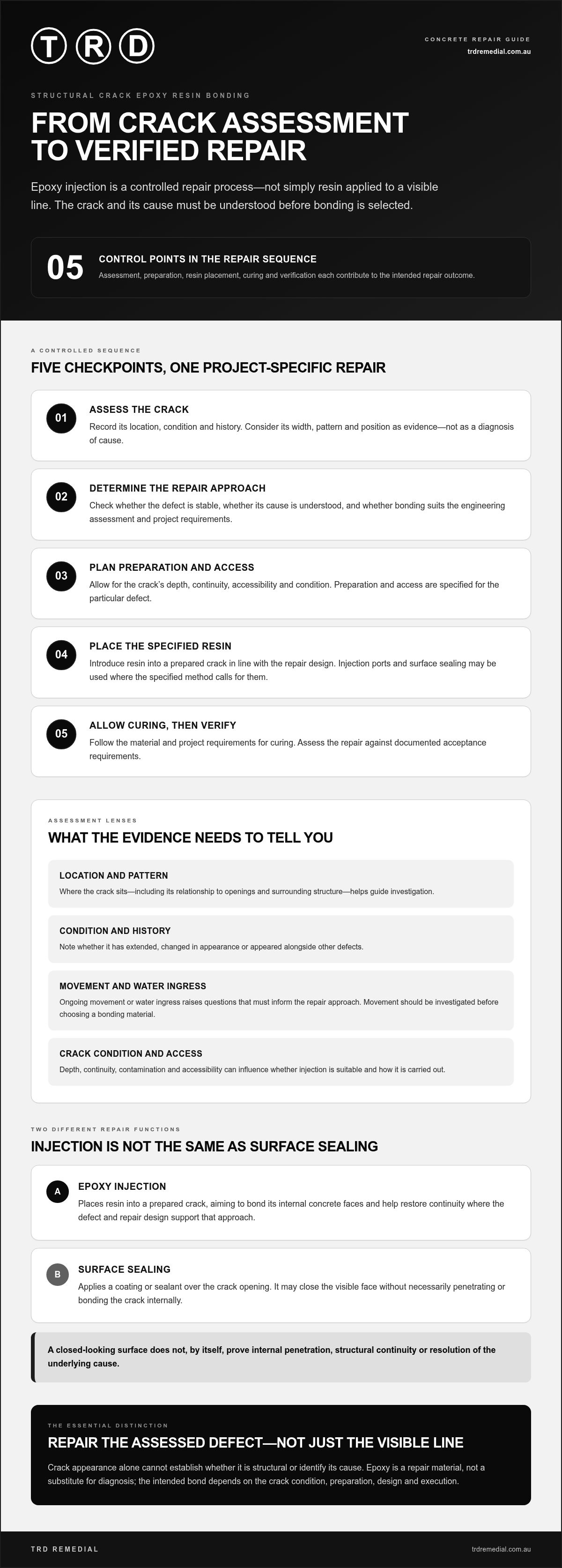
Surface sealing applies a coating or sealant over the crack opening. It may close the visible face, but it doesn’t necessarily penetrate or bond the crack internally. Injection places resin into a prepared crack, with the aim of adhering to the concrete along its internal surfaces. For a general overview of the material, see what epoxy resin is and how it is used as an adhesive.
The repair must reflect the engineering assessment and project requirements. Preparation and resin placement are selected for the defect and intended outcome. A surface that looks closed is not, by itself, evidence of structural continuity.
Which cracks need structural assessment
Crack width, pattern, location and history help guide investigation, but none diagnoses the cause alone. A diagonal crack near an opening, for example, needs to be considered in context: its relationship to the surrounding structure and any change over time matter. Record where it appears, what it looks like and whether its condition changes between observations.
Signs of change may indicate movement, which should be investigated before choosing a bonding material. Note whether the crack has extended, changed in appearance or appeared alongside other defects. The structural defect repair guide explains how defect diagnosis fits into remedial engineering.
The decision is not simply whether resin can enter a crack. It is whether bonding suits the assessed defect and the structure’s needs. Crack injection can form part of a coordinated remediation scope, alongside concrete repairs or structural strengthening where the engineered approach calls for them. Treating the visible crack without addressing its cause risks confusing a repaired surface with a resolved structural issue.
How epoxy resin bonding works inside a concrete crack
Epoxy crack injection is a sequence, not simply resin applied to a line in concrete. The repair is planned around the defect and project specification: the crack is assessed, preparation and access are determined, specified resin is placed, then allowed to cure before the repair is assessed. Each stage affects whether the intended bond can be achieved.
“Epoxy crack injection aims to bond the internal faces of a suitable, prepared concrete crack in line with the project’s repair design.” This describes the intended function, not a guaranteed outcome. Structural crack epoxy resin bonding depends on the crack’s geometry and condition, the selected material and the execution requirements set for the project.
A crack’s visible opening gives only part of the picture. Its depth, continuity, accessibility and condition can influence how resin is introduced and whether the repair approach is suitable. A neat surface finish does not prove that resin has penetrated the crack as intended or that the repair meets its performance requirements.
Why crack preparation and resin placement matter
Preparation and placement are specified for the particular crack. Loose material or contaminants may interfere with the intended bond, while restricted access or an irregular crack path can affect how the repair is carried out. The process needs to account for site observations and the repair design.
Depending on the specified method, injection ports may provide access to the crack, and surface sealing may help manage resin placement. These steps are not universal. Their use, along with preparation, equipment and material behaviour, must follow the project requirements and be reviewed by a qualified technical professional. The aim is controlled placement, not simply visible coverage.
What curing and verification can establish
Curing allows the resin to develop in accordance with the specified repair process. The repair must reach the required stage before it is assessed or subjected to any work defined by the project. Timing and conditions depend on the material and project specification, so don’t assume a generic cure period.
Visual completion can show that accessible work has been finished, but it can’t, on its own, establish internal penetration or prove that the repair satisfies its acceptance criteria. Verification should follow the project’s documented requirements. Depending on the scope, this may include reviewing repair records and inspecting the completed work. Any additional assessment needs to be specified for the project.
For builders, engineers and strata managers, clear coordination helps align the repair method, site access and verification requirements before work proceeds. TRD Remedial delivers specialist crack injection within a broader remediation scope, shaped around the defect and project needs. Explore TRD Remedial crack injection as part of a diagnosis-led approach to concrete repair.
When epoxy resin bonding suits a crack, and when it may not
Epoxy bonding is a possible repair approach when assessment indicates that a crack is stable and the design calls for bonding across it. It isn’t a default response to every crack. Movement, moisture and the condition of the surrounding concrete can affect whether the specified repair can be carried out as intended. The useful question is not just whether resin can be injected, but whether bonding suits the defect and the structure.
| Observed condition | Questions for engineering assessment |
|---|---|
| Crack assessed as stable | Is the crack suitable for bonding, and does the repair design require structural continuity across it? |
| Crack with movement or changing signs | Is movement ongoing, what may be driving it, and should that cause be addressed before specifying a repair? |
| Water-ingress condition | Where is water entering, are site conditions changing, and is the scope addressing water ingress as well as any structural concern? |
How crack movement and moisture affect suitability
Movement history matters because a bonding repair is intended to join crack faces, not accommodate an unidentified ongoing change. If the crack’s appearance has altered, investigate before selecting a material. A change doesn’t establish the cause on its own, but it may affect whether a rigid bond is appropriate or whether the underlying issue needs attention first.
Water ingress is a symptom to investigate, not a structural diagnosis. Wet or changing conditions may influence preparation and the repair specification. Assessment should establish what the water evidence means for the defect and site before a system is selected.
When another remediation approach may be required
If the cause of cracking remains unresolved, resin placement alone may treat the visible defect without addressing the condition behind it. A wider scope may be needed to deal with the source of movement or other contributing defects. Structural bonding, waterproofing and flexible sealing have different intended functions; one shouldn’t be assumed to replace the others. The selected scope should respond to the assessed problem.
For example, a crack associated with continuing movement raises a different repair question from a stable crack with no observed water ingress. Where water is present, stopping its path and restoring structural continuity may be related but distinct objectives. A coordinated assessment helps establish which outcomes are required and whether crack injection belongs within a broader concrete repair or structural remediation plan.
This is the central limit of structural crack epoxy resin bonding: it can be considered for a suitable, assessed crack, but it doesn’t independently resolve an unknown cause or guarantee that changing conditions will stop. The professional concrete crack repair guidance provides wider context for matching remediation to the defect and site conditions.
What to assess before specifying structural epoxy resin bonding
A sound repair scope starts with evidence, not a preferred resin. The assessment records what is visible, investigates what may be driving the defect and establishes what the repair must achieve. Repair selection follows diagnosis, not resin preference. That sequence keeps structural crack epoxy resin bonding within an engineered scope suited to the concrete and project requirements.
A practical pre-repair assessment sequence
Work through the defect in order. Keep observations separate from conclusions: a recorded crack pattern is evidence for investigation, not a diagnosis of its cause.
- Document the defect. Record the crack’s location, visible pattern, condition and relationship to nearby structural elements. Note the surrounding concrete condition and photograph observations consistently where project procedures allow.
- Investigate the context. Review movement history and record signs of change or water ingress. Consider what further assessment is needed to understand likely causes; visible evidence alone doesn’t establish them.
- Align the repair scope. Use the assessment and relevant engineering advice to define the intended repair outcome, method and preparation requirements. Project documents should identify applicable sequencing and acceptance criteria.
- Deliver the specified repair. Coordinate access and site requirements, then carry out preparation and resin placement under the approved scope. If conditions differ from those assumed in the specification, document the change and resolve its implications before proceeding.
- Verify and record completion. Assess the completed work against the project’s stated criteria. Keep inspection and repair records with the project documentation so the outcome can be reviewed against the intended scope.
Controls during repair and after completion
Access, preparation, placement and curing are controlled stages, not interchangeable tasks. The repair team works to the agreed scope, while project requirements guide how each stage is documented and what must be checked before subsequent work proceeds. If site conditions affect the planned sequence, coordination with the relevant project team helps keep decisions traceable.
Verification should be proportionate to the repair design. A finished surface is not, by itself, proof that the work meets the specified acceptance criteria. Project-specific inspection records can show what was completed and assessed without making unsupported assumptions about strength or performance.
Clear records also help engineers, builders, strata managers and remediation teams coordinate decisions when a defect forms part of a wider repair programme. Broader concrete remediation considerations can inform how an individual crack repair fits the asset’s needs. For a coordinated crack injection scope, discuss your structural repair requirements with TRD Remedial.
How TRD Remedial delivers crack injection within structural remediation
Crack injection is most useful when it forms part of a repair scope shaped around the defect, rather than being applied to every visible crack. TRD Remedial provides specialist epoxy and polyurethane crack injection within broader structural remediation. The work is coordinated with the project’s engineering advice and site requirements, so the method and its role in the overall scope are clear before delivery.
An injection repair may sit alongside other remedial work. Depending on the assessed defect and specified scope, related tasks may include concrete repairs or structural strengthening. The aim is to address the project requirements as a whole, rather than treat the crack in isolation.
Coordinating assessment, specification and site delivery
TRD Remedial works with engineers, builders and strata managers to coordinate the information and practical requirements that shape remedial work. The project team aligns on the observed defect, engineering input, access needs and agreed repair scope. This helps the site team understand what the injection work is intended to achieve and how it fits with surrounding tasks.
Project requirements guide the sequence and delivery arrangements before work proceeds. Access constraints, nearby work and concrete condition can affect how the scope is organised. Clear communication helps identify relevant changes on site and keeps the project team aligned on the work being undertaken. Work is carried out in line with the agreed scope, with attention to site safety and coordination with other activities.
Where a specification calls for crack injection alongside concrete repair or structural strengthening, these activities can be planned as connected parts of the remediation scope. That doesn’t mean every crack requires additional work. The assessed defect and project documentation determine what belongs in the repair.
Choosing a repair scope built around the structure
The crack condition and engineering requirements guide repair selection. Structural crack epoxy resin bonding is one possible approach when the assessed defect and project specification support it; it isn’t a universal solution. If assessment identifies related concrete defects or a broader structural concern, the scope can account for those matters rather than relying on resin placement alone.
A specialist remediation process brings the assessment, specified work and site coordination together. For builders and strata managers, this supports clearer planning; for engineers, it connects the repair activity with the design intent. The scope remains project-specific, with no assumption that a visible crack tells the full story.
If you’re planning a structural crack remediation project, discuss the defect, engineering requirements and site coordination with TRD Remedial. Contact TRD Remedial about crack injection to start a conversation about a repair scope suited to your structure.
Move from crack observations to a clear repair plan
Before committing to a repair, bring the available evidence together: dated photographs, notes on when changes were noticed, crack locations, water-ingress observations and relevant engineering or maintenance records. This gives project discussions a practical starting point and helps separate what has been observed from what still needs investigation.
Next, establish who will assess the defect, what the repair must achieve and how the work will fit with site access and other activities. Recording these requirements can make decisions clearer for owners, facility teams and project stakeholders. A considered scope keeps the focus on the structure’s needs, rather than the appeal of a particular material. Structural crack epoxy resin bonding belongs within that decision-making process, not in place of it.
TRD Remedial supports a diagnosis-led approach through specialist crack injection and structural remediation, coordinating with engineers, builders and strata managers as project requirements call for. Discuss your structural crack remediation project with TRD Remedial to set out the next steps and develop a repair plan grounded in the needs of your structure.
Frequently Asked Questions
What is structural crack epoxy resin bonding?
Structural crack epoxy resin bonding is a repair approach that uses injected resin to bond the internal faces of a suitable concrete crack. It’s specified when assessment and repair design call for that function, not simply because a crack is visible. Record the crack’s location, what has changed and any related site conditions so the observations can inform the project’s engineering requirements.
Can epoxy resin bond a moving concrete crack?
It may be unsuitable if the crack is continuing to move, because movement can compromise a repair intended to bond the crack faces. The distinction is between a crack with a history of change and one assessed as stable. Note changes observed during inspections, such as a new extension or altered opening, and investigate them before selecting a repair method. The cause and expected behaviour matter to the specification.
Does epoxy crack injection stop water ingress?
Epoxy crack injection shouldn’t be assumed to stop water ingress in every situation. Water may enter through the crack or another part of the structure, and a visible damp area may not identify its entry path. An assessment needs to consider both the water symptoms and the structural repair objective. Where water penetration is a key concern, the repair scope must address that requirement rather than rely on a structural bond alone.
How does epoxy resin bonding differ from crack sealing?
Epoxy bonding aims to place resin within a suitable crack so it can adhere to its internal faces. Crack sealing generally means treating the surface opening, which may help close or protect that face but doesn’t, by itself, demonstrate an internal bond. The terms can describe different repair functions, so the project specification should state the intended outcome. A finished surface alone can’t confirm which function has been achieved.
How long does epoxy resin take to cure in a concrete crack?
There isn’t one cure time that applies to every epoxy crack repair. The required period depends on the specified resin and the conditions set out for the project, so a generic timeframe may be misleading. Allow the repair to reach the stage required by its specification before assessment or further work. Project documentation should guide when the repaired area can be inspected or subjected to subsequent activities.
Can structural epoxy crack repairs be assessed after completion?
Yes. A completed repair can be reviewed against the project’s specified acceptance criteria, but a tidy surface doesn’t prove that every requirement has been met. Depending on the scope, assessment may include inspecting the visible work and reviewing repair records. The engineer’s requirements determine what evidence is relevant. Keep observations and repair documentation together so the completed work can be considered in its project context.
When should a structural concrete crack be assessed by a specialist?
Arrange specialist assessment if a crack is changing, appears alongside other concrete defects or is located in an element whose structural role is uncertain. For example, a crack that extends between inspections or appears with local concrete damage warrants investigation rather than cosmetic covering. Record its location, visible pattern and changes over time. TRD Remedial provides crack injection and structural remediation, coordinating with engineers, builders and strata managers on project requirements.


