

What if the visible rust is only part of the problem? Corroded reinforcement can expand beneath the concrete, contributing to cracking, delamination and spalling. A surface patch may conceal the damage without addressing the conditions driving corrosion. Choosing an effective corroded reinforcement bar treatment starts with understanding what is happening below the surface.
Rust staining or damaged concrete can be worrying, but appearance alone cannot show how serious the problem is or whether a repair will last. The right approach depends on the extent of corrosion, the condition of the steel and concrete, and the underlying cause. No single treatment suits every structure.
This article explains why reinforcement corrodes and how specialists assess the damage before recommending a repair. You’ll compare concrete removal and reinstatement, steel treatment and broader corrosion-control measures, including their roles and limitations. You’ll also learn what an engineered repair process should consider, from identifying affected areas to matching the diagnosis and repair scope with structural requirements. The aim is to show how a durable repair addresses the corrosion, damaged reinforcement and concrete together.
Key Takeaways
- Rust staining, cracking and spalling can indicate different levels of damage. Investigation helps establish what lies beneath the concrete.
- Carbonation and chloride ingress are possible corrosion mechanisms, but the cause should be assessed rather than assumed.
- The right corroded reinforcement bar treatment depends on the steel’s condition, the affected area and whether corrosion extends beyond a local repair.
- Compare concrete patch repairs, reinforcement replacement or supplementation, and broader corrosion-control measures with their limitations in mind.
- A coordinated repair sequence links investigation and planning with controlled concrete removal, reinstatement and structural requirements.
Corroded reinforcement bar treatment: what the visible damage can tell you
Reinforcement corrosion occurs when the steel embedded in concrete loses some of its protection and begins to rust. As corrosion products build up, they can occupy more space than the original steel. The resulting pressure can crack the surrounding concrete, weaken its bond with the reinforcement and eventually push sections away from the surface.
Concrete cover helps protect reinforcing steel, but cracks, moisture and exposure conditions can affect how well that protection performs. A rust mark, crack or loose patch is a warning sign, not a diagnosis. Surface appearance alone can’t confirm how far corrosion has progressed, whether the steel has lost section or what the damage means for the structure’s capacity. That requires assessment of the affected concrete and reinforcement.
For an overview of how steel and concrete work together, see Reinforced concrete and rebar corrosion. In practice, the distinction is simple: surface staining is a clue; corrosion-related cracking, delamination or spalling is physical concrete damage that warrants investigation. Staining may have another source, while damage can extend beyond the area that looks worst.
Which visible signs warrant a closer assessment?
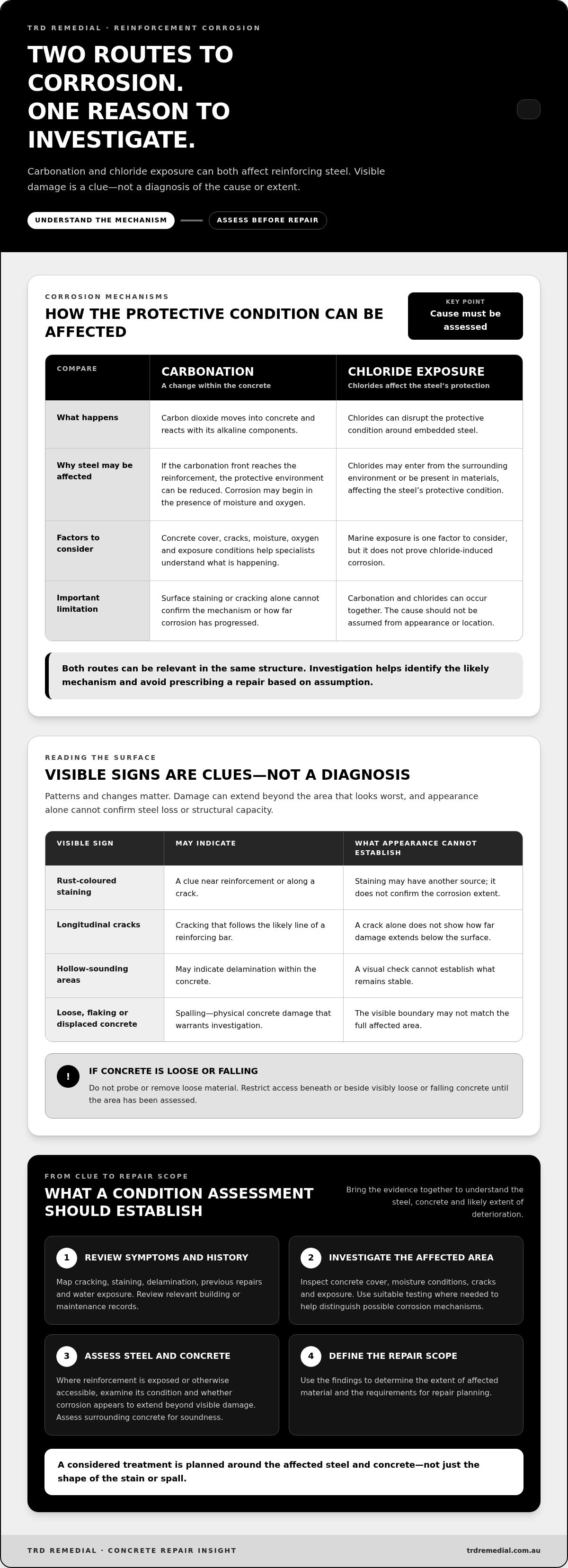
Look for patterns and changes rather than trying to diagnose the problem from one mark. Common signs include:
- Rust-coloured staining near reinforcement or along a crack.
- Longitudinal cracks that follow the likely line of a reinforcing bar.
- Areas that sound hollow when tapped, which may indicate delamination.
- Loose, flaking or displaced concrete, known as spalling.
Exposed reinforcement may mean the concrete cover has already broken away. Don’t probe or remove loose material. Restrict access beneath or beside visibly loose or falling concrete until the area has been assessed. A visual check cannot establish what remains stable.
Why a patch can fail when the underlying problem remains
A patch can restore the surface locally, but corrosion may also be active beyond the visible damage or the repair boundary. If only the loose concrete is covered or replaced, affected steel and the conditions contributing to corrosion may remain. The surface can look sound while deterioration continues around or beside the repair.
A considered corroded reinforcement bar treatment is planned around the affected steel and concrete, not just the shape of the stain or spall. Assessment helps define what needs removal, whether the reinforcement needs attention and how the reinstated concrete should fit the repair scope. This is the difference between concealing a symptom and addressing the damage. Concrete remediation connects repair decisions with structural requirements and the ongoing condition of the asset.
How reinforcement corrosion develops and how specialists assess it
Visible damage is the starting point, not the repair specification. Reinforcement can corrode through different mechanisms, and the appropriate investigation depends on the structure’s materials, exposure and history. Moisture, oxygen, concrete cover, cracks, previous repairs and the surrounding environment all help specialists understand what is happening within the concrete.
Carbonation and chloride exposure: different routes to corrosion
Concrete is normally highly alkaline, which helps maintain a protective layer around embedded steel. Carbonation occurs as carbon dioxide moves into the concrete and reacts with its alkaline components. If the carbonation front reaches the reinforcement, that protective environment can be reduced and corrosion may begin in the presence of moisture and oxygen.
Chlorides, which may enter concrete from the surrounding environment or be present in materials, can disrupt the steel’s protective condition. Marine exposure is one factor specialists may consider, but it doesn’t prove chloride-induced corrosion. Carbonation and chlorides can also occur together. Investigation is needed to identify the likely mechanism and avoid prescribing a repair based on assumption.
What a condition assessment should establish
A condition assessment connects visible symptoms with the likely extent and cause of deterioration. It should establish where concrete is unsound, whether reinforcement is exposed, and whether affected areas extend beyond what can be seen. The findings help define a repair boundary that reflects the condition of both the steel and surrounding concrete.
A methodical investigation may include:
- Reviewing symptoms and history: Map cracking, staining, delamination, prior repairs and water exposure, and review relevant building or maintenance records.
- Investigating the affected area: Inspect concrete cover, moisture conditions, cracks and exposure, then use suitable testing where needed to help distinguish possible corrosion mechanisms.
- Assessing steel and concrete: Where reinforcement is exposed or access is otherwise available, examine its condition and whether corrosion appears to extend beyond the visible damage. Assess the surrounding concrete for soundness.
- Defining the repair scope: Bring the evidence together to determine the extent of affected material and the requirements for repair planning.
Testing should answer a practical question, such as whether carbonation has reached the reinforcement or whether chloride ingress may be contributing to corrosion. Results need to be interpreted alongside site observations and exposure conditions. An isolated test result isn’t, by itself, a complete diagnosis.
Project requirements matter too. The assessment and repair scope should account for the relevant, current Australian Standards and project documentation. References must be checked for applicability rather than assumed from a generic detail or an older specification.
Treatment selection depends on how far corrosion has progressed and the environment acting on the concrete, not simply on the size of the visible stain. Where assessment identifies concrete damage requiring remedial work, TRD Remedial’s structural remediation and concrete repair services support a considered next step from diagnosis to repair planning.
Comparing corroded reinforcement bar treatment options
The right repair depends on more than how much concrete has broken away. Specialists consider the extent and distribution of corrosion, the condition of the reinforcement, the surrounding concrete and the exposure conditions. A local repair may suit isolated damage, while recurring or widespread deterioration can call for a broader, engineered strategy.
Common approaches address different parts of the problem:
- Localised concrete repair removes unsound concrete, allows affected reinforcement to be assessed and prepared, then reinstates the area using a specified repair system. It can suit discrete damage where investigation supports a clear repair boundary. If corrosion extends beyond that boundary, patching alone may leave the surrounding problem unresolved.
- Reinforcement replacement or supplementation may be considered if the steel’s measured condition means the existing reinforcement needs replacing or additional reinforcement is required. The decision depends on structural design and assessment, not appearance alone. Planning must also address how the work will maintain the required structural performance.
- Broader corrosion-control measures may be considered where corrosion is widespread, recurring or linked to conditions beyond a single repair. Options can include specialist electrochemical approaches or corrosion-control systems, selected to suit the structure and project requirements. They require specific assessment and design, and don’t automatically replace the need to repair damaged concrete or address compromised steel.
Localised repair: when removing and reinstating concrete may suit
A local repair generally involves removing concrete that is no longer sound, exposing enough of the affected area to assess and prepare the reinforcement, then reinstating the concrete with a repair system specified for the project. The amount of steel loss, the extent of damage and the repair boundary all affect whether this approach is suitable. If corrosion activity continues outside the patch, nearby concrete may deteriorate even after the surface has been restored.
Protective coatings or corrosion inhibitors may form part of a repair specification, but they aren’t universal substitutes for dealing with unsound concrete or affected reinforcement. Their suitability depends on the diagnosed cause, the product system and how it is intended to work within the repair. Applying a coating or surface treatment without considering active corrosion beyond the treated area can leave the underlying issue unresolved.
Widespread corrosion: when broader control may be considered
Where damage appears across a larger area, or deterioration has occurred near previous repairs, isolated patching may not address the full condition. An engineered strategy may consider the wider concrete environment and whether corrosion-control or electrochemical measures are appropriate. Steel replacement or supplementation may also be required, but only when the assessment and structural design support that scope.
Each option has limits. No method should be selected solely because it is less disruptive or appears to address the visible symptoms. A durable corroded reinforcement bar treatment links investigation to repair scope, specifications and structural requirements, with the approach tailored to the measured condition rather than assumed performance.
The treatment sequence: from concrete removal to reinstatement
A sound repair follows a planned sequence. The scope should connect investigation findings with structural requirements, the method of removal and the repair specification. This keeps work controlled as the condition of the reinforcement and concrete becomes clearer on site. If removal reveals damage beyond the planned boundary, review the scope before work proceeds.
- Confirm the repair plan. Review the investigation findings, define the repair area and agree how the work will be carried out. Where structural conditions warrant it, the plan should address temporary support and access controls before concrete removal begins.
- Set up and remove concrete under control. Protect the work area and remove unsound concrete in line with the approved scope. The removal method should avoid unintended damage to reinforcement or surrounding concrete.
- Expose and assess the reinforcement. Provide sufficient access to inspect the affected steel and surrounding concrete. If site conditions differ from the assessment, pause for direction on any change to the repair boundary or method.
- Prepare or alter the steel as specified. Cleaning, assessment of steel section, protective treatment, replacement or supplementation should follow the project specification and engineering direction. These are not interchangeable steps; the measured condition informs what is required.
- Reinstate the concrete. Place the repair material selected for the project conditions and design requirements, following the specified preparation and application process.
- Inspect and document completed work. Check the repair against the project requirements, record relevant stages and note any specified follow-up monitoring.
Preparing and treating the affected reinforcement
Concrete removal needs to expose enough of the affected area to assess the steel and prepare it as specified. Cleaning is a controlled task, not a cosmetic step: the required preparation depends on the approved repair scope. Assessing the steel section helps determine whether the reinforcement can remain or whether the design calls for protection, replacement or supplementation. The project specification should direct that decision.
Reinstating concrete and checking the repair
Reinstatement should use a repair material suited to the design and site conditions, with placement, curing and inspection carried out in accordance with the project specification. There is no single acceptance check that applies to every repair. Clear records of preparation, steel treatment, reinstatement and inspection help demonstrate what was completed and support any follow-up monitoring requirements.
A carefully managed corroded reinforcement bar treatment links each stage to the assessed condition and agreed repair scope. For concrete remediation and spalling repairs, discuss your repair requirements with TRD Remedial.
How TRD Remedial approaches reinforcement corrosion repairs
Corrosion repairs need a clear connection between the condition found on site and the work ultimately carried out. TRD Remedial provides structural remediation and concrete repair for residential, commercial and industrial projects. Its work includes concrete and spalling repairs, with repair planning informed by the structure’s condition and project requirements.
Coordination matters because a repair can affect more than the damaged patch. Access, work sequencing and structural requirements need consideration alongside the condition of the concrete and reinforcement. Builders, engineers and strata managers each bring relevant project knowledge, from site constraints and engineering direction to building history and stakeholder coordination.
Connect diagnosis, repair scope and structural requirements
Accurate diagnosis helps define where concrete repair is required and how the work should proceed. If the scope changes as the repair area is investigated, project stakeholders can coordinate next steps against the engineering requirements, access arrangements and safety controls. This supports a coherent remedial plan rather than treating removal, repair and reinstatement as disconnected tasks.
Structural defects can involve several related issues, so corrosion repair may need to sit within a broader remediation plan. The extent and sequencing of concrete work should reflect the assessed condition and the project’s structural requirements. TRD Remedial works with builders, engineers and strata managers to coordinate remedial projects and deliver repairs in line with the agreed scope.
Plan the next step for a corroded reinforcement issue
Before discussing the work, gather useful information about the affected area. Clear photographs can show the location and visible condition of staining, cracking or spalling. Note when the damage was first observed, whether it has changed, and any relevant maintenance or previous repair history. These details provide context, but they don’t replace an assessment of the concrete and reinforcement.
The project-specific scope depends on the condition identified and the engineering requirements. It may need to define the repair area, removal approach, treatment or repair of reinforcement, reinstatement and any access or support measures. The aim is to establish a practical sequence that connects the diagnosis with the work required, without assuming a method before the condition is understood.
TRD Remedial’s concrete repair and structural remediation services support property owners, strata managers and project teams dealing with reinforcement corrosion. If you’re planning a corroded reinforcement bar treatment project, bring together available photos, maintenance history and project information to help define the repair requirements.
Discuss a concrete remediation project with TRD Remedial.
Turn the repair decision into a clear next step
A corroded reinforcement bar treatment project is easier to plan when the structure’s condition, the repair scope and the people involved are considered together. Before work is scoped, bring relevant photographs, maintenance records and previous repair information into one place. This gives project discussions a practical starting point and helps identify what still needs assessment.
TRD Remedial brings structural remediation and concrete repair expertise to projects, working with builders, engineers and strata managers to coordinate remedial requirements. Discuss the specific condition and project context so the repair approach can be considered against structural requirements, rather than selected on appearance alone.
Discuss a concrete remediation project with TRD Remedial. A clear plan helps move the issue towards informed action.
Frequently Asked Questions
What causes reinforcement bars to corrode inside concrete?
Reinforcement bars corrode when their protective conditions are disrupted and moisture and oxygen are present. Carbonation can lower concrete alkalinity around the steel, while chlorides can also undermine its protection. Persistent dampness near a crack or water leak may be relevant to an investigation, but it doesn’t prove the cause. Assessment considers exposure and concrete condition before treatment is selected.
Is rust on exposed reinforcement always a sign of structural danger?
No. Visible rust alone can’t establish whether a structure is unsafe, but exposed steel deserves attention. The amount of visible rust doesn’t show how much steel remains or how the affected element performs under load. If concrete is loose, falling or overhead, keep people clear and arrange prompt assessment. Don’t scrape or disturb the area to judge the steel yourself.
Can corroded reinforcement be treated without removing concrete?
In some cases, a project may consider corrosion-control measures that don’t rely on extensive concrete removal. That doesn’t mean a surface-applied product can safely cover exposed rust or damaged concrete. The appropriate corroded reinforcement bar treatment depends on the mechanism, affected area, access and structural requirements. If the steel or concrete needs direct inspection, the repair plan may require carefully controlled removal.
What happens if corroded reinforcement is left untreated?
If conditions supporting corrosion remain, deterioration may continue. Over time, this can contribute to further cracking, concrete detachment or loss of steel, with possible implications for structural performance. There’s no reliable universal timeline: exposure, moisture and the condition of the element all matter. If damage is visible, record its location and changes, address falling-concrete risks promptly and arrange an assessment.
Does a protective coating stop reinforcement corrosion permanently?
No coating should be treated as a permanent guarantee. Its role depends on the repair design, preparation of the steel and the conditions around it. A coating may not address corrosion outside the treated area or replace reinforcement section already lost. If coating is specified, the repair documents should state how it fits with concrete repair and other measures required for the project.
How can corrosion return after a concrete patch repair?
Corrosion can recur if the repair leaves affected steel or conducive conditions in adjacent concrete outside the patch. A small reinstated area, for example, may not resolve deterioration if the underlying cause extends beyond it. This doesn’t mean patch repairs always fail; it means their boundaries and specification need to reflect the assessment. Changes near an existing patch are useful information for follow-up review.
How long does reinforcement corrosion treatment take?
There’s no single timeframe for every repair. Duration can depend on access, the area requiring removal, the condition found once concrete is opened, staged work and the specified repair material’s curing requirements. Unexpected changes in the exposed steel or concrete may also affect the planned sequence. Timing is best considered once the repair scope and project constraints are understood, rather than estimated from visible damage alone.
Is reinforcement corrosion treatment covered by Australian Standards?
Relevant Australian Standards and project specifications may apply, depending on the structure and scope of work. They don’t provide one universal treatment for every corrosion problem. The project team should identify which current documents and requirements apply, including any specified assessment, repair and quality-control provisions. Because editions and clauses can change, references should be verified for the project rather than copied from an older repair document.


